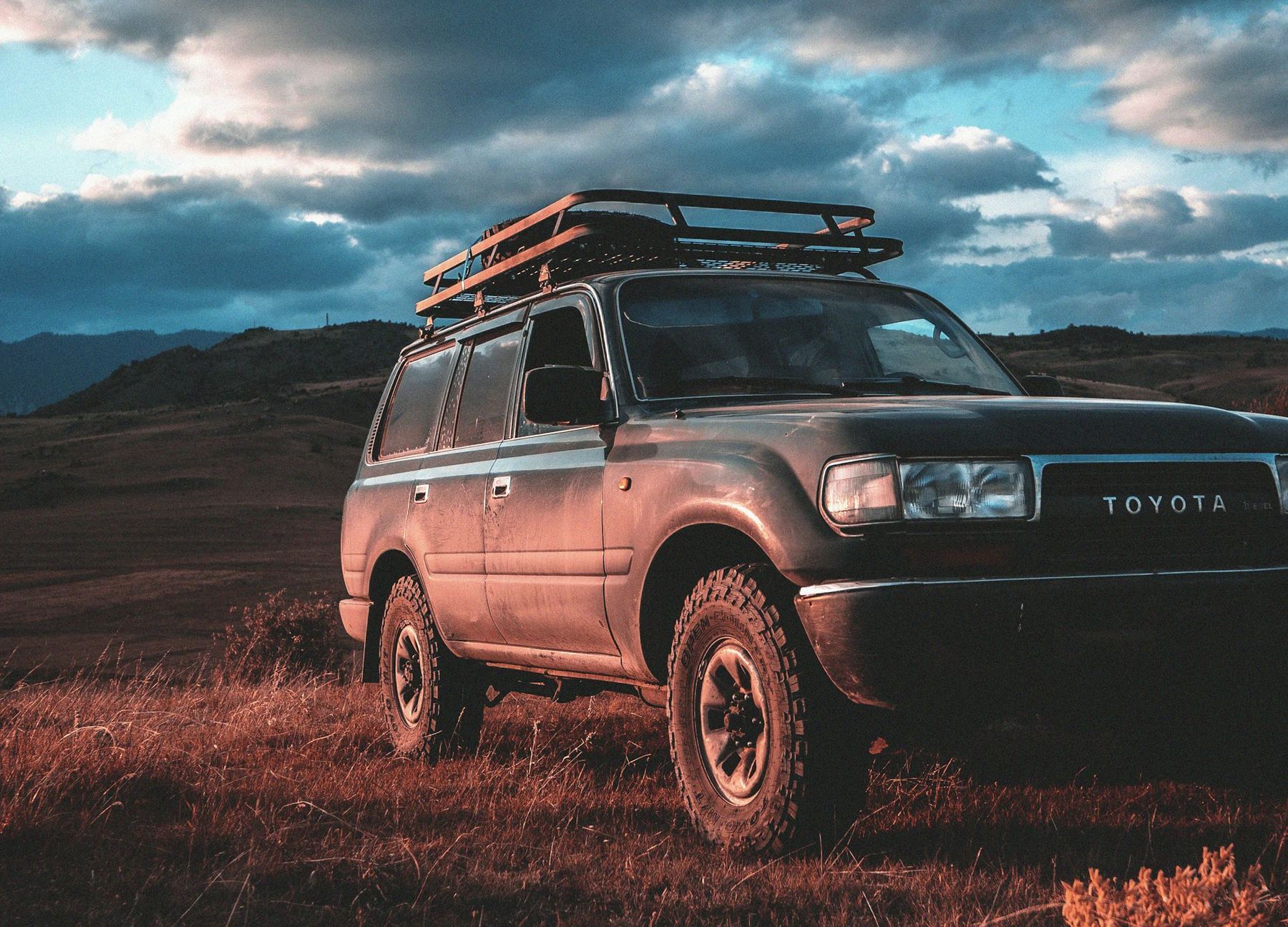
Land Cruiser
“The truck the rest of the world actually depends on — the one that turns up, fully loaded, in places where a breakdown isn't an inconvenience but a plot twist. Seven decades in, Toyota still hasn't figured out how to make it fragile.”
It started as a 1951 prototype called the BJ, went into regular production in 1953, and picked up the name Land Cruiser in June 1954 — coined by Toyota's Hanji Umehara. What followed is one of the longest-running nameplates in the business and a lineage that splits, roughly, into two tribes: the utilitarian short- and long-wheelbase workhorses, and the station wagons that slowly learned to carry families in comfort without forgetting how to cross a riverbed.
The utility line runs from the FJ40 — built from 1960 into the mid-1980s and the truck that made the name in America — through the long-wheelbase FJ45 to the 70 Series, introduced in 1984 and still in production for Africa, Australia, Latin America and the Middle East. The wagon line begins with the FJ55 'Iron Pig' (1967–1980), Toyota's first purpose-built Land Cruiser wagon, then the 60 Series, the coil-sprung 80 Series, the V8 100 and 200, and today's 300 Series.
America's relationship with the name has been complicated lately. Toyota confirmed in December 2020 that the big wagon would leave North America after 2021, and the 300 Series has never been sold here. The name came back for 2024 on the smaller, Prado-derived 250 Series — a hybrid with center and rear lockers standard. For hands-on owners, though, the heart of the family is still the older iron: solid axles, straight-sixes and a parts network that never really closed.