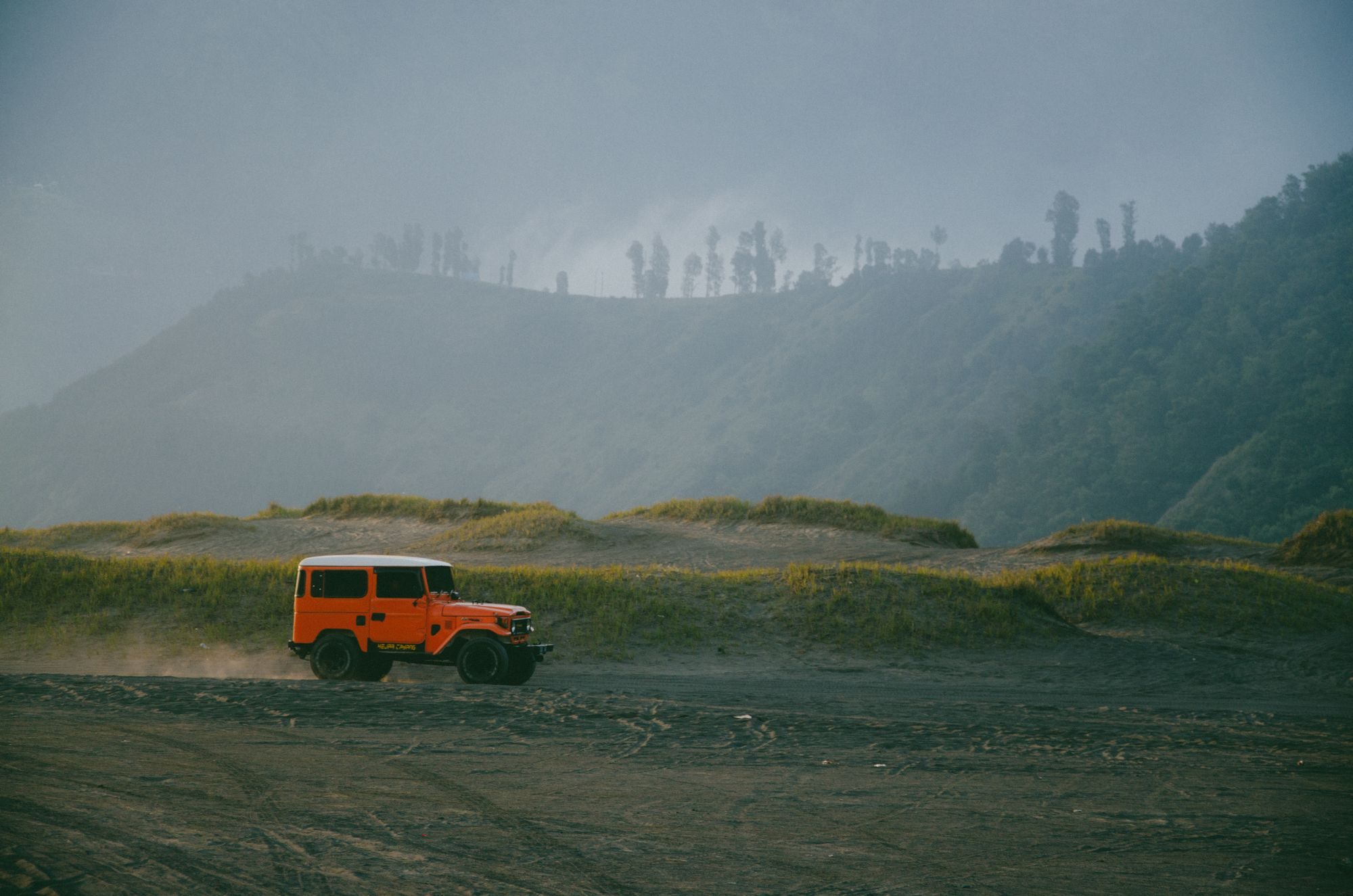
A green short-wheelbase FJ40 hardtop with a roof rack and rear-mounted spare crossing the volcanic sand sea below Mount Bromo in morning mist
TOYOTA LAND CRUISER · J40 · 1960–1984

Land Cruiser FJ40

FJ40BJ40F 3.9 / 2F 4.2 I62-SPEED TRANSFER CASEFRONT DISCS FROM '76 (US)

“The FJ40 is a farm implement that accidentally became a fashion icon: leaf springs, a straight-six with the manners of a tractor and steering vague enough to count as a suggestion. It is also the reason anybody outside Japan cares what a Land Cruiser is.”

PART 01

Overview

Where it came from, why it matters, and how it changed year to year.

The story

Toyota launched the 40 Series in 1960 as a ground-up replacement for the 20 Series, and then barely changed it for nearly a quarter of a century. Toyota's own UK history notes the 1979 facelift was the first visual change in 19 years. Underneath sat solid axles on leaf springs at both ends and, for the first time in a Land Cruiser, a two-speed transfer case. The short-wheelbase FJ40 is the one on posters, but the J40 family also included the medium-wheelbase FJ43 and the long-wheelbase FJ45 pickups and wagons.

A JEEP RIVAL THAT OUTSOLD EVERYTHING

In America the FJ40 was pitched against the Jeep and it worked. Toyota's pressroom says the Land Cruiser was the company's best-selling vehicle in the US until 1965, when the Corona passenger car took over; Wikipedia records global output passing 50,000 that year. Toyota's US pressroom says the FJ40 came to America in 1960, two years after the first Land Cruiser was sold here; Hagerty dates FJ40 imports from 1963, so the exact start depends on whom you ask. Either way, a little Japanese 4x4 was carrying the brand in its biggest export market before most Americans had heard of Toyota.

The engine did a lot of the persuading. The 3.9-liter F straight-six made 125 hp in Toyota's US history, and Hagerty calls it 'virtually indestructible' and essentially a reverse-engineered Chevrolet 235 'Stovebolt' six (Wikipedia says the bottom end is closer to GMC's 236 six, so treat the family tree as folklore). It drove a three-speed column-shift manual at launch. Diesels came later for other markets, the H six in the long-wheelbase HJ45 from 1972 or 1973 (sources differ) and the four-cylinder B in 1974, but Wikipedia notes diesel 40s were never sold to the general US public; a few arrived as mine trucks.

QUIET EVOLUTION

Changes came mechanically rather than visually. US trucks got the 4.2-liter 2F and a four-speed in 1975, along with rear barn doors and, a year earlier, a standard roll bar. Front disc brakes arrived in 1976. In 1979 came the square headlight bezels, optional power steering and air conditioning on petrol trucks, and a switch from 4.11 to 3.70 axle gears. IH8MUD members still steer first-time buyers to post-1976 trucks for the discs and the 2F, and warn that 1980-and-later bodies seem to rust more readily.

The truck stayed crude to the end. Retro Rides sums up the driving experience as vague steering, wayward handling, a harsh ride on heavy leaf springs and a cabin that gets very hot in summer. That's part of the appeal: almost everything on it can be reached with a 17 mm wrench and a bit of patience. Free-wheeling front hubs became standard in Australia from 1982, and a five-speed arrived later in the run, but US buyers never saw much luxury.

THE END, AND THE AFTERLIFE

The 1983 model year was the last for US FJ40s; Wikipedia estimates only about 300 were imported that final year. Production ended in most markets in 1984, when the 70 Series took over the utility role, though Canada got a run of BJ42 diesels with a five-speed overdrive. Brazil kept going much longer: the Toyota Bandeirante used the 40's body with Mercedes-Benz and later Toyota diesels until 2001, giving the basic shape more than four decades of production.

Values climbed sharply in the 2010s, then settled. In 2019 Hagerty put the average #2-condition FJ40 at $47,375, down 7.6 percent since 2016, while Retro Rides tracks an Australian example rising from $4,400 in 1995 to $33,000 in 2024. Toyota noticed too: in 2021 it announced GR Heritage Parts reproductions for the 40 Series, starting with engine, driveline and exhaust components. The FJ40's legacy even includes the 2007 FJ Cruiser, which borrowed its white roof and round headlights.

SIDEBAR · THE BRAZILIAN COUSIN

The Bandeirante: a 40 that refused to die

Toyota do Brasil began building Land Cruisers in 1962 and, from 1968, switched its Bandeirante to the FJ40 body. Instead of Toyota petrol sixes, it used Mercedes-Benz diesels: the OM324, then the OM314 and OM364, before Toyota's own 14B four-cylinder diesel arrived in 1994.

Brazil also got a five-speed in 1993, square headlights from 1989 and pickup and wagon versions on the long wheelbase. Production finally ended in November 2001, decades after Japan had moved on to the 70 Series.
Year by year

What changed, model year by model year. Sweet spot Beware

  1. 1960J40 series launched in Japan with the 3.9 L F six, a three-speed and a two-speed transfer case
  2. 1963Hagerty's date for the start of US FJ40 imports (Toyota's US pressroom says 1960); by 1965 the Land Cruiser is Toyota's best-selling vehicle in America
  3. 1974Factory roll bar becomes standard on US FJ40s
  4. 19754.2 L 2F replaces the F with a four-speed; rear barn doors on US trucks
  5. 1976Front disc brakesSweet spot
  6. 1977Front door vent windows deleted; rear vent windows added to US hardtops
  7. 1979Optional power steering and A/C, square grille bezels, US axle ratio raised from 4.11 to 3.70 for highway cruising
  8. 1984End of J40 production in most markets, replaced by the 70 Series; Brazil's Bandeirante continues to 2001
PART 02

Specs & capability

How it’s built, what it can do, and what fits under it.

How it’s built

The FJ40 is about as simple as a 4x4 gets: a ladder frame, live axles on leaf springs, drum brakes until 1976 and a big, slow-revving straight-six. The front axle uses closed knuckles with Birfield CV joints and tapered knuckle bearings set up with shims, the same basic design Toyota carried into the FJ60 and FJ62.

CHASSISLadder frame, 2,285 mm (90.0 in) wheelbaseFJ43 used 2,430 mm; long-wheelbase FJ45s 2,650 or 2,950 mm.
SUSPENSIONSolid axles, leaf springs front and rearLifted trucks are prone to shackle inversion, hence anti-inversion shackles and plates.
4WD SYSTEMPart-time, two-speed transfer caseThe first Land Cruiser with a two-speed transfer case. A split case arrived around 1980.
ENGINEF 3.9 L (to 1975) / 2F 4.2 L OHV I6F rated 125 hp in Toyota's US history; 2F 135 hp. Pushrod valvetrain needs periodic adjustment.
GEARBOX3-speed, then 4-speed (US 1975)Column-shift three-speed at launch; H55F five-speed swaps are a popular upgrade.
BRAKES & STEERINGDrums to 1975; front discs from 1976 (US)Power steering optional on petrol trucks from 1979; manual recirculating-ball box before that.

Variants & engines

YEARSPLATFORMENGINEOUTPUTWORTH KNOWING
1960–1974FJ40 (early)F 3.9 L OHV I6 (petrol)125 hp (Toyota US)Three-speed manual, four-wheel drums, 4.11 gears in the US.
1975–1978FJ40 (mid)2F 4.2 L OHV I6 (petrol)135 hp / 200–210 lb-ftFour-speed manual in the US; barn doors from 1975; front discs from 1976.
1979–1984FJ40 (late)2F 4.2 L OHV I6 (petrol)135 hp / 200–210 lb-ftSquare headlight bezels, optional power steering and A/C, 3.70 gears in the US. Last US model year 1983.
1974–1984BJ40 / BJ42B 3.0 L, later 3B 3.4 L I4 diesel80–90 hpNot sold to the US public; Canada got the BJ42 with a five-speed in 1984.
1972–1984HJ45 / HJ47H 3.6 L, later 2H 4.0 L I6 diesel94–105 hpLong-wheelbase diesels for export markets.
1968–2001Bandeirante (Brazil)Mercedes-Benz, then Toyota 14B diesel77–95 hpBrazilian-built 40 body; production ended in 2001.

Capability numbers

Curb weight1,480 kg (3,263 lb)FJ40, Japanese-market figure
Wheelbase2,285 mm (90.0 in)

Wheels & tires

FACTORY TIRES
H78-15 (≈205/75R15) on 15x5.5 steel wheels
Bolt pattern6x139.7 (6x5.5")
Offset3.25 in backspacing (OEM 15x5.5 steel)
LIFTBIGGEST TIREWHAT IT TAKES
Stock31x10.50R15IH8MUD's 'tried and true' answer. 33x9.50R15 fits on stock rims but rubs at the rear over bumps or at full flex; owners fix it with 1-inch bump-stop spacers and by adjusting the front steering stops.

Forum consensus, not a guarantee: wheel offset, tire brand and suspension wear all change clearance. Confirm before you buy.

Production & special editions

Toyota built the J40 for nearly a quarter-century in Japan, and Brazil kept making it for 17 more years.

Production (Japan)1960–1984
Brazil (Bandeirante)1968–2001
US importsFrom 1960 (Toyota) or 1963 (Hagerty)
Wheelbases2,285 mm (J40/41/42) · 2,430 mm (J43/44/46) · 2,650 / 2,950 mm (J45/47)

Wikipedia's paint-code table includes Freeborn Red (309), Mustard Yellow (532), Sky Blue (854), Royal Blue (822) and code 681 Green, nicknamed 'John Deere Green'.

PART 03

Buying one

What to pay, what to check, and how to tell a good one from a clone.

What they cost

FJ40 prices have come off their 2016 peak but stay strong for original, rust-free trucks, while ICON-style restomods sit in a class of their own.

Project / needs work$3k–16k
Driver$22k–42k
Excellent / restored$55k–110k+

Based on 244 Bring a Trailer sales from January 2025 to October 2026 (median about $29,400). V8-swapped trucks sold for a median of about $25,300, below stock ones. ICON builds sold for $98,500–$140,000. In 2019 Hagerty put the average #2 (excellent) FJ40 at $47,375. Prices move; checked October 2026. See live listings below.

What to check before you buy

  1. 01
    Rust beats everythingIH8MUD veterans rank rust above every mechanical issue combined. Check door bottoms, the rear sill, the body behind the under-seat fuel tank, wheel wells, the outer front fender brace, inside sills and windscreen pillars. Get underneath and look at all of the metal.
  2. 02
    Body mounts and floorsOn 1979-and-later trucks, look hard at the body mounts. If they're heavily rusted, expect the floor pans and door pillars to be rotten too. Reproduction floor pans exist, but a badly rusted frame may not be worth saving.
  3. 03
    Frame endsCheck the rear frame horns and the body around them, a spot IH8MUD members flag as the biggest worry on many listings.
  4. 04
    Signs of hard wheelingHeavily dented skid plates, gouged differential drain plugs and leaf springs with a slight S-shape all suggest a hard life. None is fatal, but they mean work ahead.
  5. 05
    Driveline slop and leaksCheck both driveshafts for play ('any slop is too much'), look for cracks or welds on the transfer case, and watch for leaks at the transmission, transfer case, axles and wheels. Oil between engine and gearbox often means a rear main seal.
  6. 06
    Compression, not the odometerMileage tells you little on a truck whose engine may have been rebuilt. A compression test does. Members put a full 2F rebuild at $2,000–3,000 in the mid-2000s, and expect $1,000–2,000 of catch-up work after purchase.
  7. 07
    Brakes and fluidsFour-wheel drums need constant adjustment. Black brake or clutch fluid suggests the previous owner skipped bleeding, and probably other maintenance too.
  8. 08
    Smog and wiringIn smog-check states, make sure the emissions equipment is all present and the truck passes. Messy wiring is a sign of future electrical gremlins.

Spotting the real thing

Few FJ40s are still original: engines are swapped, bodies re-skinned and trucks titled by build date or sale date. Match the numbers before you pay for originality.

  1. ID
    Frame number and plateCheck that the frame number on the frame matches the VIN plate. On 1960s US trucks the plate is on the firewall, later on the passenger-side fender well; an A-pillar plate appears from about 3/1969, and from about 1978 the plate is pop-riveted back on the firewall. Specter Off-Road's frame-number chart dates a truck to its build month.
  2. ID
    Build date vs model yearThe driver's door pillar is stamped with the build month. A truck built late in a year is often titled as the next model year, so quote the production date at the parts counter.
  3. ID
    Engine numbersThe firewall plate lists the engine number. A mismatch means a replacement block. Small-block Chevy V8 swaps are very common, and on BaT swapped trucks sell for less than stock ones.
  4. ID
    Year tellsUS trucks: barn doors from 1975, front discs from 1976, vent-window changes for 1977, square grille bezels and optional power steering and A/C from 1979.
  5. ID
    Diesels and BandeirantesDiesel 40s (BJ, HJ) were never sold to US retail buyers, so a US diesel is an import or an ex-mine truck. Brazilian Bandeirantes (OJ and BJ codes) look like FJ40s but used Mercedes-Benz or later Toyota 14B diesels.

Recalls & service bulletins

Open recalls follow the VIN, not the model. Run yours through NHTSA before you buy, and ask the seller for dealer records showing recall work.

Check a VIN at NHTSA ↗
Notable recalls
Fuel tank separator welds can crack ↗1980–1990 (NHTSA listing) · NHTSA 91V110000High temperature and load can pressurize the tank and crack its welds, leaking fuel, which can cause a fire near an ignition source; the remedy was an improved tank. NHTSA files it under 1980–90 Land Cruisers (38,500 vehicles), and Corsetti describes it as a 60 Series campaign, so confirm it applies to your truck.
Steering tie rod can fracture on rough roads at speed ↗1981 · NHTSA 81V117000NHTSA lists this campaign (855 vehicles) for 1981 Land Cruisers without naming the body style, and Corsetti Cruisers describes it as an FJ60 recall: driven continuously above 50 mph on extremely rough roads, the tie rod can resonate, bend and eventually fracture. The remedy was a new tie rod and relay rod. Check with Toyota whether a 1981 FJ40 was included.
Electrical wiring campaign ↗1968–1969 · NHTSA 69V027000NHTSA lists a 1968–69 Land Cruiser electrical-wiring campaign covering 263 vehicles, but its online record carries no defect summary or remedy text and doesn't name the body style.

Importing & legality

US FJ40s were all gasoline sixes. Diesel BJ40s, BJ42s and H-engine 40s, and Brazilian Bandeirantes (built to 2001), are gray-market. A vehicle at least 25 years old, measured from its date of manufacture, can be imported into the US without meeting FMVSS, so every J40-family truck now qualifies. JDMBUYSELL notes that EPA still expects the original-design engine or an EPA-certified replacement. Corsetti Cruisers warns that California may refuse to register an import without a 50-state-compliant emissions system, so plan for that before buying a BJ or HJ.

Rules change and vary by state and country. Confirm with your DMV and a licensed importer before you buy.

The one you’ll own someday

For sale now

1960–1974FJ40 (F engine, drums)
1975–1984FJ40 (2F, four-speed)
1960s–1980sFJ43 (medium wheelbase)
PART 04

Owning one

Baseline service, the repairs you’ll actually do, and where the manuals live.

Post-purchase baseline

After you buy it

Every FJ40 is now 40 to 60 years old, so start from zero: change every fluid, grease every fitting and set the valves. Fluid types and capacities below are from Toyota publications as compiled on IH8MUD for the 40 and 55 series.

Engine oil & filter2F: 7.8 L (≈8.2 qt) with filter · F: 7 L · factory spec API SC/SD (use a modern oil suited to a flat-tappet engine)Baseline now; then per your owner's-manual schedule

One IH8MUD owner warns the owner's manual figure led him to overfill; another always uses 8 qt in a 2F with a filter change. Fill to the dipstick, not the book. New drain-plug washer every time.

Air filterPaper element in the factory air cleanerBaseline now

Replace it before you judge how the carburetor runs.

Ignition tune-upPlugs, points (where fitted), cap & rotor · gap and dwell [CONFIRM IN MANUAL]Baseline now
Valve lashAdjustable rockers · clearances [CONFIRM IN MANUAL]Check now; then periodically

The F and 2F have adjustable rockers that need periodic checks; tight valves are the ones that burn. Valve layout front to back is E-I-I-E-E-I-I-E-E-I-I-E.

Coolant & thermostatEthylene-glycol coolant · 2F: 16.5 L (the original F table lists 15.2 L)Baseline flush now

The early F-engine table even lists plain water; use proper ethylene-glycol coolant now, flush until it runs clear, fit a fresh thermostat and check the bypass hose.

Manual transmissionAPI GL-4, SAE 90 · J30 3-speed 1.7 L · H41 4-speed 3.1 LBaseline now

A swapped-in H55F five-speed takes 4.9 L (60/70-series table) and needs its fifth-gear oiler.

Transfer caseAPI GL-4, SAE 90 · 1.7 L (2.1 L with PTO)Baseline now

A PTO winch also has its own gearbox: front winch GL-4 SAE 90, 600 cc.

Front & rear differentialsAPI GL-5 hypoid 80W-90 · 2.5 L each · LSD oil for limited-slipBaseline now
Front knuckles & BirfieldsMolybdenum-disulfide lithium-base grease, NLGI-2Check now; repack with any seal job
Steering box & power steeringManual box: API GL-4 SAE 90, 600 cc · power steering (1979–84): ATF Dexron, 0.8 L totalCheck level now

Top up the manual box through its fill plug; most play is in the box, center arm and tie-rod ends.

Brake fluidDOT 3 (SAE J1703)Baseline flush now

Bleed every corner and look for weeping wheel cylinders on drum-brake axles.

Chassis grease, U-joints & wheel bearingsChassis: moly lithium NLGI-2 · driveshafts & wheel bearings: lithium multipurpose NLGI-2Grease now and at every oil change; repack wheel bearings now
Fuel filterInline filterReplace now
Belts & hosesV-belts and radiator hoses · gear-driven camshaft, so no timing beltInspect now; replace anything cracked or original
For the hands-on owner

Common repairs

The jobs owners actually end up doing, rated for a competent home mechanic with a decent tool kit. Always confirm torque figures, fluids and procedures against the factory service manual for your VIN, and work safely — support the truck on stands, never just a jack. You do this work at your own risk; see the disclaimer. Some parts links are affiliate links.

Front knuckle and Birfield rebuild
DIFFICULTY · 3 / 5TIME · ≈ Two days the first time; half a day once experiencedSHOP COST · Knuckle kit about $160 (Cruiser Corps) plus seals and grease
SYMPTOMSGrease and gear oil oozing from the knuckle wiper seals, a mix of grease and 90-weight inside the knuckle, or play when you lift a front wheel and shove it.
THE FIXPull the hub and spindle, slide out the Birfield, then remove the steering-arm cones (they stick, so use penetrating oil and tap the arm from below) and the top and bottom knuckle caps. Clean everything, replace the inner axle seal, knuckle bearings and wiper seals, repack the Birfield and knuckle, and reassemble. Bottom shims center the knuckle and top shims set preload: if preload is low, remove shims from the top. One IH8MUD write-up set preload at 4–5 lb with shims; check your factory service manual for the exact figure and where to hook the spring scale.
TOOLS & PARTSHub socket · brass drift · spring scale · seal driver · torque wrench · Cruiser Corps knuckle kit 514-108 (1958–9/1975) or 514-109 (9/1975–1/1990) · OEM knuckle wiper kit · moly grease
Valve adjustment on the F / 2F
DIFFICULTY · 2 / 5TIME · ≈ 1–2 hoursSHOP COST · Valve cover gasket about $17–22 (Cruiser Corps) plus washers
SYMPTOMSLoud ticking from the top end (loose valves), or poor running and burned valves (tight valves, which are the ones to worry about).
THE FIXWarm the engine. With it idling, use go/no-go feeler gauges to find the tight and loose valves. Shut down and adjust only those: turn the engine until a cylinder's intake valve has just closed, rotate a few degrees more, then set both valves for that cylinder. Valve layout front to back is E-I-I-E-E-I-I-E-E-I-I-E. Pulling the spark plugs makes turning the engine by hand easier, and a long screwdriver in the plug hole finds top dead center. Use the clearances in your service manual.
TOOLS & PARTSFeeler gauges (fresh ones; soft gauges bend) · 17 mm wrench (a 17/19 mm socket-ended flex wrench helps) · new valve cover gasket and acorn-nut washers
Carburetor rebuild
DIFFICULTY · 2 / 5TIME · ≈ Half a daySHOP COST · Keyster kit about $35
SYMPTOMSHesitation, stumbling, rough idle or stalling at low rpm on a truck with an original carburetor.
THE FIXRead the carburetor number stamped on the body first: Cruiser Corps lists more than a dozen Keyster kits for FJ40, FJ45 and FJ55 carburetors from 1966 to 1984, matched by carb number and date range. Strip, clean and rebuild with the correct kit, set the float level, and check vacuum lines and choke operation while it's off.
TOOLS & PARTSScrewdrivers · carb cleaner · correct Keyster rebuild kit (by carb number, e.g. 21100-60280 for 9/1973–9/1975)
Front disc brake conversion (pre-1976 trucks)
DIFFICULTY · 3 / 5TIME · ≈ 4 hours with a bolt-on kitSHOP COST · Kits about $550–700; a mini-truck parts swap about $800
SYMPTOMSDrum brakes that pull, fade or need constant adjustment on a 1960–1975 truck.
THE FIXBolt-on kits replace the front drums with bracketed calipers and rotors: remove the hub cover, snap ring, drum and hub, fit the bracket, test-fit the rotor (Off-Road.com's install had to grind the hub slightly, only to the casting mark), refit the hub, mount the caliper, fit new lines and bleed. The DIY route on IH8MUD swaps 1979–85 Hilux/4Runner knuckles with later Land Cruiser calipers and vented rotors, but means rebuilding the knuckles and sorting tie-rod geometry.
TOOLS & PARTSHub tools · grinder · flare-nut wrenches · brake bleeder · Cruiser Corps kit A151 (front, 8/1970–9/1975) or similar
Lift and anti-inversion shackles
DIFFICULTY · 3 / 5TIME · ≈ A daySHOP COST · Old Man Emu 2" kits about $2,350 (Cruiser Corps)
SYMPTOMSSagging springs, cracked leaves, or a rear shackle that flips over center on a lifted truck.
THE FIXOld Man Emu's 2-inch FJ40 kits come with springs, Nitrocharger shocks, greaseable shackles and pins, bushings, U-bolts and a steering damper. Swap one axle at a time with the frame supported. If you reuse factory shackles with lifted springs, OME's FK08 anti-inversion plates weld to the frame to stop them binding over center. Note the spring-bushing size change around 7/1980: Cruiser Corps says two-bolt spring pins mean the early small bushings.
TOOLS & PARTSJacks and stands · breaker bar · welder (anti-inversion plates) · ARB/OME kit (e.g. ARB-103 for 1975–8/1980) · urethane bushing kit A216
Floor pan replacement
DIFFICULTY · 4 / 5TIME · ≈ A weekend per sideSHOP COST · OEM-reproduction pan about $195 each
SYMPTOMSSoft or holed floors, often found with rotten body mounts on 1979–84 trucks.
THE FIXPull the seats and floor mats, cut back to clean metal, fit and clamp the reproduction pan, and weld it in. IH8MUD's old-school advice: cut out the rust, weld in steel, and use filler only to smooth the surface. Seam-seal and paint underneath before refitting.
TOOLS & PARTSCut-off wheel · MIG welder · clamps · seam sealer · Cruiser Corps 605-111L (left front, 1979–1984 FJ40/FJ45)
Tighten sloppy steering
DIFFICULTY · 3 / 5TIME · ≈ Half a day for a seal jobSHOP COST · Power-steering seal kit about $91; Saginaw conversion about $900
SYMPTOMSExcessive play or backlash at the wheel after tie rods and the center arm have been checked, or fluid weeping from a factory power-steering box.
THE FIXOn 1979–84 trucks with factory power steering, rebuild the box with fresh seals and O-rings, replacing any worn internals. Manual-steering trucks often get a GM Saginaw power-steering conversion. Cruiser Corps recommends reading the full procedure first and having a qualified technician install it.
TOOLS & PARTSPitman arm puller · seal kit 520-139 (1979–10/1984 FJ40/45) or conversion kit 524-117
Five-speed swap
DIFFICULTY · 4 / 5TIME · ≈ A long weekendSHOP COST · Parts plus labor
SYMPTOMSScreaming highway rpm on 33s with a 1:1 top gear.
THE FIXThe H55F five-speed has a 0.845:1 fifth and a much deeper first. On 1975–80 FJ40s with a four-speed, the IH8MUD guide lists floor and transmission-cover changes, a custom crossmember, transfer-case shift linkage and boot, driveshaft length changes, speedometer cable and parking-brake work. Early three-speed trucks also need a bellhousing and frame-crossmember changes. Fit an oiler for fifth gear: Cruiser Corps says the H55F needs a split transfer case built 10/1982 or later, which has the oiler provision.
TOOLS & PARTSTransmission jack · H55F (input shaft to suit the engine) · oiler pipe · shifter · linkage kit · gaskets
Asked on every forum

Land Cruiser FJ40 questions, answered

What's the biggest tire I can fit without a lift?

The 'old tried and true' answer on IH8MUD is 31x10.50R15 on stock wheels and suspension. 33x9.50R15 is a popular size on stock 15-inch rims too, but owners report rubbing at the rear over bumps or at full flex. One fixed it with 1-inch spacers under the bump stops, and another had to adjust the front steering stops. One member said 33x10.50s looked 'pretty stuffed.'

SOURCE · IH8MUD
Which years should I look for?

Most buyers prefer 1976-and-later trucks for front disc brakes and the 4.2 L 2F. 1979 added optional power steering and A/C and taller 3.70 gears in the US. IH8MUD veterans like the '78 and would consider 1979–83 at the right price, but note that 1980-and-later bodies seem to rust more readily.

SOURCE · IH8MUD · WIKIPEDIA
Three-speed or four-speed?

The four-speed arrived with the 2F in 1975 in the US. Most owners prefer it, especially on 33-inch tires. If you want overdrive, the H55F five-speed swap is well documented, though it takes floor, crossmember, linkage and driveshaft work.

SOURCE · TOYOTA · IH8MUD
Did the US get diesel FJ40s?

Not for the general public. Diesel 40s were never sold to US retail buyers, though some arrived as mine trucks. Canada was the exception in 1984, when it got the BJ42 diesel with an overdrive five-speed for about CA$14,000.

SOURCE · WIKIPEDIA
Does it have power steering?

Only as an option on petrol FJ40s from 1979. Earlier trucks have manual steering, and many owners fit a GM Saginaw power-steering conversion. It isn't a casual bolt-on, and Cruiser Corps recommends professional installation.

SOURCE · WIKIPEDIA · CRUISER CORPS
Are the drum brakes OK?

They work, but they need constant adjustment. Front discs came on US trucks in 1976. Bolt-on conversion kits exist for 1970–75 trucks, and IH8MUD has a write-up using mini-truck knuckles with later Land Cruiser calipers and rotors.

SOURCE · IH8MUD · OFF-ROAD.COM
What are the lift options?

The common choice is an Old Man Emu 2-inch kit with greaseable anti-inversion shackles. For bigger lifts, some owners go spring-over-axle, which IH8MUD members say gives roughly 6 inches and is usually paired with power steering.

SOURCE · CRUISER CORPS · IH8MUD
Should I swap in a V8?

Plenty of owners have. Hagerty notes many FJ40s got small-block Chevy V8s on the secondary market. The stock six is durable, though, and a healthy 2F with good compression will run a long time.

SOURCE · HAGERTY · IH8MUD
Can I still get parts?

Yes. Toyota announced GR Heritage Parts reproductions for the 40 Series in 2021, starting with engine, driveline and exhaust parts. Specialists such as Cruiser Corps, CruiserTeq, Cool Cruisers of Texas and JT Outfitters stock everything from knuckle kits to floor pans.

SOURCE · GOAUTO · CRUISER CORPS
What's one worth?

It depends heavily on condition and originality. In 2019 Hagerty put the average #2-condition FJ40 at $47,375, after a 7.6 percent drop since 2016, with a 1968 at $49,100 and a 1975 at $44,800. Retro Rides says tidy Australian examples run roughly AU$30,000–50,000 and that US prices are far higher.

SOURCE · HAGERTY · RETRO RIDES
PART 05

Building one

Who makes the good stuff, where owners gather, and who to watch.

Common modifications & who does them

SUSPENSION LIFTFresh springs and shocks fix the sag and harsh ride of 40-year-old leaves, and 2 inches clears 33s more comfortably. Greaseable anti-inversion shackles stop the rear shackle flipping over center.
DISC BRAKESPre-1976 trucks stop on four drums. A front disc conversion is the single biggest safety upgrade.
STEERINGFactory steering boxes develop play, and manual steering is heavy on big tires. A Saginaw conversion is the common fix.
ROLL CAGE & ARMORThe factory roll bar is a start. Full cages, overhead bars and tube doors add protection for rock work.
RESTORATION & OEM PARTSBody panels, seals, knuckle kits and trim keep a 40-plus-year-old truck original and on the trail.
BUILDS & RESTOMODSFor a full rebuild, specialist shops build everything from stock restorations to modern-drivetrain FJ40s.

Clubs & events

Resources

Channels, accounts & forums

All Land Cruiser resources →
SourcesWikipedia — Toyota Land Cruiser (J40)Wikipedia — Toyota Land CruiserToyota Pressroom — A Toyota global icon for nearly 70 yearsToyota UK Magazine — Toyota Land Cruiser history: Station Wagon editionHagerty — As the Toyota FJ40 market settles, now might be the time to buyRetro Rides — Top tips for buying a Toyota LandCruiser FJ40 (1976–83)JDM Buy Sell — Land Cruiser J40 buyer's guideGoAuto — Toyota to reproduce 40 Series LandCruiser partsIH8MUD — Purchasing an FJ40: buyer's guide (FAQ)IH8MUD — What to look for when buying an FJ40?IH8MUD — FJ40 tire sizeIH8MUD — 33x9.50 on stock 40?IH8MUD — First valve adjustment on my '78 FJ40IH8MUD — Knuckle preloadIH8MUD tech — Mini-truck disc brake conversion on a 1972 FJ40IH8MUD — So you want to swap an H55F 5-speed into your 40, 60 or 62?Off-Road.com — Disc brakes for your Toyota 4x4 Land CruiserCruiser Corps — Knuckle rebuild kit, FJ40/45/55 1958–1975Cruiser Corps — Keyster carburetor rebuild kitsCruiser Corps — ARB/OME 2" lift kit, FJ40 1975–1980Cruiser Corps — Leaf spring bushing kit, FJ40Cruiser Corps — Floor pan, FJ40/FJ45 1979–1984Cruiser Corps — Power steering gear seal kitCruiser Corps — Saginaw power steering conversionIH8MUD — Service specifications & fluids, Land Cruiser FJ/BJ/HJ 40 & 55 series (from Toyota publications)IH8MUD — Service specifications & lubricants, Land Cruiser 60 & 70 seriesIH8MUD — Oil capacity, '70 or '80 FJ40Wikipedia — Toyota F engineCruiser Corps — H55F 5-speed transmission, OEM (split-case/oiler requirement)Wikipedia — Toyota Land Cruiser (J40)Hagerty — Now is the time to buy a Toyota FJ40JDMBUYSELL — Toyota Land Cruiser J40 guideCruiser Corps — 15" wheel rim, OEMIH8MUD — FJ40 tire sizeIH8MUD — 33x9.50 on stock 40IH8MUD — What year is my 40?IH8MUD — VIN number infoNHTSA recalls API — Toyota Land Cruiser by model yearNHTSA — Recall 91V110000Corsetti Cruisers — Toyota Land Cruiser FJ60 factory recalls (1981–1987)Bring a Trailer — Toyota Land Cruiser FJ40 resultsNHTSA — Importation and certification FAQsCorsetti Cruisers — The new LENO Law in CaliforniaToyota Land Cruiser AssociationIH8MUD — TLCA Cruise Moab 2025Visit Utah — Land Cruiser Heritage MuseumNHTSA — Recall 81V117000Toyota Pressroom — A Toyota global icon for nearly 70 years