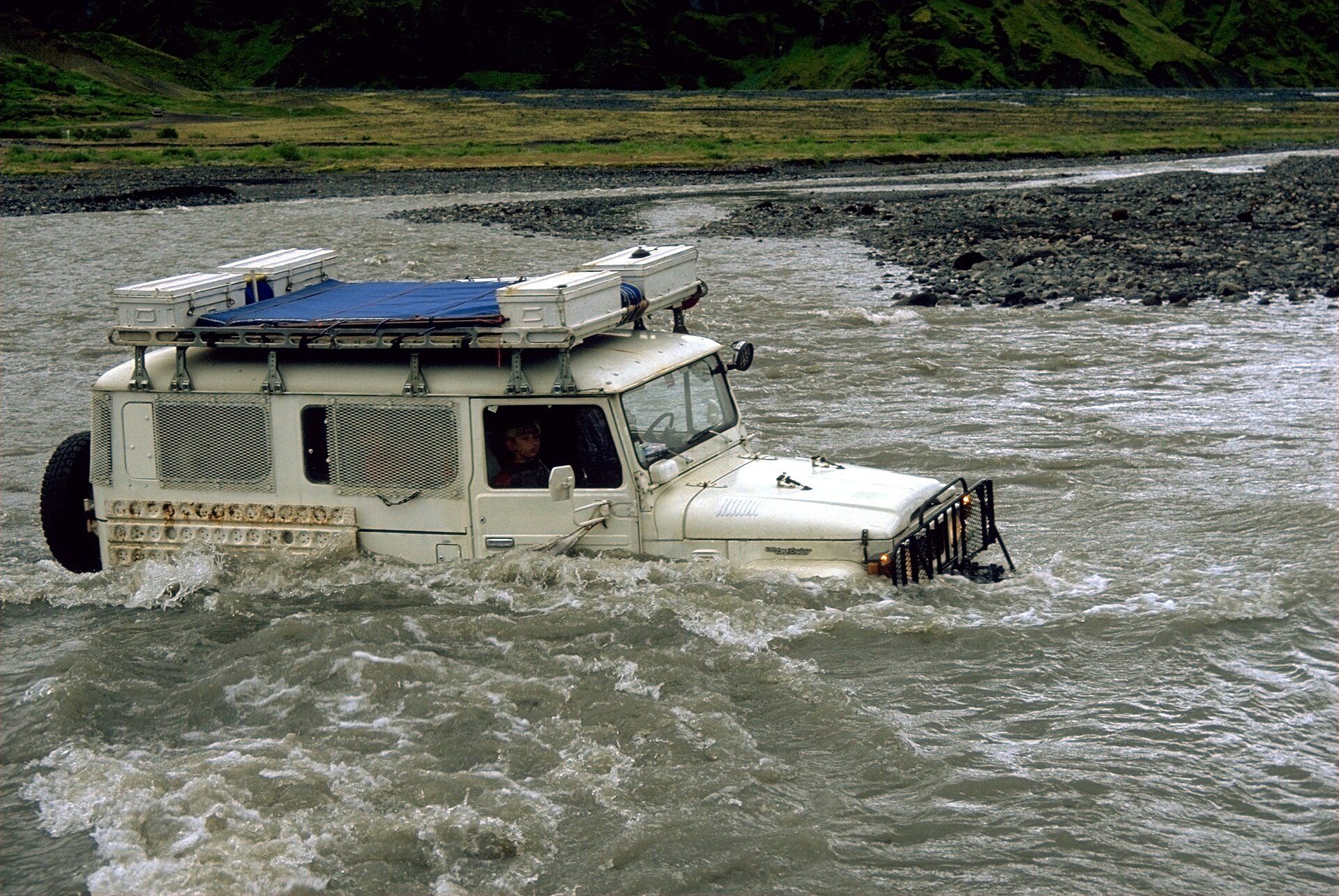
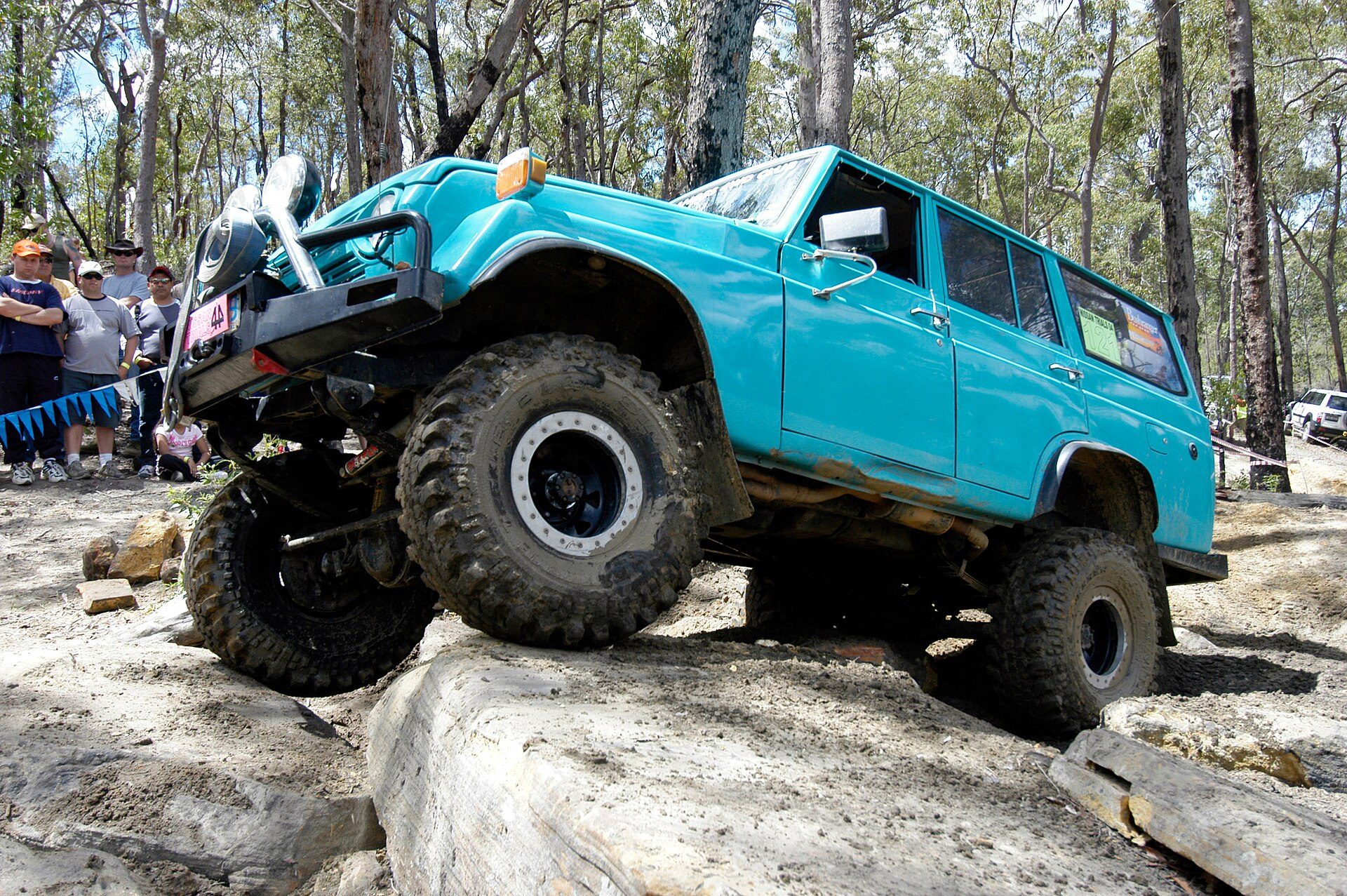
A white Land Cruiser FJ55 wagon with a roof rack fording a shallow river in a Yemeni wadi, with a 60 Series following behind
TOYOTA LAND CRUISER · J45 / J55 · 1960–1984 / 1967–1980

Land Cruiser FJ45 / FJ55

FJ45FJ55 'IRON PIG'F 3.9 / 2F 4.2 I6FULLY BOXED FRAME (FJ55)POWER TAILGATE WINDOW

“The FJ45 is the 40 Series stretched until it could carry a squad or a pallet; the FJ55 is what happened when Toyota decided American families wanted one too. The Iron Pig is ungainly, rust-prone and impossible to find panels for, and people who own one would not swap it for anything.”

PART 01

Overview

Where it came from, why it matters, and how it changed year to year.

The story

Every Land Cruiser wagon you've ever seen traces back to two awkward long-wheelbase trucks. The FJ45 stretched the FJ40 into pickups, cab-chassis, hardtops and a short-lived four-door wagon. The FJ55, launched in August 1967, was something new: Hagerty calls it Toyota's first Land Cruiser designed from the start as a wagon, and Wikipedia calls it the first 'real' station wagon in the line. Americans nicknamed it the Iron Pig: Hagerty says the two-tone paint made the front end look like a pig's snout. Wikipedia records 'Moose' as another nickname.

THE LONG-WHEELBASE WORKHORSE

The FJ45 grew out of the 40 Series from the beginning. Wikipedia lists a four-door FJ45V wagon on a 2,650 mm wheelbase and, from 1963, a 2,950 mm long-wheelbase pickup and cab-chassis. Those long trucks became export staples. Truck Encyclopedia describes the super-long version as a major military troop carrier, often with the windshield folded flat, and notes the Irish Army took 77 FJ45s in 1977. They were praised for speed and reliability, and they rusted badly in the Irish wet.

The four-door FJ45V was the shortest-lived variant. Wikipedia says it was replaced by the FJ55 in 1967, and Truck Encyclopedia says only about 60 of the J30-style FJ45-V/LV wagon bodies were built. The pickups carried on through the 1970s, picking up the H diesel in the HJ45 from 1972 or 1973 (sources differ) and the 2H six in the HJ47 from 1980, before the 70 Series replaced the lot in 1984.

THE IRON PIG

The FJ55 was aimed squarely at North America and Australia. It used the FJ40's drivetrain under a four-door body on a 2,700 mm wheelbase, about 16 inches longer than the FJ40's according to Toyota. Under it was the first Land Cruiser frame with fully boxed members. In the US, Hagerty says, it was sold against the Chevrolet Suburban and Kaiser/Jeep Wagoneer, and it brought a rare luxury: a bottom-hinged tailgate with a power window, worked from a dash switch or the key.

Mechanical changes tracked the FJ40. From 1967 to 1974 it used the 3.9-liter F six at 125 hp with a three-speed manual whose first gear lacked synchromesh. In 1975 the 4.2-liter 2F (135 hp), a four-speed and front disc brakes arrived, along with a domed hood to clear the new induction system. Toyota UK says the design brief was a wagon that could cruise comfortably at 80 mph without losing the 40's off-road ability, and that it made up about 11 percent of Land Cruiser sales by the time production ended in July 1980.

HOW IT ENDED, AND WHY THEY'RE SO RARE

The FJ60 replaced the FJ55 in 1980, taking the wagon idea upmarket with air conditioning and a proper interior. That left the Iron Pig as a working truck that was driven until it dissolved. Hagerty says rust is the top concern and complete replacement panels generally don't exist (specialists sell only repair sections such as rockers and lower-fender patches), and trim and weatherstripping are hard to find. Low production and high attrition, it notes elsewhere, are why good ones are rare.

Rarity has started to show up in prices. In Hagerty's FJ55 buyer's guide (first published in 2021 and updated in 2023), the median FJ55 value for all conditions was $34,500 and for #2 condition $46,300, with the median quoted value up 65.8 percent since 2020. Gen X buyers accounted for 58.5 percent of the quotes. The FJ45 is rarer still in the US and turns up mostly as imported pickups and troop carriers. Bring a Trailer lists both as separate model pages.

SIDEBAR · NAMING THE PIG

Van, wagon, Moose or Pig

Toyota's codes are confusing. Japan registered the FJ55 as a van, hence the 'V' in FJ55V, and Wikipedia says the Japanese model became the FJ56 when the 2F arrived in 1975.

In English it went by two nicknames. Hagerty traces 'Iron Pig' to the front end, whose two-tone paint made it look like a pig's snout. Wikipedia records 'Moose' as well, and Australia's LandCruiserClub forum lists both on its 50 Series board.
Year by year

What changed, model year by model year. Sweet spot Beware

  1. 1960FJ45V four-door wagon (2,650 mm) launched alongside the short-wheelbase 40
  2. 19632,950 mm long-wheelbase FJ45 pickup and cab-chassis added
  3. 1967FJ55 wagon launched in August with Toyota's first fully boxed frame, replacing the FJ45 wagon
  4. 1972HJ45 launched with the 3.6 L H diesel six; FJ55 gets revised side markers
  5. 19754.2 L 2F and a four-speed replace the 3.9 L F and three-speed; FJ55 gets a domed hood (sold as the FJ56 in Japan)Sweet spot
  6. 1978FJ55 rear lamps move lower with integrated turn signals and reverse lights
  7. 1980FJ55 production ends in July; HJ47 and BJ45 arrive
  8. 1984End of J40-family production in Japan; Venezuela built long-chassis trucks until 8/1985
PART 02

Specs & capability

How it’s built, what it can do, and what fits under it.

How it’s built

Both trucks share the 40 Series mechanicals: leaf-sprung live axles, closed-knuckle front axle with Birfield joints, a two-speed part-time transfer case and Toyota's long-stroke F or 2F straight-six. The FJ55 adds a longer, fully boxed frame and a wagon body, and the long FJ45 runs single rear wheels, which Truck Encyclopedia notes limited payloads in military service.

CHASSISLadder frame; FJ55 fully boxedFJ55 2,700 mm wheelbase. FJ45: 2,650 mm (wagon) or 2,950 mm (pickup and cab-chassis).
SUSPENSIONSolid axles, leaf springs front and rearShared design with the FJ40.
4WD SYSTEMPart-time, two-speed transfer caseSame basic transfer case as the FJ40.
ENGINEF 3.9 L to 1974 · 2F 4.2 L from 1975OHV straight-sixes, 125 hp and 135 hp. Diesel HJ45/HJ47 versions for export.
GEARBOX3-speed (non-synchro first), then 4-speedFour-speed arrived with the 2F in 1975.
BRAKESDrums; front discs from 1975 (FJ55)Disc conversions are common on earlier trucks.

Variants & engines

YEARSPLATFORMENGINEOUTPUTWORTH KNOWING
1960–1967FJ45VF 3.9 L I6125 hpFour-door wagon on a 2,650 mm wheelbase; replaced by the FJ55.
1963–1984FJ45 pickup / cab-chassisF, then 2F I6125–135 hp2,950 mm long wheelbase. Military troop carriers in many markets.
1972–1980HJ45H 3.6 L I6 diesel94 hpLong-wheelbase diesel for export.
1980–1984HJ47 / BJ452H 4.0 L I6 / 3B 3.4 L I4 diesel90–105 hpLast long-wheelbase 40s before the 70 Series.
1967–1974FJ55F 3.9 L I6125 hpThree-speed with non-synchro first; drum brakes.
1975–1980FJ55 (FJ56 in Japan)2F 4.2 L I6135 hpFour-speed, front discs and domed hood. Production ended July 1980.

Capability numbers

Wheelbase2,700 mm (106.3 in) FJ55 · 2,650 mm wagon / 2,950 mm pickup FJ45
Length (FJ55)4,675 mm (184 in)
Curb weight (FJ45V)1,850 kg (4,079 lb)Japanese-market figure

Wheels & tires

FACTORY TIRES
H78-15 (≈205/75R15) on 15x5.5 steel wheels
Bolt pattern6x139.7 (6x5.5")
Offset3.25 in backspacing (OEM 15x5.5 steel)

Forum consensus, not a guarantee: wheel offset, tire brand and suspension wear all change clearance. Confirm before you buy.

Production & special editions

The FJ55 ran for 13 years as Toyota's first purpose-built station wagon, while the long-wheelbase 45 outlived it as a pickup and Troopy.

FJ55 productionAugust 1967 – July 1980
J45/J47 production1960–1984 (Venezuela to 8/1985)
FJ45 built412,383
HJ47 built39,593
BJ45 built9,488
PART 03

Buying one

What to pay, what to check, and how to tell a good one from a clone.

What they cost

Long-bed FJ45 pickups and Troopies have overtaken FJ55s at auction, while stock FJ55s stay surprisingly affordable and LS-swapped restomods fetch big money.

FJ55 projectUnder $5k
FJ55 stock driver$11k–21k
FJ55 restored or restomod$33k–106k
FJ45 pickup / Troopy, driver$14k–41k
FJ45, excellent or rare$69k–152k

Based on Bring a Trailer sales from January 2025 to October 2026: 18 FJ55s (median about $19,100, with LS3 and Vortec swaps at $42,500–$106,000) and 54 FJ45s, excluding Bandeirantes (median about $28,400; a 1965 SWB pickup made $122,000). Hagerty's FJ55 guide put the 2023 median at $34,500 and #2 condition at $46,300. Prices move; checked October 2026. See live listings below.

What to check before you buy

  1. 01
    Rust is the dealOn an FJ55, Hagerty's checklist starts at the roof near the drip rails, then the cowl, fenders, doors, rocker panels and wheel arches. Under it, check the frame rails, body mounts and anywhere mud collects.
  2. 02
    Judge the old repairsReplacement panels generally don't exist for the FJ55, so past rust repairs were fabricated. Look closely at how well they were done, since redoing them is expensive.
  3. 03
    Trim and sealsWeatherstripping and trim are hard to find. A truck with complete trim is worth more than its paint suggests.
  4. 04
    Interior conditionVinyl seats tear and original dash tops and rubber mats go brittle. Original, undamaged interiors are the most desirable.
  5. 05
    Test the tailgate windowThe FJ55's power tailgate window works from a dash switch or the key. Make sure it does, with the tailgate both up and down. A dead window is often a stuck safety switch or a corroded power strip, but it can also be a stripped regulator (see the repair below).
  6. 06
    BrakesStock drums are adequate if they work well and the powertrain is stock. Disc upgrades are common and parts are easy to find; check what's been fitted and how.
  7. 07
    Engine healthThe F and 2F are durable with basic maintenance and periodic valve adjustments. Compression matters more than mileage, and mechanical repairs are cheap next to rust repair.
  8. 08
    Know which truck it isCheck the wheelbase and engine code against the chassis plate: FJ45 wagons, pickups and diesel HJ/BJ versions differ, and export-spec trucks are sometimes misidentified.

Spotting the real thing

Long-wheelbase 40s came in a confusing spread of body and engine codes, and Brazilian Bandeirantes sometimes get sold as FJ45s or FJ55s.

  1. ID
    FJ55 frame numbersOwners date FJ55s from the frame number using Toyota production microfiche, for example frames 76441–77572 for July 1977. Some California titles carry an extra leading zero that isn't on the frame, so check that the numbers match.
  2. ID
    FJ55 year tellsA center-domed hood means a 1975-or-later 2F truck; lower rear lamps with integrated turn signals mean 1978 or later. Two-tone paint and grille-set headlights are original.
  3. ID
    FJ45 body codesIH8MUD's J45 chart lists codes by body: FJ45V/FJ45L wagons (1961–67), FJ45P-B long-bed pickups (8/64–1/75), FJ45RP and FJ45LP pickups from 1975, and FJ45V/LV Troopies from 6/77. HJ45 and HJ47 are diesel sixes; BJ45 is the four-cylinder diesel.
  4. ID
    Bandeirante isn't a 55Brazilian Toyota Bandeirantes (OJ50/OJ55, later BJ50/BJ55) are 40-series derivatives with Mercedes-Benz or Toyota 14B diesels. An 'OJ55' is a Brazilian pickup or wagon, not an FJ55.

Recalls & service bulletins

Open recalls follow the VIN, not the model. Run yours through NHTSA before you buy, and ask the seller for dealer records showing recall work.

Check a VIN at NHTSA ↗
Notable recalls
Wiring campaign (1968–69 Land Cruisers) ↗1968–1969 · NHTSA 69V027000NHTSA lists a 1968–69 Land Cruiser electrical-wiring campaign covering 263 vehicles, but its online record carries no defect or remedy text and doesn't name the body style. Earlier write-ups describe mis-fitted door scuff plates chafing the harness; we couldn't re-verify that, so ask Toyota or check the harness under the sill plates yourself.

Importing & legality

The US got gasoline FJ45s and FJ55s. HJ45, HJ47 and BJ45 diesels, right-hand-drive Troopies and Brazilian Bandeirantes are gray-market. A vehicle at least 25 years old, measured from its date of manufacture, can be imported into the US without meeting FMVSS, so every J40-family truck now qualifies. JDMBUYSELL notes that EPA still expects the original-design engine or an EPA-certified replacement. Corsetti Cruisers warns that California may refuse to register an import without a 50-state-compliant emissions system, so plan for that before buying a BJ or HJ.

Rules change and vary by state and country. Confirm with your DMV and a licensed importer before you buy.

The one you’ll own someday

For sale now

1967–1980FJ55 Iron Pig
1960–1984FJ45 pickups and wagons
PART 04

Owning one

Baseline service, the repairs you’ll actually do, and where the manuals live.

Post-purchase baseline

After you buy it

Every FJ45 or FJ55 is now 40 to 60 years old, so start from zero: change every fluid, grease every fitting and set the valves. Fluid types and capacities below are from Toyota publications as compiled on IH8MUD for the 40 and 55 series; the FJ55 shares the FJ40's F/2F engine and driveline lubricants.

Engine oil & filter2F: 7.8 L (≈8.2 qt) with filter · F: 7 L · factory spec API SC/SD (use a modern oil suited to a flat-tappet engine)Baseline now; then per your owner's-manual schedule

One IH8MUD owner warns the owner's manual figure led him to overfill; another always uses 8 qt in a 2F with a filter change. Fill to the dipstick, not the book. New drain-plug washer every time.

Air filterPaper element in the factory air cleanerBaseline now

Replace it before you judge how the carburetor runs.

Ignition tune-upPlugs, points (where fitted), cap & rotor · gap and dwell [CONFIRM IN MANUAL]Baseline now
Valve lashAdjustable rockers · clearances [CONFIRM IN MANUAL]Check now; then periodically

Hagerty notes the F and 2F want periodic valve adjustments; tight valves are the ones that burn. Valve layout front to back is E-I-I-E-E-I-I-E-E-I-I-E.

Coolant & thermostatEthylene-glycol coolant · 2F: 16.5 L (the original F table lists 15.2 L)Baseline flush now

The early F-engine table even lists plain water; use proper ethylene-glycol coolant now, flush until it runs clear, fit a fresh thermostat and check the bypass hose.

Manual transmissionAPI GL-4, SAE 90 · J30 3-speed 1.7 L · H41 4-speed 3.1 LBaseline now

A swapped-in H55F five-speed takes 4.9 L (60/70-series table) and needs its fifth-gear oiler.

Transfer caseAPI GL-4, SAE 90 · 1.7 L (2.1 L with PTO)Baseline now

A PTO winch also has its own gearbox: front winch GL-4 SAE 90, 600 cc.

Front & rear differentialsAPI GL-5 hypoid 80W-90 · 2.5 L each · LSD oil for limited-slipBaseline now
Front knuckles & BirfieldsMolybdenum-disulfide lithium-base grease, NLGI-2Check now; repack with any seal job
Steering box & power steeringManual box: API GL-4 SAE 90, 600 cc · power steering (where fitted): ATF Dexron, 0.8 L totalCheck level now

Top up the manual box through its fill plug; most play is in the box, center arm and tie-rod ends.

Brake fluidDOT 3 (SAE J1703)Baseline flush now

Bleed every corner and look for weeping wheel cylinders on drum-brake axles.

Chassis grease, U-joints & wheel bearingsChassis: moly lithium NLGI-2 · driveshafts & wheel bearings: lithium multipurpose NLGI-2Grease now and at every oil change; repack wheel bearings now
Fuel filterInline filterReplace now
Belts & hosesV-belts and radiator hoses · gear-driven camshaft, so no timing beltInspect now; replace anything cracked or original
For the hands-on owner

Common repairs

The jobs owners actually end up doing, rated for a competent home mechanic with a decent tool kit. Always confirm torque figures, fluids and procedures against the factory service manual for your VIN, and work safely — support the truck on stands, never just a jack. You do this work at your own risk; see the disclaimer. Some parts links are affiliate links.

Front knuckle and Birfield rebuild
DIFFICULTY · 3 / 5TIME · ≈ Two days the first timeSHOP COST · Knuckle kit about $160 (Cruiser Corps)
SYMPTOMSGrease and gear oil weeping past the knuckle wiper seals, sludge inside the knuckle, or play in the front wheel.
THE FIXSame job as an FJ40: pull the hub, spindle and Birfield, remove the steering-arm cones and knuckle caps, then replace the inner axle seal, knuckle bearings and wiper seals. Repack and reassemble, using top shims to set knuckle-bearing preload and bottom shims to center the knuckle. Use the spec from the factory service manual.
TOOLS & PARTSSpring scale · brass drift · seal driver · Cruiser Corps kit 514-108 (FJ40/45/55, 1958–9/1975) or 514-109 (9/1975–1/1990) · knuckle wiper kit · moly grease
Carburetor rebuild
DIFFICULTY · 2 / 5TIME · ≈ Half a daySHOP COST · Keyster kit about $35
SYMPTOMSStumbling, hesitation, rough idle or stalling at low rpm.
THE FIXIdentify the carburetor by the number on its body, since Cruiser Corps sells more than a dozen different Keyster kits for FJ40, FJ45 and FJ55 carburetors built between 1966 and 1984. Strip, clean and rebuild, set the float, and check vacuum lines and the choke while it's apart.
TOOLS & PARTSScrewdrivers · carb cleaner · Keyster kit matched to the carb number
Valve adjustment
DIFFICULTY · 2 / 5TIME · ≈ 1–2 hoursSHOP COST · Valve cover gasket about $17–22 (Cruiser Corps) plus washers
SYMPTOMSTicking from the top end, or a rough-running engine with tight valves.
THE FIXHagerty notes the F and 2F want periodic valve adjustments. With the engine warm, find tight and loose valves with go/no-go feeler gauges at idle, then shut down and adjust only those, setting each cylinder's pair once its intake valve has just closed. Tight valves are the dangerous ones because they can burn.
TOOLS & PARTSFeeler gauges · 17 mm wrench · valve cover gasket
Front disc conversion
DIFFICULTY · 3 / 5TIME · ≈ 4 hours with a bolt-on kitSHOP COST · Front kit about $700 (Cruiser Corps, 8/1970–9/1975)
SYMPTOMSFading or pulling drum brakes on an early truck.
THE FIXBolt-on kits replace the front drums with brackets, calipers and rotors; the job is hub off, bracket on, rotor and hub back on, caliper mounted, new lines and a full bleed. IH8MUD's mini-truck knuckle conversion, written up on a 1972 FJ40, is also reported to work on an FJ55.
TOOLS & PARTSHub tools · flare-nut wrenches · brake bleeder · Cruiser Corps kit A151 (front) or A150 (front and rear, 8/1970–8/1980)
Fabricate rust repairs
DIFFICULTY · 5 / 5TIME · Days to weeksSHOP COST · Parts plus a lot of labor
SYMPTOMSBubbling at the drip rails, cowl, rockers and wheel arches, or soft frame rails and body mounts.
THE FIXBecause complete FJ55 panels generally don't exist, repairs mean cutting out rot and either fitting the few repair sections sold (rockers, lower-fender patches) or forming patches by hand, then welding, seam-sealing and protecting the area. Fix structural metal (frame rails and body mounts) before cosmetic panels, and get a professional opinion on the frame first.
TOOLS & PARTSMIG welder · cut-off wheel · sheet-metal brake or hammer-and-dolly set · seam sealer
Fresh springs, shackles and bushings
DIFFICULTY · 3 / 5TIME · ≈ A daySHOP COST · OME FJ45 2" kits about $2,300–2,700 (Cruiser Corps)
SYMPTOMSSagging, cracked or S-shaped leaf springs and worn bushings.
THE FIXOld Man Emu's FJ45 kits (1963–80 and 1980–84) include springs, shocks, greaseable shackles and pins, bushings, U-bolts and a steering damper. Cruiser Corps notes the OEM round washer must be used at the spring-to-frame pin instead of OME's teardrop washer. Confirm fitment before ordering parts for an FJ55, which isn't listed for these kits.
TOOLS & PARTSJacks and stands · breaker bar · ARB-120 (FJ45 1963–1980) or equivalent kit · bushing kit
Clutch master and slave cylinders
DIFFICULTY · 2 / 5TIME · ≈ Half a day including bleedingSHOP COST · Aisin master about $115 and slave about $35 (Cruiser Corps); OEM master rebuild kit about $51
SYMPTOMSA clutch that slowly loses pressure, has to be double-pumped to shift without grinding, or a pedal that sinks. Look for fluid under the dash or around the slave on the bellhousing.
THE FIXOff-Road.com's FJ40 project, which shares the early clutch hydraulics with the FJ45, replaced the master, the slave and the hose. Pump the old fluid out. Unbolt the slave (two bolts), fit the new one with thread-locker and set the fork pushrod with its locknut. Free the old line with penetrating oil and flare-nut wrenches. Under the dash, pull the cotter pin and spring at the pedal, then remove the three 12 mm master bolts. Fit the new master with a new cotter pin, connect the line and don't overtighten the banjo bolt. Fill with DOT 3, bleed at the slave with a helper, then adjust the pedal rod and slave pushrod. Bench-bleed the new master, and keep the pedal down until the bleeder is closed. Check fitment by build date: Cruiser Corps lists this master for 1970–75 trucks and the slave for 1974–80.
TOOLS & PARTS12 mm socket and wrench · 12 mm and 16 mm flare-nut wrenches · needle-nose pliers · bleeder hose and bottle · thread-locker · DOT 3 fluid
FJ55 power tailgate window won't move
DIFFICULTY · 3 / 5TIME · An afternoon to a weekendSHOP COST · Often only cleaning, wiring and a power strip; a used motor or regulator if the gear is stripped
SYMPTOMSThe rear glass won't go up or down from the dash switch or the key. It may work only with the tailgate down. Or you hear the motor clunk while the glass stays put.
THE FIXIH8MUD members work from the simple stuff inwards. The tailgate has a safety switch: the motor won't run unless its plunger is pushed in. Slop in the gate or a broken plastic actuator can leave the switch open. Next, check the power strip and the harness where it flexes at the hinge; one owner found his strip 'rotten' and replaced it. A meter will tell you whether power reaches the motor when you press the dash switch. If the motor runs on direct battery power but the glass doesn't move, suspect a stripped regulator gear. Members say the glass tray has to be separated from the regulator by driving out two clips, and that the mechanism is often packed with old grime. Be gentle with the glass: one owner broke a donor truck's window getting it down.
TOOLS & PARTSScrewdrivers · multimeter · jumper leads and a 12 V battery · drift and hammer for the tray clips · grease
Asked on every forum

Land Cruiser FJ45 / FJ55 questions, answered

What's the biggest tire I can fit without a lift?

We couldn't find a solid FJ55- or FJ45-specific consensus. They use 40 Series axles, and for the stock FJ40, IH8MUD's 'tried and true' size is 31x10.50R15, with 33x9.50R15 fitting but rubbing at full flex. Try any size on your own truck before committing.

SOURCE · IH8MUD (FJ40)
What's the difference between an FJ45 and an FJ55?

The FJ45 is the long-wheelbase version of the 40 Series: pickups and cab-chassis on 2,950 mm and an early four-door wagon on 2,650 mm. The FJ55 (1967–80) is a purpose-built four-door wagon on a 2,700 mm wheelbase with its own fully boxed frame.

SOURCE · WIKIPEDIA · HAGERTY
Why is it called the Iron Pig?

Hagerty traces the name to the FJ55's front end, where the two-tone paint made it resemble a pig's snout. Wikipedia also records 'Moose.'

SOURCE · HAGERTY · WIKIPEDIA
Which years are best?

1975–80 trucks have the 4.2 L 2F, a four-speed and front disc brakes, and the domed hood is the easy tell. Earlier trucks use the 3.9 L F and a three-speed whose first gear has no synchro, which some collectors prefer for originality.

SOURCE · HAGERTY · WIKIPEDIA
Can I get body panels?

Not complete ones. Hagerty says replacement panels generally don't exist and missing metal usually has to be fabricated, and trim and weatherstripping are hard to find. Cruiser Corps does sell FJ55 repair sections, including outer rockers and lower-fender patch panels with the inner brace. Buy the most solid truck you can afford.

SOURCE · HAGERTY · CRUISER CORPS
Are the drum brakes good enough?

Hagerty says stock drums are adequate if they're in good order and the powertrain is stock. Disc conversions are common and parts are easy to find.

SOURCE · HAGERTY
What are the lift options?

Old Man Emu makes 2-inch kits for the FJ45 (1963–80 and 1980–84), sold through specialists such as Cruiser Corps, with greaseable shackles and a steering damper. Confirm fitment for an FJ55 before ordering.

SOURCE · CRUISER CORPS
Is the engine reliable?

Yes, with basic care. Hagerty calls the F and 2F durable with basic maintenance and periodic valve adjustments, and says mechanical repairs are easy and cheap compared with rust repair.

SOURCE · HAGERTY
What's an FJ55 worth?

In Hagerty's FJ55 buyer's guide (first published in 2021 and updated in 2023), the median value for all conditions was $34,500 and for #2 condition $46,300, with quoted values up 65.8 percent since 2020. Its earlier wagon-values piece mentioned private sales approaching six figures.

SOURCE · HAGERTY
Were FJ45s really used by armies?

Yes. Truck Encyclopedia describes the super-long-wheelbase FJ45 as a major military export used as a troop carrier, and the Irish Army took 77 FJ45s in 1977.

SOURCE · TRUCK ENCYCLOPEDIA · WIKIPEDIA
PART 05

Building one

Who makes the good stuff, where owners gather, and who to watch.

Common modifications & who does them

SUSPENSIONFresh springs and shocks are the biggest ride and safety improvement on a truck with tired 40-year-old leaves.
DISC BRAKESEarly trucks run four-wheel drums. Kits cover FJ40, FJ45 and FJ55 from 1970 to 1980.
CARBURETOR & TUNE-UPA correctly matched rebuild kit fixes most driveability problems on the F and 2F.
KNUCKLES & DRIVELINEKnuckle seals and bearings are the classic leak on these axles.
RESTORATION PARTSTrim, glass seals and body parts are scarce; specialists are the best hope.

Clubs & events

Resources

Channels, accounts & forums

All Land Cruiser resources →
SourcesHagerty — Your handy 1967–80 Toyota FJ55 buyer's guideHagerty — Toyota Land Cruiser wagons do nothing but go up in valueWikipedia — Toyota Land Cruiser (J40)Wikipedia — Toyota Land CruiserToyota Pressroom — A Toyota global icon for nearly 70 yearsToyota UK Magazine — Toyota Land Cruiser history: Station Wagon editionTruck Encyclopedia — Toyota FJ45JDM Buy Sell — Land Cruiser J40 buyer's guideIH8MUD — FJ40 tire sizeIH8MUD — 33x9.50 on stock 40?IH8MUD — Knuckle preloadIH8MUD tech — Mini-truck disc brake conversion on a 1972 FJ40IH8MUD — First valve adjustment on my '78 FJ40Off-Road.com — Disc brakes for your Toyota 4x4 Land CruiserCruiser Corps — Knuckle rebuild kit, FJ40/45/55 1958–1975Cruiser Corps — Keyster carburetor rebuild kitsCruiser Corps — Disc brake conversion kits, FJ40/45/55Cruiser Corps — ARB/OME 2" lift kit, FJ45 1963–1980LandCruiserClub.net — 50 Series forumIH8MUD — Service specifications & fluids, Land Cruiser FJ/BJ/HJ 40 & 55 series (from Toyota publications)IH8MUD — Service specifications & lubricants, Land Cruiser 60 & 70 seriesIH8MUD — Oil capacity, '70 or '80 FJ40Wikipedia — Toyota F engineCruiser Corps — Outer rocker panel, left, FJ55 1968–79Off-Road.com — Project FJ40 Cruiser: clutch system upgradeIH8MUD — Clutch won't bleedCruiser Corps — Aisin clutch master, FJ40/45/55 1970–75Cruiser Corps — Clutch release/slave cylinder, FJ40/45/55 1974–80IH8MUD — Rear window issue (FJ55)IH8MUD — Rear window (FJ55 regulator)Wikipedia — Toyota Land Cruiser (J40)Wikipedia — Toyota Land CruiserHagerty — Toyota Land Cruiser FJ55 buyer's guideJDMBUYSELL — Toyota Land Cruiser J40 guideCruiser Corps — 15" wheel rim, OEMIH8MUD — FJ55 VIN decodingIH8MUD — J45/47 body style, frame dates and production numbers (revised)NHTSA recalls API — Toyota Land Cruiser by model yearNHTSA — Recall 69V027000Bring a Trailer — Toyota Land Cruiser FJ45 resultsBring a Trailer — Toyota Land Cruiser FJ55 resultsNHTSA — Importation and certification FAQsCorsetti Cruisers — The new LENO Law in CaliforniaToyota Land Cruiser AssociationIH8MUD — TLCA Cruise Moab 2025Visit Utah — Land Cruiser Heritage Museum