The story
Most 4x4s start as a ladder frame with axles bolted underneath. The Pinzgauer starts as a steel tube. Steyr-Daimler-Puch began developing it in 1964 as the bigger brother of its Haflinger. Pilot production started in 1969, and the 710 (4x4) and 712 (6x6) went into series production in Graz in 1971. They have an air-cooled 2.5-liter petrol four, swing axles with portal reduction hubs, hydraulic diff locks you engage on the move, and a 24-volt system built to military spec. The result is one of the most capable off-roaders ever built, and one of the strangest to drive on the street.
THE HAFLINGER'S BIG BROTHER
The Pinzgauer, like the Haflinger, was developed in Graz under Erich Ledwinka. He was the son of Tatra's Hans Ledwinka and served as Steyr-Daimler-Puch's chief engineer from 1950 to 1976. The Austrian sources say the name comes from the Pinzgauer horse of the Pinzgau region. English-language sources usually credit the region's cattle instead. To win the Austrian Bundesheer contract, it had to beat the Husar from rival maker ÖAF, and it did.
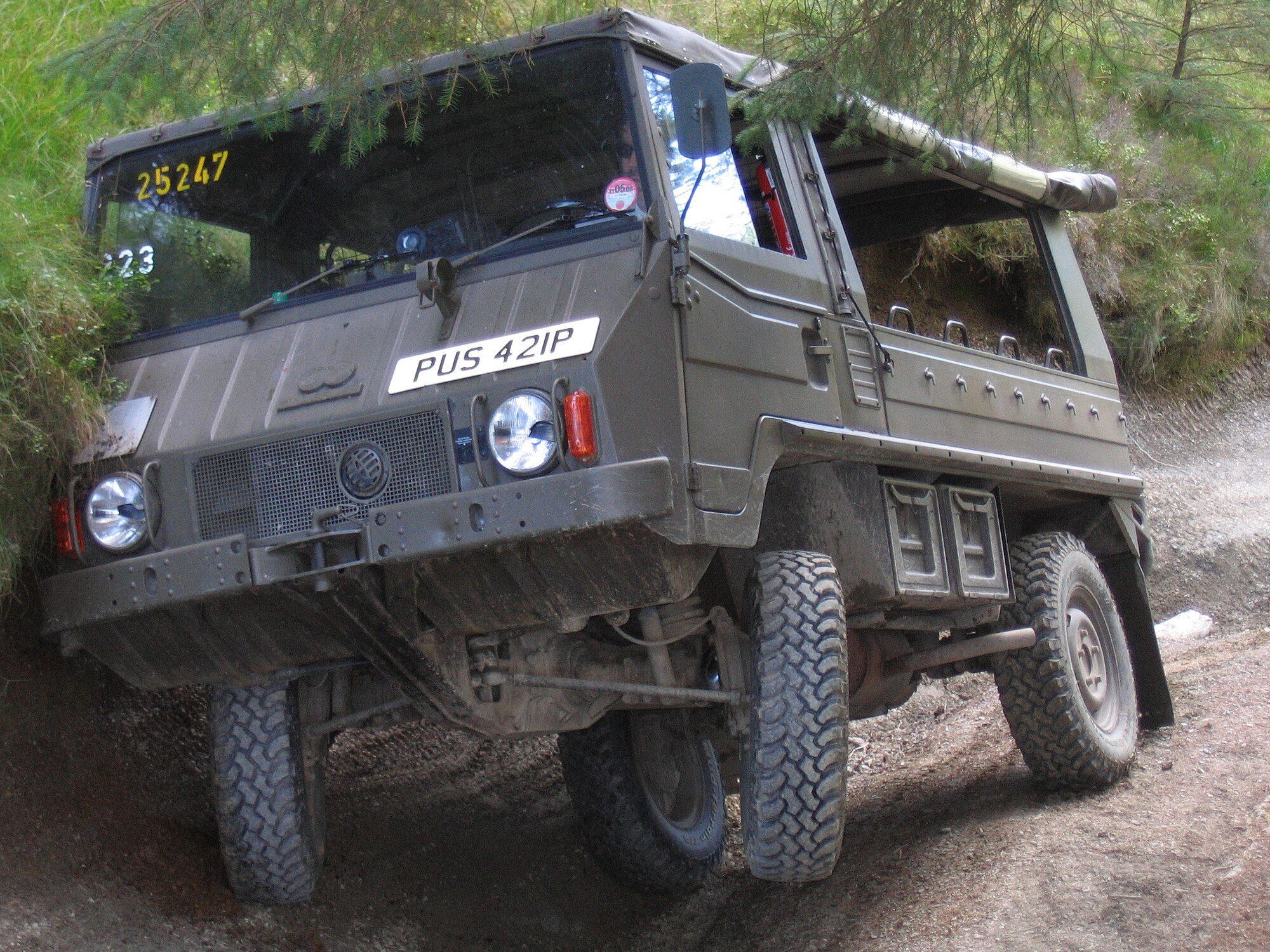
Where the Haflinger carried its engine in the tail, the Pinzgauer put it up front over the front axle. The backbone-tube layout made it easy to build many different bodies on the same chassis. Steyr's two main customers were the Austrian and Swiss armies, and Yugoslavia bought 3,975 of them in both 4x4 and 6x6 form. Wikipedia counts 18,349 first-generation 710s and 712s built between 1971 and 1985, for civilian and military buyers.
HOW IT WORKS
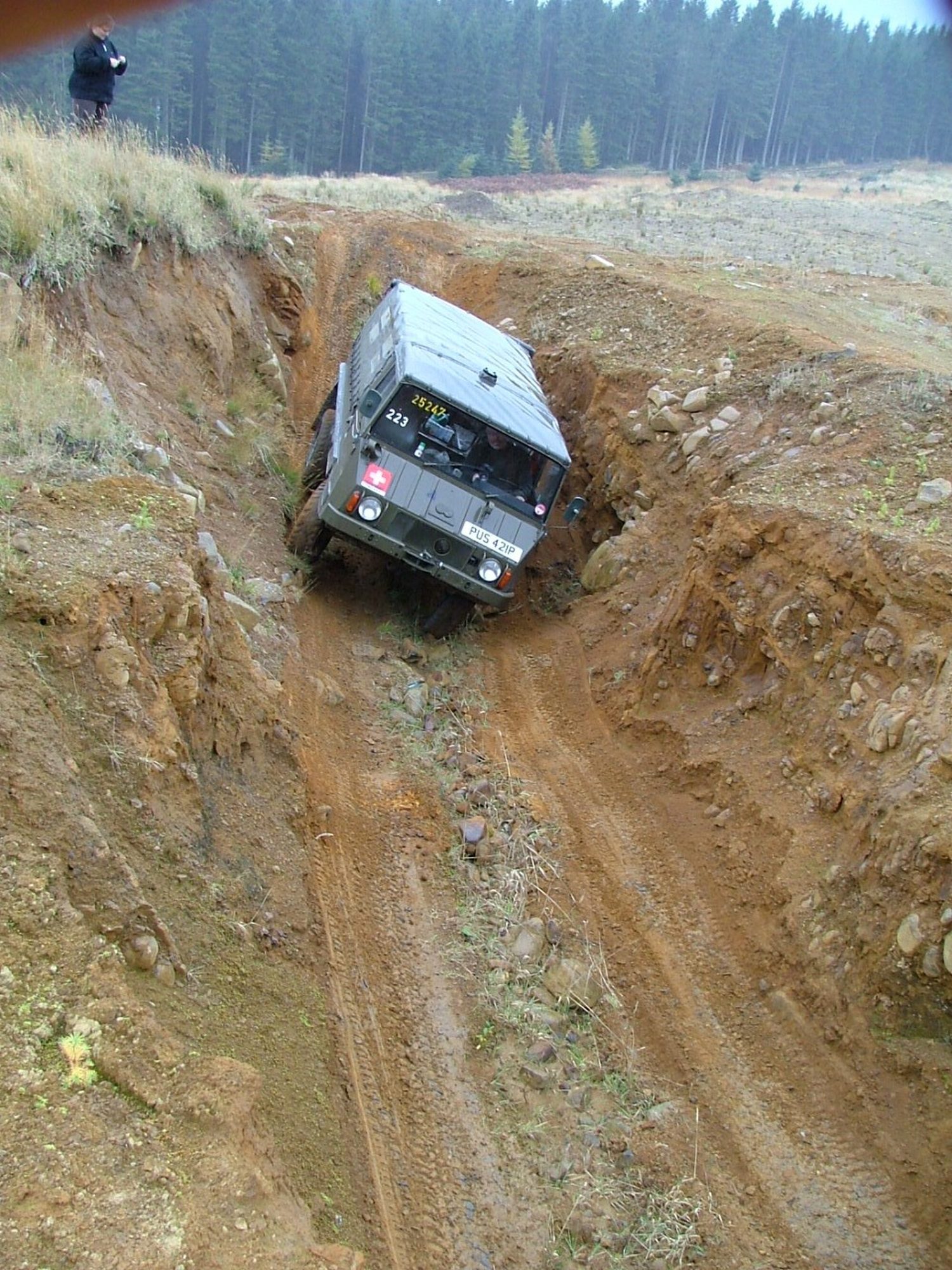
The central tube contains the drivetrain. The transfer case and differentials sit inside it, and the swing half-axles pivot from it, ending in portal gearboxes that drop the drive by 2.266:1 at each wheel. No diff housing hangs underneath to catch on rocks, so ground clearance is 335 mm (13.2 in). SDP-Pinzgauer's technical data quotes 45-degree approach and departure angles, 700 mm (27.6 in) of fording depth and a 100 percent climbing ability. Steering is a ZF-Gemmer worm and roller with five turns lock to lock, and there is no power assistance.
The engine was designed for the vehicle: a 2,499 cc pushrod four with twin Zenith 36 NDIX carburetors and separate pressure and return oil pumps, so it isn't starved of oil on steep slopes. BaT lists it at 87 hp and 133 lb-ft. It drives a ZF five-speed and a two-speed transfer case, which gives ten forward gears. Front-wheel drive and the front and rear lockers are engaged hydraulically with levers in the center stack. There is no center differential, so the Pinzgauer runs as a part-time 4x4. Everything electrical runs on 24 volts through two 12-volt batteries and push-pull circuit breakers.
FOUR WHEELS OR SIX
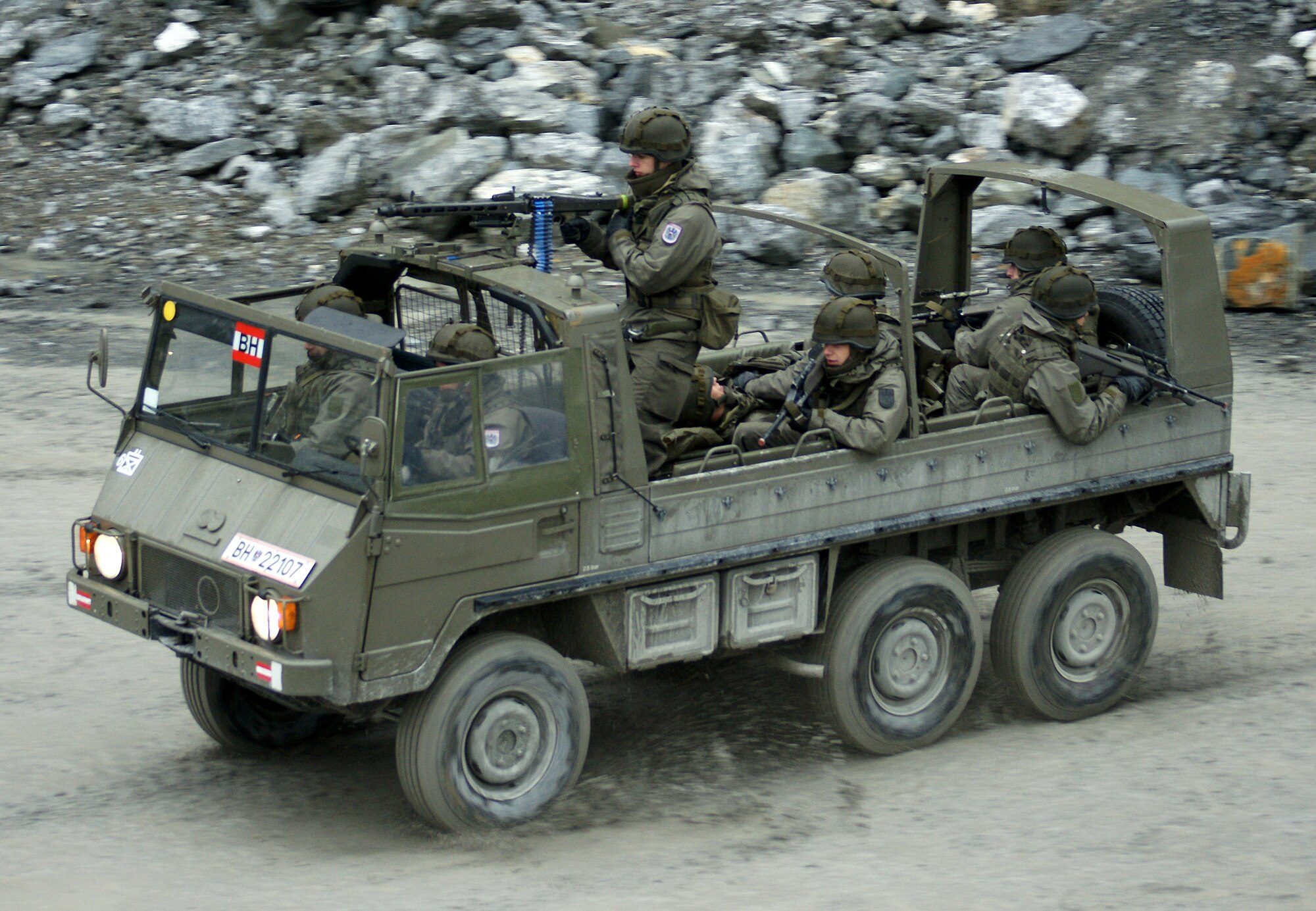
The 710 was the more popular model, but Steyr designed the 6x6 into the platform from the start. The 712's rear bogie uses inverted parabolic leaf springs where the 710 uses coils. It raises payload from 1,000 to 1,500 kg and seats 14 in M (troop carrier) form, against 10 in a 710M. Owners say the 712 rides better on the road and the 710 copes better in tight spaces. Bodies included the M soft top, the K five-door hardtop, the T flatbed, ambulances, workshop and fire trucks, and the 712 DK crew cab.
Production figures from Das Puch Automobil Buch show the mix changing. In 1978 Graz built 444 710s and 167 712s, and from 1981 the 712 outsold the 710 every year. Late in production, some 712s, mostly ambulances, got a 2.7-liter version of the air-cooled four. Otherwise the first generation hardly changed in 15 years. That helps if you are hunting for parts, and it means there are no particularly good or bad years to look out for.
AFTER THE ARMY
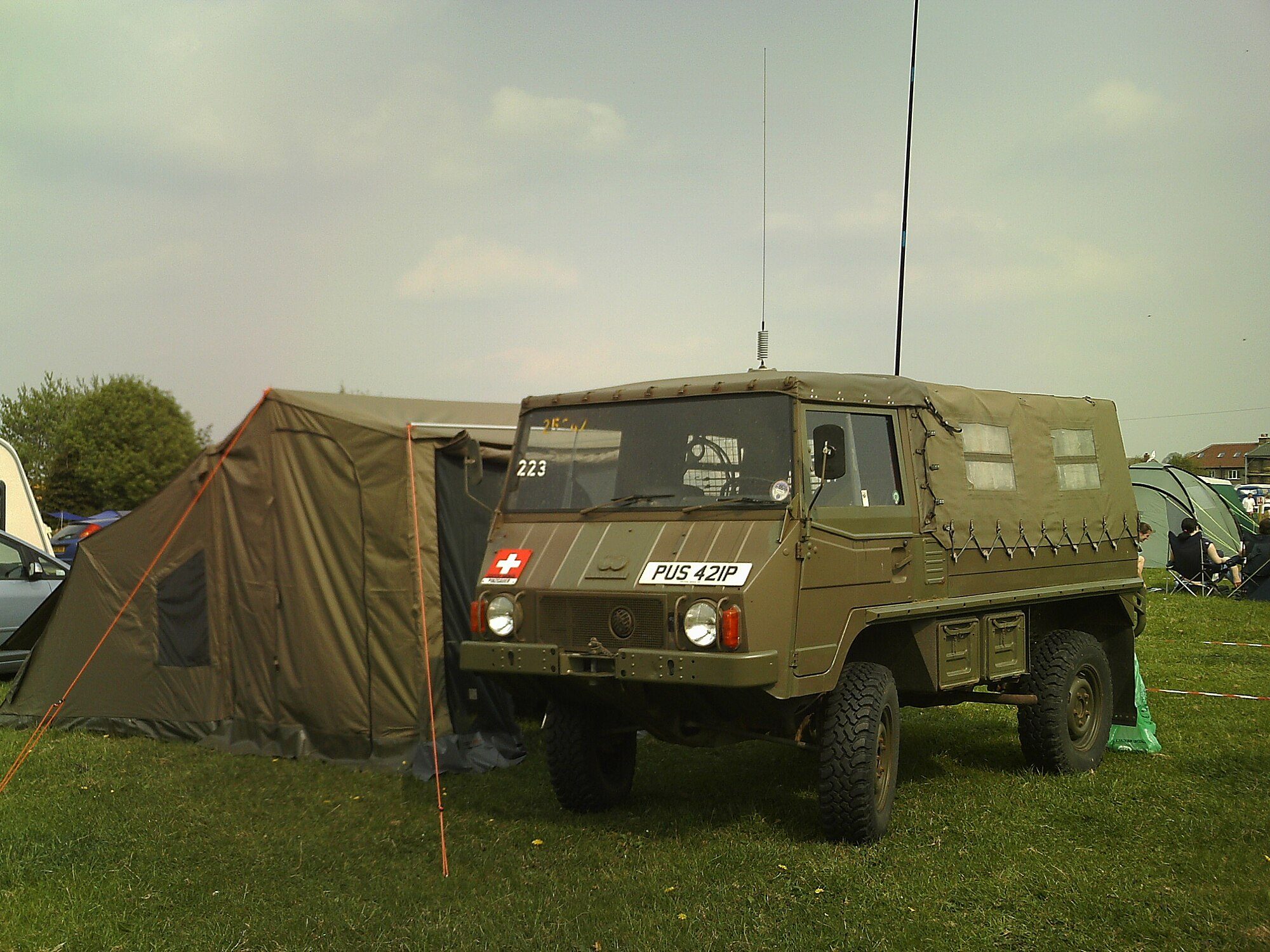
In 1985 the redesigned 716 and 718 took over. They had a turbocharged VW diesel six, disc brakes, a slightly wider track and an optional automatic. The petrol trucks stayed in service for decades and then came onto the surplus market, mostly from Switzerland. In America they became tour buses as well as campers. Wikipedia notes that the Navajo Nation was still using a small fleet for visitor trips in Canyon de Chelly in 2024. Car executive Bob Lutz bought an ex-Swiss 710M in 1991.
Today a 710 makes a strong case as a low-cost expedition truck, as long as you accept its limits. Bring a Trailer sales from 2023 to 2026 mostly land between about $10,000 and $25,000. Parts are still made or stocked by specialists such as Swiss Army Vehicles in Arkansas and Expedition Imports. And the community has documented almost every job, from the 0.2 mm valve lash to fitting split axle boots.
SIDEBAR · THE SWISS PIPELINE
Why most American Pinzgauers come from Switzerland
The Swiss Army bought petrol Pinzgauers in large numbers and kept them for decades. As the Swiss and Austrian armies retired their trucks, demand grew in the US. Swiss Army Vehicles in Fayetteville, Arkansas, says it has dealt in European military vehicles and parts since 1998. The SDP-Pinzgauer owners' site warned buyers that the trucks' infrared-reflecting paint fades quickly and isn't very water resistant. The Swiss Army repainted the trucks by hand at regular intervals, so a shiny coat can hide plenty.
There are other Swiss details too. Swiss trucks use a single amber bulb for turn and brake lights plus a red tail lamp, where Austrian trucks have separate red brake lights. The 710K radio command trucks, or Funkkommandowagen, carry their own wiring. Some trucks arrive with paperwork as well: the ex-Lutz 710M that sold on BaT in 2026 came with a Swiss registration document alongside its Texas title. The checklist also notes that the trucks were steam-cleaned before shipping, and still advises lifting the footwell plates, where 'most likely you will find half of the Alps.'
 YT