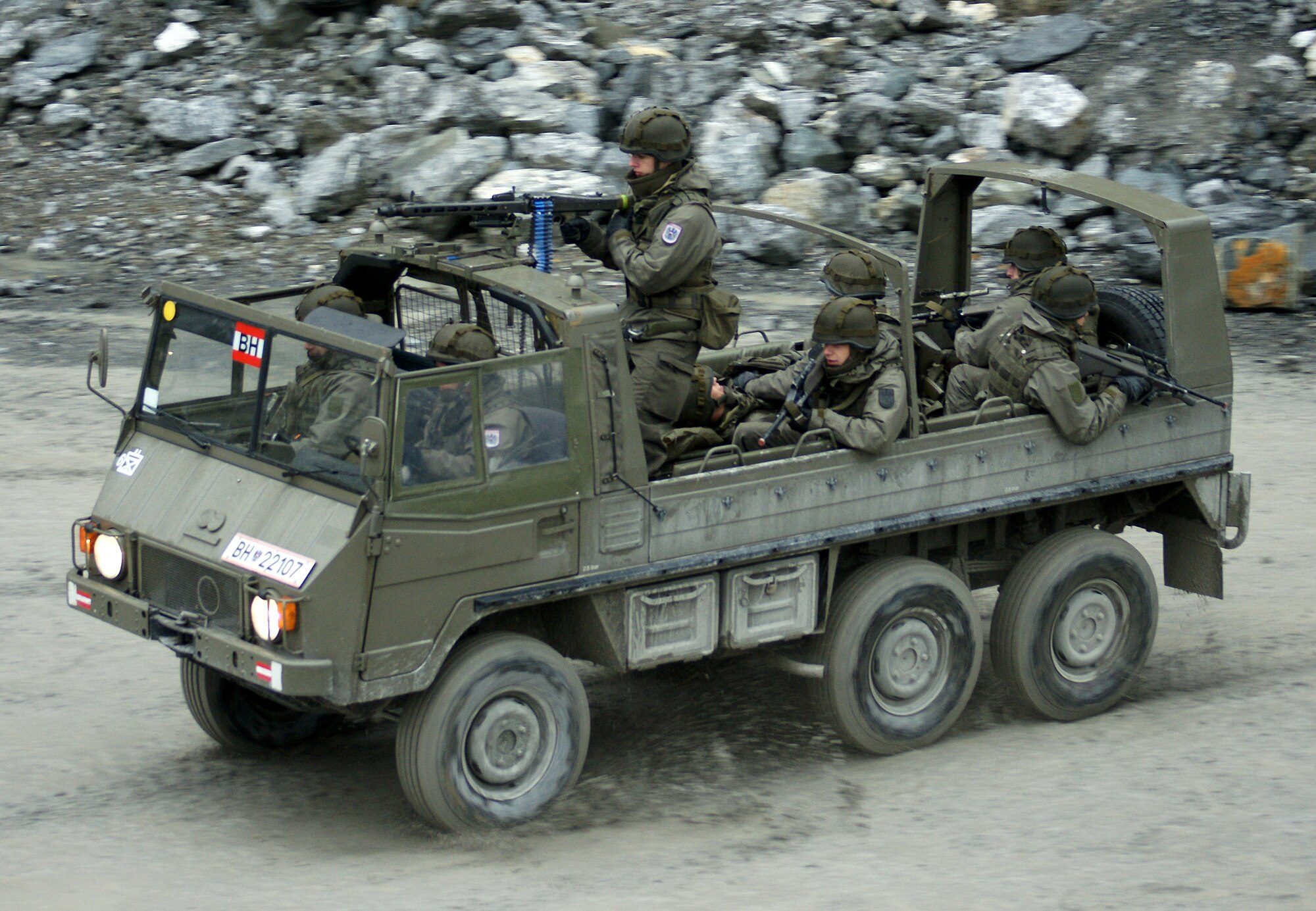
Pinzgauer
“An Austrian army truck with an air-cooled engine, a backbone tube where the chassis should be and portal hubs at every corner. It is slow, loud and narrow, and it will follow a mountain goat up a hill.”
Steyr-Daimler-Puch started work on the Pinzgauer in 1964 as a bigger brother to its little Haflinger. Pilot production began in 1969 and series production in 1971, at the same Graz works that would later build the Puch G. Like the Haflinger, it uses a central backbone tube with swing axles instead of a ladder frame. Its main customers were the Austrian and Swiss armies, and it went on to serve with more than two dozen others, from Britain and New Zealand to Saudi Arabia and Thailand.
The 710 and 712 (1971–1985) are the originals: a 2.5-liter air-cooled petrol four, a five-speed ZF gearbox, a 24-volt electrical system and drum brakes, with four wheels (710) or six (712). In 1985 they gave way to the 716 and 718 Turbo D, with a water-cooled Volkswagen turbodiesel six, disc brakes, a wider track and bigger tires. That generation was built in Graz until 2000 and then under licence in Britain, where production ended around 2007.
Steyr never sold the Pinzgauer new in the United States. Nearly every American example arrived later as military surplus, most of them petrol trucks retired by the Swiss Army. Today they are a cult choice for overlanders and expedition builders. People buy them for portal-axle clearance, on-the-fly lockers and a load bed that seats ten. They put up with a cabin you have to shout across and parts priced, as one owner put it, 'somewhere between Lexus and airplane'.
Every generation
Best Steyr-Puch Pinzgauer years to buy, and which to avoid →
Resources
 YTExpedImports (Expedition Imports)Official channel of the US parts specialist focused on the Unimog, G-Wagen and Pinzgauer.YTpinzcfr (Pinzgauer Club de France)Channel of the French Pinzgauer owners' club.YTThe Fast Lane Truck — What the heck is a Pinzgauer?Explainer video on the Pinzgauer, cited by Wikipedia.