AM GENERAL HUMMER H1 · CIVILIAN HMMWV · 1992–2006

Hummer H1

M998 HMMWV-BASEDGEARED PORTAL HUBSINBOARD DISC BRAKESCTIS6.5 TD · 6.6 DURAMAX (ALPHA)

“A military truck with a stereo, built on the same line as the Army's and engineered to follow tanks. It's slow and wide, and it eats front ends, but geared hubs, inboard brakes and CTIS let it go places nothing else this size can.”

PART 01

Overview

Where it came from, why it matters, and how it changed year to year.

The story

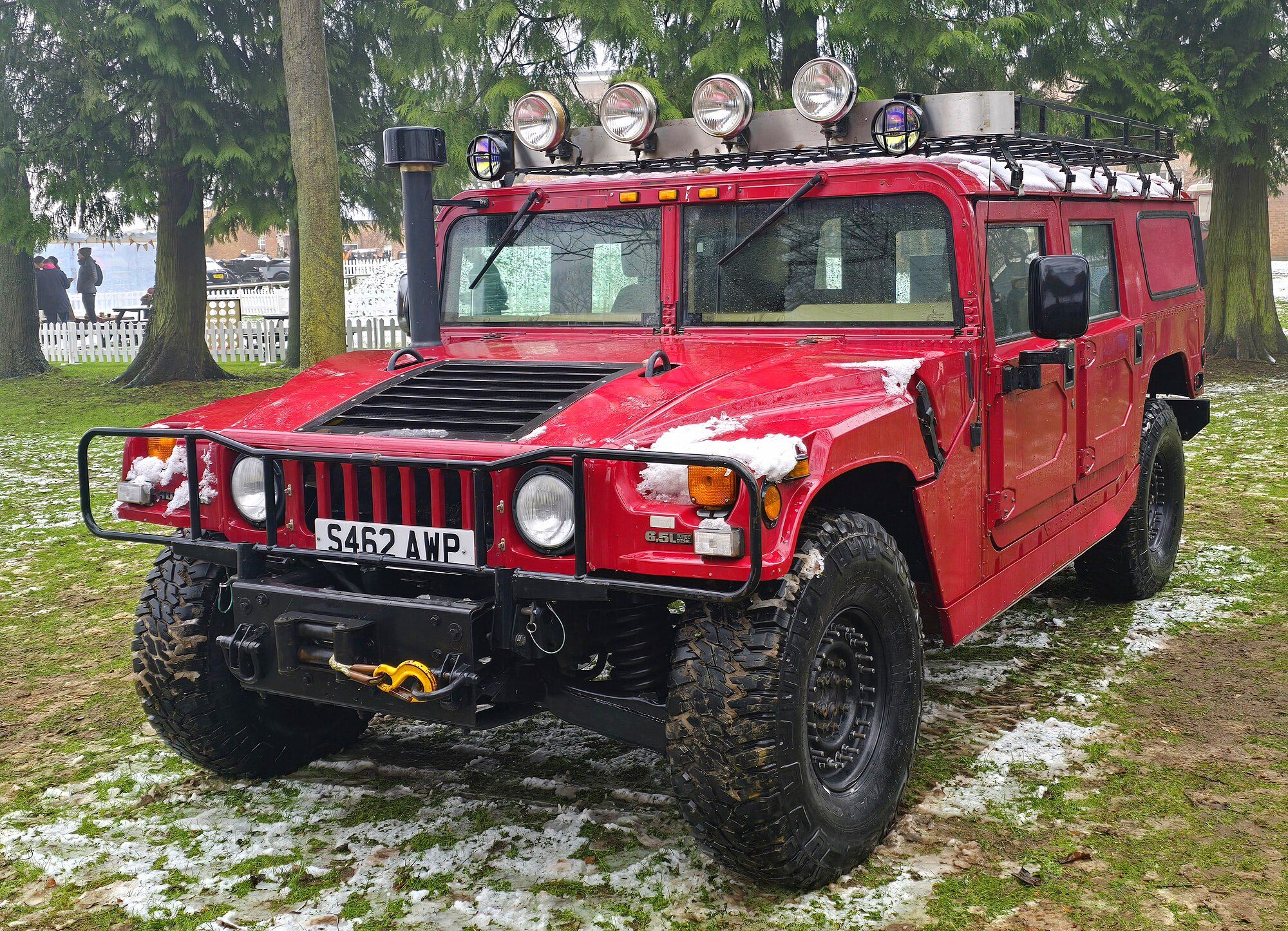
The Hummer H1 is what happened when a defense contractor took a call from a movie star. Underneath, it's the Army's M998 HMMWV with gloss paint, carpet and a stereo. The frame, axles and brakes are shared with the military trucks, and so are the hood, tailgate and quarter panels. AM General built both versions on the same Mishawaka, Indiana, line from 1992 to 2006, 11,818 civilian trucks in all. It is 86.5 inches wide, seats four either side of a driveline tunnel the size of a footlocker, and can climb a 22-inch step. Nothing else on this site was built to that brief.

FROM JEEP'S DEFENSE ARM TO THE HUMVEE

AM General began as the General Products Division of Kaiser Jeep, the old Studebaker defense plant in South Bend. American Motors made it a subsidiary in 1971. In 1979 the Army published draft specifications for one truck to replace the M151 jeep, the M561 Gama Goat and the commercial-based CUCV pickups. It had to have a diesel, 16 inches of ground clearance and enough ability to climb a 60 percent grade. AM General developed its entry as a private venture and finished its first prototype in August 1980.

In July 1981 the Army ordered 11 prototypes each from AM General, Chrysler and Teledyne. They were tested at Aberdeen Proving Ground and Yuma. On March 22, 1983, AM General won the production contract for 55,000 HMMWVs. That same year LTV bought AM General: Renault had taken a large stake in AMC, and federal rules barred defense contractors owned by foreign governments, which included partly state-owned Renault. AM General had nicknamed its prototypes 'Hummer' and had the foresight to trademark it. Humvees were in service by 1985.

ARNOLD'S TRUCK

AM General had considered a civilian model since the late 1980s. Gulf War photographs and Arnold Schwarzenegger, who saw an Army convoy while filming Kindergarten Cop in Oregon, made the case. The civilian Hummer went on sale in 1992, and Schwarzenegger bought the first two. At first there were no dealers. You ordered from the factory and could collect the truck in Indiana. Flash Off-Road's year-by-year guide lists the 1992 truck with a mechanical 150-hp 6.2-liter GM diesel, a three-speed 3L80 automatic and a 65-mph top speed. It built 316 that year.

Then came constant change. Because of how the military contracts were written, AM General slipped fixes into production as soon as they were ready, not just at model-year changes. In 1994 the trucks got the 6.5 diesel and a four-speed 4L80-E. For 1995 a 5.7-liter gas V8 was offered to buyers who were wary of diesel, and it was dropped during 1996. In 1996 the 6.5 turbo diesel and a second fuel tank arrived, and by 1997 the turbo made 195 hp and 430 lb-ft.

HOW IT CLEARS 16 INCHES

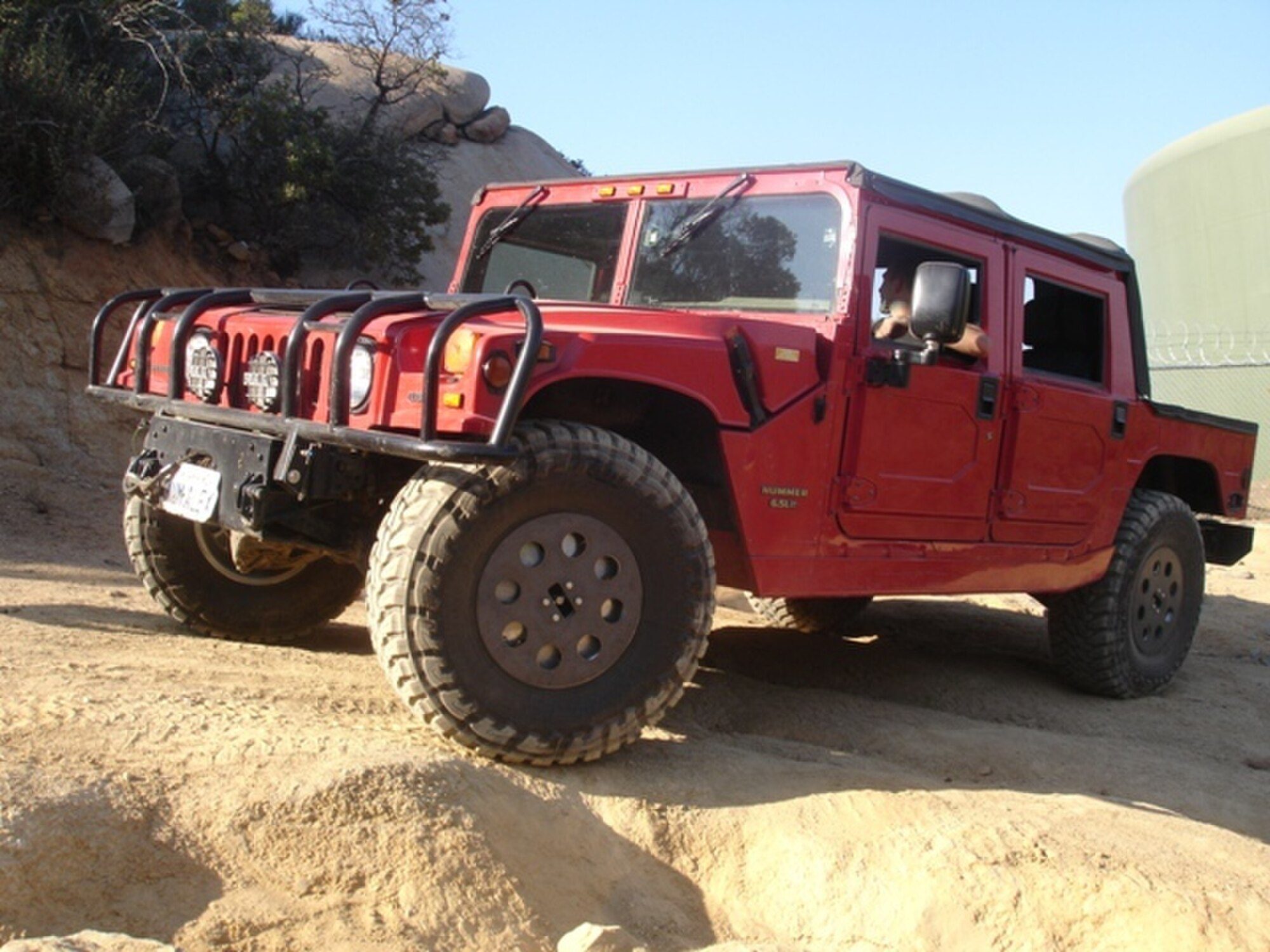
The H1's clearance doesn't come from a lift. Each wheel has a geared hub, a portal reduction box with a 1.92:1 ratio in the 1999 brochure. It sits the axle shaft above the wheel center, so the halfshafts and differentials ride high in a channel down the middle of the truck. The disc brakes are inboard, next to the differentials, rather than in the wheels. Suspension is independent double A-arms with coil springs at every corner, and the track is 71.6 inches, wide enough to follow tank tracks. Mercedes used the same portal-axle trick decades later on the G 500 4×4².

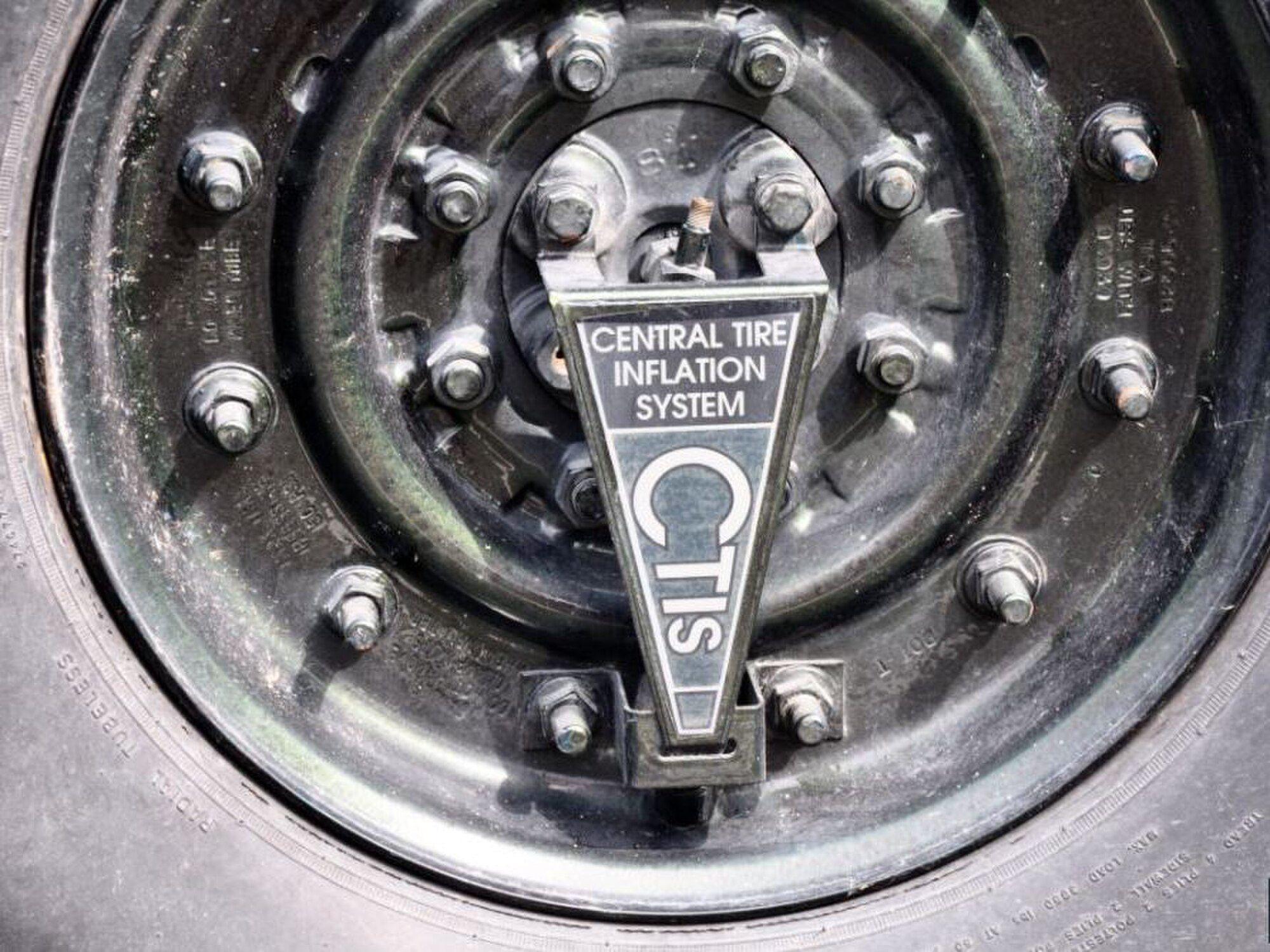
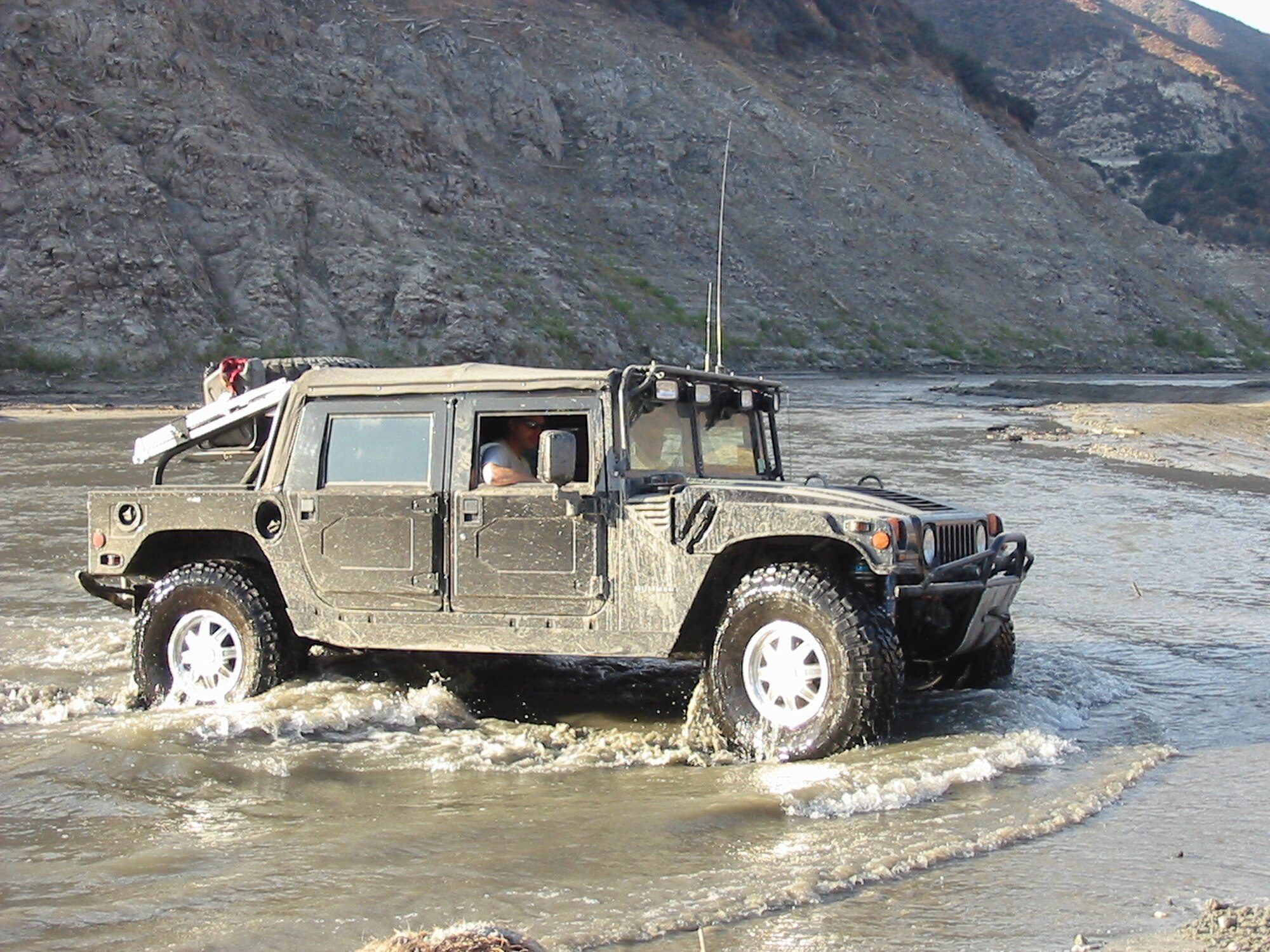
Wading depth is 30 inches with a diesel, thanks to a high air intake and a radiator mounted high and sloped over the engine. The central tire inflation system lets the driver air the tires down or up from the cab, front and rear pairs together, and runflat inserts were optional. Torsen I differentials handled traction through 1998. In 1999 ABS arrived, along with Torsen II units and electronic TorqTrac4 traction control, and Eaton electric lockers followed from 2003.

GM, THE ALPHA AND THE END

In December 1999 General Motors bought the Hummer brand name and took over marketing. AM General kept building the truck, now called the H1, and also built GM's own H2 under contract. GM's smaller H3 came from a GM plant in Shreveport, Louisiana. In 2001 AM General began building the 6.5 diesels itself, having taken over GM's engine plant, and the 2004 'Optimizer' 6.5 made 205 hp. That set up the last and best H1: the Alpha, shown in Anaheim on October 27, 2004.

The Alpha used GM's 6.6-liter Duramax LLY, rated at 300 hp and 520 lb-ft, with an Allison five-speed automatic. To make room, AM General lifted the body 2 inches and redesigned the cooling. It also fitted helical-cut gears in the hubs, a stronger steering box and 51 gallons of fuel. There was no 2005 model year. Only 729 Alphas were built, at about $128,000 to $140,000 each. In May 2006 GM announced the end, with sales slow and new diesel emissions rules due for 2007, and production stopped in June. The Hummer brand itself closed in 2010. The name returned in 2020 on the electric GMC Hummer EV.

SIDEBAR · BODY STYLES

Wagon, open top, pickup, slant-back

AM General's VIN chart lists a two-door pickup, a four-door pickup, the station wagon and an open-body soft top, plus fleet and 'Recruit' versions. For 1995 it added an extended-cab two-door truck and an open top with full hard doors. The wagon got barn doors instead of a tailgate that year. The two-door short-cab pickup and the half-door open top were dropped for 1997, and the two- and four-door hardtops were dropped after 2001 except for fleet buyers.

In 2000 the factory offered a slant-back with the same body shape as the military Humvee. Flash Off-Road counts just 39 built, which makes it the rarest regular H1. By the end, individual buyers could only choose the soft-top open top or the wagon, and those were the only two bodies offered on the 2006 Alpha.
Year by year

What changed, model year by model year. Sweet spot Beware

  1. 1992Civilian Hummer launches: mechanical 6.2 diesel (150 hp), 3L80 three-speed, 25-gal tank, batteries under the passenger seat, non-adjustable seats. Sold factory-direct at first. 316 built
  2. 1994Electronic 6.5 diesel (170 hp, 290 lb-ft) and 4L80-E four-speed; batteries move under the hood; new HVAC, adjustable seats, catalytic converter
  3. 19955.7 gas V8 option (23-gal tank, 24-in fording); extended-cab pickup and full-door open top added; wagon gets barn doors. From VIN 163985, stronger steering arms, center link and ball joints
  4. 19966.5 turbo diesel arrives (190 hp, 385 lb-ft) with a second fuel tank on every truck; new CTIS with solenoid valves; body raised 3/4 in; gas engine dropped mid-year. Start of the No. 8-cylinder crack risk period
  5. 1997Turbo diesel to 195 hp and 430 lb-ft with oil-cooled pistons; sound insulation; Detroit Locker optional. From VIN 176477 ('97.5') a much better redesigned HVAC system
  6. 1998Axle ratio changes from 2.73 to 2.56; eccentric camber adjustment; quieter geared hubs. The last year of Torsen I and no ABS; Flash Off-Road calls it the quintessential pre-Alpha H1Sweet spot
  7. 1999ABS, TorqTrac4 traction control and Torsen II differentials; naturally aspirated diesel dropped. AM General starts fitting improved 6.5 blocks from May. GM buys the Hummer brand in December
  8. 2000Slant-back body offered (39 built, per Flash Off-Road); 16.5-in and 17-in aluminum wheel options; redesigned cabin. Later 2000 trucks (after VIN 137ZA9037YE188469) not at risk of the No. 8 crack
  9. 2001First AM General-built 6.5 engines ('F' in the fourth VIN digit); redesigned gauges and heated mirrors
  10. 2002Higher torque-bias differentials; H1 badging; 10th Anniversary edition of 65 orange wagons; two- and four-door hardtops dropped except for fleets
  11. 2003Optional Eaton electric rear locker; factory leather and heated seats
  12. 2004'Optimizer' 6.5 turbo diesel with Caterpillar-built ECM (205 hp, 440 lb-ft); all-new interior; optional front and rear Eaton lockers. No 2005 model year followsSweet spot
  13. 2006H1 Alpha: 6.6 Duramax (300 hp, 520 lb-ft), Allison five-speed, 2-in body lift, helical-gear hubs, 12-in brakes, 51 gal of fuel. 729 built; production ends June 2006Sweet spot
PART 02

Specs & capability

How it’s built, what it can do, and what fits under it.

How it’s built

The H1 is the HMMWV's driveline under a civilian body. A steel ladder frame carries independent double-A-arm suspension at all four corners. The engine sits well back, and the transmission, transfer case and both differentials run down a central tunnel. Halfshafts from the differentials drive geared hubs at the wheels, which drop the wheel center below the axle line. That's where the 16 inches of clearance comes from, along with the inboard brakes mounted at the differentials.

CHASSISSteel box-section ladder frameFive crossmembers; 130-in wheelbase, 86.5-in width (1999 brochure)
SUSPENSIONIndependent double A-arms, coils16-in ground clearance; 71.6-in track
GEARED HUBSPortal reduction at each wheel1.92:1 (1999). Spur gears, cross-cut for noise from 1999; helical on the Alpha
BRAKESFour-wheel inboard discs10.5-in rotors at the differentials; ABS from 1999; 12-in rotors on the Alpha
DRIVELINEFull-time 4WD, NVG 242 transfer caseTorsen I to 1998, Torsen II with TorqTrac4 from 1999; Eaton E-lockers from 2003
TIRESCentral tire inflation (CTIS)Inflate or deflate front and rear pairs from the cab; runflat inserts optional

Variants & engines

YEARSPLATFORMENGINEOUTPUTWORTH KNOWING
1992–1993H1 · 6.2 dieselGM 6.2 V8 diesel (mechanical injection)150 hp3L80 three-speed automatic, 25-gal tank, batteries under the passenger seat. No overdrive; 316 built for 1992.
1994–1998H1 · 6.5 dieselGM 6.5 V8 diesel, naturally aspirated170 hp / 290 lb-ftElectronic controls and the 4L80-E four-speed from 1994. The non-turbo diesel was dropped for 1999.
1995–1996H1 · gasGM 5.7 L05 V8, throttle-body injection190 hp / 300 lb-ft23-gal tank and 24-in fording depth. Dropped during 1996.
1996–2003H1 · 6.5 turbo dieselGM (from 2001 AM General) 6.5 V8 turbo diesel190 hp / 385 lb-ft (1996); 195 hp / 430 lb-ft (1997 on)Second fuel tank from 1996. Blocks from 1996 to early 1999 are at risk of a crack at the No. 8 cylinder.
2004H1 · Optimizer6.5 V8 turbo diesel with Caterpillar-built ECM205 hp / 440 lb-ftChanged to meet emissions rules. New interior; optional front and rear Eaton lockers. There was no 2005 model year.
2006H1 AlphaGM 6.6 Duramax LLY V8 turbo diesel300 hp / 520 lb-ftAllison 1000 five-speed, 2-in body lift, 51 gal of fuel, open top or wagon only. 729 built.

Capability numbers

Towing7,710 lb (3,497 kg) wagon · 8,050 lb (3,651 kg) open top1999 turbo diesel, 10,300/10,800-lb GVWR (brochure); Edmunds gives 9,300 lb for an Alpha open top
GVWR10,300 or 10,800 lb1999 brochure
Payload3,210 lb (1,456 kg) wagon · 3,550 lb (1,610 kg) open top10,300-lb GVWR, 1999 brochure
Curb weight7,090 lb (3,216 kg) wagon · 6,750 lb (3,061 kg) open top1999 turbo diesel
Fuel tank25 gal (95 L) + 17 gal (64 L) reserve1996 on; 25 gal only before 1996 (23 gal on gas trucks); 51 gal on the Alpha
Ground clearance16 in (406 mm)
Approach / departure72° / 37.5°47° approach with a winch (1999 brochure)
Grade / side slope60% / 40%
Wading depth30 in (762 mm)24 in for the 1995–96 gas trucks (Flash Off-Road)
Turning radius26.5 ft (8.1 m)
Width / wheelbase / track86.5 in / 130 in / 71.6 in
Runflat range20 miles at 30 mphWith the optional runflat inserts (1999 brochure)
0–60 mph18.0 s (1999 turbo diesel) · 13.5 s (2006 Alpha)Brochure; Edmunds
Fuel economyAbout 11.5 mpg city / 15 highwayReal-world 1996 turbo diesel driven under 67 mph (Flash Off-Road); the gas trucks returned 7–11

Wheels & tires

FACTORY TIRES
37x12.50R16.5 LT load range D Goodyear Wrangler MT radial on 16.5-in wheels (1999 brochure)37x12.5R17 on 17-in aluminum wheels (offered from 2000; 16.5-in aluminum wheels discontinued by 2002)
Bolt pattern8x165.1 (8x6.5")
Offset7-in backset on all factory wheels; a GT/Cepek 17x9 is +50 mm
Center boreAbout 4-3/4 in on the hub-centric factory one-piece steel wheel
Lug thread9/16-18 (7/8-in hex nut; a 22 mm socket fits)
LIFTBIGGEST TIREWHAT IT TAKES
Stock38x15.5Flash Off-Road calls this the largest tire for stock wheels without a lift. Watch for contact with the suspension in tight turns. Load ratings on 38s are lower than on most 37s.
1 in (body)40 in (MT/R)Flash Off-Road saw a 40-in MTR on a turbo diesel with a 1-in body lift, but notes the 40s were load range C against E for the 37s.
2 in (body)39.5 inOwners quoted by Flash Off-Road ran 39.5s with a 2-in body lift and no rubbing. Flash estimates 42s need about 3 in and slight trimming.
4 in (2 in suspension + 2 in body)Up to 42 inPredator Inc's recommendation for its combined 4-in kit.

Forum consensus, not a guarantee: wheel offset, tire brand and suspension wear all change clearance. Confirm before you buy.

Production & special editions

AM General built 11,818 civilian H1s in Mishawaka, Indiana, between 1992 and June 2006 (Wikipedia).

Total built11,818
Peak year1995: 1,432
By year1992 316 · 1993 612 · 1994 718 · 1995 1,432 · 1996 1,374 · 1997 1,209 · 1998 945 · 1999 831 · 2000 1,333 · 2001 869 · 2002 704 · 2003 494 · 2004 252 · 2005 0 · 2006 729
H1 Alpha729: 448 built January–May 2005, 281 from September 2005 to May 2006
Limited Edition1992Launch trucks; 1993 models carried the same features, so the 'LE' badges were dropped (Flash Off-Road)
Slant-back2000Military-style sloping rear body; 39 built, per Flash Off-Road
10th Anniversary200265 burnt-orange wagons with tan interiors (Flash Off-Road)
H1 Alpha Wave 1 / Wave 22006Wave 2 trucks, built from September 2005, have an all-black interior

Factory colors ran from the 1992 CARC Green and semi-gloss Tan to gloss shades such as Fly Yellow (1997) and Competition Yellow (1998). The Alpha added Flame Red Metallic (R35) and Mystic Green Metallic (G38).

PART 03

Buying one

What to pay, what to check, and how to tell a good one from a clone.

What they cost

H1 prices are well off the new-truck sticker but strong for clean, documented trucks. The Alpha and Duramax conversions sit in a different bracket.

Driver, 1992–2003 6.2 / 6.5$30k–60k
Low-mileage or excellent pre-Alpha$60k–100k
2006 H1 Alpha$120k–146k
Duramax-converted pre-Alpha$73k–212k

Based on about 50 Bring a Trailer H1 sales from January 2025 to October 2026. Drivers sold for $30,500–60,255. Low-mileage trucks and a 2002 10th Anniversary reached $62,000–101,500. Stock Alphas sold for $120,000–146,000, and Duramax conversions for $73,000–212,500. Prices move; checked October 2026. See live listings below.

What to check before you buy

  1. 01
    Cold-start the turbo diesel and check the coolant1996 to early-1999 6.5 turbo diesels can crack at the No. 8 cylinder. Flash Off-Road's test: with the engine stone cold, open the radiator cap, run the engine for about a minute, shut it off and open the cap again. Pressure in the coolant, foaming at the bleeder once it's warm, or milky sludge in the CDR valve point to a cracked block or head gasket. A 'Z' in the fourth VIN digit is a GM-built turbo engine; an 'F' is the later AM General engine.
  2. 02
    Front-end playFlash Off-Road calls the front end the H1's biggest weakness: idler arms, pitman arms and steering gears wear out. With the engine running, if the steering wheel moves an inch or two before the front wheels do, suspect the pitman arm. If the steering turns more easily one way than the other, suspect the steering box. Uneven tire wear points to worn front-end parts or a bad alignment.
  3. 03
    Geared-hub and halfshaft leaksA fan of oil sprayed on the inside of a tire means a leaking hub seal. So does a CTIS that won't hold air, through the spindle seal. Look for torn halfshaft boots, and wet spots where the shafts meet the differentials and hubs. Wet calipers can be differential oil, because the brakes sit right next to the differentials.
  4. 04
    Make the CTIS workRun the pump on the fronts, the rears and all four, and watch the cab gauge. Owners do abandon CTIS when the pump dies, and Flash Off-Road says a new pump can cost well over $1,000. Retrofitting CTIS, the four-speed transmission or the second fuel tank to a truck that lacks them is hard and rarely worth it, so buy the features you want.
  5. 05
    Transfer case fluid and the 'vampire'Pull the transfer case fill plug. If fluid pours out, the cooler loop inside the case may be leaking transmission fluid into it, the 'vampire' that AM General addressed with customer-satisfaction campaign R0101 in 2001. Brown, burnt fluid is a sign of long stretches at 80 mph. Flash Off-Road recommends keeping it under about 65 mph (2,400 rpm).
  6. 06
    Heater and A/C: pre- or post-1997.5The HVAC system used from 1994 leaked heater cores and was replaced from VIN 176477 (the '97.5'). Flash Off-Road says the old parts are discontinued and the upgrade runs $3,000 to $4,000. Upgraded systems use a vacuum-controlled heater valve and lack separate recirculate and A/C buttons on the control head.
  7. 07
    Correct wheels and tiresEvery H1 wheel uses an 8x6.5-in bolt pattern with a 7-in backset. Flash Off-Road says only AM General and GT/Cepek wheels have the right offset and load rating. Wrong wheels stress the front end, need custom CTIS lines and throw dirt up the sides. Tires for 16.5-in wheels are scarce, so check the spare.
  8. 08
    Body, rockers and undersideThe body is aluminum but the doors and wagon top are steel. Expect some corrosion where the two meet and around the marker lights, and lift the wheel-well carpet on wagons to check the inner seams. Look for bent rockers and undercarriage protection pushed up against the exhaust, which comes from off-road use.

Spotting the real thing

H1s were updated mid-year, re-engined by owners and sometimes built from military parts, so the VIN and the hardware tell you more than the title's model year.

  1. ID
    VIN engine and transmission codesFourth digit is the engine: X = 6.2 diesel, Y = 6.5 non-turbo diesel, Z = GM 6.5 turbo diesel, F = 6.5 turbo diesel with Caterpillar ECM, D/L = 5.7 L05 gas, W = 350 gas. Fifth digit: E = 3L80 three-speed, A = 4L80-E four-speed. On the 2006 Alpha the fourth digit is P (Duramax) and the fifth H (Allison).
  2. ID
    VIN body and year codesDigits 6–7 give the body: 82 VLC2 two-door truck, 83 HMC4 four-door truck, 84 HMCS wagon, 85 VLCO open top, 86 HMCF fleet, 87/88 Recruit, 89 XLC2 extended cab, 90 HMCO open top with full hard doors. Digit 10 is the model year (N = 1992 … 4 = 2004, 6 = 2006) and digit 11 is the plant (E = Mishawaka).
  3. ID
    Spotting an AlphaA square intake cap in place of the round 'mushroom', a Duramax badge on the hood, a hood hinged at the bottom center, a brush guard without its top bar, and a black block-off strip above the rear bumper filling the 2-in body-lift gap. Wave 2 trucks (from September 2005, first VIN 6E226861) have an all-black interior.
  4. ID
    Torsen type and axle ratioDifferential covers normally carry a tag with the ratio and Torsen type. Otherwise read the ring-gear tooth count: 41/15 is 2.73:1, 41/16 is 2.56:1. All trucks through 1998 have Torsen I; 1998 is the only Torsen I truck with 2.56 gears.
  5. ID
    Old or upgraded HVACPre-'97.5 control heads have extra recirculate and A/C buttons and an electric heater valve. The upgraded system uses a vacuum-controlled heater valve, with small colored vacuum tubes behind the control head.
  6. ID
    6.5 block castingThe definitive check for the improved No. 8-cylinder block is the casting number, readable only with the engine cover off: C-159 (March 15, 1999) and later are the revised design.

Recalls & service bulletins

Open recalls follow the VIN, not the model. Run yours through NHTSA before you buy, and ask the seller for dealer records showing recall work.

Check a VIN at NHTSA ↗
Notable recalls
Engine-cover insulation chafing fuel return hose and wiring ↗1992–1993 · NHTSA 94V-162Insulation in the engine cover can wear through the fuel return hose and a wiring harness; dealers fitted steel lines and rerouted the wiring.
Fuel-pump oil pressure switch missing seal ↗1992–1994 · NHTSA 94V-164A missing seal lets contaminants into the switch that powers the fuel pump, so it can fail open or closed.
Cruise control cable can freeze ↗1994–1995 · NHTSA 95V-023Water in the cable can freeze and stop the cruise control releasing; dealers replaced and rerouted the actuator and cable.
Fuel tank can expand into the propshaft ↗1995 · NHTSA 95V-161In heat above 95°F the tank can swell against its shield and be holed by the propeller shaft; dealers added a supplemental vent system.
Accelerator pedal shaft corrosion ↗1992–1996 · NHTSA 96V-049The pedal shaft's coating reacts with its bronze bushing and can corrode, raising friction; dealers fitted a revised pedal and shaft.
Master cylinder fastened with metric nuts ↗1999 · NHTSA 99V-059The master cylinder was attached to the Hydroboost with metric nuts instead of the required inch-thread nuts.
Brake lines chafing between master cylinder and ABS modulator ↗1999–2000 · NHTSA 00V-005The flexible lines can chafe and leak; dealers replaced them.
Turn signals fail to cancel ↗1998–2000 · NHTSA 01V-336The plastic cancelling pin in the switch can wear; dealers fitted a switch with a metal pin.
Wrong steering-gear mounting hardware ↗2006 · NHTSA 06V-377Some Alphas were assembled with an incorrect combination of steering-gear-to-frame hardware; dealers inspected and corrected it.
Service bulletins & known fixes
Transfer case cooler loop leak ('the vampire') ↗AM General Customer Satisfaction Campaign R0101 (September 2001)Cracks at the cooler loop's welded fittings let transmission fluid flow into the transfer case, draining the transmission. The revised loop has a bracing angle and tab, and a light-blue band on one hose connection.
The one you’ll own someday

For sale now

1992–2006 · USHummer H1 (all)
1992–1993 · US6.2 diesel, 3-speed
1996–2004 · US6.5 turbo diesel
2006 · USH1 Alpha (Duramax)
PART 04

Owning one

Baseline service, the repairs you’ll actually do, and where the manuals live.

Post-purchase baseline

After you buy it

Assume the last owner skipped things. H1s changed constantly in production, so decode the VIN first: the fourth digit is the engine and the fifth the transmission. AM General's HUMMER Recommended Maintenance Schedule (#0574480) runs on a 3,000-mile cycle with inspection groups A, B and C, and a truck that's over 24,000 miles and behind on service should start at the 12,000-mile service.

Engine oil & filterDiesel-rated oil (Flash Off-Road uses Shell Rotella T) · 6.5 TD ≈ 7.5 qt, 6.5 NA ≈ 8 qt with filterEvery 3,000 mi on the factory schedule

Flash Off-Road uses a Delco PF-1218 filter. Diesel oil turns black almost at once, which is normal.

Chassis greaseNLGI-LB chassis grease · 26–27 fittingsEvery oil change

Don't forget the two steering-column fittings behind the kick panel and the one in the steering shaft U-joint under the hood. Go easy on the front driveshaft slip joint or you'll pop the cap.

Fuel filter (diesel)Replace element; drain water from the filter bowlElement every 6,000 mi on the factory schedule; drain as needed

Water reaching the injectors destroys them. Carry a spare filter off-road.

Air filterFactory-type paper elementClean or replace every 6,000 mi

Flash Off-Road advises against K&N filters on H1s. The geared hubs and transfer case vent into the air cleaner, so keep the housing sealed.

Coolant & thermostatsCoolant type and capacity [CONFIRM IN MANUAL] · two 195°F thermostats, GM 12559336Flush every 12,000 mi on the factory schedule

Flash Off-Road weighs nitrite-protected diesel coolants such as Fleet Charge against regular antifreeze; its author went back to regular antifreeze, citing the 6.5's thick, unsleeved cylinder walls. It also reports a batch of bad thermostats in the supply chain around 2000. On a turbo diesel, run the No. 8 cylinder pressure check at the same time.

Automatic transmissionDexron III per Flash Off-Road · Allison 1000 fluid on the Alpha [CONFIRM IN MANUAL]Service every 12,000 mi on the factory schedule

There are three different filter and pickup designs depending on the year and pan depth, so match the filter. Flash Off-Road flushes every 35,000 mi or so and changes the filter after 50,000.

Transfer case (NVG 242)Dexron III; Flash Off-Road recommends synthetic DexronService every 12,000 mi on the factory schedule

If it's overfull or pours out when you open the fill plug, the cooler loop is leaking ('the vampire', AM General campaign R0101).

DifferentialsGL-5 gear oil · trucks with Eaton E-lockers need AM General synthetic 75W-90 with friction modifier · capacity [CONFIRM IN MANUAL]Check level and condition at every Group A inspection

Tags on the covers give the ratio and Torsen type. 1998 and later trucks use 2.56:1, earlier ones 2.73:1.

Geared hubsGL-5 80W-90 or 75W-90 · about 1/2 qt per hubCheck at every Group A inspection; change after deep water

Milky oil means water got in through a seal or a cracked vent line. Drain and fill plugs need only 8–13 lb-ft.

Brake fluidType [CONFIRM IN MANUAL]Flush at purchase, then per the manual

The 1999–2000 trucks had a recall for chafing master-cylinder-to-ABS lines. Check the brake lines for corrosion.

Steering & front endIdler arm, pitman arm, tie rods, ball jointsInspect every 3,000 mi; alignment check every 12,000

Flash Off-Road says aligning a pre-'97.5 truck means shimming the upper A-arms and can take 6–8 hours; eccentric washers made camber adjustable from 1998.

Halfshaft bolts & boots57 lb-ft with Nord-Lock washer pairsInspect bolts every 3,000 mi and boots every 6,000 mi

The factory figure was originally 48 lb-ft; Flash Off-Road gives 57 lb-ft as the current recommendation.

CTIS functionInflate and deflate test, front, rear and bothEvery Group A inspection

Flash Off-Road suggests 30–37 psi cold on the road, depending on the tire.

Serpentine belt & batteriesInspect the belt; check battery voltage and conditionBelt every 6,000 mi; batteries checked at 24,000 mi

Batteries moved under the hood in 1994; 1992–93 trucks keep them under the passenger seat.

For the hands-on owner

Common repairs

The jobs owners actually end up doing, rated for a competent home mechanic with a decent tool kit. Always confirm torque figures, fluids and procedures against the factory service manual for your VIN, and work safely — support the truck on stands, never just a jack. You do this work at your own risk; see the disclaimer. Some parts links are affiliate links.

Replace geared-hub output and spindle seals
DIFFICULTY · 3 / 5TIME · ≈ 1.5–2 hours per hub (Flash Off-Road)SHOP COST · Parts plus labor
SYMPTOMSOil sprayed on the inside of a tire, oil dripping off the lower ball joint, or a CTIS pair that loses pressure overnight. Pull the hub's breather line and put it under water: bubbles mean CTIS air is leaking past the spindle seal into the hub.
THE FIXJack under the lower A-arm and chock the truck. Disconnect the CTIS line on the opposite wheel so it doesn't deflate. Drain the hub with a 5/16-in hex. Remove the CTIS line and the four 3/4-in steering-arm cover bolts, then the snap ring, and tap out the small spindle seal. Remove the clamp-nut lock screw and the clamp nut, and lay out the nut, keyed washer and bearing in order. Pull the spindle, drive out the output seal, clean the bore and the spindle's sealing surface, and drive the new seal flat. Reassemble following the AM General manual's clamp-nut sequence with red Loctite 272 inside its 10-minute window (lock screw 90 lb-in). Clear the hub vent line, then refill with GL-5 80W-90 or 75W-90 to just under the fill plug, about half a quart.
TOOLS & PARTS5/16-in hex · 5/8 and 13/16-in wrenches · 3/4-in socket · 5/32-in hex socket · clamp-nut socket (Flash Off-Road made one from a NAPA 2467 Dana 44 spindle socket) · snap-ring pliers · inch-lb and ft-lb torque wrenches · Loctite 272 and 518 · output seal 5579060, spindle seal 6005193 (Flash Off-Road)
Replace the idler and pitman arms
DIFFICULTY · 3 / 5TIME · ≈ Half a daySHOP COST · Parts plus labor
SYMPTOMSSteering wheel off-center or loose, with an inch or more of free play before the wheels move. Front tires that splay apart over obstacles. A shimmy at around 35 mph that fades by 40. The shop manual's limits are 5/16 in of vertical play at the center link for the idler, 1/8 in for the pitman, and 1/32 in at either ball stud.
THE FIXUnbolt the idler arm from the frame and separate it from the center link with a puller or pickle fork. Flash Off-Road had to cut away the rubber seal first. With the idler off, the center link drops and the pitman arm comes off the steering box shaft. Pack grease around the box output shaft. Fit the new pitman on the splines and the center link together, torque the big nut to 180 lb-ft and the 15/16-in ball-stud nut to 80 lb-ft, and line up the cotter pin. Bolt the new idler to the frame at 60 lb-ft and its ball stud at 80 lb-ft, then grease both. 1993–94 trucks with the 7/8-in center link need spacers; the 1-in link started at VIN 163985.
TOOLS & PARTSPitman puller · 1-5/16-in socket and breaker bar · 18 mm, 11/16 and 5/8-in sockets · torque wrench to 180 lb-ft · jack stands · cotter pins · AM General idler 5745558 and pitman 6011300 (Flash Off-Road, 2005)
Relocate the 6.5 TD's pump-mounted driver (PMD/FSD)
DIFFICULTY · 2 / 5TIME · ≈ An afternoonSHOP COST · Parts plus labor
SYMPTOMSA turbo diesel that stalls when hot and restarts once it cools, then gets harder to restart as the fault worsens. Codes P0251 and P0370 point at the injection pump's optical sensor and the PMD. A fuel shutoff solenoid problem is different: it sputters before stalling.
THE FIXFirst rule out fuel: change the filter, check the lift pump and look for a kinked return hose. The Stanadyne DS4831 pump on 1996–2004 turbo diesels carries its electronic driver (PMD, also called FSD) on the pump itself, in the engine's heat. Fit a new PMD on a remote heat sink outside the engine bay, with thermal paste and the extension harness. If codes persist, have a Stanadyne shop check the pump; Flash Off-Road says to fit a DS4831-5288 or -5521, not the early -5067.
TOOLS & PARTSTorx and socket set · thermal compound · scan tool to read and clear codes · Stanadyne fuel additive
Replace the fuel shutoff solenoid
DIFFICULTY · 1 / 5TIME · ≈ 30 minutesSHOP COST · Parts only (about $70 rebuilt in 2012, per Flash Off-Road)
SYMPTOMSOccasional hard starts, sputtering and stalling while driving, and an engine that won't restart straight away. This differs from a PMD fault, which usually stalls without sputtering.
THE FIXDisconnect the connector and unscrew the solenoid from the top of the injection pump (1/2-in hex). Don't lose the coil spring in the bore, and keep dirt out of the pump. Install the new solenoid, torque it to 200 lb-in per Stanadyne, and reconnect it.
TOOLS & PARTS1/2-in wrench · inch-lb torque wrench · clean rags
Find and fix a CTIS leak
DIFFICULTY · 2 / 5TIME · ≈ An afternoon to several days of testingSHOP COST · Parts plus labor
SYMPTOMSOne axle's tires drop pressure overnight, or CTIS won't inflate or deflate at all. The fronts and rears are paired, so a leak can be in either tire, either hub seal, the lines, the manifold solenoids, the over-pressure valve or the pump.
THE FIXSpray soapy water on the tires, rims, lines and fittings. Inflate to normal, pull both quick-disconnects at the wheels and leave it overnight. If the cab gauge drops, the leak is in the lines, manifold or pump; if not, reconnect one wheel at a time to find the leaking tire or hub. Bubble-test each hub vent for a bad spindle seal. Check the braided hose swivel at the hub with the wheels turned both ways. Clean sand out of the manifold solenoid valves. If the pump won't run, jump it from the battery, then check the 5-amp (1G) and 40-amp fuses and the relay, per Gil Herman's checklist on Flash Off-Road.
TOOLS & PARTSSpray bottle · 7/8-in and 1-3/16-in deep sockets (the latter sold as a GM oil-sender socket) · 9/16-in wrench · multimeter · jumper lead
Rebuild or replace a halfshaft
DIFFICULTY · 3 / 5TIME · ≈ Half a day per shaftSHOP COST · Boot kits under $10 locally in Flash Off-Road's report; a shop charged $25 a boot or $50 a joint
SYMPTOMSTorn boots throwing grease, clicking on turns, or a worn seal surface where the shaft enters the hub input seal.
THE FIXThe halfshaft bolts to the inboard brake rotor at one end and splines into the geared hub at the other. On the right rear you must remove the parking brake cable to get it out. Each CV joint has a star, cage and six balls, and the cage is usually what fails. Flash Off-Road says the 1994-on joints share Rockford parts with the 1993–98 Mercury Villager and Ford Explorer. Fit new boots and clips, and a Speedi-Sleeve (99199) if the seal surface is grooved. Reinstall the six M10 class 10.9 bolts with new Nord-Lock washer pairs and red Loctite at 57 lb-ft. Overtightening can warp the rotor.
TOOLS & PARTS3/8-in drive short socket and extension · retaining-ring pliers · CV boot crimper · torque wrench · Nord-Lock washers · Loctite 272
Replace inboard brake pads (and rotors)
DIFFICULTY · 3 / 5TIME · ≈ Half a daySHOP COST · Parts plus labor
SYMPTOMSPads under 1/8 in, chatter from new pads, a pulsing pedal from warped rotors, or fluid on the caliper from a piston seal.
THE FIXThe front and rear pads are the same; the front calipers are Jeep parts and the rears carry the parking brake. Fronts retract with pliers, while the rear pistons must be turned to retract. Flash Off-Road shows how to do it without the $350 Kent-Moore tool. Chamfer the edges of new pads to stop chatter. Rotors have a minimum thickness of 0.815 in cast into them. Replacing or turning them means removing the halfshaft bolts, so have new Nord-Lock washers ready.
TOOLS & PARTSChannel-lock pliers · piston tool for the rears · 3/8-in flare-nut wrench (1/2-in for the caliper fitting) · brake fluid · AM General pad 5745162C (Flash Off-Road)
Test and replace glow plugs
DIFFICULTY · 2 / 5TIME · ≈ 2–3 hoursSHOP COST · Plugs about $10–12 each in Flash Off-Road's report
SYMPTOMSHard cold starts that get worse as temperatures drop, or black smoke and a stall right after starting. Flash Off-Road's 1996 turbo diesel wouldn't start below 50°F when its plugs failed.
THE FIXWith the ignition on, the voltmeter should dip as the plugs draw current. Measure about 50–55 amps per bank and 13–14 amps per plug while they cycle (6.5 non-turbo procedure; military 24-volt trucks are different). Replace failed plugs; Flash Off-Road recommends the self-limiting AC 60G. Check the controller and alternator voltage too, because both can burn out plugs. They aren't a routine service item.
TOOLS & PARTSMultimeter with a DC amp clamp or in-line ammeter · deep sockets · anti-seize

Manuals & documentation

Asked on every forum

Hummer H1 questions, answered

What's the biggest tire I can fit without a lift?

The factory tire was a 37x12.50R16.5, and later trucks used 37-inch tires on 17-inch wheels. Flash Off-Road says a 38x15.5 is the largest you can run on stock wheels without lifting the truck, though you need to watch for rubbing on the suspension at full lock. Taller tires need a body lift: Flash Off-Road reports owners running 39.5s with a 2-inch body lift and no rubbing.

SOURCE · FLASH OFF-ROAD
Which year should I buy?

Flash Off-Road calls the 1998 the quintessential pre-Alpha truck. It has the 1997.5 HVAC, better sound insulation, the 2.56 axles and the last of the Torsen I differentials, before ABS and TorqTrac4 arrived in 1999. The 1992–93 6.2 trucks are simple and a favorite of hard-core off-roaders, but slow. The 2006 Alpha is the best H1 on and off road, with prices to match.

SOURCE · FLASH OFF-ROAD
Should I worry about the 'No. 8 cylinder' crack?

On turbo diesels from 1996 to early 1999, yes. One large Hummer dealer told Flash Off-Road that most cracks appear on '96 through early-'99 trucks, with '97s and '98s most common. GM changed the block casting from casting number C-159 (March 15, 1999); AM General started using the new blocks at E-019 (May 1, 1999). An 'F' in the fourth VIN digit means an AM General-built engine, which isn't at risk. Many at-risk engines were replaced under warranty.

SOURCE · FLASH OFF-ROAD
Diesel, turbo diesel or gas?

The turbo diesel. Flash Off-Road owned all three. His 1995 gas truck could barely hold 40 mph over Loveland Pass, while his 1996 turbo diesel held 55 and returned about 11.5 mpg in town and 15 on the road. The gas and non-turbo diesel trucks run out of power at altitude. The gas truck also fords only 24 inches, versus 30 for the diesel, because the diesel's starter is waterproof and it has no ignition to drown.

SOURCE · FLASH OFF-ROAD
What does CTIS do, and do I need it?

The central tire inflation system lets you inflate or deflate the tires from the cab, front and rear pairs together, through seals in the geared hubs. Airing down gives more grip in sand and rock. It was optional on some years (it's on the 1999 options list). Flash Off-Road says retrofitting it is hard and rarely economical, so buy a truck that has it if you want it.

SOURCE · 1999 BROCHURE · FLASH OFF-ROAD
Torsen, TorqTrac4 or lockers?

Through 1998, H1s use Torsen I differentials, which owners can coax into locking with brake-throttle modulation. When ABS became mandatory in 1999, AM General moved to Torsen II with electronic TorqTrac4 traction control, which Flash Off-Road says is good in snow and loose dirt but weaker for rock crawling. The 2002 trucks got a higher torque-bias ratio. From 2003 a rear Eaton electric locker was offered, and front and rear lockers came with the 2004 and 2006 Off-Road Adventure package.

SOURCE · FLASH OFF-ROAD
How fast can I cruise?

Flash Off-Road says not to run it past about 2,400 rpm, which is around 65 mph, if you want it to last. Faster driving burns the transfer case oil and strains a truck designed for unimproved roads. Below 65 he saw 13 to 15 mpg from a turbo diesel. A 1999 turbo diesel took 18 seconds to reach 60 mph according to the brochure; the Alpha took 13.5 according to Edmunds.

SOURCE · FLASH OFF-ROAD · EDMUNDS
How much can it tow?

The 1999 brochure gives a maximum towed load of 7,710 lb for a turbo-diesel wagon and 8,050 lb for an open top. Edmunds says a properly equipped 2006 Alpha open top can tow 9,300 lb.

SOURCE · 1999 BROCHURE · EDMUNDS
Can I run aftermarket or H2 wheels?

H1 wheels use an 8x6.5-inch bolt pattern with a 7-inch backset. Flash Off-Road says only AM General and GT/Cepek wheels have the correct offset and load rating for a truck that weighs 7,000 to 8,000 lb. Owners on Hummer4x4Offroad report that H2 wheels fit with modification, and Moab tour operators have run them. Non-factory wheels also need custom CTIS lines.

SOURCE · FLASH OFF-ROAD · HUMMER4X4OFFROAD
How deep can it wade?

30 inches for a diesel, according to the 1999 brochure and Wikipedia, and 24 inches for the 1995–96 gas trucks. The geared hubs and transfer case vent to the air cleaner, so check that the vent lines and intake seals are intact before deep water.

SOURCE · 1999 BROCHURE · FLASH OFF-ROAD
Is the Alpha just a re-engined H1?

No. AM General told Flash Off-Road that the control arms were the only parts under the truck carried over from 2004. The Alpha has the 12,100-lb GVW upgrade's bigger brakes, halfshafts and springs, a new Sheppard steering box, helical-gear hubs, a longer front driveshaft and reshaped 51-gallon fuel tanks. The downside is that most of those parts are unique to one model year.

SOURCE · FLASH OFF-ROAD
PART 05

Building one

Who makes the good stuff, where owners gather, and who to watch.

Common modifications & who does them

LIFTFlash Off-Road reports owners clearing 39.5-inch tires with a 2-inch body lift. Predator's combined 2-inch suspension and 2-inch body lift is meant for tires up to 42 inches. Body lifts need block-off bars to hide the gap at the rear.
6.5 TD RELIABILITYMoving the PMD away from engine heat and improving cooling are the standard fixes for 6.5 turbo diesel stalling and overheating.
ENGINE SWAPSDuramax and Cummins swaps are the established answer to the 6.5's weak spots. Duramax-converted H1s have sold on Bring a Trailer for between $73,000 and $212,500 since 2025.
LOCKERSTorsen II and TorqTrac4 trucks (1999 on) benefit most. AM General sold Eaton E-locker kits to upgrade older trucks, and Flash Off-Road also lists Auburn and ARB lockers as options.
ARMOR & RECOVERYThe rockers and undercarriage protection take the hits off-road, and the factory brush guard isn't a winch bumper.
DRIVELINE & BRAKESBigger tires load the halfshafts, hubs and 10.5-inch brakes. The Alpha's 12,100-lb GVW parts are the usual upgrades.
WHEELS & CTISStock-backset wheels and properly routed CTIS lines keep air down and up working on bigger tires.

Clubs & events

Resources

Channels, accounts & forums

All Hummer H1 resources →
SourcesWikipedia — Hummer H1Wikipedia — HumveeWikipedia — Hummer (brand)Wikipedia — AM GeneralWikipedia — GMC Hummer EVWikipedia — Hummer H31999 Hummer H1 brochure — specifications and components (oldcarbrochures.org)Flash Off-Road (Chuck Kopelson) — Year-by-Year DifferencesFlash Off-Road — Buying a Used Hummer and What to Look ForFlash Off-Road — Cracked Block Problems in GM Turbo DieselsFlash Off-Road — Geared Hub Internal RepairFlash Off-Road — How to Replace Geared Hub Output and Spindle SealsFlash Off-Road — Hub seal parts and toolsFlash Off-Road — CTI Trouble Shooting & RepairFlash Off-Road — Idler Arm and Pitman Arm ReplacementFlash Off-Road — Stanadyne 6.5 Electronic Injection PumpFlash Off-Road — Halfshaft Rebuild / UpgradeFlash Off-Road — Brakes on a HummerFlash Off-Road — Glow Plug Operation, Testing & TroubleshootingFlash Off-Road — Hummer Maintenance ScheduleFlash Off-Road — How to Change Your OilFlash Off-Road — Transmission InformationFlash Off-Road — The Transfer Case VampireFlash Off-Road — Differentials: Torsen and Detroit LockersFlash Off-Road — Eaton Electric LockersFlash Off-Road — AntifreezeFlash Off-Road — Thermostats & Cooling FanFlash Off-Road — TiresFlash Off-Road — What Kind of Wheel Can I UseFlash Off-Road — What It Takes to Install 42-in TiresFlash Off-Road — The Hummer H1 Alpha DuramaxFlash Off-Road — Hummer History: the original 1992 sales brochuresFlash Off-Road — Hummer VIN ChartEdmunds — 2006 Hummer H1 Alpha reviewHummer4x4Offroad — 'Tired of military rims/tires' threadBring a Trailer — Hummer H1 resultsPredator Inc — H1 lift and performance productsNHTSA recalls API (AM General Hummer / Hummer H1)Wikipedia — Hummer H1 (production table, Alpha details)1999 Hummer H1 brochure — specifications (oldcarbrochures.org)Flash Off-Road — Year-by-Year DifferencesFlash Off-Road — Buying a Used HummerFlash Off-Road — Hummer VIN ChartFlash Off-Road — Cracked Block Problems in GM Turbo DieselsFlash Off-Road — The Hummer H1 Alpha DuramaxFlash Off-Road — Differentials: Torsen and lockersFlash Off-Road — The Transfer Case VampireFlash Off-Road — TiresFlash Off-Road — What Kind of Wheel Can I UseFlash Off-Road — Lug NutsFlash Off-Road — What It Takes to Install 42-in TiresPredator Inc — 4-in Suspension / Body Lift KitEdmunds — 2006 Hummer H1 Alpha reviewNHTSA recalls API — AM General Hummer and Hummer H1, 1992–2006Bring a Trailer — Hummer H1 sold resultsThe Hummer Club Inc. — upcoming events