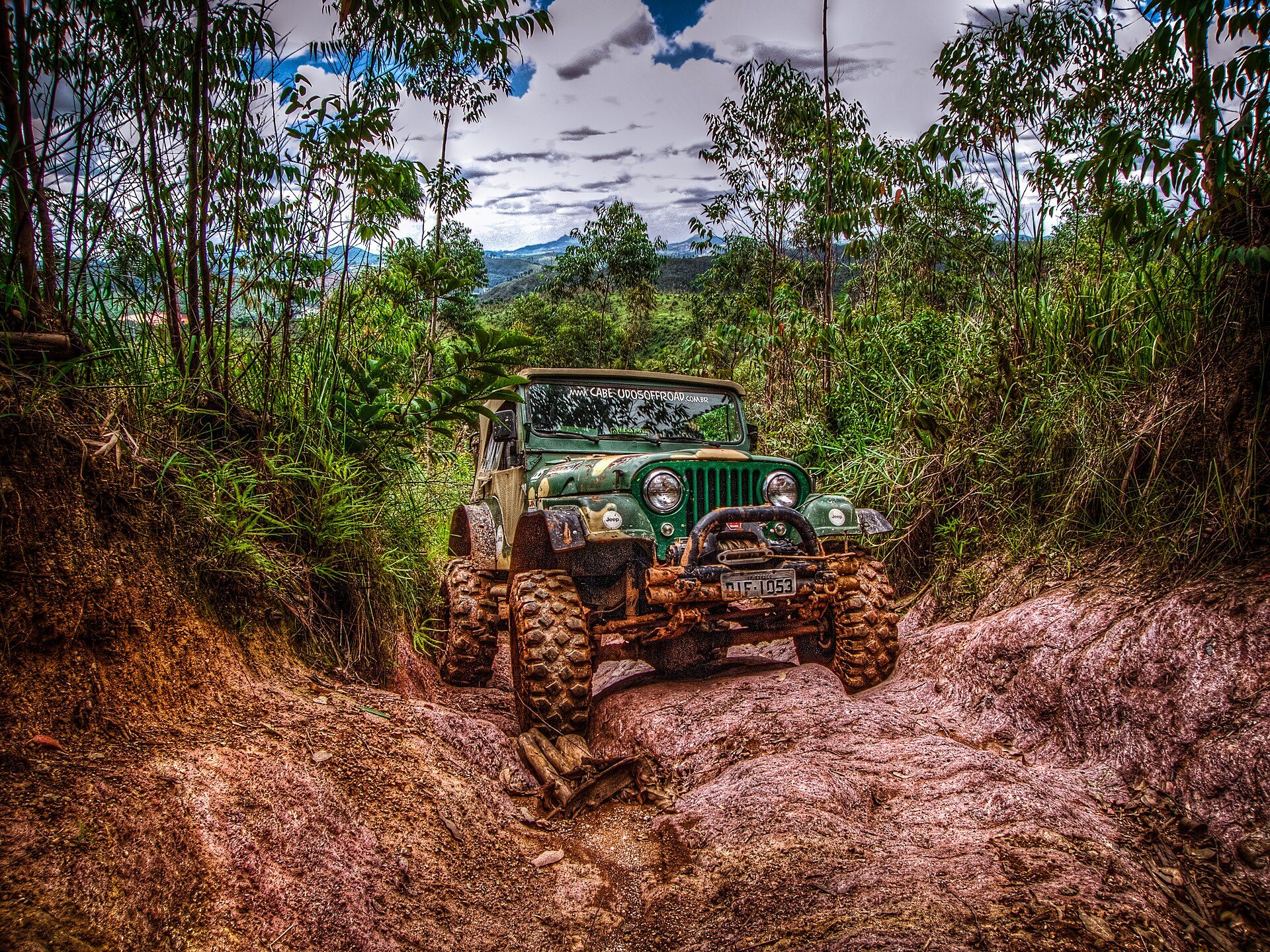
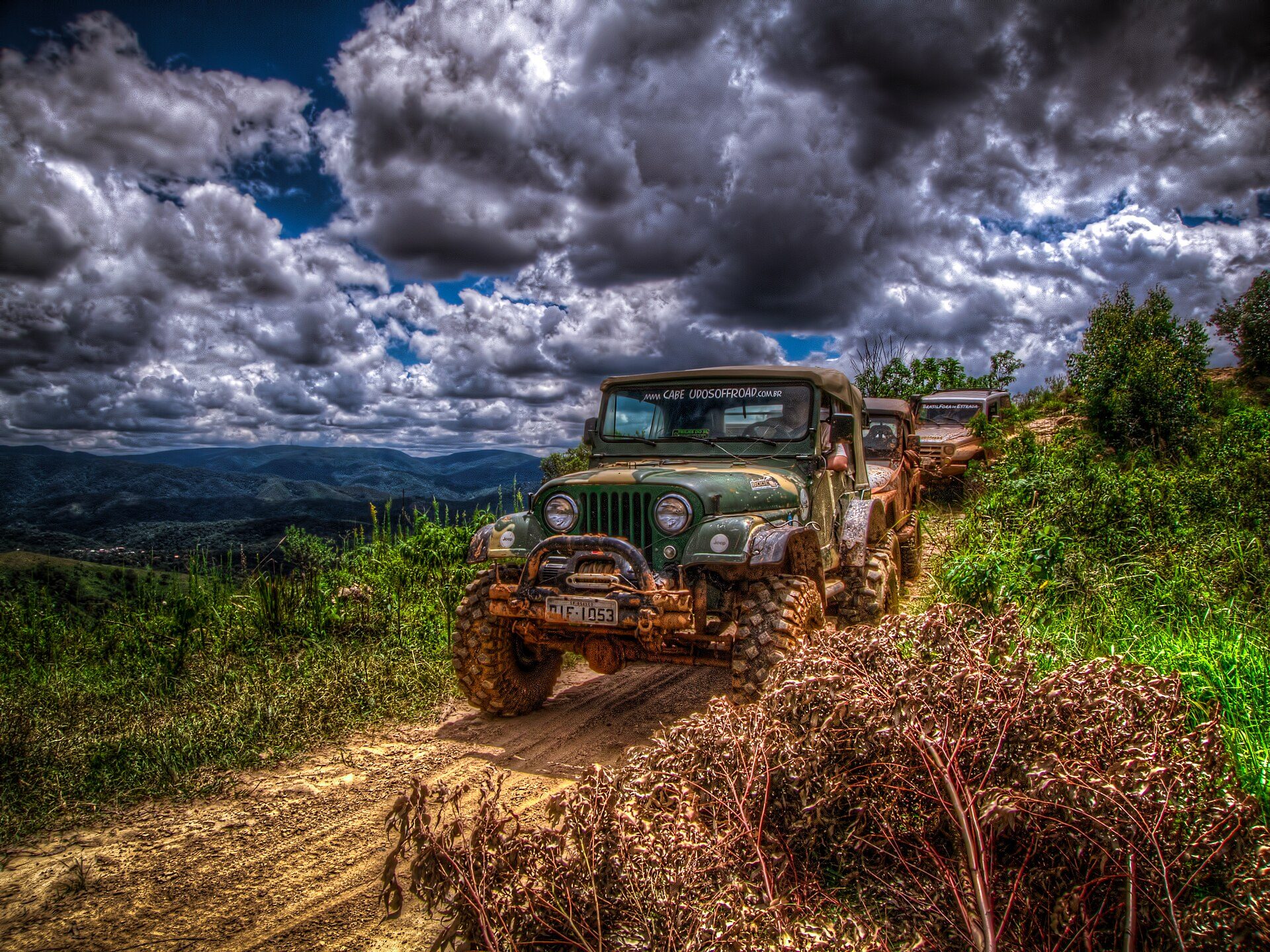
A green, Brazilian-registered CJ-5-type Jeep on oversized mud tires leading a line of Jeeps along a dirt trail above a valley in Brazil
JEEP CJ-5 · WILLYS / KAISER / AMC · 1955–1983

Jeep CJ-5

CJ-5F134 HURRICANE I4DAUNTLESS 225 V6AMC 232 / 258 I6 · 304 V881 → 83.5 IN WHEELBASE

“The CJ-5 outlived three corporate owners, four engine families and a television hit piece, and it still feels like the original idea of a Jeep with the corners filed off. Short, loud and happiest on a trail, it is the purest classic Jeep you can still use most weekends.”

PART 01

Overview

Where it came from, why it matters, and how it changed year to year.

The story

The CJ-5 went on sale in October 1954 as a 1955 model. It was the civilian version of the Korean War M38A1, built by Willys Motors under Kaiser ownership, and Hagerty says it took that truck's chassis, axles, brakes, suspension and gearbox, then added a rounder body, a bigger windscreen and a lidded glovebox. It was supposed to replace the flat-fendered CJ-3B. Instead the two were built side by side, and the CJ-5 kept going for 29 model years and 603,303 units. The wartime MB, the 1945 CJ-2A (the first production civilian Jeep) and the CJ-3A and 3B came before it. The CJ-5 is where the round-fendered civilian Jeep really starts.

KAISER'S UNIVERSAL

Early trucks used the Willys F134 Hurricane, an F-head four with intake valves over exhaust, rated at 75 hp and 114 lb-ft (gross), behind a three-speed manual and a two-speed transfer case. Hagerty says it is happy at about 50 mph, which tells you most of what you need to know. From 1961 to 1965 a British Perkins diesel with 62 hp was optional, and from 1961 the Tuxedo Park trim tried to sell the CJ as a sports car with chrome bumpers and bucket seats. It didn't sell well.

The engine that changed things came from Buick. In 1965 Kaiser licensed the 225-cubic-inch V6, branded it the Dauntless and rated it at 155 hp, roughly double the Hurricane. Kaiser fitted a much heavier flywheel to smooth out the odd-fire engine's lumpy firing pattern, and power steering became an $81 option. Buyers loved it: by 1968 about three quarters of CJ-5s left the factory with the V6. The 1969 '462' package and the 1970 Renegade I added a roll bar, skid plate, locking differential and loud paint.

AMC STRETCHES THE NOSE

American Motors bought Kaiser Jeep in 1970 and dropped the Buick V6 after the 1971 model year. For 1972 the CJ-5 got AMC's 232 straight-six as standard, the 258 as an option (standard in California) and the 304 V8, which Wikipedia says gave the little Jeep a muscle-car power-to-weight ratio. Fitting them meant stretching the wheelbase from 81 to 83.5 inches and the hood and fenders by 5 inches. A new open-knuckle Dana 30 front axle shaved 25 lb and 6 feet off the turning circle, and the fuel tank moved from under the driver's seat to the rear.

The changes kept coming. The 1976 trucks got a reworked tub, a wider and more fully boxed frame, and an AMC 20 rear axle with two-piece shafts in place of the Dana 44. In 1977 the frame was fully boxed, and power front disc brakes and air conditioning joined the options list. In 1979 the 258 with a two-barrel Carter BBD became standard. From 1980 to 1983 the base engine was GM's 151 'Iron Duke' four, branded Hurricane, with an SR-4 four-speed, while the 258 got a Tremec T-176 four-speed.

THE RIVALS: FJ40 AND SERIES

Two of the CJ-5's great rivals exist because of the Jeep. Rover's Maurice Wilks used an army-surplus Jeep on his farm in Anglesey, and the first Land Rover prototype was built on a Jeep chassis. The production Series Land Rover used no Jeep parts and ended up slightly shorter but wider, heavier and faster than its inspiration. In Japan, Toyota's postwar 'Jeep BJ' was renamed Land Cruiser in June 1954 after Willys complained about the trademark, a few months before the CJ-5 launched. Its successor, the FJ40, arrived in 1960.

On the road, Hagerty reckons the CJ-5 corners better than a contemporary Land Rover, with accurate, if not sporty, steering. Off-road it calls the CJ-5 superb. The Jeep also spread worldwide under licence: Brazil assembled CJ-5s from 1957, and Ford do Brasil kept making them until 1983, with a Pinto-derived 2.3-litre four and, from 1980, an ethanol-fuelled version. Mitsubishi built Japanese Jeeps from the CJ-3B line, competing directly with the Land Cruiser and Nissan Patrol at home.

60 MINUTES AND THE LONG GOODBYE

The end is usually blamed on a December 1980 episode of 60 Minutes, in which the Insurance Institute for Highway Safety staged tests suggesting the CJ-5 could roll over at low speed in routine driving. Years later it came out that the testers had managed only eight rollovers in 435 runs, and only after hanging weights in the corners of the body, out of camera shot. The damage was done. By then the 10-inch-longer CJ-7 had been on sale since 1976, and the CJ-5 bowed out after 1983.

The CJ line ended in 1986, and the Wrangler YJ took over as a 1987 model. Today CJ-5s are bought for fun as much as for work. Hagerty's UK guide put clean, usable US cars from about $12,000 and Renegade or Laredo models at about $20,000. It recommends the straight-six for smooth power and lower running costs than the V8. Mechanical, service and body parts are easy to find from US specialists, but special-edition trim and upholstery are not.

SIDEBAR · THE RENEGADE

Wild Plum, Mint Green and Big Bad Orange

The Renegade began as a limited run. The 1970 Renegade I carried over the 462 package's V6, roll bar, locking differential and skid plate, added 8-inch white wheels and came only in Wild Plum or Mint Green. Somewhere between 250 and 500 were built. The 1971 Renegade II swapped in alloy wheels and offered Baja Yellow, Mint Green, Riverside Orange and Big Bad Orange, the same paint AMC used on the AMX and Javelin.

It was popular enough that from 1972 to 1983 the Renegade became a regular option, with the 304 V8, alloy wheels and a Trac-Lok limited-slip rear. A 1973-only 'Super Jeep' filled in when aluminum wheels ran short. In 1979 the Silver Anniversary edition, 1,000 Renegades in Quick Silver metallic, marked 25 years of the CJ-5.
Year by year

What changed, model year by model year. Sweet spot Beware

  1. 1955Willys CJ-5 arrives on an 81 in wheelbase, derived from the Korean War M38A1, with the 134 cu in Hurricane four
  2. 1961–1965Optional Perkins 192 cu in diesel four (62 hp); Tuxedo Park trim lines run 1961–64
  3. 1965Buick-designed 225 cu in Dauntless V6 (155 hp) becomes optional; by 1968 about 75% of CJ-5s have it. 'Jeep CJ-5' replaces 'Willys' after 1964Sweet spot
  4. 1971AMC era begins (bought Kaiser Jeep in 1970); last Buick V6 year; Trac-Lok replaces Powr-Lok; PTOs dropped
  5. 1972AMC 232/258 sixes and optional 304 V8; wheelbase stretched 2.5 in to 83.5 in, nose 5 in longer, new six-crossmember frame, open-knuckle Dana 30 front (6 ft tighter turning circle), fuel tank moved behind the rear axleSweet spot
  6. 1976Revised frame and more rounded tub; new windshield angle, so 1955–75 tops don't fit; AMC 20 two-piece-shaft rear replaces the Dana 44
  7. 1977Fully boxed frame; power disc brakes, air conditioning and the Golden Eagle package become optionsSweet spot
  8. 1979258 six with two-barrel Carter BBD becomes standard; 1,000-unit Silver Anniversary edition
  9. 1980–1983GM 151 Iron Duke four becomes standard with an SR4 four-speed; 258 option gets the T-176 four-speed; locking hubs change to a five-bolt pattern (1980 per Wikipedia, 1981 per Offroaders.com). 1983 is the last year
PART 02

Specs & capability

How it’s built, what it can do, and what fits under it.

How it’s built

The CJ-5 is a ladder frame, two live axles on leaf springs, a part-time gear-driven transfer case and a removable top. Everything else changed with the owner. Willys and Kaiser trucks have the short 81-inch wheelbase, a closed-knuckle front axle and four-cylinder or V6 power. AMC trucks from 1972 have the longer nose, the 83.5-inch wheelbase, an open-knuckle Dana 30 and inline sixes or a V8. The 1976 and 1977 frame and tub changes split the AMC years again.

CHASSISLadder frame · 81 in (1955–71), 83.5 in (1972–83)Open-channel frame with riveted crossmembers to 1975. From 1976 it was mostly boxed with welded crossmembers and widened toward the rear. Fully boxed from 1977.
SUSPENSIONLive axles, leaf springs front and rearCheck spring hangers and shackle mounts for rust, especially at the rear.
4WD SYSTEMPart-time, two-speed, gear-drivenDana 18 on early trucks, then Dana 20, then Dana 300 from 1980. All gear-driven, with manual locking hubs.
ENGINESF134 I4 · Perkins diesel · Dauntless V6 · AMC I6 / V8 · Iron Duke I4Hurricane 75 hp; Dauntless 155 hp; Hagerty quotes 150 bhp for the 304 V8.
AXLESDana 30 open-knuckle front from 1972 · Dana 44 rear to 1975, AMC 20 from 1976The AMC 20's two-piece shafts are the CJ-5's best-known weak link.
BRAKES & STEERINGDrums; power front discs optional from 1977Power steering became an $81 option with the V6 in 1965. Hagerty recommends it with the bigger engines.

Variants & engines

YEARSPLATFORMENGINEOUTPUTWORTH KNOWING
1955–1971Willys / Kaiser CJ-5F134 Hurricane 2.2 L F-head I475 hp / 114 lb-ftT-90 three-speed at launch, 81-inch wheelbase. The four stayed available alongside the V6.
1961–1965CJ-5 dieselPerkins 4.192 3.1 L I4 diesel62 hp / 143 lb-ftRare and slow, according to Hagerty.
1965–1971Kaiser Jeep CJ-5 V6Buick-designed Dauntless 225 3.7 L V6155 hpFitted to about 75% of CJ-5s by 1968. Odd-fire, with a heavy flywheel.
1972–1978AMC CJ-5 (long nose)AMC 232 I6 · 258 I6 · 304 V8304: 150 bhp (Hagerty)Wheelbase 83.5 in; new Dana 30 front; 258 standard in California.
1979–1983AMC CJ-5 (late)AMC 258 I6 with Carter BBD 2-bbl110 hp / 195 lb-ft (1979–81, Offroaders.com) · 115 hp / 210 lb-ft from 1982258 standard from 1979. Jeep-CJ.com dates the 304 option to 1981.
1980–1983AMC CJ-5 (base four)GM 151 Iron Duke 2.5 L I4 ('Hurricane')—SR-4 four-speed. Jeep-CJ.com's buyer's guide says to avoid it.

Capability numbers

Wheelbase81 in (2,057 mm) 1955–71 · 83.5 in (2,121 mm) 1972–83
Curb weight2,665 lb (1,209 kg)Wikipedia figure

Wheels & tires

FACTORY TIRES
225/75R15 (1980, P-metric equivalent)
Bolt pattern5x139.7 (5x5.5")
Center bore108 mm
Lug thread1/2"-20
LIFTBIGGEST TIREWHAT IT TAKES
Stock31x10.50R15Owners call 31 in the practical ceiling and 30x9.50s a known-good fit; one long-time owner ran 32x11.50s on stock springs with minor rubbing. Test-fit, since actual diameters vary
2.5 in32–33 inA 2.5 in spring lift plus 3/4 in shackles runs 32s without trouble; 33s fit until the suspension stuffs. Narrow-track CJs need the steering stops reset or the tires hit the leaf springs
4 in33x12.50R15Usually with flares and trimmed rear wheel openings; 33–35s generally mean cutting the rear openings and revisiting the bump stops

Forum consensus, not a guarantee: wheel offset, tire brand and suspension wear all change clearance. Confirm before you buy.

Production & special editions

The longest-running CJ: built from 1954 (as 1955 models) to 1983 across Willys, Kaiser and AMC ownership.

Total built603,303 (1954–1983)
Licensed derivativesFord Jeep (Brazil), Jeep Shahbaz (Iran, Pars Khodro), Shinjin Jeep (South Korea)
Tuxedo Park (Mark I–IV)1961–1965Chrome-trimmed 'sports car' Jeeps; the Mark IV came on 81 or 101 in wheelbases. Sales were low
Jeep Camper1969–1970Factory slide-in camper with its own axle; 336 built
4621969V6, roll bar, heavy-duty frame and springs, locking differential, skid plate, swing-out tire carrier
Renegade I1970Estimated 250–500 built, Wild Plum or Mint Green
Renegade II1971About 600: 200 Baja Yellow, 200 Mint Green, 50 Riverside Orange, 150 Big Bad Orange
Super Jeep1973Appearance package created during an alloy-wheel shortage; a few hundred built
Golden Eagle1977–1983Tachometer, clock and Golden Eagle decals (Wikipedia); period summaries also list the 304 V8, power disc brakes and power steering, so check the build sheet
Silver Anniversary19791,000 Quick Silver Metallic Renegades with a dash plaque marking 25 years of the CJ-5
Golden Hawk1980One-year sticker package
PART 03

Buying one

What to pay, what to check, and how to tell a good one from a clone.

What they cost

Still the cheapest way into a classic CJ: the CJ-5 trails the CJ-7 by several thousand dollars, and only clean, original V8 trucks and tidy restorations break $25k.

Project / needs work$1k–7k
Driver$8k–18k
Excellent / restored$20k–36k+

Compiled from Bring a Trailer CJ-5 results in October 2026 (about 67 sales of Willys and Jeep CJ-5s, median around $10,500, middle half roughly $7,000–16,000). Recheck current results before relying on these figures. Prices move; checked October 2026. See live listings below.

What to check before you buy

  1. 01
    Frame firstCheck the whole frame for rust and cracks, especially at the suspension and steering mounts. Jeep-CJ.com flags the front and rear shackle mounts, the area behind the rear wheels and the six body mounts. Mud blocks the drain holes in boxed frames. Hagerty adds the outriggers, which usually rot first.
  2. 02
    Steering box mountBoxed frames (1976 on) often crack around the steering box, especially with a lift and big tires. Look for cracks, fresh welds and a box that moves when someone turns the wheel.
  3. 03
    The tubCheck the rockers, rear corners, wheel wells, under the roll bar and the floor. Hagerty adds the tops of the inner and outer wheel tubs, the tailgate and the windscreen-to-scuttle joint. Jeep-CJ.com's warning: patches welded over rust become rust. Knock on panels to find filler.
  4. 04
    Windshield frameFold the windshield forward and check the bottom of the frame, the hinges and the screw holes. Failed cowl and tailgate gaskets trap water and rot the metal around them.
  5. 05
    Which engineHagerty recommends the 232 or 258 six for smooth power and lower running costs than the V8. Jeep-CJ.com says to avoid the 1980–83 Iron Duke. On any engine, look for start-up smoke, rattles and oil or coolant leaks.
  6. 06
    Gearbox and transfer caseHagerty calls the T-14 three-speed strong and longer-lasting than the later four-speeds, and Jeep-CJ.com rates the T-18 four-speed as the best transmission ever put in a CJ. Check gear-driven transfer cases for leaks and low oil. Test 4WD in high and low range on gravel.
  7. 07
    Wiring and ignitionHagerty calls ignition the weak point, especially on AMC engines. Be wary of duct-tape splices, wire nuts, Scotch-locks and foil-wrapped fuses. Jeep-CJ.com puts it bluntly: grounding failure is directly proportional to rust.
  8. 08
    Buy a stock oneJeep-CJ.com says project Jeeps and heavily built trail rigs are generally poor buys and recommends mostly stock trucks. Keep the emissions parts if you can. In some states removing them is illegal.

Spotting the real thing

Twenty-nine years of CJ-5 means three body generations, five engine families and a flood of postal and Willys parts trucks, so date the tub before you trust the title.

  1. ID
    Early vs late body1955–75: 81 in wheelbase (83.5 in from 1972), 59 in windshield, windshield retainer welded on, windshield at 90° to the hood, no factory door hinges. 1976–83: 55 in sloped windshield with screw-on retainer, factory roll bar and door hinges, 83.5 in wheelbase, about 71.5 in from door hinge to the rear of the tub.
  2. ID
    CJ-5 vs CJ-6 vs DJ-5A CJ-6 is the same Jeep with a longer rear tub (101 in wheelbase to 1971, then 103.5 in per Wikipedia; Quadratec says 103 in). DJ-5 Dispatchers are two-wheel-drive postal Jeeps, so check for a front driveshaft and driven front axle.
  3. ID
    VIN format1971–80 CJs use a 13-character Jeep VIN; 1981–83 trucks use the 17-character federal VIN, where characters 6–7 read 85 for a CJ-5, the 4th character is the engine (B = 151 four, C = 258 six, H = 304 V8) and the 10th the model year (B = 1981, C = 1982, D = 1983).
  4. ID
    VIN plate vs frameThe main VIN tag is riveted to the driver's side firewall; compare it with the partial VIN stamped on the passenger-side frame rail above the rear wheel. A mismatch can mean a swapped tub or salvage history.
  5. ID
    Real RenegadesFrom 1972 the Renegade package meant the 304 V8, alloy wheels and a Trac-Lok rear. A six-cylinder 'Renegade' with steel wheels is either re-engined or wearing borrowed stripes.

Recalls & service bulletins

Open recalls follow the VIN, not the model. Run yours through NHTSA before you buy, and ask the seller for dealer records showing recall work.

Check a VIN at NHTSA ↗
Notable recalls
Headlight dimmer switch ↗1972 · NHTSA 72V-086Campaign on the high/low-beam dimmer switch of 10,357 1972 CJ-5 and CJ-6s; NHTSA's online record carries no defect summary.
Brake master cylinder ↗1972 · NHTSA 72V-173Campaign on the master cylinder of 15,819 1972 CJ-5 and CJ-6s; no defect summary in NHTSA's online record.
Front leaf-spring shackle ↗1974 · NHTSA 74V-157Campaign on the front spring shackles of 19,088 1974 CJ-5 and CJ-6s; no defect summary online.
Steering gear ↗1976 · NHTSA 76V-034Campaign on the steering gear box of 1976 CJ-5 and CJ-7s; no defect summary online.
Electronic ignition wire connectors ↗1975–1976 · NHTSA 78V-065Connectors could not carry enough current for the electronic ignition control.
Transmission adapter-plate seal ↗1976–1978 · NHTSA 78V-039A mis-seated seal could let gear oil migrate from the manual transmission into the transfer case.
Intermediate steering-shaft coupling ↗1978 · NHTSA 78V-049Oversized serrations could stop the coupling clamping properly to the steering-gear shaft.
Tie-rod adjuster clamp bolts ↗1979 · NHTSA 78V-243Loose clamp bolts could shift the steering-wheel position and risk loss of steering.
Transmission-to-transfer-case gasket ↗1979 · NHTSA 79V-070Wrong gasket could block lubricant flow and damage the manual transmission.
Rear seat-belt buckles missing ↗1981 · NHTSA 80V-158Some Jeeps got two tongue-end rear belt halves and no buckle.
Manual transmission first-gear lubrication ↗1982 · NHTSA 82V-125Factory-fill gear oil might not protect first gear.
The one you’ll own someday

For sale now

1955–1971 · USCJ-5 (F-head & Dauntless V6)
1972–1983 · USCJ-5 (AMC six & V8)
PART 04

Owning one

Baseline service, the repairs you’ll actually do, and where the manuals live.

Post-purchase baseline

After you buy it

A CJ-5 is at least 40 years old and has probably had several owners, each with their own idea of maintenance. Change every fluid, grease every fitting and sort the ignition before you judge how it runs. Specs vary by era and engine; the capacities below are from ExtremeTerrain's CJ chart, which mostly covers AMC-era drivetrains. Check anything for a Willys or Kaiser truck against its manual.

Engine oil & filter5W-30 or 10W-30 · 4.2 L six: 6 qt · 5.0 L 304: 5 qt · 2.5 L four: 4 qt · F134 / V6 [CONFIRM IN MANUAL]Baseline now; then per your owner's manual
Air filterPaper element in the factory air cleanerBaseline now
Ignition tune-upPlugs, cap, rotor, wires; points and condenser on pre-electronic trucks · gaps and timing [CONFIRM IN MANUAL]Baseline now
Coolant & thermostat50/50 coolant · 4.2 L: 10.5 qt · 304 V8: 14.5 qt · Iron Duke: 7.8 qt (ExtremeTerrain)Baseline flush now
Belts & hosesV-belts and molded hoses by engineBaseline now if cracked, glazed or soft
Manual transmission80W-90 · T-18: 3.25 qt · T-150: 1.4 qt · SR-4: 1.5 qt · T-176: [CONFIRM IN MANUAL] · T-90 / T-14: GL-4 (1955 manual) [CONFIRM CAPACITY]Baseline now

ExtremeTerrain's T-176 figure (3.5 qt / 1.7 L) contradicts itself, so check the manual. On T-14/Dana 18 trucks, oil can migrate from the gearbox into the transfer case, so check both levels.

Transfer case80W-90 · Dana 300: 2 qt · Dana 20: 1.6 qt · Dana 18: GL-4 [CONFIRM CAPACITY]Baseline now
Front differential80W-90 · Dana 30: 1.25 qt · pre-1972 front axle [CONFIRM IN MANUAL]Baseline now
Rear differential80W-90 · AMC 20: 2.4 qt · Dana 44: 2 qt · Trac-Lok: add 4 oz limited-slip additiveBaseline now

Renegades and many V8 trucks have Trac-Lok. Look for a tag on the cover and add friction modifier if it's there.

Front wheel bearings & hubsRepack and adjust · preload [CONFIRM IN MANUAL]Baseline now; then after deep water crossings

Inspect the manual locking hubs while they're apart. Later trucks use five-bolt hubs, earlier ones six-bolt; Offroaders.com dates the change to 1981, Wikipedia to 1980, so count the bolts.

Brake & clutch fluidDOT 3Flush now

Old drum-brake trucks also need the shoes adjusted. Check the wheel cylinders for weeping.

Power steeringPower Steering +4, or ATF+4 if unavailableCheck and top up now
Grease pointsDriveshaft U-joints and slip yokes · shackles · steering jointsEvery oil change, and after water
Fuel filterInline filter by engineBaseline now
For the hands-on owner

Common repairs

The jobs owners actually end up doing, rated for a competent home mechanic with a decent tool kit. Always confirm torque figures, fluids and procedures against the factory service manual for your VIN, and work safely — support the truck on stands, never just a jack. You do this work at your own risk; see the disclaimer. Some parts links are affiliate links.

Steering box mount and frame cracks
DIFFICULTY · 3 / 5TIME · ≈ Half a day if the frame is sound; longer with weldingSHOP COST · Rust Buster RB1008 mount about $125 (Quadratec)
SYMPTOMSWandering steering, a box that shifts on the frame when the wheel is turned, or cracks around the box mounting holes. RockCrawler.com reports a CJ-5 that tore its steering box off the frame on a trail.
THE FIXRockCrawler's install of a plate-steel bracket: remove the drag link, hoses and steering shaft, pull the box, fit the bracket's studs and spacers with thread-locker, trial-fit and file the bolt holes if needed. Bolt the mount to the box at 65 ft-lb, then to the frame with Grade 8 hardware at 55 ft-lb, adding the through-frame bolt for clamping force. Weld any frame cracks before fitting it. Route the hoses so they can't rub, and reconnect the shaft and tie rod.
TOOLS & PARTSPitman arm puller · sockets and torque wrench · thread-locker · file · welder for frame cracks · Rust Buster RB1008 (1976–86 CJ-5/7/8)
AMC 20 one-piece axle conversion (1976–83)
DIFFICULTY · 3 / 5TIME · ≈ Half a day to a daySHOP COST · Crown RT23007 kit about $410 at Quadratec (October 2026)
SYMPTOMSClunks on take-off, a rear hub working loose on its shaft, or worn and spun splines. Quadratec's listing explains the cause: the factory hardened hubs cut splines into softer axle shafts, leaving weak spots in the driveline.
THE FIXReplace the two-piece shafts and hubs with one-piece shafts that have the hub flange fixed to the shaft, which stops the splines spinning and handles torsional loads better. Remove the wheels, drums and pressed-on hubs (a hub puller is the usual tool), unbolt the bearing retainers and pull the shafts. Fit the new shafts with their bearings and seals, following the kit instructions. Fit new inner seals while the axle is apart, and refill with gear oil (plus friction modifier for a Trac-Lok).
TOOLS & PARTSHub puller · slide hammer · seal driver · torque wrench · Crown RT23007 kit (1976–83 CJ-5; not for Quadra-Trac)
Clutch bellcrank (Z-bar) rebuild
DIFFICULTY · 2 / 5TIME · ≈ 2–3 hoursSHOP COST · V6 bellcrank about $20 (Crown, Quadratec)
SYMPTOMSA sloppy or heavy clutch, trouble finding first, or linkage that falls apart. On Jeep-CJ.com, members say the plastic bushings wear out, and that the pivots can break once the motor mounts go.
THE FIXCheck the motor mounts first, because a sagging engine stresses the bellcrank pivots. Unhook the linkage, remove the bellcrank and replace worn bushings and ball studs, or the whole bellcrank. One forum fix replaces the worn bushing with a ground-to-fit solid rod, with bolts welded into drilled ends as pivots. Grease everything and readjust free play. Some owners switch to a hydraulic clutch when engine torque keeps pushing the linkage out of the throwout lever.
TOOLS & PARTSWrenches · grease · new bushings or bellcrank · motor mounts if worn
Carter BBD rough idle (1979–83 258)
DIFFICULTY · 2 / 5TIME · ≈ 1–2 hoursSHOP COST · A can of carb cleaner; rebuild kits are inexpensive
SYMPTOMSStumbling, sputtering or stalling at idle and poor fuel economy, but running fine at higher rpm. Offroaders.com says the cause is almost always clogged idle tubes, which let fuel drip from the venturis.
THE FIXWith the engine running and choke open, look down the throat. Fuel dripping from the idle nozzles confirms it. Remove the air cleaner (tag every hose), the choke plate and rod, then the two screws and the venturi cluster. Check the idle pickup tubes are seated, clear the tubes and nozzles with fine wire and carb cleaner without dislodging the check ball, and reassemble. Tighten the carb body screws, which tend to loosen. For a longer-lasting fix, the article suggests drilling the idle tubes to 0.032 inch. Pre-1979 sixes use a one-barrel Carter YF.
TOOLS & PARTS3/16 in socket · small screwdrivers · carb cleaner · fine wire · 0.032 in drill bit · Crown 83300057 kit for 1973–78 YF carbs
Ignition refresh or HEI swap (AMC sixes)
DIFFICULTY · 2 / 5TIME · ≈ Half a daySHOP COST · The BustedJeep author paid $15 for a junkyard HEI
SYMPTOMSHard starting, rough idle, hesitation and poor economy. Hagerty calls ignition the weak point of AMC-engined CJs, and Jeep-CJ.com's write-up blames the factory Duraspark.
THE FIXStart with a cap, rotor, plugs and wires. For a bigger upgrade, the Jeep-CJ.com HEI swap uses a 1976–82 GM inline-six HEI distributor with an AMC V8 drive gear. Mark the No. 1 position, remove the old distributor, install the HEI and run it from the constant-12 V firewall wire, not the resistor coil feed. Gap the plugs to .045 in. The firing order is 1-5-3-6-2-4. Set the timing with a light; the write-up says many owners use about 8° BTDC. CJs with a feedback ECM need it bypassed first.
TOOLS & PARTSTiming light · volt meter · soldering iron · plug gapper · HEI distributor and AMC V8 drive gear · 8 mm plug wires
Rear main seal (232 / 258 / 304)
DIFFICULTY · 3 / 5TIME · ≈ Half a day to a daySHOP COST · Seal and pan gaskets plus labor
SYMPTOMSOil dripping from the joint between the engine and bellhousing.
THE FIXFollowing Jeep's 1973 service-manual procedure (via IFSJA): drain the oil and remove the pan. Remove the rear main cap and discard the lower seal half, loosen the other caps and tap out the upper half with a brass drift. Oil the crank, fit the new upper half with the lip facing the front of the engine, put sealant only on the lower half's end tabs, and seat it in the cap. Seal the cap's chamfered edges, torque the caps to spec and refit the pan with new gaskets. Always replace both halves together.
TOOLS & PARTSBrass drift · torque wrench · Permatex No. 2 or equivalent · two-piece rear main seal · oil pan gasket set
Floor pan and tub rust repair
DIFFICULTY · 4 / 5TIME · ≈ A weekend per side; a new tub is a full strip-downSHOP COST · Key Parts half floor pan about $242; Omix 1955–69 front pan assembly about $1,350
SYMPTOMSSoft or holed floors, rot along the rockers, rear corners and under the roll bar, and rusty body mounts. Hagerty says floors usually go around the chassis mounts.
THE FIXCut back to clean metal, then fit, clamp and weld in the replacement pan. Jeep-CJ.com warns that patches welded over rust just become rust, so remove all of it. Replace the body-mount bushings while the floor is open, then seam-seal and paint underneath. If the tub is too far gone, Omix and others sell complete steel tubs for 1976–83 CJ-5s.
TOOLS & PARTSCut-off wheel · MIG welder · clamps · seam sealer · weld-through primer

Manuals & documentation

Asked on every forum

Jeep CJ-5 questions, answered

What's the biggest tire I can fit without a lift?

In a Jeep-CJ.com thread on stock CJs, members (one running a '79 CJ-5) put 31-inch tires as the safe maximum: one says '31's without rubbing,' and another says 32s rub the rear wheel wells. A little trimming can make 32s fit, but there isn't much to trim ahead of the rear wheels, and most doubt 33s will fit. Old springs sag, so 31s may be the practical limit. Wide tires may need wheels with less backspacing to clear the springs and fenders at full lock.

SOURCE · JEEP-CJ.COM
Which engine should I look for?

Hagerty recommends the 1972-on 232 or 258 straight-six for smooth power, relaxed cruising and lower running costs than the V8. Jeep-CJ.com praises the 258 for torque and reliability, and says to avoid the GM Iron Duke four used from 1980 to 1983. The early Hurricane four is authentic but limited by its three-speed. The Dauntless V6 is the period hot-rod choice.

SOURCE · HAGERTY · JEEP-CJ.COM
What's the difference between early and late CJ-5s?

For 1972, AMC lengthened the wheelbase from 81 to 83.5 inches and the hood and fenders by 5 inches to fit its sixes and V8. AMC trucks also got the open-knuckle Dana 30 front axle. The tub and windshield changed again for 1976, so tops for 1955–75 trucks don't fit 1976–83 trucks.

SOURCE · WIKIPEDIA
Is the CJ-5 really a rollover risk?

It's short and tall, so drive it with respect. The famous December 1980 60 Minutes segment overstated the case: the IIHS testers got only eight rollovers in 435 runs, and only after hanging hidden weights in the body's corners. A roll bar and seat belts are worthwhile upgrades, and Hagerty advises care on damp roads.

SOURCE · WIKIPEDIA · HAGERTY
What's wrong with the AMC 20 rear axle?

From 1976 the CJ-5 used an AMC 20 with two-piece axle shafts. The hardened hubs cut into the softer shaft splines over time. One-piece axle kits, such as Crown's RT23007 for 1976–83 CJ-5s, fix the hub to the shaft. They don't fit Quadra-Trac axles.

SOURCE · QUADRATEC · WIKIPEDIA
What is the Dauntless V6?

It's Buick's 225-cubic-inch V6, which Kaiser licensed in 1965; GM sold Kaiser-Jeep the design and tooling in 1967. It made 155 hp, about double the Hurricane four, and by 1968 about 75% of CJ-5s had it. It's an odd-fire engine, so Jeep fitted a much heavier flywheel to smooth it out. The V6 was dropped after 1971.

SOURCE · WIKIPEDIA
Did the CJ-5 get disc brakes?

Power front disc brakes became an option in 1977. Earlier trucks have drums all round. Power steering became optional with the V6 in 1965, and Hagerty recommends it with the bigger engines.

SOURCE · WIKIPEDIA · HAGERTY
What fluids does it take?

ExtremeTerrain's CJ chart lists 5W-30 or 10W-30 oil (6 qt for the 4.2, 5 qt for the 304, 4 qt for the 2.5), 80W-90 gear oil in the Dana 30 (1.25 qt), AMC 20 (2.4 qt) and Dana 300 (2 qt), with limited-slip additive for Trac-Lok axles. Brakes take DOT 3. For pre-AMC trucks, a BITOG thread starter summarizes the original 1955 recommendation as GL-4 in the transmission and transfer case [CONFIRM IN MANUAL].

SOURCE · EXTREMETERRAIN · BITOG
What's a Renegade worth compared with a base CJ-5?

Hagerty's UK guide put clean, usable US CJ-5s from about $12,000, with Renegade and Laredo models at about $20,000. Rare special editions command more. Original special-edition trim and upholstery are hard to find, so check that a Renegade is complete before paying a Renegade price.

SOURCE · HAGERTY
Can I still get parts?

Yes. Hagerty says most mechanical, service and body parts are available from US specialists. Quadratec alone lists Omix and Crown replacement parts back to the 1955 CJ-5, including complete steel tubs, floor pans and F-head gasket sets.

SOURCE · HAGERTY · QUADRATEC
Which transmission is best?

Jeep-CJ.com calls the T-18 four-speed (often with a granny-low first) the best transmission ever put in a CJ, and recommends the T-176 among the 1980s gearboxes. Hagerty rates the T-14 three-speed as durable. On 1980–83 trucks, the Iron Duke came with the SR-4 and the 258 with the T-176.

SOURCE · JEEP-CJ.COM · HAGERTY · WIKIPEDIA
PART 05

Building one

Who makes the good stuff, where owners gather, and who to watch.

Common modifications & who does them

SHACKLES & SPRINGSFresh bushings and greaseable shackles fix most of the squeak and slop in a 40-year-old leaf-sprung Jeep. Mild lift shackles add a little clearance.
STEERINGStamped factory steering-box brackets crack with age and big tires. A plate mount is cheap insurance.
AXLES & FRONT ENDA one-piece AMC 20 conversion and fresh ball joints in the Dana 30 are the classic AMC-era driveline upgrades.
FUEL & IGNITIONCarburetor and ignition are where AMC sixes lose their manners. Common fixes are a Weber, throttle-body EFI or a better distributor.
DRIVETRAIN SWAPSGearbox, transfer-case and engine swaps are part of CJ culture. Members on Jeep-CJ.com use adapter kits to fit T-18s and other boxes.

Clubs & events

Resources

Channels, accounts & forums

All Jeep resources →
SourcesWikipedia — Jeep CJWikipedia — Willys Hurricane engineWikipedia — Buick V6 engine (Dauntless)Wikipedia — Land Rover SeriesWikipedia — Toyota Land CruiserHagerty UK — Buying guide: Jeep CJ-5 (1955–83)Jeep-CJ.com — CJ Buyers GuideJeep-CJ.com — Tire size (stock CJ)Jeep-CJ.com — Bell crank fix?Jeep-CJ.com (BustedJeep) — GM HEI distributor upgradeJeep-CJ.com — T-14 transmission / Dana 18 transfer caseOffroaders.com — Carter BBD carburetor on the Jeep 258RockCrawler.com — Big Daddy CJ steering box bracketIFSJA — Rear main seal replacement (Jeep 1973 service manual)ExtremeTerrain — Jeep CJ fluid capacities and typesBob Is The Oil Guy — Lubricants for my 1955 WillysQuadratec — Crown RT23007 AMC 20 one-piece axle kitWikimedia Commons — Category: Jeep CJ-5Offroaders.com — AMC 258 I6 (output by year)Offroaders.com — Dana 30 front axle (hub bolt pattern by year)Wikipedia — Jeep CJQuadratec — Jeep vehicle model identificationQuadratec — Jeep wheel bolt patterns and lug nut torque specsExtremeTerrain — Jeep wheel specifications & size guideOffroaders.com — 1981–1986 CJ & J-Series VIN decoderExtremeTerrain — Jeep CJ VIN decoder 1971–1986TireSize.com — 1980 Jeep CJ-5 original tire sizesExpedition Portal — Largest tire size for stock (no lift) '83 CJ5Jeep-CJ.com — Lift size for 33sNHTSA recalls API — Jeep CJ5 1972NHTSA recalls API — Jeep CJ5 1976NHTSA recalls API — Jeep CJ5 1982Bring a Trailer — Jeep CJ-5 sold resultsRed Rock 4-Wheelers — Easter Jeep Safari