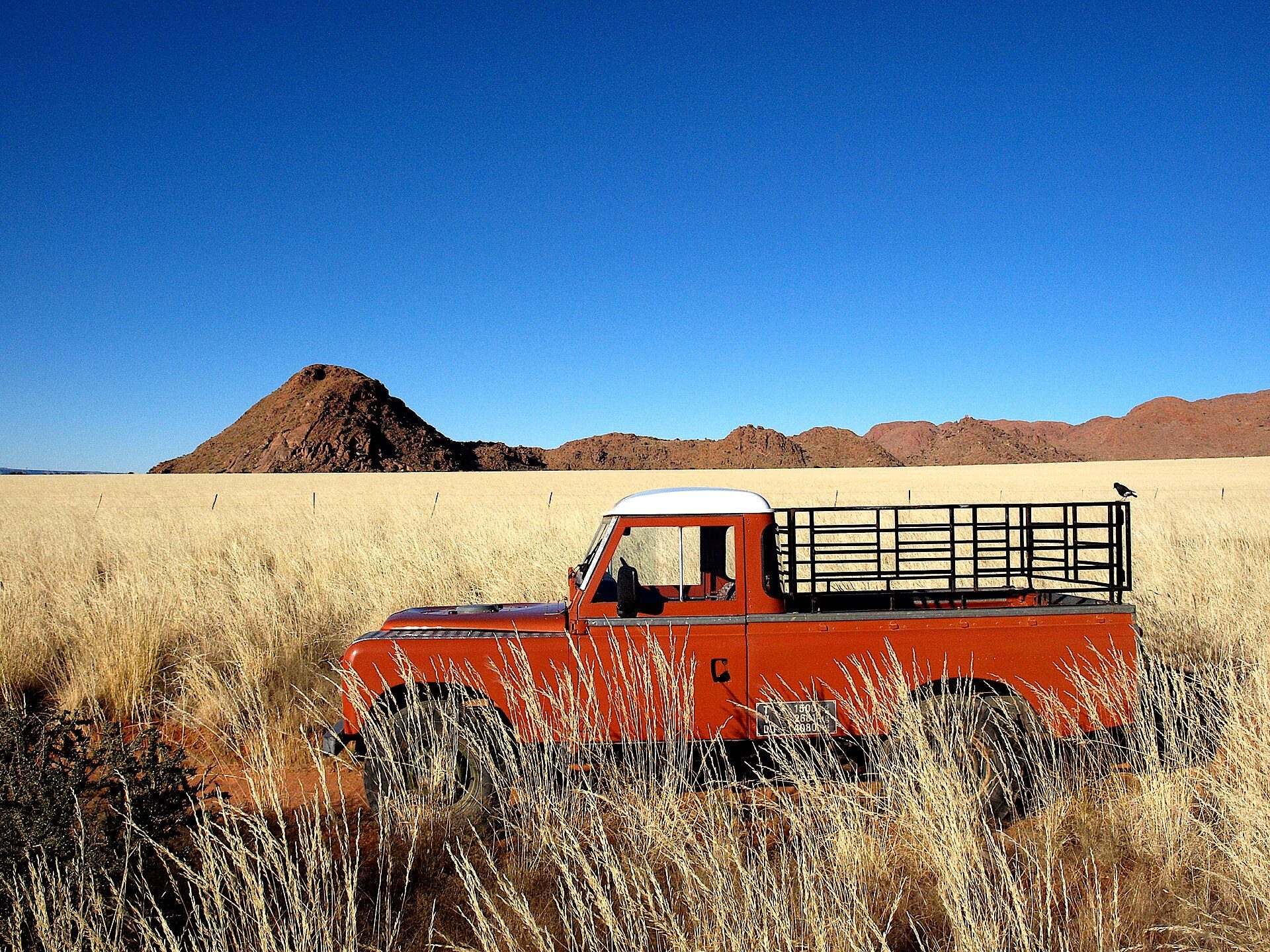
An orange Series III Land Rover 109 pickup with a cage-sided bed in tall golden grass below the Tiras Mountains, Namibia
LAND ROVER · SERIES I, II, IIA, III · 1948–1985

Land Rover Series I–III

80 · 86/88 · 107/109 INLEAF SPRINGS, SELECTABLE 4WD1.6 · 2.0 · 2.25 · 2.6 SIX · 3.5 V8

“A tractor that learned to do 55 mph, built from aluminium because steel was rationed, and still the vehicle that taught most of the world what a 4x4 is. Slow, loud, honest, and fixable with the tools in a farm shed.”

PART 01

Overview

Where it came from, why it matters, and how it changed year to year.

The story

The Series Land Rover is the original: a boxed steel ladder frame, two beam axles on leaf springs, a four-speed gearbox and flat aluminium panels you can unbolt with hand tools. It was meant to be a stopgap for a car company with an empty factory, and it outlived nearly everything else that company built. Today a good one is a collector's car with a Hagerty valuation, but underneath it is still a farm implement, and the owners who get the most out of them treat it exactly like one.

A JEEP, A FARM AND A STEEL SHORTAGE

After the war Rover had a bombed Coventry factory, a shortage of steel and no affordable car to build. Chief designer Maurice Wilks, who used an army-surplus Jeep on his farm on Anglesey, proposed a light agricultural and utility vehicle with a power take-off. The first prototype used a Jeep chassis, a Rover P3 engine and gearbox, Birmabright alloy bodywork and a steering wheel in the middle, which earned it the nickname 'centre steer'. Early trucks were painted light green because surplus aircraft cockpit paint was available.

The production truck dropped the centre steering and every Jeep part, gained its own transfer box, and was launched at the Amsterdam Motor Show in 1948 on an 80-inch wheelbase with a 1.6-litre four of about 50 bhp. The freewheel four-wheel-drive system was replaced during 1950–51 by a simpler dog-clutch arrangement. A Tickford-bodied, wood-framed Station Wagon arrived in 1949 and flopped, with fewer than 700 sold. Land Rover learned the lesson fast: wheelbases grew to 86 and 107 inches in 1954, then 88 and 109 in 1956, and a 2.0-litre diesel followed in 1957.

SERIES II AND IIA: THE SHAPE EVERYONE DRAWS

The 1958 Series II brought David Bache's wider 'barrel side' body and the 2.25-litre petrol four, though the first 1,500 or so short-wheelbase trucks kept the 2.0. The 109 Station Wagon could be had as a 12-seater, which in Britain counted as a bus and dodged purchase tax. The IIA of 1961 added a 2.25 diesel, and from 1967 long-wheelbase models could have a 2.6-litre six with servo brakes. Just 811 of those were NADA (North American Dollar Area) trucks, the only long-wheelbase models built for the US and Canada.

By February 1968 total production was just under 600,000, with more than 70% exported, and sales peaked in 1969–70 at over 60,000 a year. From February 1969 home-market trucks moved their headlamps out of the grille panel and into the wings, which is the quickest way to tell a late IIA from an early one. Hagerty notes that because so few were sold in the US, a IIA feels more exotic here than a comparable Jeep or Land Cruiser, and the market has priced that in.

SERIES III AND THE LONG GOODBYE

The 1971 Series III was a modernisation by Land Rover standards: synchromesh on all four forward gears, a plastic grille, a moulded plastic dashboard with the instruments moved in front of the driver, and the 2.25's compression raised from 7:1 to 8:1. Long-wheelbase trucks got the one-piece Salisbury rear axle as standard. The millionth Land Rover rolled off the line in 1976, but North American factory sales had already ended in 1974, so most Series IIIs in the US arrived later through private import.

Land Rover kept fixing the known weak spots. In 1980 the 2.25 petrol and diesel engines got five-main-bearing crankshafts and the axles and hubs were strengthened, and in 1982 the driveshaft spline count went from 10 to 24 to deal with rear half-shafts that snapped under overloaded commercial use. A County station wagon trim arrived in April 1982, and a Stage 1 V8 (the Rover 3.5 detuned to 91 hp, with permanent four-wheel drive) ran from 1979 to 1985. Roughly 440,000 Series IIIs were built before the coil-sprung One Ten and Ninety took over.

WHY THEY STILL MATTER

A Series truck is about as mechanically transparent as a motor vehicle gets. There is no ECU, the body panels unbolt, the rear half-shafts slide out of fully floating hubs without even jacking the truck up, and the parts catalogue from Vermont to Solihull is still enormous. The same simplicity explains its faults: leaf springs ride hard, the gearbox wears out first and second, the steel chassis and bulkhead rot where mud sits, and a 2.25 petrol is happiest at 50–55 mph.

None of that has hurt values. In 2019 Hagerty reported a median 'Excellent' value of $39,000 for Series II/IIA trucks, with petrol engines worth more than diesels and soft-tops slightly ahead of wagons. Every boxy 4x4 on this site, from the Range Rover Classic to the Ineos Grenadier, is in some way an argument with this vehicle about how much comfort a working truck is allowed to have.

SIDEBAR · THE ODD ONES

Lightweights, Forward Controls and Pink Panthers

The military took Series trucks in directions civilians never saw. The Lightweight was an air-portable military 88, and the Dutch and Danish versions ran diesel engines. The 109-based 'Pink Panther' Long-Range Desert Patrol Vehicles were converted by Marshall's of Cambridge for the SAS, with doors and windscreens removed, weapon mounts added and extra fuel and water tanks fitted.

Civilian oddballs exist too. The Series IIA Forward Control of 1962 put the cab over a 2.25 petrol engine, and the later 101 Forward Control used the 3.5 V8. The One Ton 109, built from late 1968 to 1977, combined a standard 109 body with a 2.6 six, a lower-ratio transfer box and 900x16 tyres. Only 170 IIA and 238 Series III One Tons were built for the home market.
Year by year

What changed, model year by model year. Sweet spot Beware

  1. 1948Launched at the Amsterdam Motor Show: 80-inch wheelbase, 1.6 petrol
  2. c. 1950Freewheel 4WD replaced by selectable four-wheel drive via a dog clutch (1950–51)
  3. 1952Larger 2.0 petrol replaces the 1.6 (1950–52, sources differ)
  4. 1954–56Wheelbases grow to 86/107, then 88/109 in 1956; 2.0 diesel follows in 1957
  5. 1958Series II: wider 'barrel side' body and 2.25 petrol
  6. 1961Series IIA: 2.25 diesel; 2.6 six in the 109 from 1967
  7. 1969Headlamps move into the wings on home-market IIAs (February)
  8. 1971Series III: all-synchro gearbox, plastic grille and new dashSweet spot
  9. 1974Factory sales to North America end
  10. 1979Stage 1 V8 (3.5 Rover V8, permanent 4WD), mostly 109s
  11. 1980–82Axles and hubs strengthened (1980); half-shaft splines go from 10 to 24 (1982)Sweet spot
  12. 1985Series production ends; the coil-sprung One Ten (1983) and Ninety (1984) replace it
PART 02

Specs & capability

How it’s built, what it can do, and what fits under it.

How it’s built

Every Series truck uses the same basic recipe: a fully boxed, welded steel ladder frame, beam axles on semi-elliptic leaf springs, a four-speed gearbox with a two-speed transfer box, and selectable four-wheel drive. The body is aluminium alloy panels bolted to the frame and a steel bulkhead, a choice made in 1948 because steel was rationed and kept even after aluminium became more expensive. The result is light, rust-resistant on top and rust-prone underneath, and almost entirely serviceable with hand tools.

CHASSISBoxed steel ladder frameRear crossmember and outriggers are the usual rot spots.
BODYAluminium alloy panelsBirmabright on the first trucks; corrodes where it touches steel.
SUSPENSIONLeaf springs, beam axlesParabolic springs are the common comfort upgrade.
4WDSelectable, dog clutchFreewheel system replaced around 1950; Stage 1 V8 got permanent 4WD.
REAR AXLERover type, Salisbury on LWBSalisbury standard on Series III 109; some late IIAs had it too.
GEARBOX4-speed manual + 2-speed transferFull synchromesh only from the Series III.

Variants & engines

YEARSPLATFORMENGINEOUTPUTWORTH KNOWING
1948–1951Series I 80-inch1.6 petrol I4≈ 50 bhpLaunch model; freewheel 4WD until around 1950.
1952–1958Series I 80 / 86 / 88 / 107 / 1092.0 petrol I4; 2.0 diesel (1957–58)52 hp (diesel)Wheelbases grow in 1954 and again in 1956.
1958–1961Series II 88 / 1092.25 petrol I4 (early SWB kept 2.0)72 hpBache's barrel-side body and wider track.
1961–1971Series IIA 88 / 1092.25 petrol & diesel; 2.6 petrol I6 (LWB, from 1967)77 hp (2.25 petrol), 94 hp (2.6) per HagertyHeadlamps in wings from Feb 1969 (home market).
1971–1985Series III 88 / 1092.25 petrol & diesel; 2.6 six—All-synchro gearbox; 24-spline shafts from 1982.
1979–1985Stage 1 V8 (mostly 109)3.5 Rover V891 hpPermanent 4WD; only 24 built as 88s.

Capability numbers

Fuel economy14–17 mpg (imperial), 2.25 petrolAULRO owners; best about 21 mpg at a steady 50 mph in a SWB
Comfortable cruise55–60 mph (2.25 petrol)60–65 mph on the flat with a Fairey overdrive, per Rovers North forum members

Wheels & tires

FACTORY TIRES
7.50x16 (factory option, tube-type rims)
Bolt pattern5x165.1 (5x6.5"), shared with Defender steel wheels
OffsetDefender/NAS 110 steels fit but sit about 3 in wider overall
Center boreDefender alloys won't clear Series hubs
LIFTBIGGEST TIREWHAT IT TAKES
Stock235/85R16Fits a stock 88 or 109 once the steering stops are adjusted so the tyre clears the chassis at full lock. 215/85R16 is also close to the 7.50x16 size; 265/75R16 on 5.5 in rims rubbed the frame for one owner. Original rims are tube-type; fit tubeless tyres only on rims with safety humps.

Forum consensus, not a guarantee: wheel offset, tire brand and suspension wear all change clearance. Confirm before you buy.

Production & special editions

The Series ran from 1948 to 1985 and was overwhelmingly an export product.

Built by February 1968Just under 600,000, more than 70% exported
1,000,000th Land Rover1976
Series III builtAbout 440,000 (1971–85)
NADA long-wheelbase IIA (2.6 six)811
One Ton 1091968–19772.6 six, lower-ratio transfer box and 900x16 tyres; 170 IIA and 238 Series III One Tons for the home market
Stage 1 V8 881979–1985Only 24 Stage 1 V8s were built as 88s; most were 109s
PART 03

Buying one

What to pay, what to check, and how to tell a good one from a clone.

What they cost

Series values have kept climbing, according to Hagerty, and in its 2019 analysis petrol trucks and soft-tops commanded slightly more than diesels and wagons.

Project / needs work$11k–15k
Driver$19k–34k
Excellent / restored$45k–56k

Based on Bring a Trailer sold results in 2025–26: 18 Series 88s ($11,000–56,000, median about $26,500) and 11 Series 109s ($15,000–56,000, median $25,500). Hagerty found petrol trucks worth about 6% more than diesels and soft-tops about 2% more than wagons. Prices move; checked October 2026. See live listings below.

What to check before you buy

  1. 01
    Chassis rear crossmember and outriggersThese are repaired or replaced more than anything else on a Series frame. Feel along the top of the box sections and above the bump stops, where off-road loads concentrate. Heavy rot can mean a replacement chassis, which series123's guide puts at £1,000-plus in the UK, so make sure the price reflects it.
  2. 02
    Bulkhead and door hingesCheck the lower bulkhead, the footwell corners and around the door hinges, plus anywhere the aluminium body touches steel: body-to-chassis mounts and where the wings bolt to the bulkhead. Serious bulkhead rot usually means the body has to come off.
  3. 03
    Gearbox jumping outFirst and second wear and can jump out of gear. Press and release the throttle in each gear on the test drive, try every ratio including low range, and listen for noises. The series123 guide rates the Series III gearbox as weaker than the Series II's.
  4. 04
    Mismatched differentialsOwners sometimes fit a taller rear differential for economy. If front and rear ratios don't match, the truck will fight itself in four-wheel drive. Drive a short distance on soft ground to confirm 4WD engages and behaves.
  5. 05
    Half-shafts and drive flangesA clunk from the rear when you come to a stop (the 'Salisbury clunk' on later trucks) usually means worn splines in the drive flange. Rovers North forum members report flanges strip out occasionally and recommend carrying a spare. Check for play in the propshaft UJs too.
  6. 06
    Springs and mountsLeaves should be uniform and the truck should sit level. Look for cracked or welded spring hangers; rust at the spring mounts is an MOT failure in the UK.
  7. 07
    Engine healthLow knocking points to worn crank bearings; a lighter, rapid tapping may just be tappets needing adjustment. Occasional blue smoke can be valve-stem seals, continuous blue smoke means rings and bores, and black smoke points at the carburettor.
  8. 08
    Wheels and tyresOriginal Series rims are tube-type. Tubeless radials need wheels with safety humps (later Defender-style wheels), and you shouldn't run tubes in tubeless wheels. Check what's fitted before you assume the tyres are a simple swap.

Spotting the real thing

Series trucks were built for 37 years, in several countries, and plenty have been rebuilt from mixed parts. The chassis number tells you what you're actually buying.

  1. ID
    Chassis number (pre-1979)Stamped on an aluminium plate, on the bulkhead inside the cab on earlier trucks and under the bonnet on later ones. The first three digits give model, body and engine: 241–245 is a IIA 88 petrol, 251–255 a IIA 109 petrol, 901–905 a Series III 88 petrol, 911–915 a Series III 109 petrol.
  2. ID
    17-character VIN (late 1979 on)Land Rover switched to 17-character VINs at the end of 1979. Glencoyne's examples: LBCAH… is a Series III 109 petrol, LBAAG… a Series III 88 diesel.
  3. ID
    Which Series is it?Series I (1948–58) has flat sides. Series II (1958–61) has the wider barrel-side body. IIA (1961–71) looks almost the same, and late home-market IIAs have headlamps in the wings. Series III (1971–85) has a plastic grille and a plastic dash with instruments in front of the driver.
  4. ID
    NADA trucks and licence-buildsOnly 811 long-wheelbase 2.6 six IIAs were NADA (North American Dollar Area) trucks. Bring a Trailer also sells many Spanish-built Santana and Colombian 'Ensambladora Automotriz' 88s and 109s, so confirm the maker.
  5. ID
    Heritage certificateThe British Motor Museum's Heritage Certificates cover Land Rovers from 1948 on and copy the factory ledger: build and despatch dates, engine number, colour and equipment.

Importing & legality

Factory sales to North America ended in 1974, so most Series trucks in the US today are private imports. Every Series truck is now well past NHTSA's 25-year line, so FMVSS isn't a barrier. On EPA Form 3520-1, code E exempts vehicles at least 21 years old in original configuration; a truck with a non-original engine can't use that exemption unless the replacement is the same engine model.

California is the catch. Gasoline vehicles of the 1975 model year and older are smog-exempt, but a non-California-certified direct import from 1975 on is supposed to pass a CARB laboratory test for a Certificate of Conformance. Rovers North forum members trying to register a 1978 Series III were told by ARB that the truck would need modifying and testing to 1978 California standards. Pre-1976 petrol trucks are the easy route there.

Rules change and vary by state and country. Confirm with your DMV and a licensed importer before you buy.

The one you’ll own someday

For sale now

1958–1971Series II / IIA
1971–1985Series III
1948–1985 · LWBSeries 109
PART 04

Owning one

Baseline service, the repairs you’ll actually do, and where the manuals live.

Post-purchase baseline

After you buy it

A Series truck has no service computer and no idea when it was last looked after, so assume nothing: change every oil, grease every nipple and adjust every brake before you trust it. The Series Land Rover owner's 'green bible' (workshop manual) lists the full service schedule; the items below are what owners on LandyZone and Rovers North treat as the catch-up.

Engine oil & filter20W-50 mineral oil (the period handbook specified a 20W grade) · 2.25: about 1.9 US gal (≈7.2 L) including the filter (Series123); one owner's shop manual gives 13 pints plus 1.8 pints for the filter, which he works out as 7.4 US qt (≈7 L)Then per manual [CONFIRM IN MANUAL]

Owners stick with mineral oil; one warns that semi-synthetics can loosen old deposits in a worn engine. Petrol and diesel 2.25s use element-type or spin-on filters depending on year.

Air cleanerOil-bath canister on most trucks · refill grade [CONFIRM IN MANUAL]Clean and refill at every oil change; more often in dust

If a previous owner swapped to an SU carburettor, check the SU dashpot has oil too.

Ignition (petrol)Points gap and timing per manual · plugs N12Y (8:1 CR) or N8 (7:1 CR)Check points and timing at every service
Heater plugs (diesel)2.25 diesel heater plugsTest at purchase; replace failed plugs

Hard cold starts on a 2.25 diesel usually mean heater plugs before anything more expensive.

CoolantAntifreeze mix [CONFIRM IN MANUAL for type and capacity]Flush and refill now; then per manual

Check the block drain plug and core plugs for weeps while it's drained.

Gearbox & transfer boxEP90 gear oil · Series II/IIA: gearbox 2.5 imp pt (3 US pt, ≈1.4 L), transfer box 4.5 imp pt (≈5.5 US pt, ≈2.6 L), per Series123 and the workshop manual quoted on the Rovers North forum · Series III [CONFIRM IN MANUAL]Drain and refill now; then per manual

Check the transfer box output seal: oil leaking past it soaks the transmission handbrake shoes. Owners buy EP90 in 20 L drums because a Series uses a lot of it.

Front & rear differentialsEP90 gear oil · capacity [CONFIRM IN MANUAL]Drain and refill now; then per manual

Don't put one-shot swivel grease in the diffs; owners say drain it if someone has.

Swivel housings75-90 gear oil on IIA/III with the Railko bush (Rovers North)Check level every service; refill now

Rovers North advises oil, not grease packs, for the Railko bush, and warns that running free-wheeling hubs unlocked starves the swivels of lubrication.

Grease pointsGrease all nipples: propshaft UJs and sliding joints, steering and spring shacklesEvery service

'Do all the grease nipples' is the first line of most owners' service lists.

Wheel bearings & front hubsCheck play and adjust; check the front hubs are fullNow, then annually

Wider tyres are harder on wheel bearings, according to Rovers North forum members.

Brakes & brake fluidBrake fluid [CONFIRM IN MANUAL for DOT grade] · adjust drum brakesFluid every 2 years; adjust shoes at every service

Series drum brakes need regular manual adjustment; owners note they will need adjusting on any truck you buy.

Clutch hydraulicsSame fluid as the brakesBleed or flush with the brakes

'Don't forget the clutch' — the slave cylinder is easy to overlook.

Fuel filterCartridge filter (diesel) or in-line element (petrol)Replace now
For the hands-on owner

Common repairs

The jobs owners actually end up doing, rated for a competent home mechanic with a decent tool kit. Always confirm torque figures, fluids and procedures against the factory service manual for your VIN, and work safely — support the truck on stands, never just a jack. You do this work at your own risk; see the disclaimer. Some parts links are affiliate links.

Swivel housing rebuild (Series IIA/III)
DIFFICULTY · 3 / 5TIME · Several hours per sideSHOP COST · Parts plus labor
SYMPTOMSOil weeping past the swivel seal, pitted chrome on the swivel ball, wandering or heavy steering.
THE FIXStrip the hub and swivel housing, fit the new top pin, Railko bush with bottom wafer, bottom bearing and race, gaskets and swivel seal. Rovers North says to soak the Railko bush and wafer in 75-90 gear oil overnight and to lubricate the assembly with 75-90 oil rather than grease packs. Set preload with top-pin shims (removing shims tightens it), measuring turning effort with a spring scale with the big seal removed and the bolts fully tightened. Take the preload range from the workshop manual for your model.
TOOLS & PARTSSpring/fish scale, torque wrench, hub nut spanner · Rovers North RNA3181P swivel rebuild kit (IIA 1962–71 and Series III non-V8, one side, no ball) · 75-90 gear oil
Rear half-shaft and drive flange swap
DIFFICULTY · 2 / 5TIME · About an hour per sideSHOP COST · Parts only
SYMPTOMSClunk when stopping or taking up drive, a wheel that won't drive, or a snapped shaft (usually at the diff end).
THE FIXThe rear hubs are fully floating, so the shaft can come out without jacking the truck. Remove the six drive-flange bolts and the hub cap, pull the flange and shaft, and inspect the splines on both. Fit a new flange (and shaft if needed), clean both mating faces, add a thin film of RTV, and refit the six bolts to the specified torque. Upgraded 24-spline shafts are common; check flange bolt patterns (Series flanges have six bolts, Defender flanges five) before ordering.
TOOLS & PARTSSockets, torque wrench, RTV sealant · drive flange, half-shaft, gasket
Leaf spring and chassis bush replacement
DIFFICULTY · 3 / 5TIME · A weekend for all four springsSHOP COST · Parts plus your patience
SYMPTOMSClonks over bumps, the truck leaning or sitting low, cracked or perished bushes, or you're fitting parabolics.
THE FIXTake the springs and shackles off first, then deal with the chassis bushes. Rovers North members drive the old bush out with an air chisel and a worn socket the size of the outer shell, or burn the rubber out with a MAPP torch once the bolt is free, then cut the remaining shell lengthwise with a reciprocating saw from the inside out without cutting the frame. Fit new bushes and springs following the workshop manual.
TOOLS & PARTSAir chisel or MAPP torch, reciprocating saw, drifts, jack and stands · spring and chassis bushes, shackle pins, springs (or parabolics)
Clutch cross-shaft pins
DIFFICULTY · 3 / 5TIME · A day with the floor outSHOP COST · Pins and bushes are cheap; a seized pin can mean gearbox removal
SYMPTOMSClutch pedal suddenly stops a quarter to a third of the way down and the clutch won't disengage, while the hydraulics still work through their full stroke when disconnected.
THE FIXDisconnect the slave push rod and work the pedal to confirm the master and slave are fine. Lift the floor panels to reach the cross-shaft, check the pins, coupling tube and spherical bushes, then replace sheared pins (one Rovers North contributor recommends hardened pins), a coupling with elongated holes, and worn bushes. In one reported case a sheared pin was seized in the shaft and the transmission had to come out.
TOOLS & PARTSBasic hand tools, drifts · clutch cross-shaft pins, coupling, cross-shaft bushes
Rear crossmember and outrigger repair
DIFFICULTY · 4 / 5TIME · A weekend or moreSHOP COST · Panels are cheap; welding is the bill
SYMPTOMSFlaking or perforated steel at the rear crossmember, soft outriggers, fresh underseal hiding something.
THE FIXClean back to bare metal and assess. Outriggers and rear crossmembers are bolt-on or weld-in replacement sections; cut out the rotten section, fit the new one square to the frame and seam-weld it, then protect the inside of the box sections. If the main rails are thin as well, a galvanised replacement chassis is the permanent answer.
TOOLS & PARTSWelder, grinder, cutting discs, rust protection · replacement crossmember and outriggers or a galvanised chassis
Fit 235/85R16s and set the steering stops
DIFFICULTY · 1 / 5TIME · An hour plus tyre fittingSHOP COST · Tyres plus fitting
SYMPTOMSTyres touching the frame at full lock after fitting larger or wider tyres.
THE FIX235/85R16 is the most-recommended size on the Rovers North forum, close to (but a little wider than) the factory 7.50x16 option. If the tyres touch the chassis at full lock, wind out the steering stop bolts on the swivel housings until there's clearance. Expect a slightly bigger turning circle.
TOOLS & PARTSSpanners · 235/85R16 tyres on suitable rims (tube-type Series rims need tubes; tubeless tyres want rims with safety humps)
Steering relay: free it, reseal it, refill it
DIFFICULTY · 3 / 5TIME · A day; the radiator has to come outSHOP COST · One owner's rebuild cost about $8; a replacement relay was about $100 plus shipping (Rovers North forum)
SYMPTOMSSteering that is very heavy or tight, especially on a truck that has stood outside for years, or oil weeping from the bottom of the relay.
THE FIXThe relay is the box-shaped unit in the chassis crossmember ahead of the radiator. It isn't the steering box at the foot of the column. Rule out dry ball joints and the steering damper first. Rovers North forum members say the radiator has to come out to reach the relay bracket bolts. A stubborn relay can be rebuilt without pulling it from the chassis, and one owner freed a seized unit with a 3 ft pipe over the arm. Inside, the bushes need lubrication. One owner found his 'bone dry' and could turn the shaft by hand with pliers after the rebuild. For a leak, members say you can remove the retaining ring and bottom plate and fit a new seal without stripping the whole relay. Refill with 90-weight gear oil.
TOOLS & PARTSSpanners and sockets · ball-joint splitter · 3 ft pipe for leverage · relay seals · 90-weight gear oil
Gearbox jumping out of gear: find the cause
DIFFICULTY · 3 / 5TIME · An hour for the external checks; a weekend or more if the gearbox comes outSHOP COST · Detent springs and adjustments are cheap; internal repairs are parts plus a lot of labor
SYMPTOMSThe lever pops out of gear, often second or fourth, on the overrun or over bumps. Some owners resort to holding it in, or to a bungee cord on long trips.
THE FIXStart with the cheap checks that Rovers North forum members suggest. Look for play in the gear lever and its mounting: one owner tightened it and it 'totally' stopped jumping out of second. The same owner also found a dragging, bent clutch disc. Next, take off the top PTO cover and check the mainshaft nut for free play; an overdrive has to come off to reach it. With the cover off, inspect the selector forks and detent springs. Worn forks, a loose circlip on the gear cluster or worn synchros mean the box comes out. If the speedo also wanders and transfer-box oil leaks between the handbrake drum and its backing plate, one member says the rear output shaft nut has backed off. It gets 90 ft-lb.
TOOLS & PARTSSpanners and sockets · torque wrench · top cover gasket · transmission jack if the box has to come out

Manuals & documentation

Asked on every forum

Land Rover Series I–III questions, answered

What's the biggest tire I can fit without a lift?

235/85R16 is the size most owners recommend: a Rovers North forum member calls it close to, but a little wider than, the factory-optional 7.50x16, and it should fit a stock 88 or 109 once the steering stops are adjusted so the tyre clears the frame at full lock (expect a slightly bigger turning circle). 215/85R16 is also close to 7.50x16. 265/75R16 on stock 5.5-inch rims rubbed the frame by about half to three-quarters of an inch for one owner, and another found 265s too wide on a 109. Original rims are tube-type, so check the wheels before fitting tubeless radials.

SOURCE · ROVERS NORTH FORUMS
What's the difference between a Series I, II, IIA and III?

Series I (1948–58) has flat sides and 80, 86/88 or 107/109-inch wheelbases. Series II (1958–61) brought the wider 'barrel side' body and the 2.25 petrol. Series IIA (1961–71) looks almost identical but added the 2.25 diesel and the 2.6 six, and late home-market IIAs have headlamps in the wings. Series III (1971–85) has a plastic grille, a plastic dash with instruments in front of the driver and an all-synchro gearbox.

SOURCE · WIKIPEDIA / HAGERTY
Were Series Land Rovers sold new in the US?

Yes, but not many. Factory sales to North America ended in 1974. Only 811 of the long-wheelbase IIAs with the 2.6 six were NADA (North American Dollar Area) trucks, the only long-wheelbase models built for the US and Canada.

SOURCE · WIKIPEDIA
What fuel economy should I expect?

Owners on AULRO report roughly 14–17 mpg (imperial) for a 2.25 petrol in normal use, with a best of about 21 mpg at a steady 50 mph in a short-wheelbase truck. Loaded, hilly driving pulls it back toward 14. In US gallons, knock about a sixth off those figures.

SOURCE · AULRO
How fast will it cruise?

Owners on the Rovers North forum put the comfortable cruise for a 2.25 petrol at 55–60 mph. With a Fairey overdrive, 60–65 on the flat is realistic. One owner advises 3,000–3,400 rpm for the four-cylinder petrol and warns that sitting at 4,000-plus wears engines out faster.

SOURCE · ROVERS NORTH FORUMS
Why do Series rear half-shafts break?

Partly the design of the shafts and partly overloading in commercial use. Land Rover strengthened the axles and hubs in 1980 and increased the driveshaft spline count from 10 to 24 in 1982. Forum members say shafts usually break at the differential end, and worn drive flanges announce themselves with a clunk well before they strip.

SOURCE · WIKIPEDIA / ROVERS NORTH
Should I fit free-wheeling front hubs?

Rovers North advises against it on Series IIA/III swivels with the Railko bush: running the hubs unlocked stops the front driveline turning, which it says starves the swivel ball, Railko bush and front propshaft of lubrication. If you fit them anyway, lock them in regularly.

SOURCE · ROVERS NORTH
Petrol or diesel? Soft top or wagon?

On value, Hagerty found in 2019 that Series II/IIA petrol trucks were worth about 6% more than diesels and soft-tops about 2% more than wagons. In use, the 2.25 petrol is the more pleasant road engine; the early 2.0 and 2.25 diesels are slow even by Series standards.

SOURCE · HAGERTY
What are the rust spots?

The aluminium body doesn't rust but corrodes where it touches steel. The steel parts do rust: rear crossmember, outriggers, chassis box sections above the bump stops, the lower bulkhead and footwells, door hinge areas and door bottoms.

SOURCE · SERIES123
Can I put tubeless tyres on the original wheels?

Not properly. Original Series rims are tube-type. Tubeless radials need wheels with safety humps, which later Defender wheels have. Don't fit inner tubes in tubeless wheels.

SOURCE · ROVERS NORTH FORUMS
How many were built?

Just under 600,000 by February 1968, more than 70% of them exported. The 1,000,000th Land Rover was built in 1976, and about 440,000 Series IIIs were made between 1971 and 1985.

SOURCE · WIKIPEDIA
PART 05

Building one

Who makes the good stuff, where owners gather, and who to watch.

Common modifications & who does them

PARTS & RESTORATIONSeals, swivel kits, brakes, wiring and panels: the catalogues Series owners actually order from on both sides of the Atlantic.
GEARBOX & TRANSMISSIONWorn first and second gears and tired transfer boxes are the classic Series drivetrain complaints; rebuilt units and uprated parts exist.
GALVANISED CHASSISWhen the rear crossmember, outriggers and rails have all been patched, a hot-dip galvanised frame ends the argument.
SOFT TOPS, SEATS & TRIMCanvas, seats and door tops wear out; LRO has a video on fitting an Exmoor Trim soft top to an ex-military Series III.
ROLL CAGES & PROTECTIONA Series has no crash structure to speak of; external and internal cages are the sensible addition for trail use.

Clubs & events

Resources

Channels, accounts & forums

All Series & Defender resources →
SourcesWikipedia — Land Rover seriesHagerty — Values for the 1959–71 Land Rover Series II/Series IIA keep climbingSeries123 — Land Rover Series 3 buyer's guideRovers North — RNA3181P swivel ball rebuild kit, Series IIA/IIIRovers North Forums — Swivel pin shims questionRovers North Forums — Upgrade to 24 spline half shafts, what drive hub?Rovers North Forums — '58 S1 parabolic installationRovers North Forums — Clutch failureRovers North Forums — Fitting larger tiresRovers North Forums — Series 2A wheel and tire adviceRovers North Forums — Top speed on your RoverAULRO — MPG 2.25 petrolYouTube — Land Rover Owner International channel (Exmoor Trim soft top on a Series III)LandyZone — Engine oil Series 3LandyZone — Service items (Series 3 2.25)LandyZone — One Shot swivel grease in the diffLandyZone — Oily transmission drum brake, transfer case drain modRovers North Forums — Steering relay columnRovers North Forums — Steering relay oil leak, bad seal?Rovers North Forums — Pops out of second gearRovers North Forums — Jumping out of gearSeries123 — Series 2/2A basic specifications (capacities)Rovers North Forums — Gearbox and transfer box fluid volumeRovers North Forums — 2.5L vs 2.25L oil amountWikipedia — Land Rover seriesHagerty — Values for the 1959–71 Land Rover Series II/Series IIA keep climbingGlencoyne Engineering — Land Rover chassis numbersBritish Motor Museum — Heritage CertificatesRovers North Forums — Will Defender wheels fit my IIA?Limitless Tire — 1998 Land Rover Defender wheel and tire sizes (5x165.1)Rovers North Forums — Fitting larger tiresRovers North Forums — Series 2A wheel and tire adviceRovers North Forums — Upgrade to 24 spline half shaftsRovers North Forums — Top speed on your RoverAULRO — MPG 2.25 petrolRovers North Forums — Registering a 1978 Series 3 in CaliforniaImport a Vehicle — Smog check exempted vehicles in CaliforniaEPA — Form 3520-1, exemption code ENHTSA — Importation and Certification FAQsRovers North — RTC9840CC Parts Manual Series IIARovers North — RTC9841CE Parts Manual Series IIIRovers North — Books, Manuals and DVDsBring a Trailer — Land Rover Series 88 resultsBring a Trailer — Land Rover Series 109 resultsLand Rover Series 2 ClubANARC — Association of North American Rover ClubsRovers North blog — ANARC News, Spring 2026Rovers North blog — MAR 2025Association of Land Rover Clubs (UK)