The story
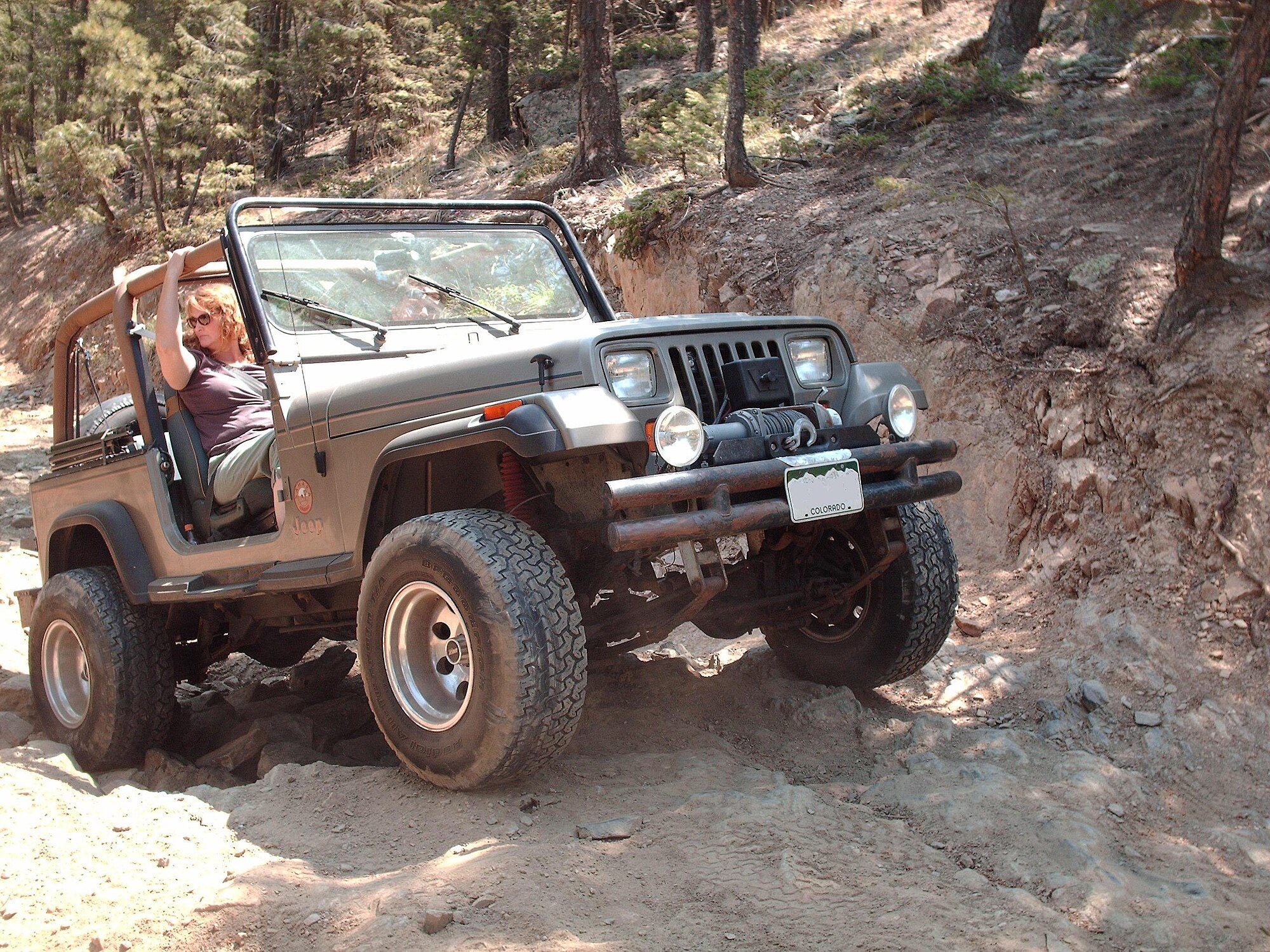
In February 1986 American Motors unveiled the 1987 Jeep Wrangler, and on May 13 of that year the first CJ replacement in four decades went on sale. It was called the YJ, and in Canada simply the Jeep YJ, because General Motors of Canada owned the Wrangler name there. Underneath, it was very much an updated CJ-7, with the same 93.4-inch wheelbase, leaf springs at both ends and a body that was largely interchangeable with the old tub. The rectangular headlights were new, and the fight over them has never really stopped.
A CJ-7 WITH MANNERS
Development of a CJ-7 replacement was approved in 1982. Chuck Mashigan's design was frozen by the fall of 1983, CJ-7-based mules ran late that year, and the first production-body prototypes followed in spring 1984. The brief was to keep the CJ's character while making it calmer on the road. The YJ kept leaf springs similar to the CJ's but made them wider, added track bars and anti-roll bars, and widened the track. Ground clearance dropped slightly as a result.
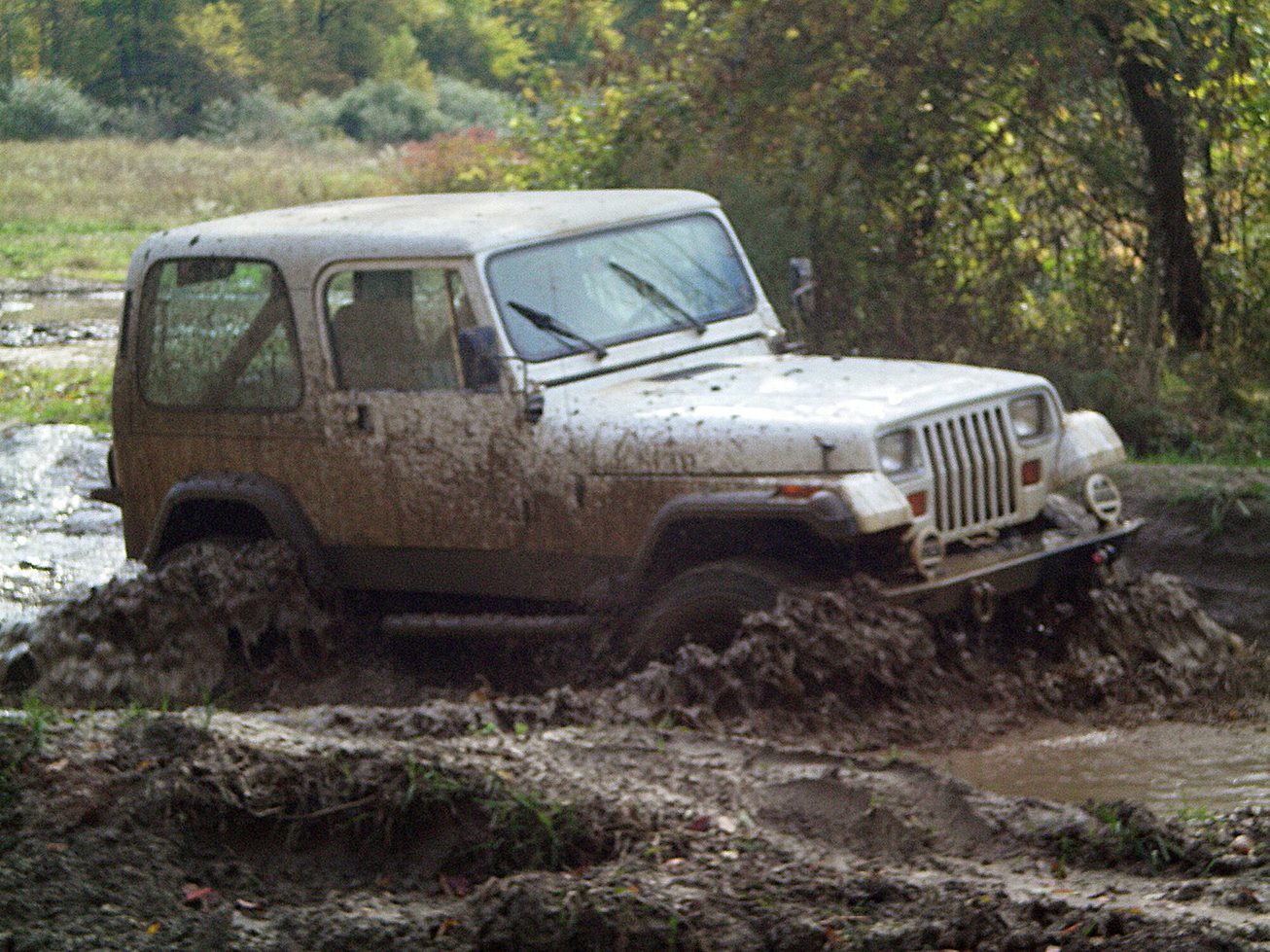
Wikipedia notes that the anti-roll bars made the Wrangler less easy to flip for untrained or unwary drivers. That mattered for a vehicle being sold to a much wider public than the CJ's farmers and diehards. The YJ also got a bigger windshield, with wipers that parked on the glass because their wider sweep needed the room. Both details disappeared when the TJ arrived. Hagerty calls the square lamps 'a point of contention for many Jeep lovers yet a point of pride for YJ owners', which is a polite way of describing a feud that has lasted since 1986.
FOURS, SIXES AND A FRENCH GEARBOX
Early YJs offered two engines. The 2.5-liter AMC four had throttle-body injection and 117 hp, which was actually more than the carry-over 4.2-liter six. That carbureted 258 made 112 hp but far more torque, and it fed its Carter BBD through a computer-controlled feedback system with a lot of vacuum hose. The six was originally paired with a Peugeot BA-10/5 five-speed, which ExtremeTerrain calls historically unreliable, and the 1987-only NP207 transfer case. The NP231 replaced the NP207 for 1988, and the Aisin AX-15 replaced the Peugeot from 1989.
The big change came in 1991, when the fuel-injected 4.0-liter six replaced the 258. Hagerty quotes 180 hp, and says it is often the most desirable YJ engine, worth a larger premium over the four. Through the run, the front axle was a Dana 30 with a vacuum-operated disconnect, and the rear was a Dana 35 with a Dana 44 available in some years. Later changes added an extended roll cage for rear shoulder belts (1992), optional anti-lock brakes (1993), an automatic for the four-cylinder (1994), and larger front U-joints (1995).
ISLANDERS, RENEGADES AND A THEME PARK
The YJ was sold as a fashion item as much as a tool, and the trim list shows it. The Laredo got chrome and a hardtop, the 1988 Sahara got body-color flares and green trail-cloth seats, and the 1988–1993 Islander wore sunset graphics. The Renegade Decor Group, fitted by Autostyle in Detroit from October 1990, added the 4.0, 8-inch alloy wheels and a widebody look for $4,266 over a base Wrangler in 1991. The 1995 Rio Grande closed the run with a Pueblo-themed interior. Sahara YJs also starred in Jurassic Park in 1993. Hagerty's price data says Renegades bring the most today, followed fairly closely by Saharas and Islanders. The Islander runs about 11 percent above a base model.
HOW IT ENDED
YJs were built in Brampton, Ontario, until that plant closed on April 23, 1992, and then in Toledo, Ohio, the factory that had built Willys Jeeps in the war. Production of the 1995 model year ended in December 1995, with 632,231 YJs built. There was no 1996 Wrangler, although leftover YJs were still being sold into mid-1996. The TJ that followed brought back round headlights and replaced the leaf springs with coils, which made the YJ the last Jeep with a leaf-sprung front axle.
For years that made the YJ the unwanted Wrangler: too new to be a classic CJ and too crude to compete with coil-sprung trucks. Hagerty now puts a median #3-condition YJ at about $8,100, against $9,900 for an earlier CJ-7, and notes that interest is rising, particularly among Gen Xers who grew up with the square-eyed Jeep.
SIDEBAR · THE RENEGADE
A $4,266 decal package that became the collector's YJ
The Renegade Decor Group arrived in October 1990 and ran until 1994. Jeep didn't build it on the line. Autostyle in Detroit fitted the package, which included the 4.0-liter six, 8-inch aluminum wheels and a leather-wrapped steering wheel, and gave the YJ a widebody look. For 1991 the package cost $4,266 over a base Wrangler, before options like a $923 hardtop and the mandatory $164 rear defroster.
The early colors were white, black and red, with blue added for 1992 and bronze for 1993. Three decades later Hagerty's data shows the Renegade at the top of the YJ price ladder, which says something about how markets treat once-unloved trucks.