The story
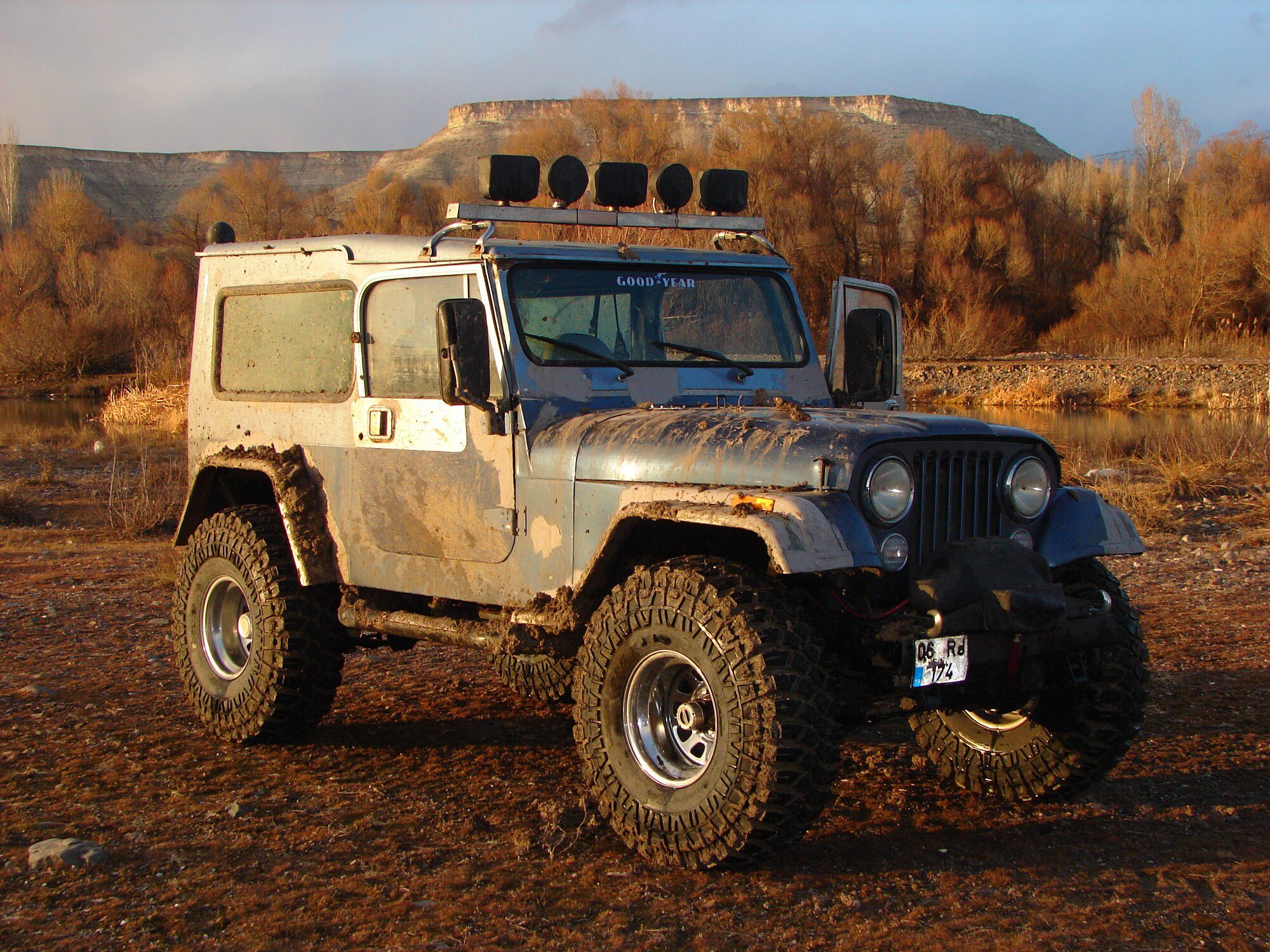
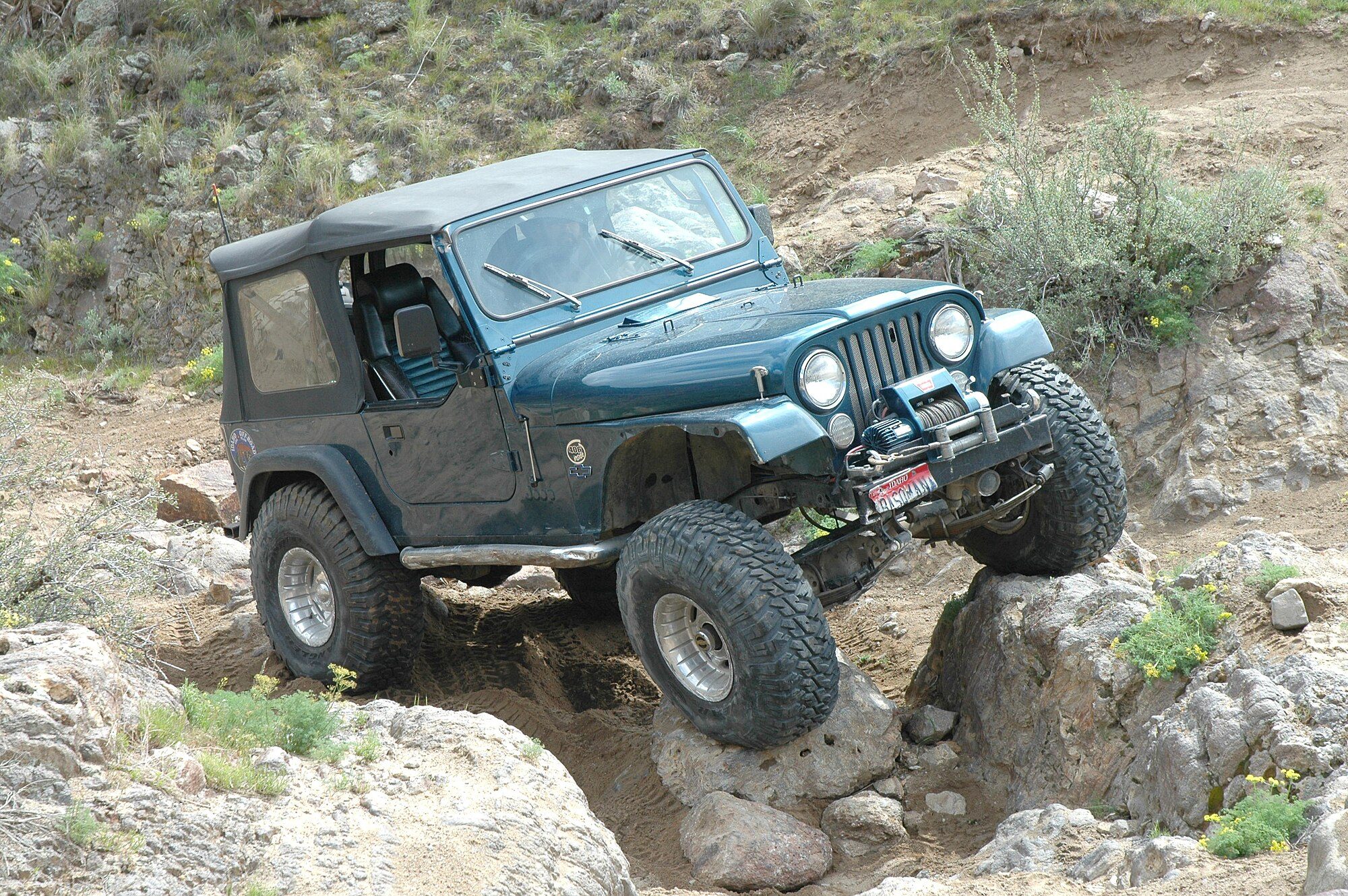
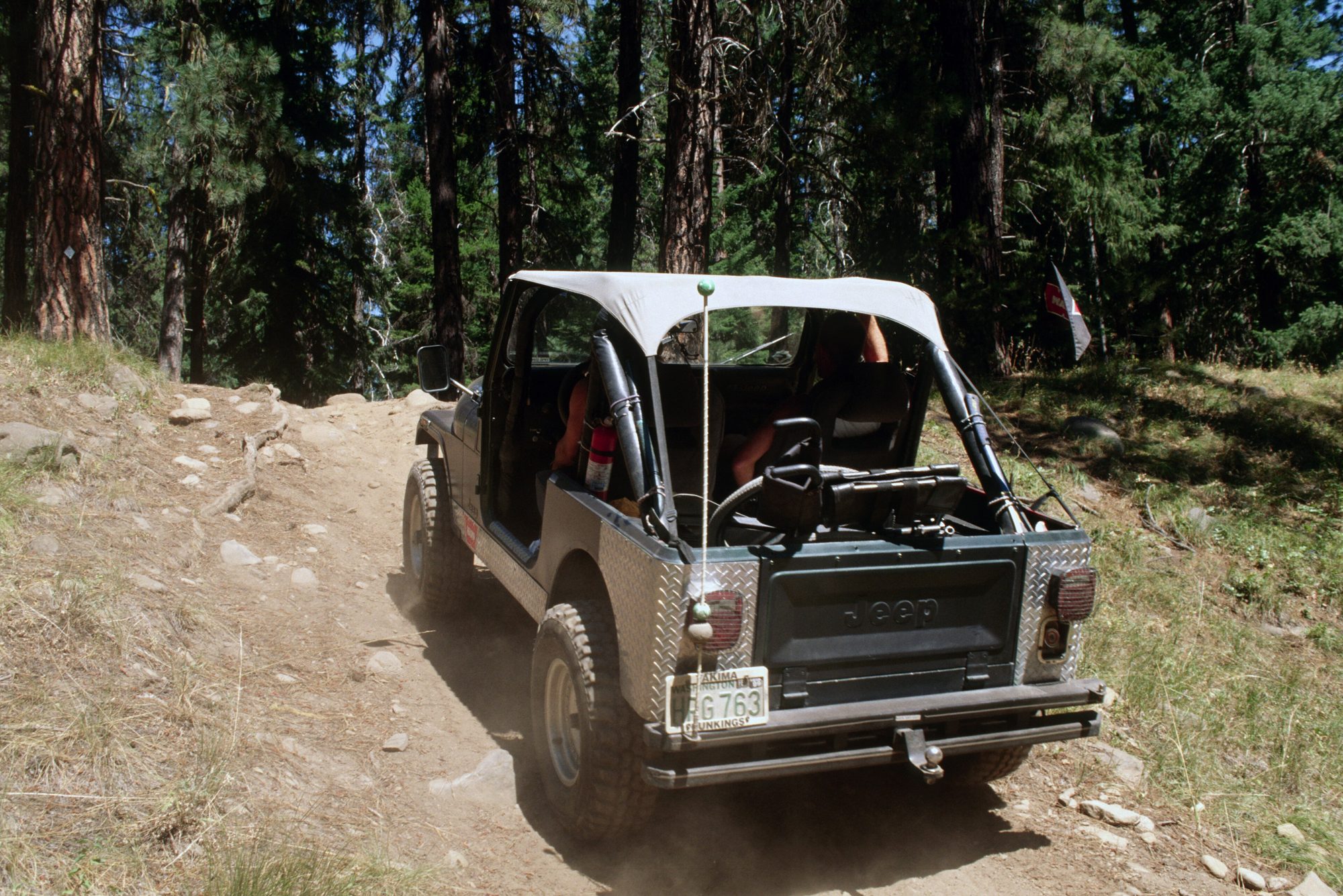
American Motors bought Kaiser Jeep in 1970 (for $70 million by Wikipedia's account; Jeep's own history says about $75 million), and in 1976 it gave the little CJ-5 a bigger brother. The CJ-7 sat on a 93.5-inch wheelbase, ten inches longer than the CJ-5's, and Jeep says the extra length was there to make room for an automatic transmission. The side openings were squared off to take doors, and for the first time a Jeep CJ could be ordered with a molded plastic hardtop and steel doors. It ran for eleven model years, and Wikipedia counts 379,299 built.
THE AMC RECIPE
Under the tub, the CJ-7 has two parallel C-section frame rails, stepped outward at the rear so the springs and shocks sit closer to the body, with leaf springs at both ends. The front axle is an open-knuckle Dana 30. At the back is AMC's own Model 20, which has a big 8⅞-inch ring gear but thin 29-spline shafts, each made of two pieces: a hub keyed and nutted onto the shaft. Wheels use the old CJ bolt pattern of 5 on 5.5 inches.
The engines came from AMC. Early trucks had the 232 straight six as standard, with the 258 optional until it became the base six for 1979. The 258 is the one owners talk about: cast iron, seven main bearings, hydraulic lifters and enough low-end torque to idle up a hill. Offroaders.com lists it at 110 hp and 195 lb-ft in 1979–81, then 115 hp and 210 lb-ft from 1982 with a computer-controlled Carter BBD two-barrel. The 304 V8 was offered until 1981, choked by smog equipment to 125 hp by the end. From 1980 a GM 151 'Iron Duke' four was standard, rated at 82 hp. JeepCJ.com's buyer's guide tells you to skip it.
GEARBOXES, TRANSFER CASES AND QUADRA-TRAC
Early trucks (1976–79) got a three-speed T-150 or the Borg-Warner T-18. From 1977 the T-18A had a 6.32:1 granny first, and Offroaders.com calls it the best transmission the factory ever put in a CJ. Behind it was a Dana 20 with a feeble 2.03:1 low range. The alternative was Quadra-Trac, a Borg-Warner 13-39 chain-drive full-time system bolted to a TH400 automatic. It had a vacuum-operated 'Emergency Drive' lock and an optional bolt-on low-range unit (2.57:1). Jeep had introduced Quadra-Trac on its full-size trucks in the early 1970s (the 1973 model year, by Wikipedia's dating), years before the Grand Wagoneer name existed.
For 1980 everything changed. The Dana 300 arrived with a 2.62:1 low range, and Novak Conversions calls it the 'gold standard' of transfer cases. It came with lighter Borg-Warner gearboxes: the SR-4 in 1980–81, then the T-4 and five-speed T-5 from 1982. Novak's verdict on those is 'essentially a small car transmission in a truck'. The tougher choice was the Tremec T-176 four-speed (1980–86), and a Chrysler TF999 three-speed automatic replaced the TH400.
WIDE TRACK, GOLDEN EAGLES AND LAREDOS
In 1982 the axles grew. The narrow-track AMC 20 measured 50.5 inches wheel to wheel, and the wide-track version 54.5 inches, which made the CJ-7 noticeably more stable. AMC also understood showroom bait. The Renegade ran the whole production life. The Golden Eagle (on the CJ-7 from 1977 to 1980, tied to the 304 V8 per Wikipedia) added a tachometer, a clock and the big Golden Eagle decals; a white 1980 CJ-7 Golden Eagle named 'Dixie' became famous as Daisy Duke's Jeep on The Dukes of Hazzard. The Laredo (1980–86) brought high-back leather seats, a tilt wheel and a chrome package.
The collectible ones are the Limited, built in 1982–83 (2,500 of them), and the 1982 Jamboree. That was 630 numbered CJ-7s, each with the 4.2-liter six, built for the 30th anniversary of the Rubicon Trail.
LAST OF A GREAT BREED
The CJ's reputation took a hit in December 1980, when 60 Minutes aired an IIHS rollover demonstration of a CJ-5. AMC green-lit a replacement in 1982, and the Wrangler YJ was designed to be more comfortable on the road and harder to flip, with track bars and anti-roll bars. It was unveiled in February 1986 and went on sale on 13 May 1986. The last CJ-7s carried a dash plaque that read 'Last of a Great Breed', and by then AMC 20 supplies had run so low that some 1986 trucks left the factory with wide-track Dana 44 rear axles.
The CJ-7 has outlived its replacement's reputation. AMC was working with Renault by the end, and Chrysler took over Jeep in 1987. The CJ-8 Scrambler, the YJ and the TJ all owe it something. Against its 1970s rivals, the FJ40 and the Series Land Rover, the CJ-7's case in the US was cheap parts, easy modification and a huge aftermarket, and that case still holds: almost every part is still reproduced.
SIDEBAR · THE CJ-7 AMERICA NEVER GOT
Isuzu diesels and Canadian Army Jeeps
From 1980 to 1982 AMC built an export-only CJ-7 diesel in Ohio. It had Isuzu's 2.4-liter C240 four, a T-176 gearbox, a Dana 300 (Wikipedia says some reportedly got a Dana 20) and, typically, narrow-track axles with 4.10 gears.
In 1985 the Canadian Army took delivery of 195 militarized CJ-7s, codified as Equipment Configuration Code 121526. They were a stop-gap between the retirement of the M38A1 and the arrival of the Bombardier Iltis, so the CJ, born of a military Jeep, ended up back in uniform.