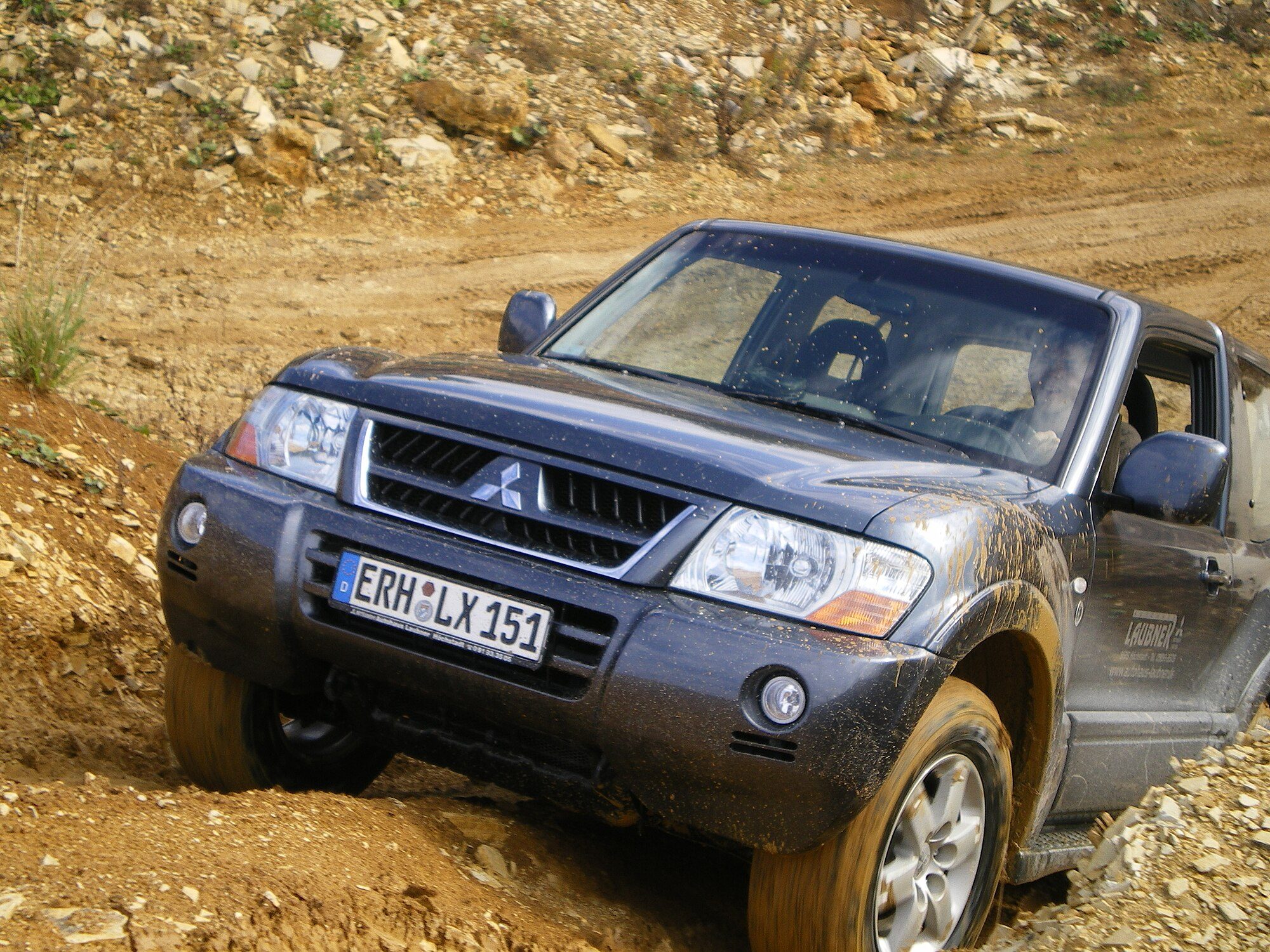
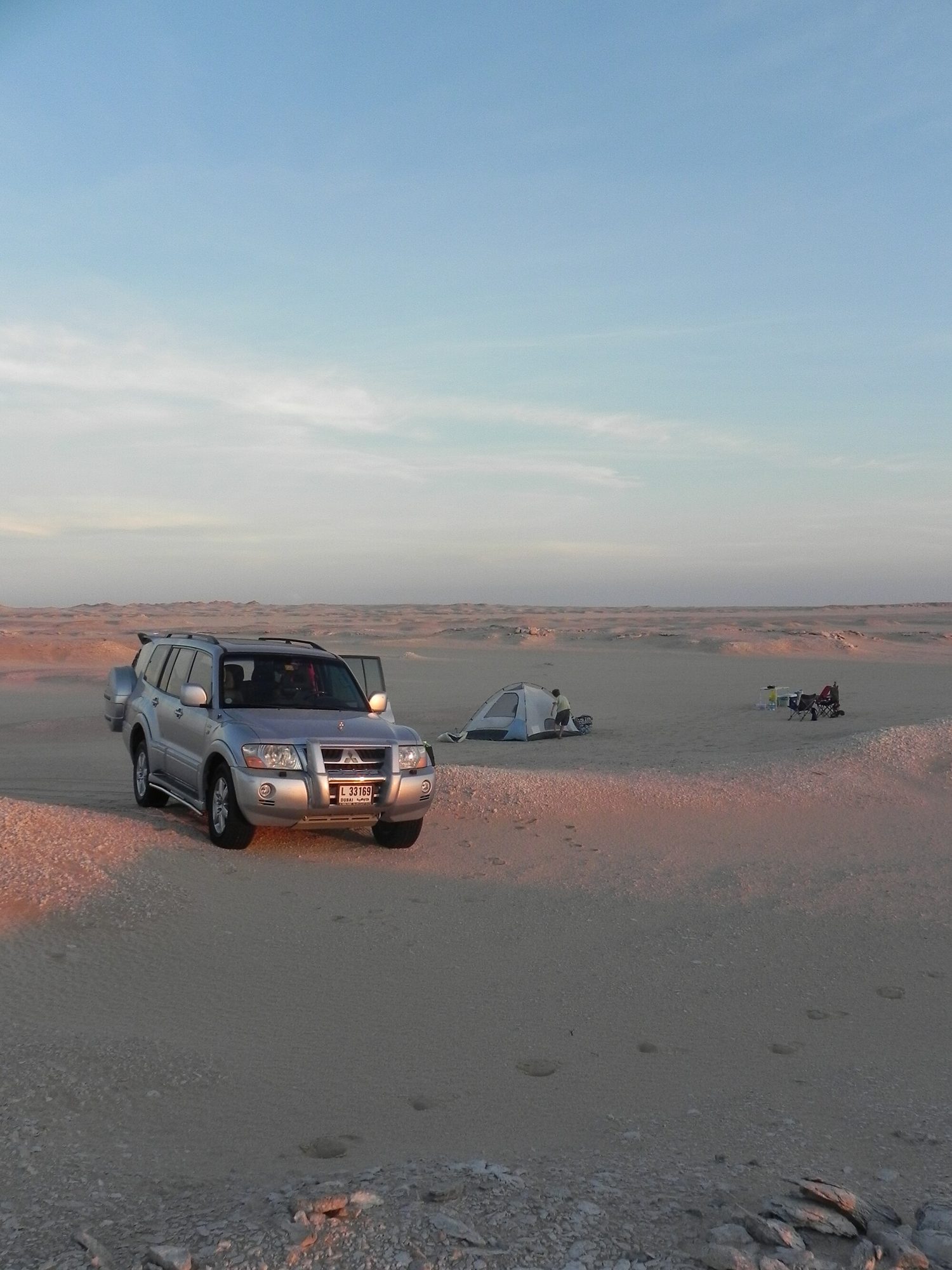
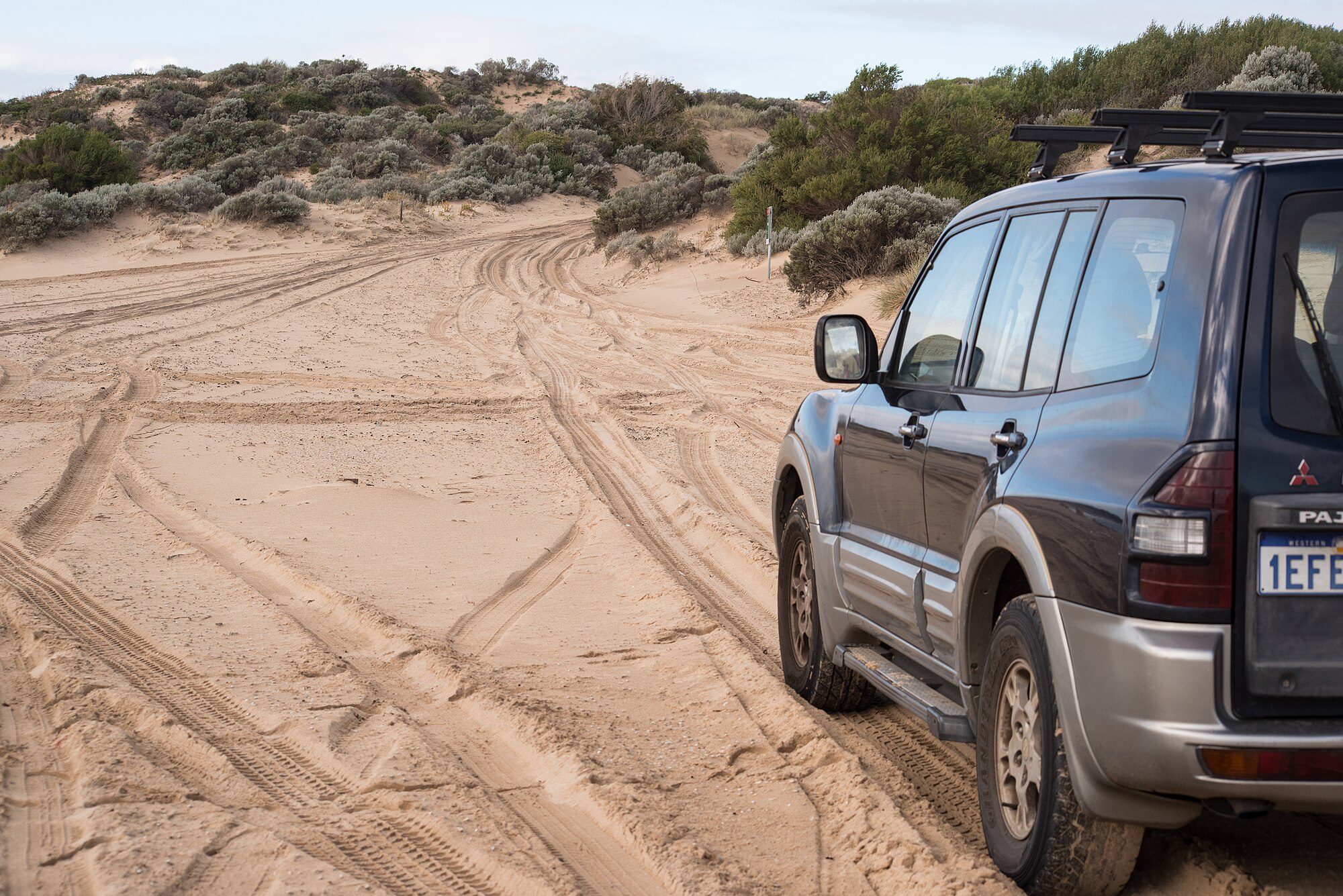
A dark grey and silver pre-facelift third-generation Pajero with roof bars on a rutted sand track through coastal dunes at Tim's Thicket, Western Australia
MITSUBISHI PAJERO · V60/V70 · 1999–2006

Pajero / Montero (Third Generation)

V63W · V65W · V68W · V73W · V75W · V78W6G74 3.5 / 6G75 3.8 V64M41 3.2 DI-DSUPER SELECT 4WD IIMONOCOQUE + BUILT-IN FRAME

“Mitsubishi bet the company argument on a monocoque with a frame welded underneath, gave it four-wheel independent suspension, and then won the Dakar with its descendants five years running. Diehards still call it soft. Keep the timing belt and the brake booster healthy and it's one of the best-riding cheap overlanders you can buy.”

PART 01

Overview

Where it came from, why it matters, and how it changed year to year.

The story

By Mitsubishi's count, the first two Pajeros, including the second generation, had sold 1.26 million in about 170 countries. The threat was the crossover SUV: buyers wanted car-like manners on the road. Mitsubishi says the decision on how to answer it split the company. In the end it dropped the separate ladder frame and built a monocoque body with a frame structure welded into its floor. The new Pajero went on sale in Japan in the autumn of 1999 and reached most export markets as a 2001 model.

THE ARGUMENT THAT SPLIT MITSUBISHI

Mitsubishi's own history admits the trade-off. A monocoque is lighter, but a frame is better at the rigidity and durability that rough tracks demand. Its answer was the 'built-in frame' monocoque, and the company says that although the truck grew, it lost a lot of weight and met an internal target of body stiffness comparable to its Dakar prototypes. Wikipedia credits Mitsubishi's RISE safety structure for a cabin that held its shape well, and the fuel tank moved between the axles to help weight distribution and ground clearance.

The suspension changed just as much. Double wishbones and coil springs went in at the front, replacing torsion bars, and the rear became independent too, on a subframe. The idea came from the rally team: the Pajero Evolution had used independent rear suspension, and Wikipedia says that design set the pattern for the third generation. Rack-and-pinion steering replaced the old recirculating-ball box. Unsealed 4X4 called the Australian NM 'the first 4×4 wagon in its class with monocoque construction and a fully independent suspension system'.

SUPER SELECT II, GDI AND A NEW DIESEL

Super Select became Super Select 4WD II. The centre differential uses planetary gears and splits torque between 33:67 and 50:50 front to rear, and the modes are now switched electrically. You still get 2H, full-time 4H, and locked-centre high and low ranges. Engines were a mix of old and new: the 6G74 3.5 V6 carried over (as a GDI direct-injection engine in Japan), the 2.8 4M40 diesel stayed in some markets, and a new 3.2-litre 4M41 DI-D four arrived. Mitsubishi Japan lists the 3.2 DI and 3.5 GDI as the two engines developed for the new truck.

Australia got the NM in 2000 with a launch drive to the Lambert Centre that a freak downpour turned into a mud epic. Unsealed 4X4's Dean Mellor remembers the petrol V6s refuelling from jerry cans while the 2.8 diesels 'made it on the smell of an oily rag'. In 2002 the 3.2 DI-D replaced the 2.8 there, and it could be ordered with the five-speed automatic. A 3.8 V6 followed in 2003, and electronic traction control arrived in 2004, ahead of the Prado.

AMERICA: THE MONTERO LIMITED AND THE MOOSE TEST

The US got the long-wheelbase five-door only, as the Montero XLS and Limited, with the 3.5 V6 rated at 200 hp and 235 lb-ft. Its first year brought bad press. In May 2001 Consumer Reports put the Montero Limited through its short-course avoidance manoeuvre, and its test truck tipped up on two wheels in eight of nine runs at 36.7 mph or faster. CR rated it 'Not Acceptable', a verdict it had previously given only the Suzuki Samurai and the 1996 Isuzu Trooper and Acura SLX. Mitsubishi disputed the method, said it had no stability complaints from customers and quoted NHTSA's view that CR's test had no scientific basis.

For 2003 the Montero was facelifted and the 3.5 gave way to a 3.8-litre 6G75 rated by Bring a Trailer's listings at 215 hp and 248 lb-ft, with Mitsubishi's M-ASTC stability and traction control. Owners on Expedition Portal say the XLS was dropped after 2003, leaving only the Limited. The Montero was Mitsubishi's only American SUV with standard four-wheel drive rather than all-wheel drive, and it left the US market after the 2006 model year.

LEGACY

The third generation was replaced in Japan in October 2006, but the platform didn't die. The fourth-generation Pajero kept the monocoque-and-frame body and independent suspension, and Unsealed notes that the same basic structure was still on sale in Australia two decades after the NM. In China, GAC Changfeng built the third generation until 2011. Today it's a bargain: Bring a Trailer has sold US Monteros for under $20,000, and the Japanese 3.2 diesels are now old enough to import. It rides like a car and has the 100 Series's cabin space, according to Unsealed, though its IFS-and-IRS layout will always start an argument at the campsite.

SIDEBAR · DAKAR 2000–2005

Five wins in a row

Mitsubishi's works team switched to a T2 rally car based on the new Pajero for the 2000 Dakar. It kept the production monocoque, stretched the wheelbase, used four-wheel independent suspension and ran a 3.5 MIVEC V6. That year Jean-Louis Schlesser's buggy won, and Mitsubishi had to settle for third.

Then the streak began. In 2001 Jutta Kleinschmidt became the first woman to win the Dakar outright, in a Pajero, after Hiroshi Masuoka broke a half shaft fighting the Schlesser buggies. Masuoka won in 2002 and again in 2003, the second year in a tube-framed Pajero Evolution prototype whose body only looked like the road car. Unsealed 4X4 counts five consecutive wins from 2001 to 2005, and Wikipedia says Mitsubishi's final Dakar wins came in 2007.
Year by year

What changed, model year by model year. Sweet spot Beware Recall

Best years across every Mitsubishi Pajero / Montero generation →

  1. 1999Third generation goes on sale in Japan (Mitsubishi gives 2 September; Wikipedia gives 2 August for its introduction). Monocoque with built-in frame, four-wheel independent suspension, Super Select 4WD II, 3.5 GDI V6 and 3.2 DI-D diesel
  2. 2000Australian NM launched with the 3.5 V6 and carry-over 2.8 4M40 diesel. Mitsubishi enters a T2 rally car based on the new Pajero at the Dakar
  3. 2001First US model year: Montero XLS and Limited, LWB only, 3.5 V6 (200 hp). Consumer Reports rates the Limited 'Not Acceptable' in June. US recall 01V254001 for the brake-booster accumulator (2001–02). Kleinschmidt wins the DakarRecall
  4. 2002Australia: the 3.2 DI-D replaces the 2.8 diesel and can be had with the five-speed auto. Owners recommend the diesel over the petrols and praise its durabilitySweet spot
  5. 2002–2004US recall 04V319000: fuel-tank leveling valve can leak when parked nose-up with a full tankRecall
  6. 2003Facelift. US Montero gets the 3.8 6G75 V6 (215 hp per BaT) and M-ASTC; 20th Anniversary Edition. Owners say the XLS was dropped after this year
  7. 2004Electronic traction control added in Australia. ANCAP tests the Pajero Exceed
  8. 2005Japan: the 3.8 V6 (219 PS) arrives in the Super Exceed in November, replacing the GDI V6
  9. 2006Final US model year for the Montero. The fourth-generation Pajero launches in Japan on 4 October
PART 02

Specs & capability

How it’s built, what it can do, and what fits under it.

How it’s built

The big change is structural: a monocoque with a ladder-type frame welded into the floor, not a body bolted to a separate chassis. The suspension is independent at all four corners on coil springs, steering is rack and pinion, and Super Select 4WD II gives full-time 4WD with a lockable planetary centre differential. US Monteros are long-wheelbase V6 automatics; elsewhere you'll find three-door short bodies and the 3.2 DI-D diesel.

BODYMonocoque with built-in frameMitsubishi Japan describes a frame structure welded to the underside of the monocoque body.
WHEELBASESWB 2,545 mm (100.2 in) · LWB 2,780 mm (109.45 in)The US got only the long-wheelbase five-door.
SUSPENSIONDouble wishbones front · independent rear on a subframeCoil springs at all four corners. Mitsubishi's Japanese history calls the rear double wishbone; its English history says multi-link.
4WD SYSTEMSuper Select 4WD IIElectrically switched. Planetary centre diff, 33:67 to 50:50 torque split, locking centre in 4HLc and 4LLc.
TRACTIONLSD (early US Limited) · M-ASTC from 2003 (US)BaT's 2001 Limited has a limited-slip rear. An ARB Air Locker is listed for the 9.5 in IRS rear diff.
ENGINES6G72 3.0 · 6G74 3.5 (MPI/GDI) · 6G75 3.8 V6 · 4M40 2.8 · 4M41 3.2 DI-DV6s use timing belts; the 4M41 has a chain.

Variants & engines

YEARSPLATFORMENGINEOUTPUTWORTH KNOWING
1999–2006 (Japan)V65W / V75W3.5 L 6G74 GDI V6162 kW (220 PS) after the 2003 faceliftDirect injection, Japan only; export trucks kept multi-point injection. Replaced by the 3.8 in 2005.
2000–2006 (US 2001–2002)V65W / V75W3.5 L 6G74 SOHC V6149 kW (203 PS); US 200 hp / 235 lb-ftUS Montero XLS and Limited with four- or five-speed automatic.
1999–2006 (outside the US)V60/V703.0 L 6G72 V6130 kW (180 PS) after the 2003 faceliftNot sold in the US.
2000–2002 (Australia NM)V60/V702.8 L 4M40 turbo-diesel I4—Carried over from the NL; manual only in Australia. Kept afterwards for developing markets.
1999–2006 (Australia from 2002)V68W / V78W3.2 L 4M41 DI-D I4175 PS / 39 kgf·m (Japan); 120 kW (160 PS) exportTiming chain. Front-mounted intercooler from the facelift. Not sold new in the US.
2003–2006 (US); 2005–2006 (Japan)V60/V703.8 L 6G75 SOHC V6US 215 hp / 248 lb-ft (BaT); Japan 219 PSElectronic throttle. Japan's Super Exceed from November 2005.

Capability numbers

Wheelbase2,545 mm (100.2 in) SWB · 2,780 mm (109.45 in) LWB
Length4,219 mm (166.1 in) SWB · 4,798 mm (188.9 in) LWB 2001–02 · 4,831 mm (190.2 in) LWB 2003–06
Curb weight2,060 kg (4,542 lb)5-door, per Wikipedia
Fuel tank90 L (23.8 US gal)NP owner on ExplorOz; YouCanic lists 23.8 gal
Fuel economy≈10–15 L/100 km (≈16–24 mpg US)CarsGuide's expected range; an NP 3.2 DI-D owner reports 10.5 town, 11 towing
Diesel torque373 N·m (275 lb-ft) at 2,000 rpm3.2 DI-D, as quoted by an NP owner
ANCAP (2004 Exceed)Frontal offset 9.88/16No curtain airbags; 0 points in the optional pole test

Wheels & tires

Try the tire fitment tool: biggest tire at every lift →

FACTORY TIRES
265/70R16 on 16-inch alloys (BaT's 2001 Limited)16x7 +46 mm factory wheel (2004 Montero, ThreePiece.us)17-inch alloys on BaT's 2006 Limited
Bolt pattern6x139.7 (6x5.5")
Offset+46 mm (factory 16x7)
Center bore67.1 mm
Lug threadM12x1.5
Lug-nut torque81 lb-ft (110 N·m) per Limitless Tire confirm in manual
LIFTBIGGEST TIREWHAT IT TAKES
Stock255/85R16 (≈33 in, narrow) or 265/75R16Owners run 235/85R16 and 255/85R16 with no rubbing on stock suspension, and an '05 runs LT265/70R17. A 285/75R16 rubs at full lock and comes close to the inner fender.
2 in255/85R16 or 265/75R16An owner with a 2 in OME lift runs 255/85R16s with no issues. With IRS the lift doesn't change the wheel's swing, so 285/75R16 still rubs at full lock on OME medium springs.
2 in + trimming34x10.50R17One owner runs 34x10.5R17 on 17x7 wheels with 4.90 gears after trimming and massaging the front liners; it touches only on big impacts. Others warn a 34 is gutless without regearing.

Forum consensus, not a guarantee: wheel offset, tire brand and suspension wear all change clearance. Confirm before you buy.

Production & special editions

Built in Japan from 1999 to 2006, and in China under licence until 2011.

AssemblyPajero Manufacturing Co., Sakahogi, Gifu; GAC Changfeng, Changsha, China (2004–2011)
Japan on saleSeptember/October 1999 – 4 October 2006 (JDMBUYSELL)
Australian NM/NP in HBB recall13,488 trucks (REC-003136)
Montero 20th Anniversary Edition2003US special edition; BaT's example has a 3.8 V6, five-speed auto and M-ASTC.
Pajero ZXFrom January 2000 (Japan)Corporate-use model with a 3.5 GDI V6, black bumpers and mirrors, in Sophia White or Satellite Silver.
Pajero Super Exceed 3.8From November 2005 (Japan)6G75 3.8 V6 rated at 219 PS.
PART 03

Buying one

What to pay, what to check, and how to tell a good one from a clone.

What they cost

Third-generation Monteros are still cheap; clean, low-mileage Limiteds are the only ones that break $15,000, and Japanese diesels are just starting to arrive.

Project / high-mileage$3.5k–6.5k
Driver$8k–14.5k
Excellent / low-mileage Limited$15k–20k

Based on 24 third-generation Montero and Pajero sales on Bring a Trailer from February 2022 to August 2026, from $3,750 (a 2001 Limited) to $19,777 (a 54k-mile 2001 Limited), median about $12,500. A 225k-mile 2003 20th Anniversary Edition brought $5,200 and a 1999 V68W 3.2 diesel import $14,600. JDMBUYSELL's seller-reported median for imports is $12,183 (n=6). Prices move; checked October 2026. See live listings below.

What to check before you buy

  1. 01
    Ask for the timing-belt receiptBoth US V6s use belts, and owners on Expedition Portal call them interference engines. One owner quotes the manual at 105,000 miles for 2001–2006 Monteros. If there's no proof, budget for a belt, tensioner, pulley, water pump and seals; owners quoted $700 at an independent shop to about $1,400 at a dealer.
  2. 02
    Test the brakes cold, and listen for the boosterThird-gen trucks use a hydraulic brake booster (HBB) with an accumulator. Recalls covered the accumulator in the US (01V254001), Australia and Hong Kong. Listen for an ABS-pump noise or tone, and check for a hard pedal on the first stop after the truck has been parked. One 2002 owner paid about $2,000 to replace the whole HBB system.
  3. 03
    Look under it for oil and ATF cooler leaksOwners on Expedition Portal chase leaks from the engine-oil and transmission-cooler hoses where they run along the frame and join the oil pan and cooler. Bring a Trailer's 2001 Limited had its oil-cooler lines replaced before sale.
  4. 04
    Cycle the Super Select leverGo through 2H, 4H, 4HLc and 4LLc on loose ground. CarsGuide's expert says a flashing 4WD light on these trucks usually points to the front-diff actuation system: solenoids, vacuum lines, actuator or diff sensor. BaT's 2001 Limited needed new transfer-case switches.
  5. 05
    Feel for driveline clunkAustralian NM owners report a clunk when going from off-throttle to on-throttle. One dealer replaced the diff centre and drive rods, which only helped a little. Owners say it didn't get worse with mileage, but factor it into the price.
  6. 06
    Check rear ride heightSeveral NM/NP owners on ProductReview say the rear sags with age, and an ExplorOz owner scraped the side steps and towbar until he fitted a 40 mm ARB kit. Look for a nose-up stance and worn rear bushings.
  7. 07
    Identify the engine, and don't expect a ladder frameJDMBUYSELL warns buyers that there's no separate chassis, that the 4M41 uses a chain while the V6s use belts, and not to accept a common-rail claim on a 1999 diesel without proof. Check the chassis code on the plate.
  8. 08
    Run the VIN for recallsUS recalls include the brake-booster accumulator (01V254001, 2001–02), a fuel-tank leveling valve that can leak (04V319000, 2002–04), and label campaigns. In Australia, REC-003136 covers 13,488 NM/NP trucks for the same accumulator.

Take these to the test drive: get the free printable Pajero / Montero (Third Generation) inspection checklist →

Spotting the real thing

US Monteros are straightforward, but imported Pajeros come in many codes and engines, and the 1999 cut-over means some '99 Pajeros are second-generation trucks.

  1. ID
    Chassis codesJDMBUYSELL lists V63W, V65W, V68W, V73W, V75W and V78W. Bring a Trailer's imports include a V65W three-door 3.5, a V68W three-door 3.2 diesel and a V75W five-door 3.5. Confirm the full code on the frame or VIN plate.
  2. ID
    Second or third generation?A 1999 Pajero can be either. Third-generation codes start V6 or V7; BaT's 1999 'Wide Exceed' with a V45 code is a second-generation truck with a separate frame.
  3. ID
    US engine from the VINOn BaT's US trucks, the 3.5 Monteros carry R as the eighth VIN character (JA4MW51R…) and the 3.8s carry S (JA4MW51S…, JA4NW31S…).
  4. ID
    Pre-facelift or faceliftMitsubishi facelifted the truck for 2003; in the US that's also when the 3.8 and M-ASTC arrived. BaT's 2003 and 2004 Limiteds list M-ASTC.
  5. ID
    Grey-import tellsRight-hand drive, a fender-mounted mirror and a km/h speedometer (BaT's 1999 V68W has a 180 km/h speedo) mark a Japanese-market truck. Ask for the import paperwork.

Recalls & service bulletins

Open recalls follow the VIN, not the model. Run yours through NHTSA before you buy, and ask the seller for dealer records showing recall work.

Check a VIN at NHTSA ↗
Notable recalls
Hydraulic brake booster accumulator can leak ↗2001–2002 · NHTSA 01V254001An improperly made accumulator can lose its nitrogen charge, causing a noise from the dash and delayed brake assist after the truck has been parked. Dealers fitted an improved accumulator. Australia's REC-003136 covers 13,488 NM/NP Pajeros for the same part.
Fuel tank leveling valve may leak ↗2002–2004 · NHTSA 04V319000With a full tank, parked nose-up on a slope, expanding fuel can get past the leveling valve and leak onto the ground. Dealers replace the valve.
Tire and loading label capacity weights wrong ↗2004 · NHTSA 04V095000The label's capacity figures were wrong and could lead owners to exceed GVWR; replacement labels were mailed.
Bilingual airbag warning labels too small ↗2001–2004 · NHTSA 04V428000Removable English/Spanish airbag labels on the dash and visor didn't meet FMVSS 208 size rules.
Owner's manual missing tether-strap headrest instructions ↗2001 · NHTSA 04V067000The manual didn't explain headrest adjustment when fitting a child-seat tether, as FMVSS 225 requires.
Passenger-side exterior mirror non-compliant ↗2001 · NHTSA 00V123002Some passenger mirrors didn't meet FMVSS 111; dealers replace the mirror.
Service bulletins & known fixes
Hydraulic brake booster: spilled fluid can damage the pump motor ↗Mitsubishi HBB notice (reported by JDMBUYSELL; six chassis codes)Spilled brake fluid entering the pump motor caused malfunction and weak assist. Wipe up spills, never wash them away with water, and have a warning lamp, buzzer or poor braking checked with Mitsubishi's tester.

Importing & legality

Only the long-wheelbase V6 Montero was sold new in the US. Short-wheelbase three-doors, the 3.0 V6, the 3.5 GDI and the 3.2 DI-D diesel are gray-market trucks. NHTSA's exemption covers vehicles at least 25 years old by their own manufacture date (49 CFR 591.5(i)), so as of October 2026 trucks built up to about October 2001 qualify and the rest follow month by month until the last ones in 2031. Bring a Trailer has already sold a 1999 V68W 3.2 diesel and a 2000 V65W three-door with import documents.

The EPA exemption is separate: JDMBUYSELL notes it requires at least 21 years and the original configuration, or an equivalent or newer EPA-certified engine and emissions system. State titling and emissions rules vary, and California is the hardest. Canada's 15-year threshold doesn't make a truck legal to bring into the US.

Rules change and vary by state and country. Confirm with your DMV and a licensed importer before you buy. How importing works: the 25-year rule, duty and registration →

The one you’ll own someday

For sale now

2001–2006 · USMontero (3.5 / 3.8 V6)
2003–2006 · USMontero 3.8 (M-ASTC)
1999–2006 · importsPajero (JDM, 3.2 DI-D)
PART 04

Owning one

Baseline service, the repairs you’ll actually do, and where the manuals live.

Post-purchase baseline

After you buy it

Assume nothing has been done without receipts. On a US Montero the big jobs are the timing belt and water pump on the interference V6, a brake-fluid flush for the hydraulic brake booster, and Diaqueen SP-III in the automatic. Capacities below are AMSOIL's figures for a 2004 Montero 3.8; confirm them for 3.5 trucks and diesel imports.

All Pajero / Montero (Third Generation) specs, fluids and service intervals on one printable page →

Engine oil & filterAPI SL · SAE 5W-20 preferred (5W-30 or 10W-30 also listed) · 5.2 US qt with filter (2004 3.8)Change now, then per the owner's manual

AMSOIL lists a WIX 57092 filter for the 3.8.

Timing belt, tensioner & water pump6G74 and 6G75: belt · 4M41 diesel: chainOwners quote the manual at 105,000 miles (2001–2006 Montero)

Owners call both US V6s interference engines. With no receipt, do it now, along with the O-ring on the pipe behind the water pump.

Spark plugs confirm in manualUsually done with the timing belt

The BaT 20th Anniversary truck had plugs and a PCV valve done after its belt.

Air & fuel filters confirm in manualReplace on a truck with no history
Coolant9.5 US qt (2004 3.8)Flush now

An NP owner on ExplorOz had a radiator block and the engine overheat, which he blamed on coolant gelling.

Automatic transmission (5-speed)Mitsubishi Diaqueen SP-III (owners) · 9.8 US qt total (AMSOIL)Drain and refill now; repeat to refresh more fluid

Owners on Expedition Portal warn that other fluids cause slipping and torque-converter damage; they name Hyundai/Kia SP-III and Eneos SP as alternatives.

Transfer case (Super Select II)GL-4 gear oil · 5.9 US pints · plugs 22–25 lb-ftChange now

Use 4WD regularly so the actuators and switches keep working.

Front differentialGL-5 80W-90 · 2.5 US pintsChange now

Check the front-diff actuator hoses while you're underneath.

Rear differentialGL-5 80W-90 · 3.4 US pintsChange now

Limited-slip rears need LSD-rated oil.

Brake fluid (HBB system)DOT 3Flush now, then regularly

Owners link HBB pump failures to dirty fluid. Wipe up spills; Mitsubishi warns spilled fluid can enter the pump motor. Check the accumulator recall.

Power steering fluid confirm in manualChange now
Oil & ATF cooler hosesNew copper washers at each fittingInspect now

A common leak point; check where the lines touch the frame.

Rear suspension bushings & CV bootsInspect for play and splitsInspect now

The independent rear has more bushings and boots than a live axle.

For the hands-on owner

Common repairs

The jobs owners actually end up doing, rated for a competent home mechanic with a decent tool kit. Always confirm torque figures, fluids and procedures against the factory service manual for your VIN, and work safely — support the truck on stands, never just a jack. You do this work at your own risk; see the disclaimer. Some parts links are affiliate links.

Hunting a used or discontinued part? Search eBay Motors for Mitsubishi Pajero / Montero (Third Generation) parts →

Timing belt, tensioner and water pump (6G74 3.5 / 6G75 3.8) →
DIFFICULTY · 3 / 5TIME · ≈ 10+ hours for a first-timerSHOP COST · Owners quoted about $700 (independent) to $1,400 (dealer) for the full job
SYMPTOMSUsually none before it fails. Owners on Expedition Portal call both US V6s interference engines and quote the manual's 105,000-mile interval for 2001–2006 Monteros. On a 2001 NM, an Australian owner's tensioner disintegrated at about 110,000 km.
THE FIXFollowing an Expedition Portal write-up: drain the coolant, remove the fan and shroud (the radiator can stay in if you protect it), then the accessory belts, accessories and main bracket. Hold the crank pulley and remove it, then the timing covers. Refit the crank bolt with spacers so you can turn the engine, and set TDC on the cam and crank marks. Remove the old tensioner and pulley, fit the new belt keeping the driver's side tight (large binder clips hold it on the cam gears), and fit the new tensioner without pulling its pin. Lever the pulley into the belt until the pin slides freely, torque the pulley bolt, rotate the crank two turns, wait five minutes and check the tensioner piston protrusion against the service manual. Replace the water pump, front seals and crank bolt while you're there, and the O-ring on the pipe behind the water pump, which owners say is often missed. One owner gives the crank-pulley bolt torque as 130 lb-ft; confirm it in the manual.
TOOLS & PARTSCrank-pulley holding tool (owners make one from flat steel) · large binder clips · torque wrench · non-marring pry bar · service manual · coolant.
Diagnose the hydraulic brake booster (HBB) and accumulator →
DIFFICULTY · 3 / 5TIME · ≈ 1 hour to check the recall; half a day to replace partsSHOP COST · Recall work is free; one owner paid about $2,000 for a complete HBB system
SYMPTOMSA hard pedal or slow brake assist on the first stop after the truck has been parked, an ABS-pump noise, or a warning lamp or buzzer. The US, Australian and Hong Kong recalls say a faulty accumulator can leak its nitrogen charge. A 2002 Limited owner on Expedition Portal had intermittent ABS tones, then a total loss of boost and a seized pump motor that drained the battery.
THE FIXRun the VIN for NHTSA 01V254001 (US 2001–02) or Australia's REC-003136 and have any open accumulator recall done first. JDMBUYSELL relays Mitsubishi's warning that spilled brake fluid can get into the pump motor: wipe up spills and never wash fluid away with water. A warning lamp, buzzer or weak assist needs Mitsubishi's tester to diagnose. The Expedition Portal owner's dealer blamed debris in the fluid, and owners there recommend regular brake-fluid flushes as these trucks age.
TOOLS & PARTSScan tool or dealer tester · brake bleeder · DOT 3 fluid · battery charger.
Replace leaking oil and ATF cooler hoses →
DIFFICULTY · 2 / 5TIME · ≈ 2–4 hoursSHOP COST · OEM hoses, copper washers and fluid
SYMPTOMSOil or ATF drips under the engine, wet hoses along the frame, a low transmission level. Owners trace leaks to the joints at the oil pan and the oil cooler, and one found a line that had chafed on the frame.
THE FIXRemove the skid plate and the two brackets that hold the hoses to the frame. Soak the fittings in penetrating oil first; one owner twisted a hose at its fitting and had to cut it off with tin snips. Fit new OEM hoses with new copper washers (don't reuse them), and protect any line that touches the frame with a split piece of old hose and zip ties. Top up or refill with the right fluids: owners insist on Mitsubishi Diaqueen SP-III in the automatic.
TOOLS & PARTSLine wrenches · penetrating oil · tin snips · new copper crush washers · drain pans · funnel.
Cure a flashing 4WD light (Super Select II) →
DIFFICULTY · 2 / 5TIME · ≈ 1–3 hours to diagnoseSHOP COST · Usually a solenoid, hose, switch or sensor
SYMPTOMSThe 4WD indicator keeps flashing after you shift, or the front axle won't engage.
THE FIXCarsGuide's expert says it's 'likely to be a problem with the actuation system for the front diff' and lists the solenoids, vacuum line, actuator and diff sensor. Start with the cheap parts: check every vacuum hose to the front-diff actuator for cracks and loose ends, test the solenoids, then the actuator and sensor. Bring a Trailer's 2001 Limited had its transfer-case switches replaced, so check those and their wiring too. Afterwards, cycle through every mode on loose ground and use 4WD regularly.
TOOLS & PARTSHand vacuum pump with gauge · multimeter · scan tool · basic hand tools.
Chase the on/off-throttle driveline clunk →
DIFFICULTY · 2 / 5TIME · ≈ 2 hours to inspectSHOP COST · From a grease gun to diff mounts and bushings
SYMPTOMSA heavy clunk from the driveline when you go from off-throttle to on-throttle. NM owners on ExplorOz report it from about 50,000–60,000 km, and say Mitsubishi called it a known issue with no fix at the time.
THE FIXRule out the simple causes first. Grease the tailshaft slip joint (one ExplorOz contributor found a dry slip joint caused the same clunk on another 4x4), then check the rear diff mounts, the rear subframe and control-arm bushings, and the CV joints for play. One owner's dealer replaced the diff centre and drive rods and got only a small improvement. Owners note that shifting to 4H removes the backlash, and that the clunk didn't get worse over 110,000–120,000 km.
TOOLS & PARTSJack and stands · pry bar · grease gun · flashlight.
Refresh tired rear springs, shocks and bushings →
DIFFICULTY · 3 / 5TIME · ≈ half a daySHOP COST · Springs, shocks and bushings, plus an alignment
SYMPTOMSA sagging rear, scraping side steps or towbar, and a floaty or clunky rear end. Several NM/NP owners say the rear sags with age, and one ExplorOz owner fixed scraping with a 40 mm ARB lift.
THE FIXSupport the body and rear subframe, remove the rear shocks, and drop the control arms enough to release the coil springs. Fit new coils matched to your load (Old Man Emu offers medium- and heavy-duty rear coils for the NM) and new shocks. Replace worn control-arm bushings while it's apart. Torque the suspension bolts at ride height, not hanging, then get a four-wheel alignment.
TOOLS & PARTSJack and stands · spring compressor if needed · torque wrench · bushing press or puller · alignment afterwards.
Replace the starter motor →
DIFFICULTY · 2 / 5TIME · ≈ 1–2 hoursSHOP COST · A starter and an hour or two
SYMPTOMSClicking or slow cranking with a good battery. Starters are the most common complaint in ProductReview's NM/NP owner reviews; one owner says they 'started to go like hot cakes'.
THE FIXCharge and load-test the battery and clean the terminals and earth strap first. Then disconnect the battery, remove the skid plate if fitted, unplug the solenoid lead and main cable, and unbolt the starter. Fit the new unit, torque the bolts, reconnect and test.
TOOLS & PARTSBattery load tester · socket set with extensions · multimeter.

Manuals & documentation

AMSOIL — 2004 Montero 3.8 capacity lookup ↗Third-party fluid specs and capacities for US trucks; confirm against the owner's manual.NHTSA — recalls for the 2001–2006 Montero ↗Search by VIN for open campaigns.
Mitsubishi Pajero / Montero factory service manual (2001–2006)Owners on Expedition Portal work from the printed FSM for the timing belt and intake; buy a legitimate copy rather than a scan.
Asked on every forum

Pajero / Montero (Third Generation) questions, answered

What's the biggest tire I can fit without a lift?

About 33 inches if it's narrow. Owners on Expedition Portal run 235/85R16 and 255/85R16 (about 33 in) on stock suspension with no rubbing, and one '05 owner runs LT265/70R17. A 285/75R16 is a step too far: owners report it rubbing at full lock even with an OME lift. A veteran owner's advice is that '265/75R16 or 17 are the best fit on these rigs, even lifted.' Stock tires on BaT's 2001 Limited are 265/70R16.

SOURCE · EXPEDITION PORTAL · BAT
Is it body-on-frame?

No. It's a monocoque with a frame structure welded into its floor, which Mitsubishi calls a built-in frame. Mitsubishi says the design was lighter than the old ladder frame and as stiff as its Dakar prototypes, but JDMBUYSELL warns that it's not for buyers who want a separate chassis.

SOURCE · MITSUBISHI JAPAN · JDMBUYSELL
Can I drive in 4WD on the highway?

Yes, in 4H. Super Select 4WD II's centre differential splits torque between 33:67 and 50:50 front to rear, so 4H works on pavement. 4HLc and 4LLc lock the centre for loose surfaces. The modes are switched electrically.

SOURCE · WIKIPEDIA · MITSUBISHI JAPAN
Does it have a locker?

Not from the factory on US trucks. BaT's 2001 Limited has a limited-slip rear, and 2003-on trucks have M-ASTC traction control. ARB lists a rear Air Locker for the 9.5-inch IRS diff in 2001–2006 Monteros, and one Expedition Portal owner runs ARB lockers with 4.90 gears.

SOURCE · BAT · HURREYS · EXPEDITION PORTAL
Should I buy a 3.5 or a 3.8?

The 2001–02 3.5 is rated at 200 hp and 235 lb-ft, the 2003–06 3.8 at 215 hp and 248 lb-ft (BaT figures). The 3.8 trucks also get M-ASTC traction control, which owners rate highly. One owner says the 3.8 wants premium fuel and the 3.5 doesn't. Both are belt-driven and, owners say, interference engines.

SOURCE · BAT · EXPEDITION PORTAL
Is it the Montero that failed Consumer Reports' rollover test?

Yes. In 2001 CR rated the Montero Limited 'Not Acceptable' after its test truck tipped up on two wheels in eight of nine runs at 36.7 mph or faster in a short-course avoidance manoeuvre. Mitsubishi disputed the method and quoted NHTSA's view that CR's test had no scientific basis, and Mitsubishi quoted a static stability factor equal to a three-star NHTSA rating.

SOURCE · ROCKCRAWLER · DESIGN NEWS
How often does the timing belt need changing?

An owner quoting the manual says 105,000 miles for 2001–2006 Monteros, and owners say the engines are interference designs, so don't stretch it. Do the water pump, tensioner and seals at the same time. The 3.2 diesel uses a chain.

SOURCE · EXPEDITION PORTAL · JDMBUYSELL
What transmission fluid does it take?

Owners insist on Mitsubishi Diaqueen SP-III and say other fluids cause slipping and torque-converter damage. Hyundai/Kia SP-III and Eneos SP are named as alternatives. AMSOIL lists 9.8 quarts total for the 2004 five-speed.

SOURCE · EXPEDITION PORTAL · AMSOIL
What fuel economy should I expect?

CarsGuide's expert puts normal consumption at 10 to 15 L/100 km. An NP 3.2 DI-D automatic owner reports about 10.5 L/100 km around town and 11 towing a caravan. Another owner says the petrol's range drops sharply when towing.

SOURCE · CARSGUIDE · EXPLOROZ
Can I import a Japanese 3.2 diesel?

Yes, once it's 25 years old by its own build date. As of October 2026 that covers trucks built up to about October 2001, and BaT has already sold a 1999 V68W 3.2 diesel in the US. Later trucks become eligible month by month. The EPA exemption is separate and needs the original configuration.

SOURCE · 49 CFR 591.5 · JDMBUYSELL · BAT
What's a third-gen Montero worth?

Not much yet. Twenty-four third-generation Monteros and Pajeros sold on Bring a Trailer between February 2022 and August 2026 brought $3,750 to $19,777, with a median of about $12,500. Low-mileage Limiteds sit at the top.

SOURCE · BAT
Are there recalls I should check?

In the US: the hydraulic brake booster accumulator on 2001–02 trucks (01V254001), a fuel-tank leveling valve that can leak on 2002–04 trucks (04V319000), and some label campaigns. Australia's REC-003136 covers the accumulator on 13,488 NM/NP Pajeros.

SOURCE · NHTSA · VEHICLERECALLS.GOV.AU
PART 05

Building one

Who makes the good stuff, where owners gather, and who to watch.

Common modifications & who does them

SUSPENSION LIFTOld Man Emu coils and shocks restore ride height and add a little lift. Owners run 2 in OME kits with 255/85R16s, and an Australian owner fixed scraping with about 40 mm of ARB lift.
LOCKERSUS trucks have an open or limited-slip rear and, from 2003, traction control. An ARB Air Locker for the 9.5 in IRS rear diff gives you a true locker.
BUSHINGSPolyurethane bushings tighten up a tired independent rear end.
WHEELS & TIRES6x139.7 mm with a 67.1 mm centre bore and factory 16x7 +46 wheels. Narrow 33s fit; wide 285s rub.
OEM & SERVICE PARTSTiming-belt kits, cooler hoses, brake and suspension parts for US Monteros, organised by engine.

Clubs & events

Resources

Channels, accounts & forums

All Pajero / Montero resources →

From the wider Pajero / Montero community:

SourcesWikipedia — Mitsubishi PajeroMitsubishi Motors Japan — Pajero history: 3rd generation (Japanese)JDMBUYSELL — Mitsubishi Pajero V60 buyer's guideUnsealed 4X4 — Revolutionary monocoque Pajero turns 20Mitsubishi Motors — Dakar Rally 2000Mitsubishi Motors — Dakar Rally 2001Mitsubishi Motors — Dakar Rally 2002Mitsubishi Motors — Dakar Rally 2003ROCKCRAWLER.com — Consumer Reports pans 2001 Montero Limited with 'Not Acceptable' rating (June 2001)Design News — The case of the maligned Montero (September 2001)Bring a Trailer — Mitsubishi Pajero & Montero resultsBring a Trailer — 2001 Mitsubishi Montero Limited, 54k miles (sold January 2026)Bring a Trailer — 2004 Mitsubishi Montero Limited (sold August 2026)Bring a Trailer — 2003 Mitsubishi Montero 20th Anniversary Edition (sold June 2025)Bring a Trailer — 30k-mile 2003 Mitsubishi Montero XLS (sold April 2024)Bring a Trailer — 2006 Mitsubishi Montero Limited (sold June 2024)Bring a Trailer — 1999 Mitsubishi Pajero Exceed 3.2 turbodiesel, V68W (sold February 2026)Expedition Portal — T-belt interval, Gen 3?Expedition Portal — 3.8L timing belt change (gen 3)Expedition Portal — Gen 3 Timing BeltExpedition Portal — 3rd gen Montero/Pajero questionsExpedition Portal — Cautionary Tale 2002 Montero Limited HBBExpedition Portal — Oil Cooler & Trans Cooler HosesExpedition Portal — New Gen III and a question about tiresExpedition Portal — 285/75/16 Montero 3rd gen. Might not fitExpedition Portal — Gen 3 Montero 34" tiresExpedition Portal — Gen 3 debate, 3.5 or 3.8?ExplorOz forum — Pajero NM clunkExplorOz forum — Pajero reliability (NM/NP)ExplorOz forum — NP PajeroCarsGuide — 2003 Mitsubishi Pajero problemsProductReview.com.au — Mitsubishi Pajero NM/NP (2000–2006) owner reviewsAustralian Government vehicle recalls — REC-003136, Pajero NM/NP hydraulic brake booster accumulatorHong Kong Transport Department — Pajero V65W/V73W/V75W/V78W brake booster accumulator recallAMSOIL — 2004 Mitsubishi Montero 3.8L lubricant and capacity lookupLimitless Tire — 2004 Mitsubishi Montero wheel and tire specsThreePiece.us — 2004 Mitsubishi Montero wheel fitmentHurreys Performance — ARB Air Locker, Mitsubishi IRS 9.5 in, 33 spline (fits 2001–2006 Montero)Hurreys Performance — ARB/OME front coil spring, Pajero NMHurreys Performance — ARB/OME rear coil spring, Pajero NM (medium duty)Hurreys Performance — OME Nitrocharger Plus rear shock, Pajero NMHurreys Performance — Whiteline rear lower control arm bushing, 2001–06 Montero/Pajero NM-NPNHTSA — Recall 01V254001 (2001–2002 Montero brake booster accumulator)NHTSA — Recall 04V319000 (2002–2004 Montero fuel tank leveling valve)eCFR — 49 CFR 591.5 (import exemptions, including the 25-year rule)Wikipedia — Mitsubishi PajeroMitsubishi Motors Japan — Pajero history: 3rd generation (Japanese)JDMBUYSELL — Mitsubishi Pajero V60 buyer's guideUnsealed 4X4 — Revolutionary monocoque Pajero turns 20ROCKCRAWLER.com — Consumer Reports pans 2001 Montero Limited with 'Not Acceptable' rating (June 2001)Bring a Trailer — Mitsubishi Pajero & Montero resultsBring a Trailer — 2001 Mitsubishi Montero Limited, 54k miles (sold January 2026)Bring a Trailer — 2004 Mitsubishi Montero Limited (sold August 2026)Bring a Trailer — 2003 Mitsubishi Montero 20th Anniversary Edition (sold June 2025)Bring a Trailer — 2006 Mitsubishi Montero Limited (sold June 2024)Bring a Trailer — 1999 Mitsubishi Pajero Exceed 3.2 turbodiesel, V68W (sold February 2026)Bring a Trailer — 2000 Mitsubishi Pajero 3-Door Exceed, V65W (sold May 2026)Bring a Trailer — 1999 Mitsubishi Pajero Exceed 3.5, V75W (sold September 2025)Expedition Portal — T-belt interval, Gen 3?Expedition Portal — 3rd gen Montero/Pajero questionsExpedition Portal — New Gen III and a question about tiresExpedition Portal — 285/75/16 Montero 3rd gen. Might not fitExpedition Portal — Gen 3 Montero 34" tiresExplorOz forum — NP PajeroCarsGuide — 2003 Mitsubishi Pajero problemsProductReview.com.au — Mitsubishi Pajero NM/NP (2000–2006) owner reviewsAustralian Government vehicle recalls — REC-003136, Pajero NM/NP hydraulic brake booster accumulatorHong Kong Transport Department — Pajero V65W/V73W/V75W/V78W brake booster accumulator recallAMSOIL — 2004 Mitsubishi Montero 3.8L lubricant and capacity lookupYouCanic — Mitsubishi Pajero/Montero 2001–2006 generation hub (fuel tank)Limitless Tire — 2004 Mitsubishi Montero wheel and tire specsThreePiece.us — 2004 Mitsubishi Montero wheel fitmentNHTSA — recalls by vehicle, Mitsubishi Montero 2001–2006 (API)NHTSA — Recall 01V254001 (2001–2002 Montero brake booster accumulator)NHTSA — Recall 04V319000 (2002–2004 Montero fuel tank leveling valve)eCFR — 49 CFR 591.5 (import exemptions, including the 25-year rule)NHTSA — Recall 04V095000 (2004 Montero loading label)NHTSA — Recall 04V428000 (2001–2004 airbag labels)NHTSA — Recall 04V067000 (2001 owner's manual, FMVSS 225)NHTSA — Recall 00V123002 (2001 passenger mirror)Mitsubishi Motors — Dakar Rally 2000Mitsubishi Motors — Dakar Rally 2001
The Boxy Dispatch · monthly

One new guide, one featured rig, one recall worth knowing. Monthly, no spam.

Subscribe and get a free printable inspection checklist for any truck we cover.