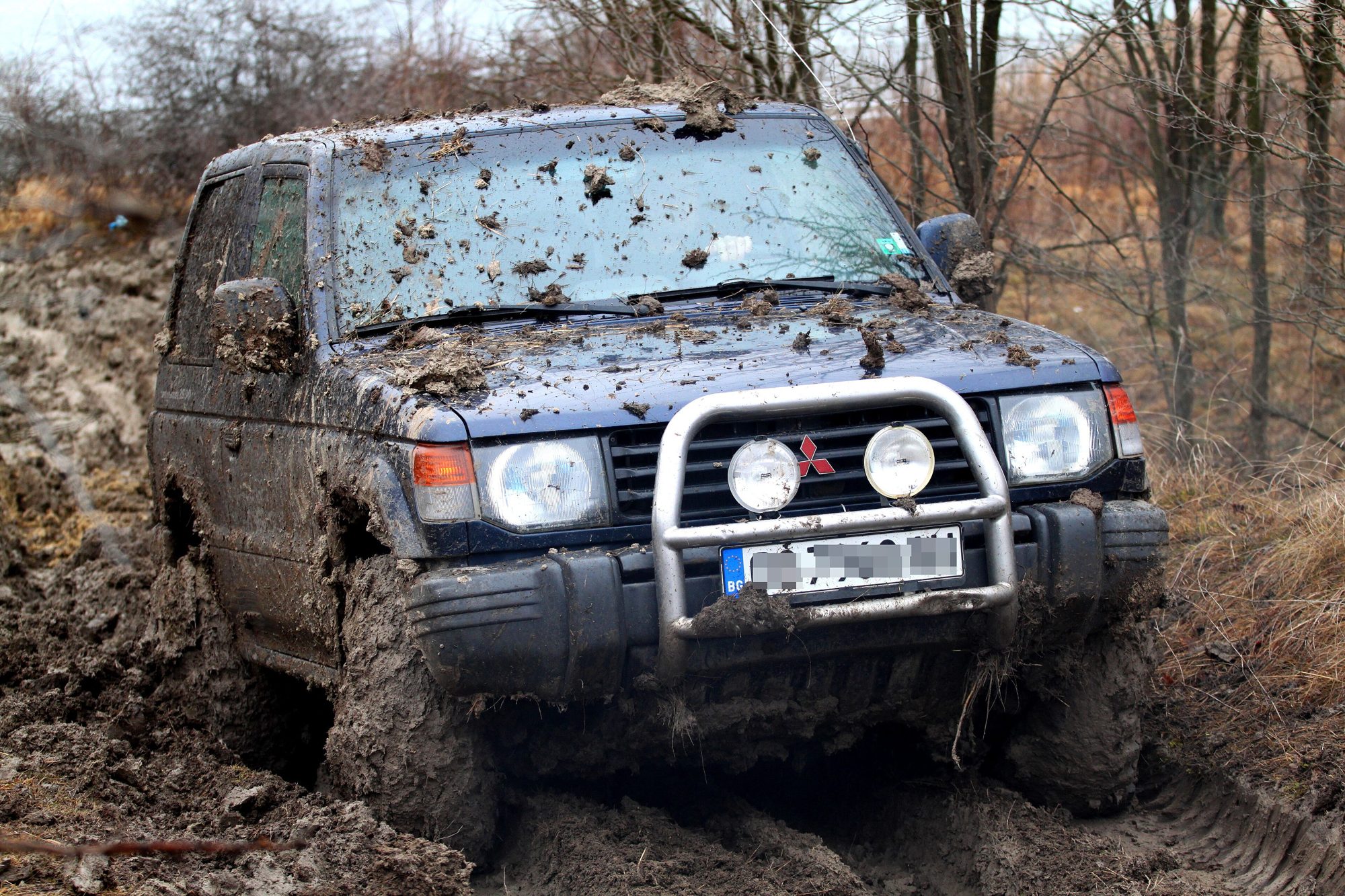
Pajero / Montero
“The Japanese 4x4 that went to the Sahara to prove it wasn't soft, then won the Dakar more times than any other car. It wore three names on three continents, and plenty of Land Cruiser owners learned to dislike all of them.”
Mitsubishi had assembled Jeeps under licence since 1953, but the licence wouldn't let it export them. So in 1978 a small design team started, almost unofficially, on a 4x4 of Mitsubishi's own: independent front suspension, car-like comfort and a dash with an inclinometer. The Pajero went on sale in Japan in May 1982. North America, Spain and most of Latin America got it as the Montero, because 'pajero' is a crude insult in Spanish. Britain called it the Shogun, and from 1987 to 1989 Dodge sold the three-door in the US as the Raider.
This guide covers the two body-on-frame generations. The first Pajero (1982–1991) won its class on its Paris–Dakar debut in January 1983 and won the whole rally in 1985. The second (1991–1999) brought Super Select 4WD, 3.0 and 3.5 V6s, the 2.8 4M40 turbo-diesel and the Evolution homologation special, and it outsold the original: Mitsubishi's designers put it at 1.15 million in eight years and seven months.
In 1999 the third generation went monocoque, with a built-in ladder frame and independent rear suspension, and the fourth generation carried the same layout from 2006 until production ended in 2021. The Montero left the US after the 2006 model year. Over 40 years Mitsubishi sold more than 3.3 million Pajeros. In 2026 the name returned on a new body-on-frame SUV based on the Triton pickup.