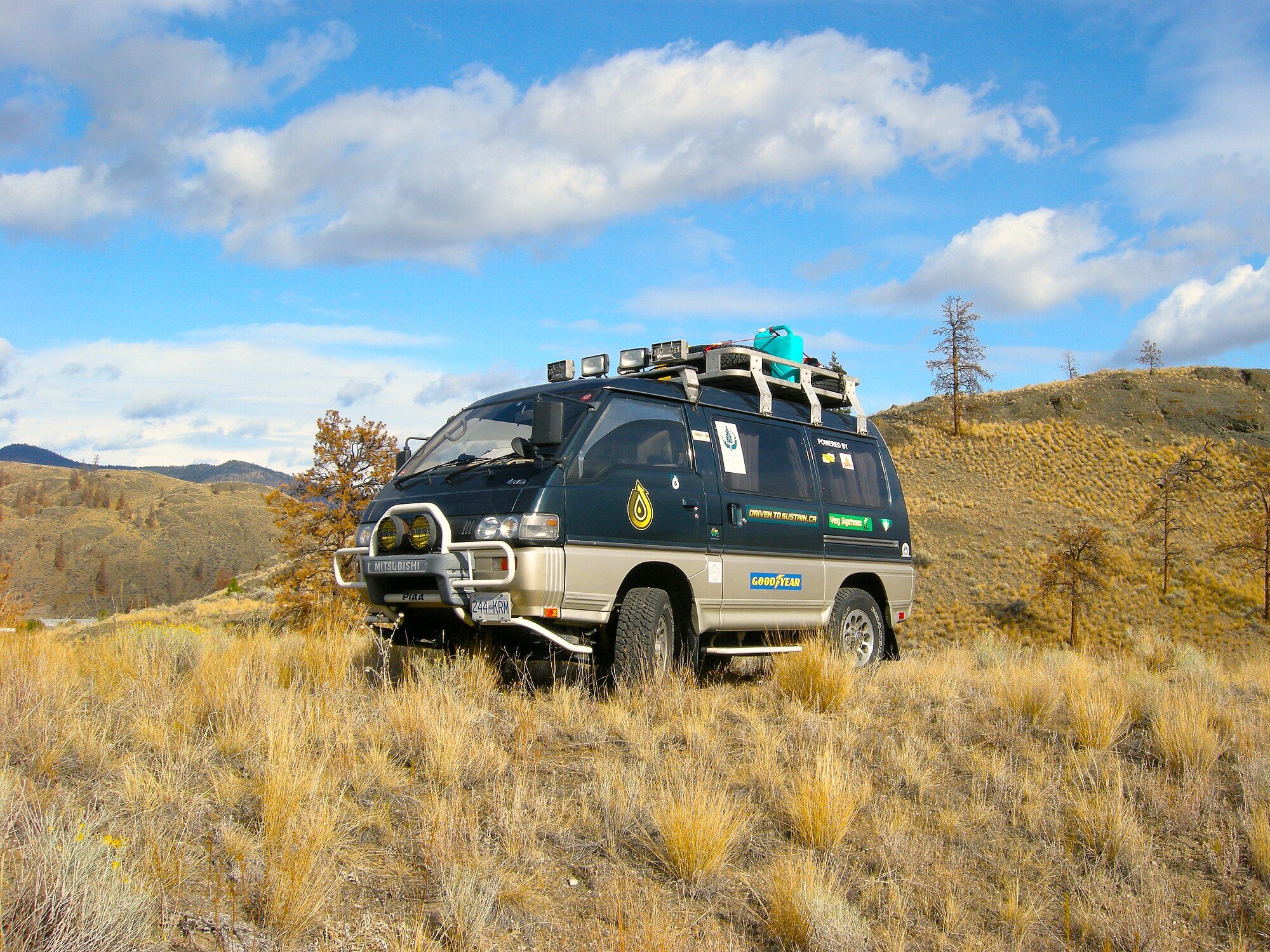
A dark green and silver late-model Delica Star Wagon 4WD with a roof rack, light bar and bull bar parked in dry grassland among pines in British Columbia
MITSUBISHI DELICA · L300 STAR WAGON 4WD · 1986–1999

Delica Star Wagon (L300 4WD)

P25W · P35W (DIESEL 4WD)P23W · P24W (PETROL 4WD)4D56 2.5 TURBO-DIESELPART-TIME 4WD · LOW RANGECAB-OVER · ENGINE UNDER THE SEATSRHD · JDM IMPORT

“A shipping container that learned to climb. You sit on top of the front wheels with a 2.5-litre turbo-diesel under your bum, 85 PS doing its honest best, and a low range that makes the whole absurd box go places minivans have no business going. Slow, tippy, rust-prone and completely lovable.”

PART 01

Overview

Where it came from, why it matters, and how it changed year to year.

The story

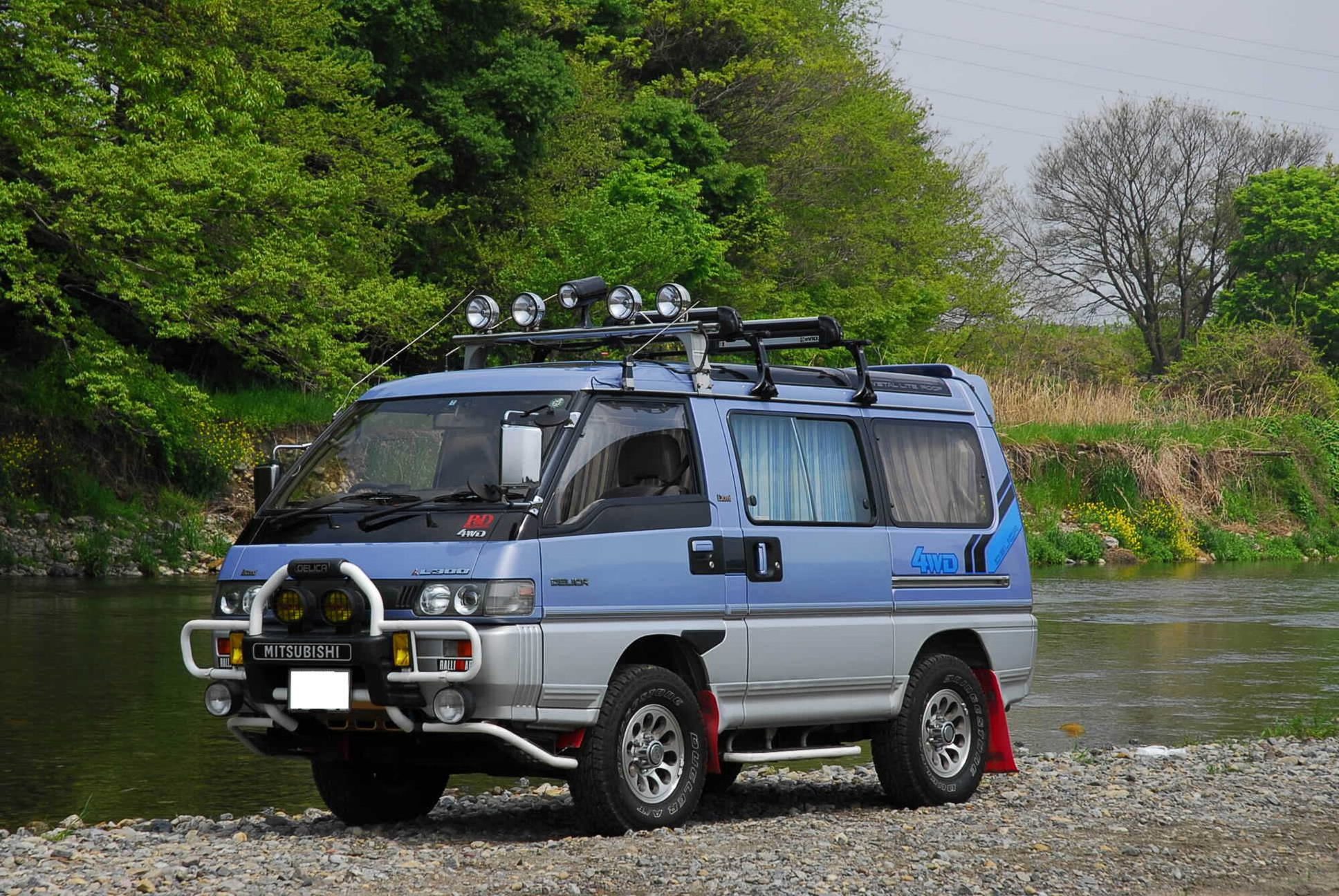
In June 1986 Mitsubishi launched the third-generation Delica, a one-box van whose rounded corners it called 'soft cube' styling. The passenger version was the Delica Star Wagon, export markets knew it as the L300, and the version that matters here had four-wheel drive, a low range and a turbo-diesel mounted under the front seats. Japan's recreational-vehicle boom was getting going, and the Star Wagon 4WD was its most improbable product: a family people-mover that could follow a Pajero up a forest road, as long as nobody was in a hurry.

A VAN BUILT ON A 4X4'S BONES

Underneath the van body, the 4WD Star Wagon borrowed its running gear thinking from the contemporary first-generation Pajero: double-wishbone front suspension on torsion bars, a leaf-sprung live axle at the back and a part-time system with a two-speed transfer case. Wikipedia notes that parts are seldom interchangeable, though, and the body is a monocoque rather than a Pajero-style ladder frame. Crankshaft Culture, whose editor runs the MDOC USA owners' group on Facebook, calls the idea that a Delica is 'just a Pajero with a van body' one of the most common misconceptions in the scene.

The layout is pure cab-over. The engine sits beneath the driver and front passenger, so you get to it by lifting the front seats, and the driver sits directly above the front wheels. At launch the 4WD came with either a 2.0-litre petrol four (P23W) or the 2,476 cc 4D56 turbo-diesel (P25W), both with a five-speed manual. Japanese catalogues rate the diesel at 85 PS at 4,200 rpm and 20 kg·m (196 N·m) at 2,000 rpm, enough to move a van of 1,700 kg or more at a dignified pace.

THE BUBBLE-ERA OPTION LIST

Mitsubishi then did what Japanese makers did in the late 1980s: it added things. An automatic for the 4WD turbo-diesel arrived in August 1988, and a 2.4-litre petrol 4G64 (P24W) followed in 1989. You could have an Aero Roof, a High Roof (the high-roof diesel is the P35W) or the Crystal Lite Roof, a high roof lined with glass panels. Trims ran from DX and XL through GLX and Exceed to the Super Exceed. Owners describe options such as a fridge-like 'Cool Box' between the front seats, swivelling middle benches and even a factory karaoke unit.

The special editions are the ones importers love. Gulliver's catalogue lists a Chamonix package almost every autumn from October 1989, and Jasper editions in February 1993 and January 1994. GearJunkie says both were aimed at winter sport, with waterproof carpet, dual batteries and a limited-slip rear differential. An August 1990 facelift stretched the body from 4,460 to 4,485 mm, and later vans have the cluster of projector headlamps that most people picture when they think 'Delica'.

SLOW, TIPPY AND SURPRISINGLY GOOD

Nobody buys an L300 for speed. Crankshaft Culture quotes a top speed of about 87 mph (140 km/h) and says its own diesel van was happiest at 60 mph. It's tall and narrow, and torsion-bar front suspension doesn't flex much. Off the pavement, though, the short 2,240 mm wheelbase, 210 mm of ground clearance, low range and 30-inch tyres on stock suspension add up to a van that took the same owners down Death Valley's Lippincott Grade and through the obstacle course at the BC Overland Rally, on open diffs. 'It does get a bit tippy, however,' they added.

THE LONG GOODBYE AND THE GREAT MIGRATION

The Delica Space Gear arrived in May 1994 with a short hood and the Pajero's Super Select 4WD, but the old van didn't disappear. Gulliver's catalogue shows the Star Wagon continuing as a 4WD turbo-diesel GLX, plus Active World specials in 1996 and 1997, until October 1999. Meanwhile, Mitsubishi had sold a two-wheel-drive, 2.4-litre petrol version in the US from 1987 to 1990, simply as the Van and Wagon. The 4WD diesel never came here new.

It came anyway. Once Canada's 15-year import rule allowed it, right-hand-drive Star Wagons began arriving in Canada, especially British Columbia, and DrivingLine counted nearly twenty vans, almost all of them right-hand-drive turbo-diesel Delicas and many imported via Canada, at a 2018 owners' meet in Oregon. The US 25-year rule has made every L300 legal to import since the last ones turned 25. Some states have pushed back: Maine began revoking Delica registrations in 2021, and Michigan sent owners similar letters in 2024. The van's reputation keeps growing, and an Italian team entered a 1990 L300 in the Classic class of the 2026 Dakar Rally.

SIDEBAR · 48,535 KM ON FRYER OIL

The Delica that set a Guinness record

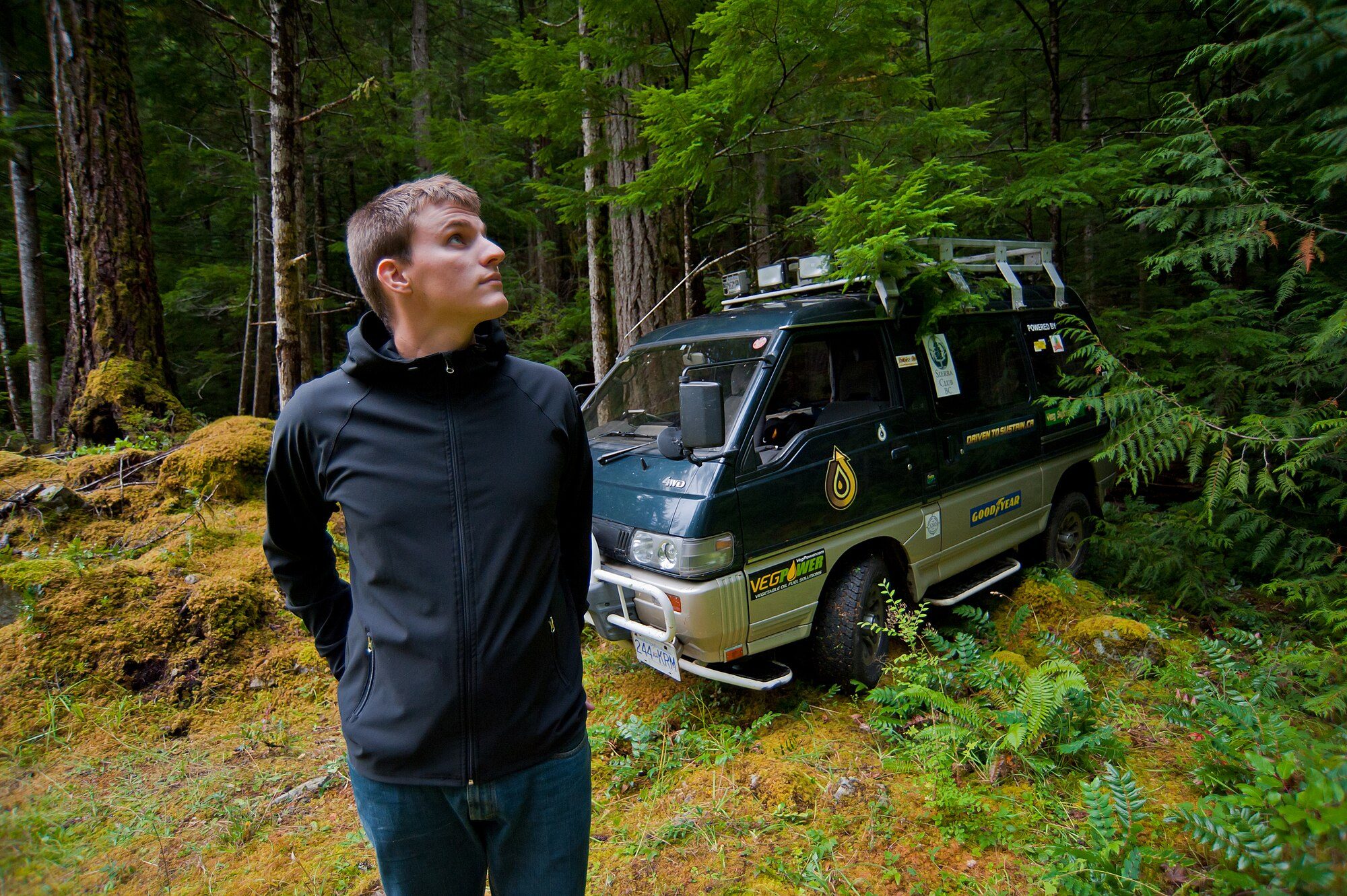
On October 1, 2008, Canadians Tyson Jerry and Cloe Whittaker left Mile Zero in Victoria, BC, in a 1993 Delica converted to run on biodiesel and waste vegetable oil. Their Driven to Sustain campaign, run with the Sierra Club of BC, visited schools along the way. The first attempt ended after 19,697 km with a mechanical failure near Columbia, South Carolina.

After repairs, Jerry restarted alone from South Carolina in November 2009, collecting used cooking oil from restaurants across Canada, the US and Mexico. He finished in Vancouver on May 4, 2010, after 48,535.5 km (30,158.5 miles). Wikipedia says that is the Guinness World Record for the longest journey by car using alternative fuel.
Year by year

What changed, model year by model year. Sweet spot Beware Recall

Best years across every Mitsubishi Delica generation →

  1. 1986June: third-generation Delica launches. Star Wagon 4WD with 2.0 G63B petrol (P23W) or 2.5 4D56 turbo-diesel (P25W/P35W), five-speed manual only
  2. 1987US sales of the two-wheel-drive, petrol Mitsubishi Van and Wagon begin (2.4 4G64, 107 hp), running to 1990
  3. 1988August: four-speed automatic (Aisin AW03-72L) for the 4WD turbo-diesel; automatic diesels get a twin-tank 75 L fuel system
  4. 1989August: 2.4 4G64 MPI petrol (P24W) replaces the 2.0 in the 4WD range; Crystal Lite Roof grades appear. October: first Chamonix special edition
  5. 1990August: facelift lengthens the body to 4,485 mm; Super Exceed added; later vans get projector headlamps and pop-out side windows
  6. 1993February: Jasper special edition. From May 1993 the 4D56 takes a different balance-shaft belt (MD310484 instead of MD363481)
  7. 1994May: Delica Space Gear launches; the Star Wagon range shrinks to GLX and X diesels, mostly 4WD
  8. 1996–1997Active World and Active World Winter Special editions
  9. 1999October: the Star Wagon drops out of Mitsubishi Japan's catalogue
  10. 2021Maine begins revoking registrations of imported Delicas, classing them as off-road vehicles
  11. 2024Michigan sends Delica owners letters saying the vans can be titled only as off-road vehicles
PART 02

Specs & capability

How it’s built, what it can do, and what fits under it.

How it’s built

The 4WD Star Wagon is a monocoque cab-over van with Pajero-style running gear: torsion-bar independent front suspension, a leaf-sprung live rear axle and a part-time transfer case with low range. The engine sits under the front seats, behind the front axle line, which is why Wikipedia lists the layout as mid-engine. Wheels bolt on with six studs on a 139.7 mm circle, like a Pajero's.

BODYMonocoque cab-over van, 2,240 mm (88.2 in) wheelbase on the 4WDAero Roof 1,975 mm tall; High Roof and Crystal Lite Roof 2,090 mm. Front subframes carry the suspension and bolt to the chassis rails.
FRONT SUSPENSIONDouble wishbone on torsion barsRide height adjusts at the torsion-bar anchors, so 1–2 in of lift is a spanner job.
REAR SUSPENSIONLive axle on semi-elliptic leaf springsLimited-slip rear differential on some grades, including Chamonix and Jasper.
4WD SYSTEMPart-time 2H / 4H / 4L, two-speed transfer caseNo centre differential (unlike the Space Gear's Super Select). Automatic-locking front hubs are most common; some vans have permanently locked flanges.
ENGINE4D56 2,476 cc SOHC turbo-diesel I485 PS at 4,200 rpm, 196 N·m (145 lb-ft) at 2,000 rpm, 21:1 compression, distributor injection pump, no intercooler. Petrol: 2.0 G63B (to 1989) and 2.4 4G64 (from 1989).
TRANSMISSION5-speed manual; 4-speed automatic from 1988The automatic is an Aisin AW03-72L, which Mitsubishi calls the V4AW2. Toyota and Volvo used versions of the same gearbox.

Variants & engines

YEARSPLATFORMENGINEOUTPUTWORTH KNOWING
Jun 1986 – Aug 1988P23W · P25W2.0 G63B petrol / 2.5 4D56 turbo-diesel115 PS / 85 PSFive-speed manual only. Aero Roof and High Roof, 4,460 mm long.
Aug 1988 – 1990P25W · P35W2.5 4D56 turbo-diesel85 PS · 196 N·mFour-speed automatic added for the 4WD diesel; automatic diesels get a twin-tank 75 L fuel system.
Aug 1989 – May 1994P24W2.4 4G64 MPI petrolNot confirmedReplaced the 2.0 in the 4WD range. Gulliver's catalogue repeats the 2.0's 115 PS figure, which we couldn't verify.
Aug 1990 – May 1994P25W · P35W2.5 4D56 turbo-diesel85 PS · 196 N·mFacelift to 4,485 mm long. Super Exceed added; Chamonix and Jasper specials.
May 1994 – Oct 1999P25W · P35W2.5 4D56 turbo-diesel85 PS · 196 N·mSold alongside the Space Gear as GLX and X diesels (the X also in 2WD), plus Active World specials in 1996–97.
1987–1990 (US)Mitsubishi Van / Wagon2.4 4G64 petrol107 hpThe only version sold new in the US: two-wheel drive, petrol, left-hand drive. LS Wagon added for 1990–91.

Capability numbers

TowingNo factory figure foundOwners tow light trailers, typically up to about 1 tonne; one says no more than 3,000 lb for long distances
Fuel tank60 L (15.9 US gal) or 75 L (19.8 US gal)75 L on automatic diesels, which use a twin-tank system, and on some later petrol vans (Gulliver; Delica.ca)
Ground clearance210 mm (8.3 in)GLX and up on 215SR15; 185 mm on base grades with 14-inch tyres
Curb weight1,600–1,960 kg (3,530–4,320 lb)From a 2.0 petrol manual GLX to a Super Exceed Crystal Lite automatic
Dimensions4,485 × 1,695 × 1,975 / 2,090 mmAero / High Roof, after August 1990; 4,460 mm long before
Wheelbase2,240 mm (88.2 in)
Turning radius5.0 m (16.4 ft) minimum1990 Exceed catalogue figure
Fuel economy≈10–12.8 L/100 km (18–23 US mpg)Real-world owner reports, diesel
Top speed≈140 km/h (87 mph)Per Crankshaft Culture; owners cruise at 60–65 mph

Wheels & tires

Try the tire fitment tool: biggest tire at every lift →

FACTORY TIRES
215SR15 on 6J x 15 steel or alloy wheels (4WD GLX and up)195SR14 on base XL / X 4WD grades with lower ride height
Bolt pattern6x139.7 (6x5.5")
Offset+22 mm (stock 6J x 15)
Center bore110 mm
Lug threadM12x1.5
LIFTBIGGEST TIREWHAT IT TAKES
Stock30x9.50R15 (or 235/75R15)Fits in most cases, per Delica.ca. Use 7-inch-wide wheels at about stock offset, because an 8-inch wheel may touch the upper ball joint. Wind sagging torsion bars back to stock height first.
2 in31x10.50R15Torsion-bar adjustment plus ball-joint spacers. Trim the seam at the rear of the front arch above the mud flap; one owner also had to rework the step brackets with 255/70R16s.
2 in+LT235/85R16Owners call it a tight fit even with 2 inches of lift. One owner made it work without a lift only by removing the front steps and modifying the front arches.

Forum consensus, not a guarantee: wheel offset, tire brand and suspension wear all change clearance. Confirm before you buy.

Production & special editions

Built at Mitsubishi's Nagoya plant; Japanese catalogue listings run from June 1986 to October 1999.

Japanese catalogueJune 1986 – October 1999 (Star Wagon)
AssemblyNagoya, Japan (licensed versions by Hyundai, CMC and others)
US sales1987–1990 only, as the two-wheel-drive petrol Mitsubishi Van and Wagon
4WD chassis codesP23W, P24W, P25W, P35W
ChamonixOctober 1989 – 1994 (annual specials)Winter-sport edition named after the French ski resort, with graphics and embroidered seats; GearJunkie lists waterproof carpet, dual batteries and a rear LSD
Super ExceedAugust 1990 – 1994Top grade, Crystal Lite Roof and automatic
JasperFebruary 1993; January 1994Outdoor-themed edition in Aero Roof and High Roof forms
GLX / Exceed Limited EditionJanuary 1994; January 1996Late limited runs
Active World / Active World Winter Special1996–1997Late editions of the GLX 4WD diesel; the Winter Special came in Aero Roof and High Roof forms

The 1990–91 Exceed Crystal Lite Roof listing shows Soffia White, Grace Silver, Lamp Black and Ivy Green, plus an optional Coral Blue and Soffia White two-tone.

PART 03

Buying one

What to pay, what to check, and how to tell a good one from a clone.

What they cost

Prices are firming, with the best money going to clean, low-rust late vans and named editions such as Jasper, Chamonix and Active World. Rust, not mileage, sets the floor.

Tired driver / some rust$7k–9.5k
Good driver$10k–14k
Excellent / special edition$15k–17.5k+

Based on 11 Bring a Trailer L300 sales from June 2025 to October 2026, from $7,400 (a 1991 Exceed) to $17,500 (a 1997 Active World Winter Special high roof). A 1993 Jasper sold for $15,250 and a 1994 five-speed for $16,200. Hagerty's valuation wasn't checked. Prices move; checked October 2026. See live listings below.

What to check before you buy

  1. 01
    Rust is the deal-breakerEvery buyer's guide and forum thread says the same thing: buy the rust-free van, not the one with the better engine. Check the pinch welds along the bottom of the body, the box sections behind the front steps, under the sliding-door step and the rear corners, then the windscreen pillars and roof gutters, which a Delica.ca veteran says are usually the first to go. A bubble outside means far more inside.
  2. 02
    Pull up the carpetsWet footwells are a known L300 problem. Water gets in through the front panel seams above the headlamps, the windscreen seal, gutter seams, the antenna base and the washer jets, and one owner found his driver's floor and a seat-mount bolt rusted through from underneath. Feel the carpet and look for that 'wet dog' smell.
  3. 03
    Crystal Lite and high roofsGearJunkie warns that Crystal Lite glass roofs are more prone to leaks and rust, and Delica.ca has threads about rusty roofs on 1993 Crystal Lite vans. Check every glass panel seal and the gutters, and look at the roof from a ladder.
  4. 04
    Ask about the head and the beltsHead gaskets and cracked heads are the 4D56's known weakness in this van, usually after overheating. Ask for records of the timing belt, balance-shaft belt and water pump. Watch the temperature gauge on a long climb, look for bubbles or pressure in the coolant overflow and check for white smoke.
  5. 05
    Test 2H, 4H and 4L, and both hubsEngage 4H and 4L and drive on loose ground to make sure both front hubs actually lock. One Delica.ca member points out that the clunk of engagement doesn't prove both hubs are working. Automatic hubs need cleaning and greasing, and a seized one is a common find.
  6. 06
    Don't trust the LSD stickerA limited-slip rear diff was standard on some grades, and many vans have a door-jamb LSD sticker. Forum members warn that stickers go missing and appear on vans without an LSD. Jack up one rear wheel and spin it: if the other wheel turns the same way, it's a limited slip.
  7. 07
    Check the paperwork and your stateGet the import entry documents (CBP and EPA forms) and a clean title. Then confirm your state will register it. Maine revoked Delica registrations in 2021 and Michigan sent owners letters in 2024. Crankshaft Culture also says many mainstream insurers won't cover a Delica at an agreed value, so get a quote first.
  8. 08
    Drive it like it'll be drivenA healthy 4D56 is slow but should pull cleanly without heavy black smoke or a clattery 'tractor' noise at idle. That noise can mean a timing belt that has jumped a tooth. On automatics, a harsh 1–2 shift under power can mean a blocked filter screen, and a missing kickdown action can mean a broken kickdown cable.

Take these to the test drive: get the free printable Delica Star Wagon (L300 4WD) inspection checklist →

Spotting the real thing

Almost every L300 in North America is a right-hand-drive Japanese import, and Mitsubishi offered a huge number of variants. Identify the exact van from its frame number and model code, not from the seller's description.

  1. ID
    Frame numberStamped plate under a plastic cover between the driver's seat and the door, reading P25W or P35W followed by the serial. Enter it into a Mitsubishi parts catalogue (Megazip, Amayama) to see the exact build, engine and parts.
  2. ID
    Chassis code4WD vans: P23W (2.0 petrol, to 1989), P24W (2.4 petrol, from 1989), P25W (diesel, Aero Roof or sunroof) and P35W (diesel, High Roof or Crystal Lite Roof). P03W, P04W, P05W and P15W are two-wheel-drive Star Wagons.
  3. ID
    Model-code prefixJapanese catalogues add an emissions prefix that dates the diesel: N-P25W (1986–88), Q-P25W/P35W (1988 to mid-1993), Y-P25W/P35W (from mid-1993), and KD-P25W/P35W on late vans (seen by 1997).
  4. ID
    RoofAero Roof vans are 1,975 mm tall and High Roof vans 2,090 mm. Crystal Lite Roof vans have a high roof with glass panels; check every seal.
  5. ID
    Special editionsChamonix and Jasper vans carry side graphics and embroidered seat backs. GearJunkie says they added waterproof carpet, dual batteries and a rear LSD. Verify against the frame-number lookup, because graphics are easy to add.
  6. ID
    Limited-slip diffDon't trust the door-jamb LSD sticker. Lift one rear wheel and spin it: if the other wheel turns the same way, it's a limited slip; if it turns the opposite way, it's open.
  7. ID
    Automatic gearbox plateThe Aisin plate reads AW03-72L when the gearbox has a lock-up converter ('L'); not every L300 automatic does. A code such as '91D' is the build year and month (D = April).

Importing & legality

No 4WD Star Wagon was sold new in the US, so every example here is an import. The federal motor-vehicle exemption applies once a vehicle is 25 years old, counted from its own build date. The last Star Wagons left the Japanese catalogue in October 1999, so as of October 2026 every L300 qualifies. EPA's exemption is separate: the vehicle must be at least 21 years old and in its original configuration, or fitted with an equivalent or newer EPA-certified engine. Keep the CBP and EPA entry paperwork, because a DMV may ask for it.

Registration is a state matter, and the Delica has been singled out. In 2021 Maine began revoking Delica registrations, treating the vans as off-road vehicles under a new definition in Title 29-A, and a 2023 bill sought to reverse that. In 2024 Michigan told owners the vans could be titled only as off-road vehicles, wrongly grouping them with kei-class mini trucks. Crankshaft Culture wrote in April 2025 that Maine was the only state still refusing them, but check your own state's current rules before you buy. Canada's threshold is 15 years, which is why many vans reach the US by way of British Columbia, and some provinces restrict right-hand-drive vehicles. Agreed-value insurance can be hard to get, and Crankshaft Culture used Hagerty.

Rules change and vary by state and country. Confirm with your DMV and a licensed importer before you buy. How importing works: the 25-year rule, duty and registration →

The one you’ll own someday

For sale now

1986–1999 · all 25-year eligibleDelica Star Wagon (L300)
1986–1990 · early, quad headlampsDelica L300 pre-facelift
1991–1999 · late, projector headlampsDelica L300 facelift (Chamonix, Jasper, Super Exceed)
PART 04

Owning one

Baseline service, the repairs you’ll actually do, and where the manuals live.

Post-purchase baseline

After you buy it

Treat any imported Star Wagon as unserviced until you see receipts, and don't take an importer's 'fully serviced' at face value. GearJunkie notes that good importers do the timing belt, water pump, hoses, glow plugs and fluids. The capacities below come from Liqui Moly's lookup, which uses European data for the L300 2.5 TD 4WD (1987–94). Confirm them in the workshop manual for your frame number, because automatics, twin-tank vans and Japanese-market specs differ.

All Delica Star Wagon (L300 4WD) specs, fluids and service intervals on one printable page →

Engine oil & filterDiesel-rated 15W-40 (among the grades Liqui Moly lists) · 4.9 L plus 0.7 L for the filterEvery 5,000 km (3,000 mi) or 6 months

That's Liqui Moly's normal interval, and the one veteran Delica.ca owners use. Some owners quote a larger total fill, so use the dipstick.

Timing belt, balance-shaft belt, tensioners & water pump4D56: two belts, change together100,000 km on a sound engine; owners use 70,000–90,000 km on old ones

No receipt means do it now. The balancer belt part number changed in May 1993.

Glow plugs6 V plugs for the super-quick glow system: Mitsubishi MD092392 or NGK 2161When starting gets slow, or on any van without records

Generic 6 V plugs often don't work with the factory controller.

Fuel filter & injection-pump inlet screen confirm in manualFuel filter on purchase, then per manual

Bleed the system afterwards. One Delica.ca thread traces high EGTs and a sluggish van to a clogged banjo filter at the injection pump inlet.

Air filterPanel element; the housing is under the driver's seatOn purchase, then per manual

Delica.ca's first advice for low power is to check the air filter (and battery terminals).

Coolant≈10 L (10.6 US qt); ≈10.5 L with rear heaterEvery 40,000 km or 48 months

The cooling system protects the head gasket. Check the radiator, fans, thermostat and hoses, not just the coolant.

Automatic transmission fluid & screenDexron II per manual (Dexron III is the usual substitute) · ≈4 L pan drop, ≈7 L totalDrain-and-fill on purchase; change the screen if shifts are harsh

An owner who tried Dexron VI went back to Dexron III. Pan bolts are only about 4.5 N·m.

Manual gearbox oil≈2.0 L · 75W-85 GL-4 (manual; 75W-90 listed for Europe)Check 20,000 km; change every 80,000 km

One owner reports better shifting with a GL-4 than a GL-5 gear oil.

Transfer case≈2.2 L · 75W-85 GL-4 per the manual quoted on Delica.ca (Liqui Moly lists 75W-90 GL-4/5)On purchase, then with the gearbox
Front & rear differentialsFront ≈1.1 L, rear ≈1.8 L · GL-5 85W-90 (or 80W); LSD-rated oil in a limited-slip rearChange every 80,000 km (40,000 km in severe use)

Spin-test the rear axle to find out whether you have an LSD before you buy oil.

Power steering fluidATF · ≈0.9 LFlush on purchase
Brake & clutch fluidDOT 3 or DOT 4Every 40,000 km or 48 months

The hydraulic clutch shares the fluid type.

Automatic locking hubsClean and regreaseAbout as often as you change brake pads

Advice from a long-time Delica.ca member. Hubs that gum up fail to lock when you need them.

Front end & subframe nutsGrease ball joints with nipples; check the 17 mm rear-subframe nutsAt every oil change

Loose subframe nuts cause 'the classic L300 clunk'.

For the hands-on owner

Common repairs

The jobs owners actually end up doing, rated for a competent home mechanic with a decent tool kit. Always confirm torque figures, fluids and procedures against the factory service manual for your VIN, and work safely — support the truck on stands, never just a jack. You do this work at your own risk; see the disclaimer. Some parts links are affiliate links.

Hunting a used or discontinued part? Search eBay Motors for Mitsubishi Delica Star Wagon (L300 4WD) parts →

Timing and balance-shaft belts (4D56) →
DIFFICULTY · 3 / 5TIME · A day for a first-timerSHOP COST · Parts plus labor
SYMPTOMSUsually none before it fails. A belt that has jumped a tooth gives a loud, clattery 'tractor' noise at idle and on the move, black smoke, low power and sometimes oil consumption. A broken balance-shaft belt can knock the timing belt off a tooth and then hide in the bottom of the cover.
THE FIXRemove the top timing cover and look for bits of belt. Turn the engine until the camshaft and injection-pump sprocket marks line up, then check that the crank pulley notch points at the leftmost 'T' mark on the lower cover (pages 11B-14 and 11B-15 of Mitsubishi's '4D5 & 4G7 Engine Manual', as quoted on Delica.ca). Replace the timing belt and the balance-shaft belt together, with their tensioners, and the water pump while you're there. You'll need to hold the crank pulley to undo its bolt and a puller to remove it. Owners say the factory 100,000 km interval suits a new, dry engine, but 70,000–90,000 km is safer on an old engine with oily, worn pulleys.
TOOLS & PARTSWorkshop manual · crank pulley holding tool and puller · torque wrench · belt tension gauge or the manual's method · balancer belt MD310484 (engines from May 1993) or MD363481 (earlier), per a Delica.ca member; confirm by frame number.
Head gasket or cracked cylinder head →
DIFFICULTY · 4 / 5TIME · A weekend or moreSHOP COST · Parts plus labor
SYMPTOMSOverheating, coolant loss, pressure or bubbling in the overflow tank, white smoke or oil in the coolant. Delica.ca members link most failures to overheating: the 4D56 has an aluminium head on an iron block and a 21:1 compression ratio, and it doesn't like being worked hard before it's warm or flogged up long hills.
THE FIXFollow the step-by-step head replacement and timing-belt thread in Delica.ca's L300 library. Owners report the head can come off with both manifolds still attached. The 4D56 head bolts are not torque-to-yield and can be reused if they're in as-new condition, but replace any pitted or galled ones. While the head is off, check the core plugs, which can rust through. Fit new injector nozzle washers; one member torques the injectors to 54 N·m. Some owners re-torque the head bolts after 5,000 km, a practice others consider unnecessary with modern gaskets. Afterwards, fit an EGT gauge and back off on climbs.
TOOLS & PARTSWorkshop manual · torque wrench · gasket scraper · straight-edge and feeler gauges to check the head · long socket for injectors · coolant and fresh timing belts.
Glow plugs and the 'super-quick glow' controller →
DIFFICULTY · 2 / 5TIME · 1–3 hoursSHOP COST · Parts plus labor
SYMPTOMSHard cold starts, a long crank before it fires, or an engine that cranks but won't start at all. A loose wire at the glow-plug bus bar or a burned trace inside the controller can stop everything.
THE FIXThe controller learns how hot the plugs are by measuring their resistance and runs 6 V plugs on a 12 V system through two relays. That's why generic 6 V plugs (often CP-06 types) don't work with it. Delica.ca members fit Mitsubishi MD092392 or NGK 2161. Check the bus-bar connection first. On right-hand-drive vans the controller sits in the driver's-side B-pillar behind the seat-belt reel. One owner found a burned trace to the relay and bridged it with wire. Don't keep cranking a no-start engine to warm it up: that overheats the glow relay and controller.
TOOLS & PARTSMultimeter · deep socket for the glow plugs · anti-seize · soldering iron if you're repairing the controller.
Valve cover gasket and half-moon seal →
DIFFICULTY · 1 / 5TIME · ≈ 30–60 minutesSHOP COST · Parts plus labor
SYMPTOMSOil weeping down the back of the engine, oily smell in the cab and a damp underside. The factory rubber half-moon seal at the back of the head shrinks and hardens.
THE FIXLift the seats and engine cover. One owner says you don't need to remove the fan shroud or timing cover: undo the two 12 mm bolts, three hoses and two plugs, then roll the cover off over the valve gear. Clean both surfaces thoroughly. Delica.ca's Growlerbearnz fits the alloy half-moon seal (Mitsubishi MD372348) with grey high-strength silicone, and says red or black silicone is too soft. Don't put silicone between the cover and its gasket.
TOOLS & PARTS10 and 12 mm sockets · degreaser and scraper · small mirror · grey RTV silicone.
Automatic transmission filter screen and fluid →
DIFFICULTY · 2 / 5TIME · ≈ 2 hoursSHOP COST · Parts plus labor
SYMPTOMSA harsh 1–2 shift when you accelerate hard from a stop, which suggests a clogged filter screen. Poor or no kickdown can be a broken kickdown cable, and one owner says replacing a broken cable transformed his shifting.
THE FIXDrain the pan, then detach the dipstick tube (one 12 mm bolt; do it from above because of its O-ring). Remove the pan. The bolts are only about 4.5 N·m. Unbolt the mesh screen (about 5.5 N·m) and catch the roughly half-litre of fluid trapped above it. Refit with the factory gasket if it comes off cleanly. The manual specifies Dexron II, which Dexron III replaces. Growlerbearnz tried Dexron VI after a rebuild and went back to Dexron III because of harsh shifts and slip. A pan drop takes about 4 L, and a full change about 7 L. Check the level hot, with the engine running, after cycling through the gears.
TOOLS & PARTSDrain pan · 8, 10 and 12 mm sockets · inch-pound torque wrench · long funnel · Dexron III ATF.
Find and seal footwell water leaks →
DIFFICULTY · 2 / 5TIME · A weekendSHOP COST · Sealant and time
SYMPTOMSWet carpets, a 'wet dog' smell and rust starting under the front mats.
THE FIXWork through Delica.ca's complete leak guide, worst offender first. Remove the front quarter panels above the headlamps, dig out the cracked seam sealer, paint and reseal: that fixed about 80% of one owner's leaks. Then check the windscreen seal and the rust-prone screen flange, the antenna base, the roof-gutter seams (reseal with an adhesive seam sealer after removing the trim), the washer-jet stalks and the wiper spindles. If the floor still gets wet, look underneath: another owner found the floor pan and a seat-mount bolt rusted through.
TOOLS & PARTSTrim tools · scraper and wire brush · primer and paint · flexible body seam sealer · non-hardening windscreen sealant.
Front-end clunk: subframe nuts, anti-roll bar bushes and upper ball joints →
DIFFICULTY · 2 / 5TIME · 1–4 hoursSHOP COST · Parts plus labor
SYMPTOMSA loud bang from the front when turning or reversing, wandering steering or clunks over bumps.
THE FIXGrowlerbearnz calls it 'the classic L300 clunk' and lists two usual causes. First, the 17 mm nuts holding the rear suspension subframe to the chassis rails work loose, and they should be very tight. Second, the anti-roll bar bushes wear. Then check the upper and lower ball joints, tie-rod ends, CV play, shock bushes and wishbone bushes. To change an upper ball joint, support the van, back the 24 mm castellated nut off a few turns, break the taper, then remove the three bolts on top of the upper arm. One member gives the OEM upper joint as MR241623. With ball-joint lift spacers, fit a long straight grease nipple.
TOOLS & PARTSJack and stands · 17 and 24 mm spanners · ball-joint separator or a big hammer · torque wrench · split pins.
Fit a LOKKA front locker →
DIFFICULTY · 4 / 5TIME · ≈ 1–2 hours to remove the diff, plus the installSHOP COST · Locker plus seals
SYMPTOMSNot a fault, but the upgrade owners make most often for traction: the front axle is open, and only some vans have a rear LSD.
THE FIXLOKKA lists an automatic front locker for the 1987–94 L300. Growlerbearnz removes the front diff without disturbing the alignment by taking off the left knuckle and loosening the left rear-subframe nuts; he reckons the removal takes about an hour without seized bolts. Measure backlash and the tooth pattern before you strip it, and keep shims and bearing caps in order. Fit the locker, then check the inter-cam clearance (0.145–0.165 in, per his write-up). He lists part numbers for a 1991 P25W: shim kit MB185519, cross pin MB241909, drive-shaft seals MB290013 (two), side bearings MB092348 and cover gasket MB160579.
TOOLS & PARTSWorkshop manual · ball-joint separator · bearing puller · dial indicator · feeler gauges · M10 x 1.25 tap · red thread locker · gear oil.

Manuals & documentation

Asked on every forum

Delica Star Wagon (L300 4WD) questions, answered

What's the biggest tire I can fit without a lift?

About 30 inches. Delica.ca's tech library says 30x9.50R15 tyres fit in most cases without issues, and 235/75R15s are a common fitment on imported vans. The stock size was 215SR15 on 15x6 wheels with a 6 x 139.7 mm bolt pattern. A 7-inch-wide wheel with the stock offset should fit, but an 8-inch wheel may touch the upper ball joint. Anything larger needs a lift and trimming of the seam at the rear of the front wheel arch. Make sure the torsion bars haven't sagged before you blame the tyre.

SOURCE · DELICA.CA · KOLESO.EE · BAT
Is a Delica just a Pajero with a van body?

No. The 4WD chassis was based on the contemporary Pajero's, but Wikipedia notes that parts are seldom interchangeable, and the Star Wagon has a monocoque body rather than a separate frame. Some brake and suspension parts are shared. Cross-reference every part by frame number.

SOURCE · WIKIPEDIA · CRANKSHAFT CULTURE
Can I import and register one in the US?

Every Star Wagon is now old enough for the US 25-year exemption, which counts from each van's build date. EPA has its own exemption for vehicles over 21 years old in original configuration. Registration is up to each state: Maine began revoking Delica registrations in 2021, Michigan sent owners similar letters in 2024, and a few DMVs simply don't know what to do with one. Check your state first.

SOURCE · JDM BUY SELL · AUTOBLOG · CRANKSHAFT CULTURE
How fast will it go on the highway?

Not very. The diesel makes 85 PS and 196 N·m. Crankshaft Culture gives the top speed as about 87 mph (140 km/h), says its own van was happiest at 60 mph and recommends staying around 65. Expect to slow down a lot on long climbs.

SOURCE · GULLIVER · CRANKSHAFT CULTURE
How does the 4WD work, and can I use 4H on pavement?

It's a part-time system with 2H, 4H and 4L and no centre differential, so 4H and 4L are for loose or slippery surfaces only. Most vans have automatic-locking front hubs. Engage 4WD before you need it, and apply power gently until the hubs lock. Rocking back and forth in mud is hard on auto hubs. With automatic hubs, 4L on pavement winds up the driveline, which is one reason some owners convert to manual hubs.

SOURCE · DELICA.CA · JDM BUY SELL
Does it have a locker or limited slip?

No factory locker, but some grades, including Chamonix and Jasper, have a limited-slip rear differential. Don't trust the door-jamb sticker: jack up a rear wheel and spin it, and if the other wheel turns the same way, it's an LSD. For more traction, LOKKA lists an automatic front locker for the 1987–94 L300.

SOURCE · DELICA.CA · GEARJUNKIE · LOKKA
How often should I change the timing belt?

Delica.ca members suggest 100,000 km on a sound engine and 70,000–90,000 km on old engines with worn pulleys and oil leaks. Always change the balance-shaft belt at the same time, because a broken balancer belt can take the timing belt with it.

SOURCE · DELICA.CA
Why do L300 head gaskets fail, and how do I prevent it?

Owners blame heat. The 4D56 has an aluminium head and a 21:1 compression ratio, and it has no intercooler. Let it warm up until the temperature needle moves, keep the cooling system healthy, and back off on long climbs. Several owners fit an EGT gauge; one keeps exhaust gas temperature under 1,000 °C, and another under about 1,400 °F. Watch the temperature gauge, not just the speedometer.

SOURCE · DELICA.CA
How much can it tow?

We couldn't find a factory towing figure. Delica.ca owners tow lightweight trailers: one tows an 1,100 lb trailer and a snowmobile trailer of about 800–900 lb, and another wasn't comfortable with anything over a tonne. A third said he wouldn't tow more than 3,000 lb for long. Fit a transmission cooler on an automatic and an EGT gauge.

SOURCE · DELICA.CA
What fuel economy and range should I expect?

Owners report roughly 10 to 12.8 L/100 km (about 18–23 US mpg). Tanks hold 60 L on most vans, or 75 L on automatic diesels, which use a twin-tank system. Owners with 75 L tanks typically get 450–550 km before refuelling.

SOURCE · DELICA.CA · GULLIVER
Diesel or petrol?

Most US imports are 4D56 turbo-diesels, which offer low-end grunt, better economy and the head-gasket caveats above. Petrol 4WD vans (the 2.0 P23W, then the 2.4 4G64 P24W from 1989) exist but are rarer. Crankshaft Culture rates the US-spec 2.4 4G64 at about 107 hp and says the petrol engine is the better highway cruiser.

SOURCE · GULLIVER · CRANKSHAFT CULTURE
Where do I get parts?

Filters, belts and many brake parts can be cross-referenced to North American parts-store items. Crankshaft Culture says the more specialised parts come from Japan through sellers such as Amayama and Megazip, or from Canadian JDM specialists, and can take a few weeks. Look parts up by the frame number (P25W- or P35W- followed by the serial), found under a plastic cover between the driver's seat and the door.

SOURCE · CRANKSHAFT CULTURE · DELICA.CA
PART 05

Building one

Who makes the good stuff, where owners gather, and who to watch.

Common modifications & who does them

FRONT LOCKERThe front axle is open and the rear may or may not be an LSD. An automatic front locker is the traction upgrade that Delica.ca's tech library documents step by step.
SUSPENSION & LIFTTorsion-bar adjustment brings sagging fronts back up, and ball-joint spacers add about 2 inches. Crankshaft Culture puts the practical limit at about 1.5–2 inches and names Ironman 4x4 and Dobinsons among the companies offering Delica suspension. Owners also fit firmer rear leaves or an extra leaf and Rancho shocks.
TIRES235/75R15 and 30x9.50R15 all-terrains fit without a lift. Lifted vans run up to 31x10.50R15, and one owner squeezed in LT235/85R16 DuraTracs by removing the front steps and trimming the arches.
MANUAL HUBSManual hubs avoid auto-hub failures when you're stuck and let you crawl in 4L on pavement without winding up the driveline. One owner bought Superwinch manual hubs from Summit Racing.
BRAKESThe stock single-piston front calipers are adequate at best. One Delica.ca member bolted on Raybestos dual-piston calipers specified for a 1992 Mitsubishi, trimming the dust shield about 2 inches.
CAMPING & AWNINGSThe fold-flat rear benches already make a bed. Add an awning and a roof basket and you have a camper. BaT's Chamonix example wore an Ironman 4x4 retractable awning.
OEM PARTS BY FRAME NUMBERGenuine Mitsubishi parts from Japan, looked up by frame number, are often the only route for trim, seals and drivetrain parts.

Clubs & events

Resources

Channels, accounts & forums

All Delica resources →
SourcesWikipedia — Mitsubishi DelicaGulliver (221616.com) — Delica Star Wagon catalogue, June 1986 – October 1999 (Japanese grade and spec listings)Gulliver — 1986–88 GLX Aero Roof P25W spec sheet (N-P25W)Gulliver — 1988–89 GLX Aero Roof P23W (2.0 petrol) spec sheetGulliver — 1989–90 GLX Aero Roof P24W (2.4 petrol) spec sheetGulliver — 1990–91 Exceed Crystal Lite Roof P35W spec sheetGulliver — 1991–92 Super Exceed Crystal Lite Roof P35W spec sheetGulliver — 1993–94 Chamonix Aero Roof P25W spec sheetGulliver — 1994 Jasper Aero Roof P25W spec sheetGulliver — 1998–99 GLX High Roof P35W spec sheet (KD-P35W)JDM Buy Sell — Mitsubishi Delica Star Wagon buyer's guideGearJunkie — Mitsubishi Delica van guideSabukaru — A Versatile Beast: The Mitsubishi Delica Star Wagon L300 (2021)Crankshaft Culture — Mitsubishi Delica Deep Dive FAQs (April 2025)Crankshaft Culture — 7 Things to Know About Owning a Mitsubishi Delica (2018)Crankshaft Culture — What We've Learned After a Year With Our Delica (2018)Crankshaft Culture — Michigan the Latest State to Revoke Mitsubishi Delica Registration (August 2024)Crankshaft Culture — Will Maine Reverse Course on Delica Deregistration? (January 2023)Crankshaft Culture — There's a 1990 Mitsubishi Delica L300 Competing in the 2026 Dakar Rally (December 2025)Autoblog — Maine is actively deregistering imported Mitsubishi Delicas — but why? (July 2021)DrivingLine — Vanlife-ing It at the Delicas Northwest Meet (2018)Wikipedia — Tyson JerryLiqui Moly oil guide (Olyslager data) — Mitsubishi L300 2.5 TD 4WD (4D56), 1987–1994 (Europe)Koleso.ee — Delica Star Wagon L300 (1986–1990) wheel and tyre dataBring a Trailer — Mitsubishi Delica auction resultsBring a Trailer — 1990 Delica L300 Star Wagon Chamonix Edition 4x4 (sold October 2026)Bring a Trailer — 1993 Delica L300 Star Wagon Jasper Edition (sold June 2026)Bring a Trailer — 1997 Delica L300 Star Wagon Active World Winter Special (sold January 2026)Delica.ca — L300 max tire size (Technical Reference Library)Delica.ca — Say you just lifted your L300Delica.ca — How does your L300 handle after a lift?Delica.ca — Adjusting the torsion barsDelica.ca — L300 head replacement and timing belt DIY, step by stepDelica.ca — Preventing blown head gasketsDelica.ca — Overheating / preventative solutionsDelica.ca — Timing belt replacement intervalsDelica.ca — Timing and balance belt part numbersDelica.ca — Timing belt slippage: black smoke, loud noises, low powerDelica.ca — Super-quick glow ECU function and glow plugsDelica.ca — Glow plug ECU fault diagnosis and repairDelica.ca — Here's how to replace your valve cover gasketDelica.ca — Transmission filter change + infoDelica.ca — Automatic transmission tips and infoDelica.ca — L300 footwell leaks: the complete guideDelica.ca — How much rust is too much?Delica.ca — Loud front suspension noiseDelica.ca — Changing the upper ball jointsDelica.ca — Upper ball joints with 2" liftDelica.ca — L300 Lokka installDelica.ca — Removing the front differential, the easy wayDelica.ca — Manual hubs for an L300Delica.ca — Twin fuel tanks and how they workDelica.ca — '91 L300 tank capacityDelica.ca — Quick answers to fuel capacity and 4WDDelica.ca — Towing capacity of L300 for a camperDelica.ca — Towing capacity, automatic versus manualDelica.ca — L300 manual transmission and transfer case fluidDelica.ca — Differential oil / transfer case / grease (LSD identification)Delica.ca — How to fit an EGR blanking plateDelica.ca — Welcome to Delica Canada: read this firstDelica.ca — EGTs high, truck sluggish: injection-pump banjo filter cloggedDelica.ca — Single to dual piston brake upgrade + auto to manual hubsDelica.ca — Canada Spring (rear leaf and shock upgrades)LOKKA — automatic differential lockersMegazip — genuine Mitsubishi parts catalogue, Delica Star Wagon 1986–1999Mitsubishi — L300 / Delica English-language workshop manuals, including the '4D5 & 4G7 Engine Manual' (as quoted by Delica.ca members)Gulliver (221616.com) — Delica Star Wagon catalogue, June 1986 – October 1999 (Japanese grade and spec listings)Gulliver — 1986–88 GLX Aero Roof P25W spec sheet (N-P25W)Gulliver — 1988–89 GLX Aero Roof P23W (2.0 petrol) spec sheetGulliver — 1989–90 GLX Aero Roof P24W (2.4 petrol) spec sheetGulliver — 1990–91 Exceed Crystal Lite Roof P35W spec sheetGulliver — 1991–92 Super Exceed Crystal Lite Roof P35W spec sheetGulliver — 1993–94 Chamonix Aero Roof P25W spec sheetGulliver — 1994 Jasper Aero Roof P25W spec sheetGulliver — 1998–99 GLX High Roof P35W spec sheet (KD-P35W)Wikipedia — Mitsubishi DelicaKoleso.ee — Delica Star Wagon L300 (1986–1990) wheel and tyre dataDelica.ca — L300 max tire size (Technical Reference Library)Delica.ca — Say you just lifted your L300Delica.ca — Upper ball joints with 2" liftDelica.ca — Transmission filter change + infoDelica.ca — Differential oil / transfer case / grease (LSD identification)Delica.ca — Timing and balance belt part numbersDelica.ca — Twin fuel tanks and how they workDelica.ca — '91 L300 tank capacityDelica.ca — Quick answers to fuel capacity and 4WDDelica.ca — Towing capacity of L300 for a camperDelica.ca — Towing capacity, automatic versus manualJDM Buy Sell — Mitsubishi Delica Star Wagon buyer's guideGearJunkie — Mitsubishi Delica van guideSabukaru — A Versatile Beast: The Mitsubishi Delica Star Wagon L300 (2021)Crankshaft Culture — Mitsubishi Delica Deep Dive FAQs (April 2025)Crankshaft Culture — 7 Things to Know About Owning a Mitsubishi Delica (2018)Crankshaft Culture — What We've Learned After a Year With Our Delica (2018)Crankshaft Culture — Michigan the Latest State to Revoke Mitsubishi Delica Registration (August 2024)Crankshaft Culture — Will Maine Reverse Course on Delica Deregistration? (January 2023)Autoblog — Maine is actively deregistering imported Mitsubishi Delicas — but why? (July 2021)Bring a Trailer — Mitsubishi Delica auction resultsBring a Trailer — 1990 Delica L300 Star Wagon Chamonix Edition 4x4 (sold October 2026)Bring a Trailer — 1993 Delica L300 Star Wagon Jasper Edition (sold June 2026)Bring a Trailer — 1997 Delica L300 Star Wagon Active World Winter Special (sold January 2026)Bring a Trailer — 1994 Delica Star Wagon Turbodiesel 4x4 5-Speed (sold February 2026)Liqui Moly oil guide (Olyslager data) — Mitsubishi L300 2.5 TD 4WD (4D56), 1987–1994 (Europe)Megazip — genuine Mitsubishi parts catalogue, Delica Star Wagon 1986–1999Mitsubishi — L300 / Delica English-language workshop manuals, including the '4D5 & 4G7 Engine Manual' (as quoted by Delica.ca members)BC Overland Rally
The Boxy Dispatch · monthly

One new guide, one featured rig, one recall worth knowing. Monthly, no spam.

Subscribe and get a free printable inspection checklist for any truck we cover.