The story
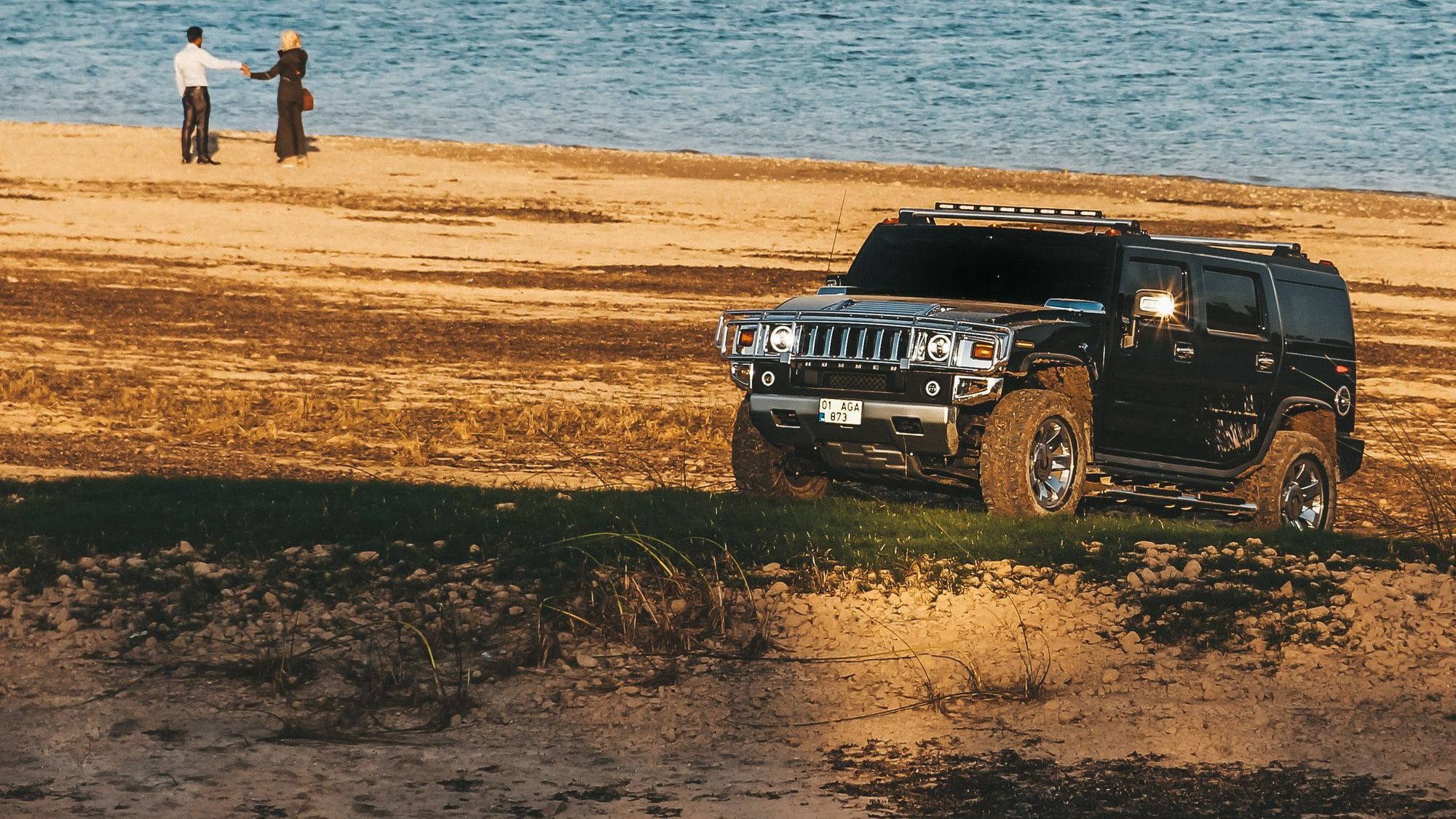
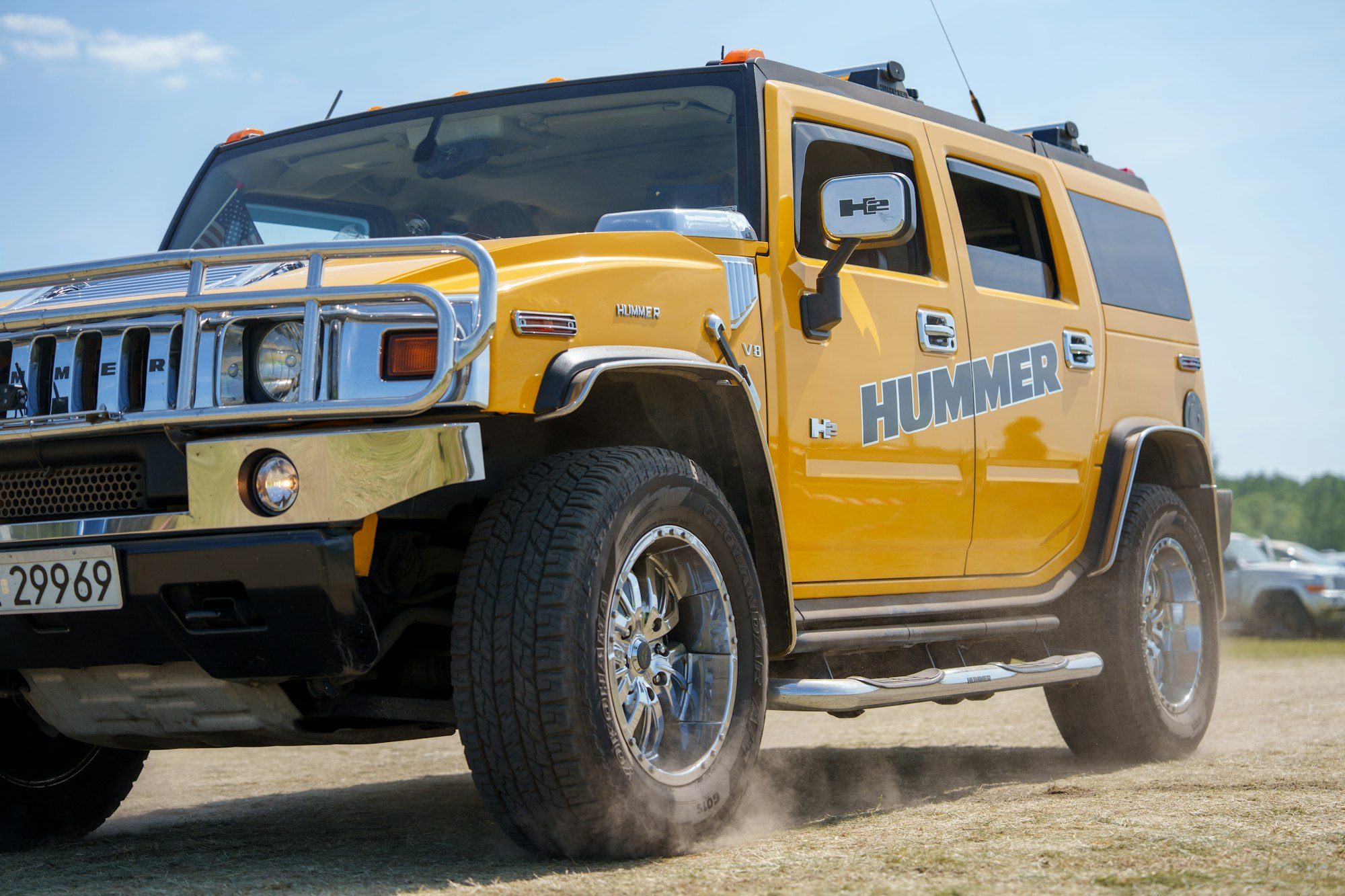
The H2 is what happened when General Motors bought the most famous name in off-roading and decided it should sell in volume. AM General built it under contract in a new plant in Mishawaka, Indiana, but GM engineered it from its own truck parts: a shortened Suburban frame, a three-quarter-ton front end and a 6.0-liter small-block V8. It went on sale as a 2003 model for less than half the price of an H1. Car and Driver took one 2,000 miles through Baja and decided it was 'not a Hummer poseur'. It was something else, and that's mostly fine.
FROM SHOW CAR TO SUBURBAN FRAME
In December 1999 GM bought the rights to the Hummer name from AM General, and the H2 was the first product of that deal. GM showed an H2 concept in 2000 with independent rear suspension, then priced it out of the production truck. Wikipedia credits the design to Clay Dean; the Chicago Tribune named Terry Henline as chief designer when the pickup concept appeared at the 2001 New York show. GM's 2003 spec sheet named the H2's rivals as the Range Rover, the Lexus LX 470 and the Lincoln Navigator, so luxury buyers were the target from the start.
The production recipe was pure GM parts bin. Engineers took a Suburban frame, cut 7.2 inches out of its middle for a 122.8-inch wheelbase and trimmed the overhangs, giving a truck nine inches shorter than a Tahoe. The torsion-bar front suspension came from a 2500-series Suburban, the rear became a five-link live axle on coils, and GM said a diesel wouldn't package. The radiator support and engine box are welded to the body, so the big front-hinged hood doesn't shimmy against the rest of the truck.
WHAT IT ACTUALLY DOES IN THE DIRT
Under the costume is a serious drivetrain. A full-time BorgWarner 44-84 transfer case sends 60 percent of the torque to the rear, locks 50/50 at any speed and has a 2.64:1 low range. The 4.10 rear axle carries an Eaton ELocker that engages only in 4LO below 20 mph. Bosch ABS and traction control are tuned for rough ground, and skid plates cover the engine, transfer case and fuel tank. The front chin plate has 'H2' embossed on it, because of course it does.
GM's figures give the coil-sprung truck a 40.4-degree approach and a 39.6-degree departure angle, and the off-road package's LT315/70R17s push the approach to 43.6 degrees. Ground clearance is about ten inches against the H1's sixteen, so in Baja Car and Driver learned to put a tire on the rock rather than straddle it. The optional rear air suspension can lift the tail about two inches and runs an air hose for the tires. The H1's central tire inflation wouldn't work with GM's axles.
THE PICKUP, THE 6.2 AND THE END
The SUT arrived for 2005: an H2 with a short bed and an Avalanche-style Midgate that folds to open the cabin into the bed. US sales peaked at 34,529 in 2003 and slid as fuel prices rose. For 2008 GM gave the H2 a new interior, a 393-hp aluminum 6.2-liter V8 and the six-speed 6L80. Towing went from 6,500 to 8,000 pounds and the crawl ratio rose to about 39:1. Owners rate those last trucks the best H2s, and they're the hardest to find.
The timing couldn't have been worse. GM put Hummer up for sale in 2008, and a deal with China's Tengzhong collapsed in February 2010. H2 production ended in 2009. Avtotor in Kaliningrad, Russia, had also assembled H2s from 2006 to 2009. GM's US sales figures add up to 153,026 H2s. The Mishawaka plant was sold in 2017 to SF Motors, a maker of electric vehicles.
SIDEBAR · THE 8,500-POUND LOOPHOLE
Why there's no EPA sticker
The H2's gross vehicle weight rating is 8,600 pounds. Until 2011 the EPA exempted vehicles over 8,500 pounds GVWR from fuel-economy testing and standards, so GM never had to publish a rating, and H2s didn't count toward its fleet average.
Magazines measured it themselves. Car and Driver and Motor Trend both recorded about 10 mpg, Edmunds 9.2 and Four Wheeler 10.8. With a 32-gallon tank, H2 owners on 37s still stop for fuel 'long before I need to pee', as one forum owner put it.
 YT
 YT
 YT
 YT