The story
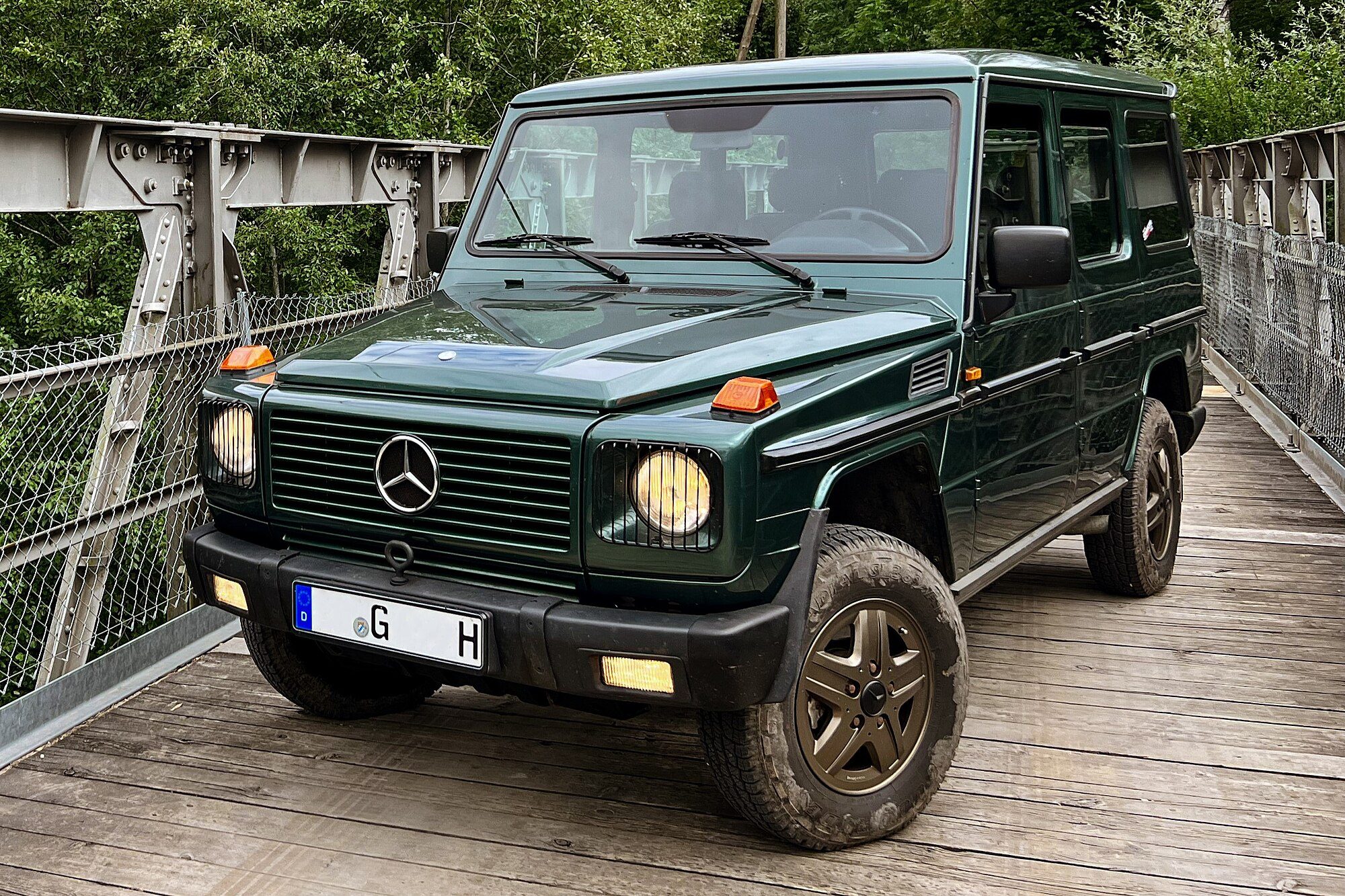
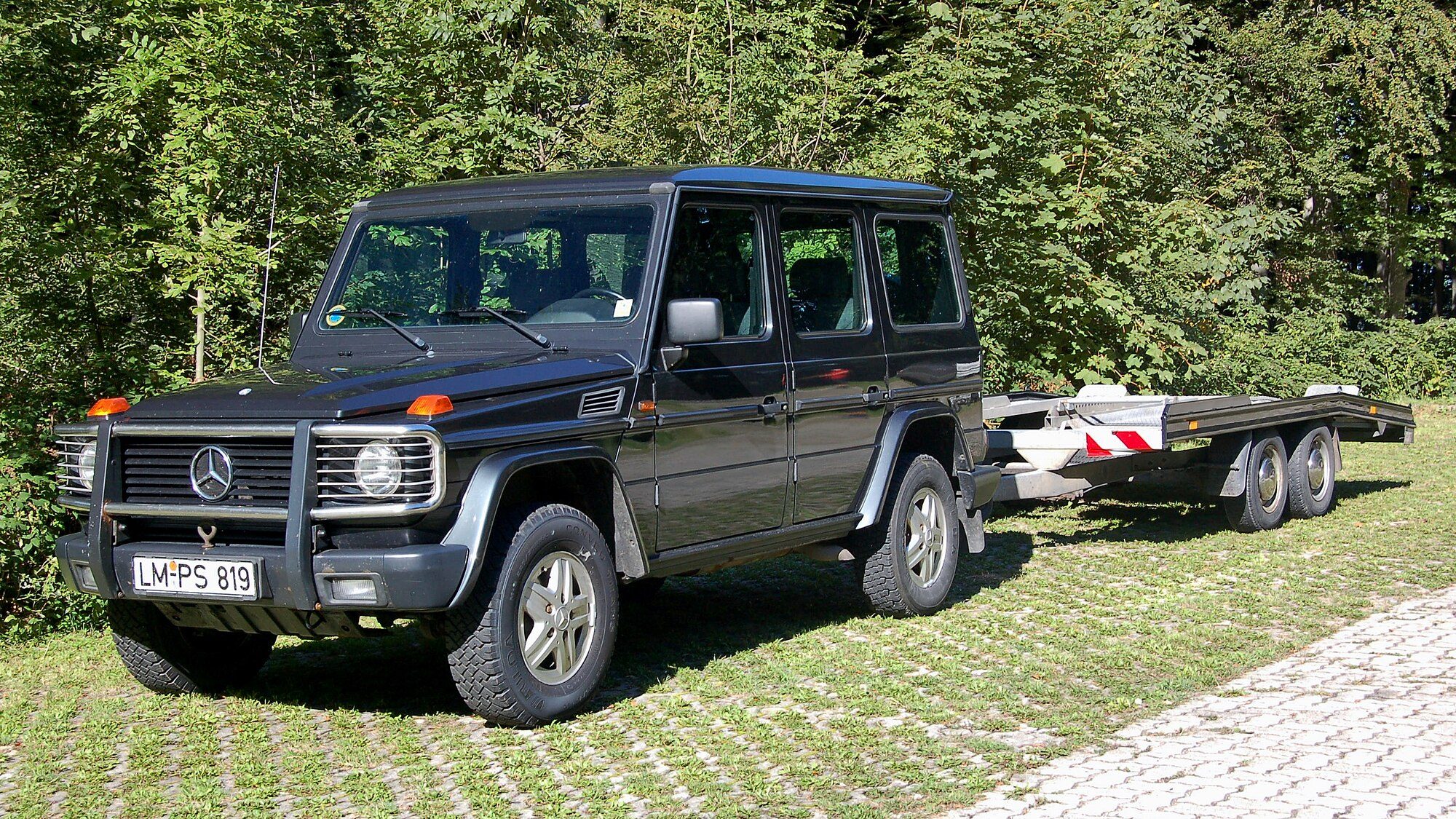
The W463 is the G-Class most people picture: square, upright, faintly absurd, and still built on a ladder frame with a solid axle at each end. Between 1990 and 2018 it went from a farmer's tool with a wood dash to a twin-turbo V12 AMG with more than 600 PS, a 6×6 cousin and a Maybach landaulet. Mercedes fitted it with more engine types than any other model it has built, and it never lost the three locking differentials that make it so good off-road.
FRANKFURT, 1989: THE G GETS A LIVING ROOM
For the G's tenth birthday, Mercedes showed a new version at the 1989 Frankfurt show, and production started the following April. It had a new chassis number, W463, and a new mission. Permanent four-wheel drive replaced the W460's part-time system, the diff locks became electrically switched from the middle of the dash, ABS was available, and for the first time the cabin got wood and leather. Autocar's 1991 test said permanent 4WD and ABS made it 'a much more convincing tool on the road.'
The working trucks went elsewhere. The W463 dropped the panel vans and barn doors, and they carried on in the utilitarian W461 for armies and agencies. Early W463s used carryover engines, with petrol 230 GEs and 300 GEs and diesel 250 GDs and 300 GDs. In 1994 the line was renamed the G-Class, the manual gearbox disappeared, and ventilated front discs and a driver's airbag became standard.
V8s, AMERICANS AND AMG
Mercedes started testing what the G could carry. The 1993 500 GE squeezed in a V8 for a run of 446 trucks. In 1996 an electronically controlled five-speed automatic arrived, and the 1997 update brought V6 engines and dual airbags. The G 500 made the V8 a regular-production option in 1998, and in 1999 the G 55 AMG became the most powerful G yet.
America came next, by a back door. Mercedes didn't sell the G in the US, so Europa International of New Mexico started certifying and selling them in 1993. Those Europa trucks proved the demand, Mercedes bought the distribution rights, and the G launched officially in the US with the 2002 model year. That facelift brought ESP, Brake Assist and the four-wheel electronic traction system, 4ETS.
LUXURY, LOCKERS AND A LOT OF CYLINDERS
From there the W463 kept adding power. The G 55 AMG got a supercharger in 2004, the 5.5-litre M273 V8 created the US G 550 for 2009, and in 2012 came the twin-turbo G 63 and the V12 G 65. Mercedes sold just over 100 G 63 6×6s, and the portal-axled G 500 4×4² followed in 2015. Ninety-nine Maybach G 650 Landaulets closed out the run. By the end there were 22 paint colours and engines from four to twelve cylinders, naturally aspirated, supercharged, turbo and twin-turbo.
Underneath, almost nothing changed. The frame, the solid axles and the three lockers were the same on a 2018 G 550 as on a 1990 230 GE. Hagerty quotes 36°/31° approach and departure angles, 80% grades and 30° side slopes for the G. Handsome Motors, a dealer who has owned more than 200 Gs, estimates that each truck still took roughly 100 hours of hand labour in Graz.
HOW IT ENDED
In late 2017 Mercedes announced the end of the first-generation W463. Its replacement, revealed at Detroit in January 2018, kept the shape, the ladder frame and three lockers. It also brought independent front suspension, rack-and-pinion steering and the first formal crash test of any G. The second generation is the better road car by a wide margin.
For the trail crowd, though, 2018 marks the last year a new G came with a solid front axle. That's why clean W463s, from the 1990s diesels to the last G 550s, are now bought as off-roaders as much as status symbols.
SIDEBAR · THE G THAT WOULDN'T DIE
How the US Marine Corps saved the W463
Mercedes announced that 2005 would be the G-Class's last year in America, naming the new GL-Class as its successor. It shipped 500 farewell Grand Edition G 500s and G 55 AMGs, and rumours spread that W463 production would end entirely: emissions and pedestrian-safety rules were tightening, and the military contracts were complete.
Then the US Marine Corps ordered 157 G-based Interim Fast Attack Vehicles, and enthusiasts protested loudly. On 11 November 2005 Dieter Zetsche announced the G would continue. At the 2006 Paris show Mercedes promised production through 2015, then extended Magna Steyr's contract to 2017. The 'replacement' GL is long gone, and the G is still in production.