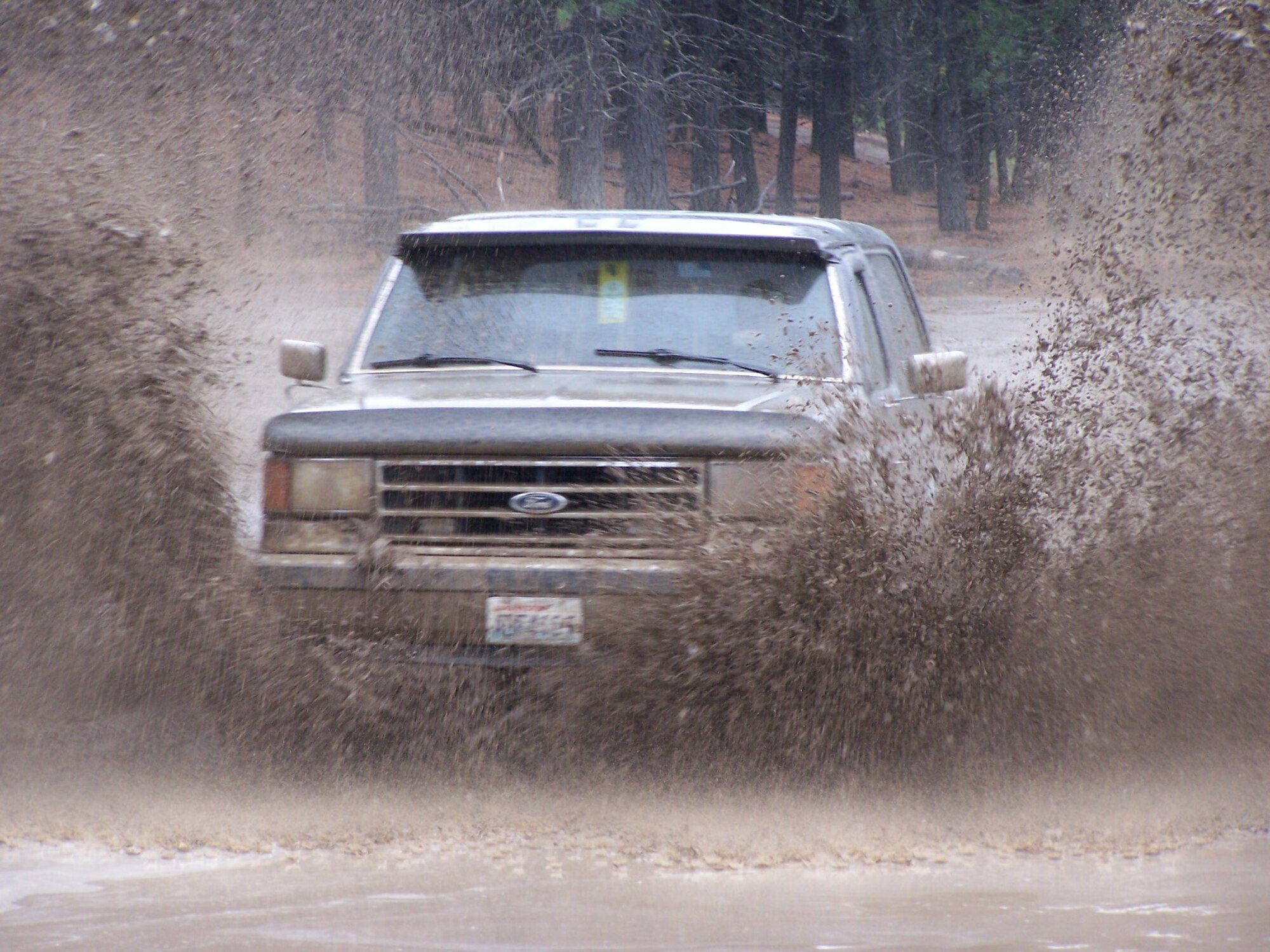
A silver 1989 Ford Bronco throwing up a wall of mud as it drives through a flooded track among pine trees
FORD BRONCO · SECOND TO FIFTH GENERATION · 1978–1996

Full-size Bronco

104 / 104.7 IN WHEELBASE300 I6 · 302 · 351 · 400 V8DANA 44 FRONT9-INCH / 8.8 REARLIFT-OFF REAR TOP

“Ford took an F-Series four-by-four, cut a foot out of it and bolted on a roof you could lift off, and in doing so built the Bronco most people still picture. Simple pushrod engines, parts in every junkyard and a Twin Traction Beam front end that rewards anyone who owns an alignment gauge.”

PART 01

Overview

Where it came from, why it matters, and how it changed year to year.

The story

For 1978 Ford stopped pretending the Bronco was a small truck. The early Bronco had been a 92-inch-wheelbase box that fought the CJ-5 and the Scout; the new one was a shortened F-100 four-by-four aimed at the Chevrolet K5 Blazer, the Dodge Ramcharger and Jeep's two-door SJ Cherokee, cousin of the Grand Wagoneer. Wikipedia's figures show what that meant: 12 inches more wheelbase, about 28 inches more length, 11 inches more width and between 1,100 and 1,600 pounds more weight, depending on the powertrain. In an era of downsizing, Ford went the other way on purpose, and it worked.

1978–79: PROJECT SHORTHORN

Development ran under the name Project Shorthorn and the truck was meant to launch for 1974. The 1973 fuel crisis pushed it back four years, so by the time the second-generation Bronco went on sale, its 1980 replacement was already nearly finished. Ford built it on the 1973–79 F-100 chassis with a 104-inch wheelbase, a coil-sprung Dana 44 front axle and a leaf-sprung Ford 9-inch rear. It was the last Bronco with a solid front axle until the nameplate went away. Part-time 4WD with a gear-driven New Process 205 was standard; a full-time, chain-driven NP203 was optional.

There was no six. The 351M V8 was standard and the 400 was optional, both two-barrel engines with about 156–158 hp; the 400 made 277 lb-ft against the 351M's 262. Doors, forward roof and dash came straight from the F-100, and Dick Nesbitt's lift-off fiberglass top covered only the area behind the B-pillars, with the seals designed to beat the leaks of the Blazer's top. The rear glass wound down into the tailgate. Demand was strong enough that buyers waited months, and Ford built 77,917 in 1978 and 104,038 in 1979, outselling the Blazer and the Ramcharger for the first time.

1980–86: TWIN TRACTION BEAM

The 1980 Bronco moved to the new seventh-generation F-150 but kept the 104-inch wheelbase. To chase fuel economy, Ford gave the 1980–81 trucks a lighter frame with holes stamped in it, saving 375 lb, then went back to a stronger frame for 1982. The big change was up front: a Dana 44 Twin Traction Beam, Ford's patented independent front drive axle. Each side pivots on its own beam, there is a U-joint in the middle, and the differential sits offset to the driver's side. Wikipedia sums up the reputation: unloved by some slow-speed crawlers, praised by high-speed desert racers.

Engines got smaller first. The 4.9-liter 300 inline-six became standard (manual only), the 302 V8 came back, the 400 was dropped and the 351M gave way to the 351 Windsor in 1982. A 210-hp high-output 351 arrived for 1984, and in 1985 the 302 gained multiport fuel injection and 190 hp. The blue oval replaced F-O-R-D lettering on the hood for 1982, and the Eddie Bauer package, with color-keyed two-tone paint, arrived for 1985. The rear axle went from the 9-inch to the 8.8 by the end of 1986.

1987–96: FUEL INJECTION, AIRBAGS AND A BOLTED-ON ROOF

The 1987 facelift brought the eighth-generation F-150 nose, composite headlights, a new dash and standard rear-wheel ABS. Fuel injection reached the 300 six for 1987 and the 351 for 1988, the year a Mazda-built M5OD five-speed manual and standard transfer-case skid plates also arrived. The C6 automatic gave way to the overdrive AOD and E4OD around 1990. For 1991, the Bronco's 25th year, the Silver Anniversary Edition brought exclusive Currant Red paint and the first leather seats in a Bronco.

The 1992 truck got a rounder ninth-generation nose. Four-wheel ABS followed for 1993, a driver's airbag for 1994, and the 300 six left the line-up, making every later Bronco a V8. Three-point rear belts and a center brake light now mounted in the hardtop, so Ford stopped describing top removal in the owner's manual and fastened the top with #40 security Torx bolts. The last Bronco left Wayne, Michigan, on June 12, 1996, and the four-door Expedition replaced it. Ford says the white 1993 Bronco on the 405 freeway in June 1994 had nothing to do with that decision, because sales were already falling.

THE RESTOMOD ERA

Thirty years on, the full-size Bronco has become the affordable way into Bronco ownership and also a favorite donor for restomods. Bring a Trailer's 1978–79 page alone listed 263 auctions by October 2026. Prices run from a $14,000 1979 Ranger XLT to a Coyote-swapped 1979 Ranger XLT at $81,500. In August 2026 a 1979 Custom with a 7.3-liter Godzilla V8, a 10-speed automatic and Super Duty axles sold for $191,000. The 1987–96 trucks are the bargain: most ordinary XLTs and Eddie Bauers on BaT sell for between $7,500 and $32,500. They are simple and plentiful, and since 2021 they have shared the name with the sixth-generation Bronco, but they are still at their best covered in mud.

SIDEBAR · THE FOUR-DOOR BRONCO

Centurion's crew-cab Bronco

Ford built the 1978–96 Bronco only as a two-door, so Centurion Vehicles of White Pigeon, Michigan, made its own four-door. The Centurion Classic joined an F-Series crew cab (from the C-pillar forward) to the rear body of a Bronco (from the B-pillar back), including its quarter panels, hardtop and tailgate. It rode on a 140-inch wheelbase and seated up to nine.

The C-150 used an F-150 chassis with 5.0 or 5.8 V8s and optional 4WD. The C-350 used a one-ton F-350 with standard 4WD and either the 7.3 diesel or 7.5 gasoline V8, the only Broncos ever built with either engine. A 1994 C-350 Classic with the 7.5 was bid to $25,250 on Bring a Trailer in September 2026 without selling.
Year by year

What changed, model year by model year. Sweet spot Beware

  1. 1978Second generation launches on the F-100 chassis: 104 in wheelbase, solid coil-sprung Dana 44 front, 9-inch rear, 351M standard and 400 optional, lift-off half hardtop. 77,917 built.Sweet spot
  2. 1979Rectangular headlights standard on all trucks; catalytic converters added; 104,038 built, the best year of the full-size run.
  3. 1980Third generation on the new F-150: Dana 44 Twin Traction Beam front, 300 six standard (manual only), 302 returns, 400 dropped. 1980–81 frames are lightened with stamped holes.
  4. 1982Stronger frame returns; 351 Windsor replaces the 351M; blue oval replaces F-O-R-D on the hood.
  5. 1985302 gets multiport fuel injection (190 hp); Eddie Bauer package arrives. (A 210-hp 351 HO came for 1984.)Sweet spot
  6. 1987Fourth generation: new nose and dash, composite headlights, standard rear ABS, optional push-button 4WD, fuel-injected 300 six.
  7. 1988Fuel-injected 351; Mazda M5OD five-speed manual; transfer-case skid plate standard.Sweet spot
  8. 1990Overdrive automatics replace the C6: AOD (1990) and E4OD (1990 on).
  9. 1991Silver Anniversary Edition (Currant Red, gray leather) and Nite package; V8 and automatic only.
  10. 1992Fifth generation: rounder ninth-generation F-Series nose, revised dash, optional leather and power mirrors.
  11. 1993Four-wheel ABS replaces rear-only ABS.Sweet spot
  12. 1994Driver's airbag; 300 six dropped; rear three-point belts and third brake light mount in the hardtop, which is now held on with security Torx bolts.
  13. 1996OBD-II engines; the first Ford with turn signals in the mirrors. The last Bronco is built on June 12, 1996.
PART 02

Specs & capability

How it’s built, what it can do, and what fits under it.

How it’s built

Every full-size Bronco is a short-wheelbase F-Series. From the B-pillars forward it shares the pickup's cab, doors and dash, and behind them sits a three-door wagon body with a removable fiberglass top and a tailgate whose glass winds down into it. The chassis is a conventional ladder frame. The front axle changed from a solid Dana 44 to a Twin Traction Beam Dana 44 in 1980, and that change splits owners more than any other.

CHASSISLadder frame · 104 in (1978–86) / 104.7 in (1987–96) wheelbase1978–79 on the F-100, 1980 on the new F-150. The 1980–81 frame was lightened with stamped holes; 1982 went back to a stronger frame.
FRONT AXLEDana 44 solid, coil springs (1978–79) · Dana 44 TTB (1980–96)TTB is independent: two beams, a center U-joint, a slip yoke on the long side and the differential offset to the driver's side.
REAR AXLEFord 9-inch, leaf springs → Ford 8.8Wikipedia says Ford moved its half-ton trucks to the 8.8 by the end of 1986.
TRANSFER CASENP205 / NP203 (1978–79) · NP208 or BW1345 (from 1980) · BW1356 (later trucks)Push-button electric shift was optional from 1987.
ENGINES351M, 400 (1978–79) · 300 I6, 302, 351M, 351W (1980–96)302 fuel-injected from 1985, 300 from 1987, 351 from 1988. The six was dropped after 1993.
ROOFLift-off fiberglass rear topFrom 1994 the top carries the rear seat-belt anchors and the third brake light, and is held on with #40 security Torx bolts.

Variants & engines

YEARSPLATFORMENGINEOUTPUTWORTH KNOWING
1978–19792nd gen · F-100 (1973–79 F-Series)351M V8 · 400 V8156–158 hp · 262 / 277 lb-ftSolid coil-sprung Dana 44 front, 9-inch rear. T-18 or NP435 4-speed, or C6 automatic. NP205 part-time or NP203 full-time.
1980–19863rd gen · F-150 (1980–86 F-Series)300 I6 · 302 V8 · 351M · 351W302 EFI 190 hp (1985) · 351 HO 210 hp (1984)TTB Dana 44 front. 351W replaces 351M from 1982. Eddie Bauer package from 1985.
1987–19914th gen · eighth-generation F-150 styling300 I6 · 302 V8 · 351W—EFI on the 300 (1987) and 351 (1988). Rear ABS, M5OD 5-speed from 1988, E4OD from 1990. Silver Anniversary Edition for 1991.
1992–19965th gen · ninth-generation F-150 styling300 I6 (to 1993) · 302 V8 · 351W—4-wheel ABS 1993, driver airbag 1994, OBD-II 1996. The hardtop is bolted on with security Torx from 1994.

Capability numbers

Wheelbase104 in (2,642 mm) 1978–86 · 104.7 in (2,659 mm) 1987–96
Length180.3 in (1978–79) to 183.6 in (1992–96)
Curb weight4,663–4,718 lb (1978–79) · 4,343–4,374 lb (1980–86)Wikipedia infobox figures
SeatingUp to 6Three-across front bench and a folding, removable rear seat from 1978

Wheels & tires

Bolt pattern5x139.7 (5x5.5") on all 1978–96 trucks
Lug thread1/2"-20 UNF (listed for 1992–96)
LIFTBIGGEST TIREWHAT IT TAKES
Stock33 in (e.g. 33x12.50R15)Bronco Zone owners run 33x12.50R15 on 15x10 wheels on stock-height 1980–96 trucks. Some needed the bumper ends trimmed or shimmed, and there can be slight radius-arm rub depending on the wheel. 31x10.50 clears with no contact.
3 in body lift35 inThe bare minimum for 35s according to one Bronco Zone owner, who warns of a lot of tire-to-body contact off-road.
4–6 in suspension35 in4 in of suspension lift is the better option for 35s, and 6 in is called optimal. Plan for TTB camber bushings and lower gears.
≈ 6 in (8 in preferred)38 inNeeds serious fender trimming and strains the stock running gear.

Forum consensus, not a guarantee: wheel offset, tire brand and suspension wear all change clearance. Confirm before you buy.

Production & special editions

Every full-size Bronco was built at Ford's Michigan Truck Plant in Wayne, Michigan, with additional assembly in Australia (1980s) and Venezuela (1987–96). These totals come from Wikipedia's annual production tables.

1978–1979181,955
1980–1986322,429
1987–1991235,451
1992–1996162,703
Total, 1978–1996≈ 902,500
Last builtJune 12, 1996, Wayne, Michigan
Free Wheelin'1978–1979Tricolor striping and blacked-out trim on Custom or Ranger XLT
Eddie Bauer1985 on; again 1992–1996Two-tone, outdoors-themed top trim; from 1994 it added an overhead console, and from 1995 front bumper vents
Silver Anniversary Edition1991Exclusive Currant Red paint and gray leather; V8 and automatic only
Nite1991–1992Blacked-out exterior with contrasting graphics
XLT Sport1994–1996Monochrome black, red or white

Currant Red was exclusive to the 1991 Silver Anniversary Edition. A two-tone light teal and white XLT was built at about 600 a year in the fifth generation.

PART 03

Buying one

What to pay, what to check, and how to tell a good one from a clone.

What they cost

The 1978–79 solid-axle trucks are the collectible ones. The 1980–86 trucks sit in the middle, and the 1987–96 trucks remain the cheapest way into a Bronco, apart from special editions and low-mileage examples.

1987–96 driver (XLT, Eddie Bauer)$7.5k–32.5k
1980–86 driver to excellent$7.75k–50k
1978–79 stock, driver to excellent$14k–49k
Restomod (Coyote, Godzilla, stroker swaps)$80k–191k

Based on Bring a Trailer sold results for the three model pages, mostly 2025–26: 24 recent results each for 1978–79, 1980–86 and 1987–96. The 1987–96 high outliers were a 1995 Eddie Bauer ($67,500) and an ex–'Stone Cold' Steve Austin 1995 XLT ($53,000). Prices move; checked October 2026. See live listings below.

What to check before you buy

  1. 01
    Rust in Ford's favorite placesBronco Zone's long-time checklist names the inner rear fender lips, the bottoms of the B-pillars and the bottom of the tailgate, where spot-welded seams trap moisture. Also check the radiator core support where it bolts to the frame (mostly the passenger side), the floor around the rear seat-belt mounts, rain gutters, body mounts and the frame itself.
  2. 02
    Run the tailgate glass both waysLower and raise the rear window from the key and from the dash switch, then open and close the tailgate. Check the tailgate drains and the outer glass seal. A window that works from only one control points to the circuit, not the motor. On many trucks the driver's window switch must be in the center position before the tailgate key switch will work.
  3. 03
    Read the tires before the TTBUneven inner or outer tread wear means camber trouble. Look at the radius-arm bushings, which perish (one Bronco Zone owner replaced his at 80,000 miles), and check the ball joints and tie-rod ends. If the truck is lifted, ask whether adjustable camber bushings were fitted, because Bronco Graveyard says even 1–2-inch lift springs normally need them.
  4. 04
    E4OD fluid and the O/D lightOn 1990–96 automatics, the fluid should be red, not brown or burnt-smelling, and read full at operating temperature. A flashing overdrive light (TCIL) while driving means the transmission has stored a fault code. Owners recommend fluid and filter service every 30,000 miles, and sooner for towing.
  5. 05
    Try 4-High and 4-LowOn push-button trucks, the shift motor and its connector are known trouble spots, often from a broken travel stop or a fouled connector. Ford recalled some 1993 trucks (93V-089) whose transfer cases had the wrong shift motor and could slip out of 4-High.
  6. 06
    Compression, cooling and leaksOwners call a bad compression or vacuum test a deal-breaker. The plastic side seams of the radiator leak, most visibly after the engine cools overnight. Check the rear main and timing-cover seals, look for a cracked exhaust manifold or Y-pipe, and check for water in the oil.
  7. 07
    Decide whether you need a removable top1978–93 tops were designed to come off. From 1994 the top carries the rear three-point belts and the center brake light and is held with security Torx bolts. You can still remove it, but Wikipedia notes that driving without it can earn a ticket in some places.
  8. 08
    Open recallsOld trucks still show up with open campaigns. The 1994–96 speed-control deactivation switch (05V-388) and its 1993 equivalents (07V-336 and 08V-051) can overheat and burn, and 1988–91 trucks had an ignition-switch short-circuit recall (96V-071). Check the VIN on NHTSA's site.

Spotting the real thing

Most full-size Broncos are what they claim to be. What you need to check is which generation and axle you are looking at, and whether a special edition is genuine.

  1. ID
    Solid axle or TTBOnly 1978–79 trucks have the solid, coil-sprung Dana 44 front axle; everything from 1980 has the Twin Traction Beam, an independent design with a U-joint in the middle and the differential offset to the driver's side. A 1980–96 truck on a solid axle has been converted.
  2. ID
    Faces by year1978 Customs had round headlights and Ranger XLTs rectangular ones, which became standard for 1979. 1980–81 trucks have F-O-R-D on the hood and 1982–86 trucks the blue oval. 1987–91 trucks have flush composite headlights, and 1992–96 trucks a rounder nose with a larger grille. Turn signals in the mirrors mean 1996.
  3. ID
    Silver Anniversary Edition1991 only. Currant Red paint was exclusive to the package and came with a gray leather interior, the first leather in a Bronco. Like the Nite and Eddie Bauer, it came only with a V8 and an automatic.
  4. ID
    Free Wheelin' and NiteFree Wheelin' (1978–79, Custom or Ranger XLT) was a cosmetic package with tricolor stripes and blacked-out trim. Nite (1991–92) was blacked out with contrasting graphics.
  5. ID
    Four doorsFord never built a four-door 1978–96 Bronco. A four-door is a Centurion Classic C-150 or C-350, an F-Series crew cab joined to a Bronco rear body on a 140-in wheelbase.

Recalls & service bulletins

Open recalls follow the VIN, not the model. Run yours through NHTSA before you buy, and ask the seller for dealer records showing recall work.

Check a VIN at NHTSA ↗
Notable recalls
Speed-control deactivation switch may overheat or burn ↗1994–1996 · NHTSA 05V-388The switch could leak internally and overheat. Dealers first disconnected the speed control, then reconnected it once replacement parts were available in 2006.
Speed-control deactivation switch (1993 trucks) ↗1993 · NHTSA 07V-336 · 08V-051The same overheating-switch problem on 1993 Broncos and F-Series, covered in two later campaigns.
Ignition switch internal short circuit ↗1988–1991 · NHTSA 96V-071The ignition switch could short internally; dealers replaced it.
Transfer case built with the wrong shift motor ↗1993 · NHTSA 93V-089Electric-shift cases could slip out of 4-High when coasting or reversing; dealers replaced the transfer case.
Parking-brake self-adjuster pawl slips ↗1992–1994 · NHTSA 94V-169The pawl could skip teeth on the ratchet; dealers fitted a wedge to hold it in engagement.
Front bumper U-clip nuts can fracture ↗1993–1994 · NHTSA 94V-018The nuts that hold the front bumper to its inner arms could break.
Door latch release cable can freeze ↗1992 · NHTSA 92V-006Water in the cable could freeze in sub-zero weather and make the door latch malfunction.
Spring-lock fuel-line coupling may not be engaged ↗1986–1987 · NHTSA 87V-139An incompletely engaged coupling could leak fuel.
Fuel-rail burrs may damage O-rings ↗1985 · NHTSA 84V-162Burrs on the new EFI fuel rails could cut adjacent O-ring seals during assembly and cause fuel leaks.
Steering-arm knuckles improperly manufactured ↗1979 · NHTSA 79V-035A knuckle could fracture and let the tie rod disengage.
Steel wheels may crack at the rim ↗1978 · NHTSA 78V-023Some steel wheels were improperly manufactured and could crack without warning.
The one you’ll own someday

For sale now

1978–1979 · US2nd gen (solid axle)
1980–1986 · US3rd gen (first TTB)
1987–1991 · US4th gen
1992–1996 · US5th gen
PART 04

Owning one

Baseline service, the repairs you’ll actually do, and where the manuals live.

Post-purchase baseline

After you buy it

These are thirty-year-old trucks with simple pushrod engines, so assume nothing has been done and baseline every fluid. Treat the front axle as a service item too. The TTB's spindle bearings, U-joints, ball joints and radius-arm bushings decide how the truck drives, and on most Broncos for sale they're original.

Engine oil & filterSAE 5W-30 preferred in all climates (Ford ESE-M2C153-E); 10W-30 acceptable in hot weather · 6 qt with filter (1992 5.8)Then every 5,000 mi, or every 3,000 mi on Ford's severe-duty schedule (1996 workshop manual)

Drain-plug torque 15–25 ft-lb (AMSOIL lookup). Owners of tired, high-mileage engines often move to thicker oils.

Engine air filterPanel element [CONFIRM IN MANUAL]Check every oil change; Ford's 1996 schedule replaces it every 30,000 mi or 30 months, sooner in dust

Check the airbox seal and the intake tube after any trail trip.

Ignition: plugs, cap, rotor, wires, TFI1996 workshop manual: 5.8 Motorcraft ASF-32C, gap 0.042–0.046 in · 5.0 ASF-42P, gap 0.052–0.056 in · 4.9 BSF-44C, gap 0.042–0.046 in. Check the VECI decal on earlier trucksBaseline once; Ford's 1996 schedule replaces plugs at 60,000 mi

On 1985–91 EFI trucks, inspect the distributor-mounted TFI module and fit any replacement with dielectric grease as a heat sink.

Coolant & hosesEthylene glycol, 50/50 premix · 14.8–15.9 qt (1992 5.8, by transmission and A/C)Flush at purchase, then every 30,000 mi or 36 months (Ford 1996 schedule; first change from new at 50,000 mi/48 months)

Check the plastic side seams of the radiator, which tend to leak after the engine cools overnight.

Automatic transmission (E4OD)Mercon V · 16.2 qt total, ≈ 8.5 qt on a pan drop (4WD E4OD)Fluid and filter every 30,000 mi (owners' recommendation); sooner if towing

A single pan drop replaces only about half the fluid. C6 (13.5 qt total) and AOD (12.3 qt) trucks: use the fluid stamped on the dipstick.

Manual transmission (M5OD-R2)Motorcraft MERCON ATF · 3.8 qt (7.6 pints) for the Mazda R2 five-speed (1996 workshop manual); AMSOIL lists 6.8–7.6 pintsDrain and refill at purchase; Ford changes it every 60,000 mi

Owners recommend resealing the rubber plugs in the M5OD shift cover, which shrink and leak. Check the slave cylinder for leaks.

Transfer caseBW1356: Mercon V (factory manual), ≈ 4 pints · BW1345: ≈ 6.3 pintsDrain and refill at purchase

AMSOIL notes Ford has since updated the spec to Mercon LV. On push-button cases, clean the shift-motor connector while you're under there.

Front differential (Dana 44, solid or TTB)Ford 4x4 Gear Oil F1TZ-19580-A (WSL-M2C191-A) · 3.6 pints for the Dana 44 IFS (1996 workshop manual, F-150/Bronco). The manual's table doesn't state a viscosity, so match the Ford specChange at purchase and after deep water

Check the axle vent tube, and look for gear oil weeping from the slip-yoke seal on the long side of a TTB.

Rear differential (8.8 / 9-inch)SAE 80W-90 (Ford XY-80W90-QL, WSP-M2C197-A) · ≈ 5.5 pints (8.8 Traction-Lok) plus 4 oz Ford friction modifier (F3TZ-19B546-MA)Change at purchase

Fill to 1/4–9/16 inch below the filler hole (factory manual via Bronco Zone). Seal the 8.8 cover with silicone (D6AZ-19562-AA or equivalent).

Front wheel bearings, spindle bearings & hubsFord High Temperature 4x4 Front Axle and Wheel Bearing Grease E8TZ-19590-A (ESA-M1C198-A), which the 1996 manual also specifies for the spindle needle bearings and axle U-jointsRepack at purchase

On a TTB truck, do the spindle needle bearings and seals and the axle U-joints while the hub is apart.

Steering & front-suspension wear partsRadius-arm bushings · ball joints · tie-rod endsInspect at purchase

Have a helper rock the steering wheel while you watch each joint. Perished radius-arm bushings are common.

Brake fluidDOT 3 (Ford C6AZ-19542-AA/BA, ESA-M6C25-A)Flush at purchase. Ford's 1996 schedule sets no fluid-change interval, only hose and line inspections every 15,000 mi

On manual trucks the hydraulic clutch shares the same fluid type.

Power steeringFord Premium Power Steering Fluid E4AZ-19582-C or E6AZ-19582-AA (ESW-M2C33-F), per the 1996 workshop manual. Some owners use Mercon V insteadCheck level and hoses at purchase

A leaking box can be resealed rather than replaced; seal kits are available.

For the hands-on owner

Common repairs

The jobs owners actually end up doing, rated for a competent home mechanic with a decent tool kit. Always confirm torque figures, fluids and procedures against the factory service manual for your VIN, and work safely — support the truck on stands, never just a jack. You do this work at your own risk; see the disclaimer. Some parts links are affiliate links.

Fix a tailgate window that won't move
DIFFICULTY · 2 / 5TIME · ≈ 1–3 hoursSHOP COST · About $20 for a pair of regulator rollers (Wild Horses lists them at $9.99 each); a motor gear kit or a regulator costs more
SYMPTOMSThe rear glass won't go up or down, moves from the key but not the dash switch (or the other way round), or grinds and stalls part-way.
THE FIXFirst find out whether the motor or the circuit is at fault. Remove the tailgate access panel, find the motor connector near the bottom center of the opening, and power the motor directly from a battery with jumper leads; reversing the leads reverses it. If it runs, trace the circuit: the safety limit switch (in the latch handle on a 1980 truck), a corroded ground or broken wire, or the driver's window switch, which must be centered for the tailgate key switch to work. If the motor hums but the glass doesn't move, replace the nylon regulator gear with a gear kit. If the glass binds or cocks, replace both regulator-arm rollers that run in the lift channels under the glass, and lube the tracks with white lithium grease.
TOOLS & PARTSTrim tools · screwdrivers · 12 V jumper leads · test light or meter · white lithium grease.
Correct TTB camber with adjustable bushings
DIFFICULTY · 3 / 5TIME · ≈ 2–3 hours plus an alignmentSHOP COST · Parts plus an alignment
SYMPTOMSTires wearing on the inner or outer edge, especially after new springs or a lift, and an alignment shop saying it's 'out of adjustment'.
THE FIXOn a TTB Dana 44, camber is set by an offset bushing (sleeve) around the upper ball-joint stud. Bronco Graveyard describes the swap: remove the wheel, the cotter pin and the upper ball-joint nut, break the stud's taper free of the sleeve, pull the old sleeve with a sleeve puller and fit the new adjustable one. Adjustable sleeves cover 0.75 to 2.75 degrees, and any correction you don't need for camber can be turned into caster. Set both sides, torque the nuts, fit new cotter pins and have it aligned.
TOOLS & PARTSJack and stands · camber/caster sleeve puller · hammer or pickle fork · torque wrench · camber gauge (optional).
Replace radius-arm bushings
DIFFICULTY · 3 / 5TIME · ≈ 2–4 hoursSHOP COST · Parts plus an alignment
SYMPTOMSA clunk over bumps or on braking, wandering steering and caster that won't hold. The rubber at the rear of each radius arm, where it passes through the frame bracket, is cracked or squashed out.
THE FIXSupport the frame on stands with the axle on a jack so the arms are unloaded. Remove the nut at the rear end of each radius arm, slide off the washers and old bushings, and pry the arm down out of the bracket just far enough to fit the new bushings and washers. Bronco Graveyard's 1980–87 kit swaps the rubber for polyurethane and replaces the loose washers; adjustable bushings are available if you need to correct caster after a lift. Torque at ride height and get an alignment.
TOOLS & PARTSJack and stands · large sockets and breaker bar · pry bar · torque wrench.
Rebuild the TTB knuckle: spindle bearings, axle U-joints, ball joints
DIFFICULTY · 4 / 5TIME · ≈ 4–6 hours per sideSHOP COST · Parts plus your weekend
SYMPTOMSClunk or play at the front wheel, grease flung around the hub, a clicking U-joint when turning in 4WD, or a ball joint that moves when you lever the wheel top to bottom.
THE FIXWith the hub and rotor off, unbolt the spindle and pull it to get at the outer axle shaft. Replace the spindle needle bearing and seals with a Spicer kit (1980–92 and 1994–96 kits differ), and replace the axle-shaft U-joints while the shafts are out; confirm the joint size for your shafts before ordering. If the ball joints are loose, press them out with a C-frame press and adapters, fit new Spicer joints, and reset the upper adjuster sleeve. Repack the wheel bearings, reassemble and set the bearing preload.
TOOLS & PARTSHub/spindle-nut socket · slide hammer or seal puller · ball-joint C-press and adapters · U-joint press or vise · torque wrench.
Replace the TFI ignition module (1985–91 EFI)
DIFFICULTY · 2 / 5TIME · ≈ 30–60 minutesSHOP COST · Parts plus a little patience
SYMPTOMSHard hot starts, intermittent stalling that clears once the engine cools, misfires or erratic running on a fuel-injected V8.
THE FIXThe Thick Film Ignition module bolts to the side of the distributor, close to the thermostat housing, where Bronco Graveyard says engine heat eventually kills it. Disconnect the battery, unplug the module, remove its two screws (a long T20 driver or Ford's module tool helps), and slide it off its terminals. Coat the mounting face of the new module with dielectric grease, which acts as a heat sink, and fit it. Bronco Graveyard recommends genuine Motorcraft modules and notes that many owners carry a spare on the trail.
TOOLS & PARTST20 Torx or Ford ignition-module tool · offset distributor clamp wrench (if the distributor has to come out) · dielectric grease.
Fix a push-button transfer case that won't shift
DIFFICULTY · 3 / 5TIME · ≈ 1–2 hoursSHOP COST · Parts plus labor
SYMPTOMSThe 4WD lights blink or the case won't go into (or out of) 4-High or 4-Low on an electric-shift truck.
THE FIXBronco Zone owners point first at the shift motor and its connector: clean and reseat the connector and check for a broken travel stop. If the motor still doesn't respond, unbolt it from the BW1356, note the shift-shaft position and fit a new motor, replacing the shift seal while it's off. Match the new motor's position to the shift shaft before bolting it on. On a 1993 truck, check that recall 93V-089 (wrong shift motor) was done.
TOOLS & PARTSSockets · electrical contact cleaner · multimeter · new shift seal.
Service the E4OD (1990–96)
DIFFICULTY · 2 / 5TIME · ≈ 2 hoursSHOP COST · Parts plus fluid
SYMPTOMSLate or harsh shifts, a flashing overdrive light, or dark, burnt-smelling fluid.
THE FIXDrop the pan, change the filter, clean the pan and magnet, and refill with Mercon V, which the factory manual quoted on Bronco Zone specifies for the E4OD. A pan drop only replaces about 8.5 of the roughly 16 quarts, so repeat the job, or add a drain plug or a deeper pan, to replace more of the old fluid. If you find particles or white (water-contaminated) fluid, get it diagnosed before you refill it. Read any stored codes if the O/D light flashes.
TOOLS & PARTSDrain pan · sockets · gasket scraper · funnel · torque wrench.
Cut out and patch the rust
DIFFICULTY · 4 / 5TIME · A weekend per areaSHOP COST · Patch panels plus welding
SYMPTOMSBubbling paint along the rear wheel-arch lips, holes at the bottom of the B-pillars or tailgate, a soft floor near the rear seat-belt anchors, a rotted radiator core support.
THE FIXBronco Zone owners blame Ford's spot-welded seams, which trap water, so the rust usually runs further than it looks. Strip back to clean steel, cut the panel out beyond the rot, and butt-weld in a patch or a full panel. Seam-seal, prime and paint, and treat the inside with cavity wax. On the tailgate, clear the drains and fit new internal hardware while it's apart.
TOOLS & PARTSCut-off wheel · MIG welder · flap discs · panel clamps · seam sealer · cavity wax.

Manuals & documentation

Asked on every forum

Full-size Bronco questions, answered

What's the biggest tire I can fit without a lift?

A 33-inch tire. On Bronco Zone, one moderator ran 33x12.50R15s on 15x10 wheels on a stock-height 1986 with no rubbing; another owner said 33s fit without a lift but snugly, sometimes needing the bumper ends trimmed or shimmed, with slight radius-arm rub depending on the wheel. For 35s, a 3-inch body lift is the bare minimum, a 4-inch suspension lift is better and 6 inches is ideal. 38s need about 6 inches plus serious fender trimming. Check your axle ratio before going bigger.

SOURCE · BRONCO ZONE
Which years should I look at?

It depends what you want. The 1978–79 trucks are the only ones with a solid front axle and 400 V8s, and they bring the most money. The 302 got fuel injection in 1985, the 351 and the five-speed manual came in 1988, and four-wheel ABS and a driver's airbag followed in 1993 and 1994. From 1994 the top is effectively fixed, and the 1996 trucks have OBD-II diagnostics.

SOURCE · WIKIPEDIA
Can I take the hardtop off?

Yes on 1978–93 trucks, which were built for it. From 1994 the top carries the rear three-point belts and the third brake light, so Ford removed the instructions from the owner's manual and fastened the top with #40 security Torx bolts. It still comes off, but driving without it can mean inoperable rear belts and a missing brake light, and in some states a ticket.

SOURCE · WIKIPEDIA
Is Twin Traction Beam bad off-road?

It's divisive. TTB was Ford's attempt to combine solid-axle simplicity with independent-suspension ride, and Wikipedia notes that slow-speed crawlers tend to dislike it while high-speed racers praise it. The practical issue is that camber changes with ride height, so lifted trucks need adjustable camber bushings: Bronco Graveyard says they're normally needed even with 1–2-inch lift springs.

SOURCE · WIKIPEDIA · BRONCO GRAVEYARD
What oil and fluids does it take?

The 1996 shop manual, quoted on Bronco Zone, prefers 5W-30 in all climates. AMSOIL's capacity lookup for a 1992 5.8 lists 6 quarts with the filter. The E4OD and BW1356 transfer case take Mercon V; AMSOIL lists 16.2 quarts total (about 8.5 on a pan drop) for a 4WD E4OD, and 4 pints for the 1356. The 8.8 rear takes 80W-90 (Ford XY-80W90-QL), about 5.5 pints, plus 4 oz of Ford friction modifier in a Traction-Lok. Coolant is a 50/50 ethylene-glycol mix. The 1996 workshop manual adds Mercon ATF for the Mazda five-speed (3.8 quarts), Ford 4x4 gear oil for the Dana 44 front (3.6 pints) and Ford Premium Power Steering Fluid for the pump.

SOURCE · 1996 FORD WORKSHOP MANUAL · BRONCO ZONE · AMSOIL
9-inch or 8.8 rear axle?

The 1978–79 Bronco and early third-generation trucks have the leaf-sprung Ford 9-inch. Ford moved its half-ton trucks to the 8.8 by the end of 1986, so most later Broncos have the 8.8. If it matters to you, confirm which axle a given truck has from its axle tag or with the seller.

SOURCE · WIKIPEDIA
Can I get one with a manual gearbox?

Yes, through 1996. The 1978–79 trucks offered Borg-Warner T-18 or New Process 435 four-speeds, and the 300 six was manual-only in the early 1980s. A Mazda-built M5OD five-speed arrived for 1988. The 1991 Silver Anniversary and Nite editions, and the Eddie Bauer, came only with a V8 and an automatic.

SOURCE · WIKIPEDIA
How many were built?

Wikipedia's year-by-year figures add up to about 902,500: 181,955 in 1978–79, 322,429 in 1980–86, 235,451 in 1987–91 and 162,703 in 1992–96. Treat the total as approximate, because the table repeats identical figures for 1983–84 and for 1987–88.

SOURCE · WIKIPEDIA
Did the O.J. Simpson chase kill the Bronco?

No, according to Ford. Al Cowlings's white 1993 Bronco XLT made the June 17, 1994 chase famous, but Ford said sales were already declining. The Expedition replaced the Bronco for 1997, and the last one was built on June 12, 1996.

SOURCE · WIKIPEDIA
What are they worth?

On Bring a Trailer in 2025–26, ordinary 1987–96 trucks mostly sold for $7,500 to $32,500, and the best Eddie Bauers and celebrity-owned trucks went higher (a 1995 Eddie Bauer sold for $67,500). 1980–86 trucks ran from a $7,750 project to $50,000. The 1978–79 trucks are the most expensive: stock examples sold for about $14,000 to $49,000, and big-engine restomods sold for $80,000 to $191,000.

SOURCE · BRING A TRAILER
PART 05

Building one

Who makes the good stuff, where owners gather, and who to watch.

Common modifications & who does them

SUSPENSION LIFTTaller coils up front and longer shackles or springs at the rear make room for 35s. On a TTB truck, plan for camber bushings and radius-arm work at the same time.
ALIGNMENT & BUSHINGSAdjustable camber/caster sleeves and poly radius-arm bushings are the cheapest way to make a lifted TTB truck drive straight and stop eating tires.
FRONT AXLE STRENGTHBigger tires find the weak spots in TTB shafts and U-joints, and the aftermarket sells chromoly and CV axle sets for the half-ton Dana 44.
LOCKERS & GEARSOpen front differentials and tall highway gears were the norm, so a locker and lower gears go together with bigger tires.
ENGINE SWAPSThis is the restomod route: Coyote and Godzilla swaps at the top of the market, and the older big-block 460 swap for a simpler build.
RECOVERYA two-ton-plus short-wheelbase truck on 33s or 35s needs a winch and real recovery points before it needs light bars.
Resources

Channels, accounts & forums

All Bronco resources →
SourcesWikipedia — Ford Bronco (second to fifth generations, Centurion Classic, discontinuation)Wikipedia — Twin-Traction BeamWikipedia — Ford C6 transmission (E4OD applications)Bronco Zone — Tire sizes (stock-height and lifted fitment)Bronco Zone — Advice on what to look for when buying a BroncoBronco Zone — Looking at three Broncos (1992–96 inspection points)Bronco Zone — Rear window motor replacement (diagnosis)Bronco Zone — All fluids (1996 factory manual specs)AMSOIL — 1992 Ford Bronco 5.8L capacities lookupBronco Graveyard — 1980–96 Bronco adjustable alignment bushings (fitting procedure)Bronco Graveyard — 1985–91 TFI module (heat failure, dielectric grease)Wild Horses 4x4 — Tailgate window regulator arm roller bushing, 1978–96Cararac — Ford Bronco bolt pattern by generationNHTSA — recalls API, Ford Bronco 1978–1996Bring a Trailer — Ford Bronco 2nd Generation 1978–1979 resultsBring a Trailer — Ford Bronco 3rd Generation 1980–1986 resultsBring a Trailer — Ford Bronco 4th–5th Generations 1987–1996 resultsBring a Trailer — Godzilla-powered 1979 Ford Bronco Custom (sold $191,000)Bring a Trailer — Coyote-powered 1979 Ford Bronco Ranger XLTFord — 1996 F-150/F-250/F-350/F-Super Duty and Bronco Workshop Manual, Section 00-03 Maintenance and LubricationFord — 1996 F-Series and Bronco Workshop Manual, Section 03-07A Ignition (specifications)Ford — 1996 F-Series and Bronco Workshop Manual, Section 11-02A Steering Pump (specifications)Wikipedia — Ford BroncoNHTSA — recalls API, Ford Bronco 1978–1996 model yearsBronco Zone — Tire sizesCararac — Ford Bronco bolt pattern by generationBring a Trailer — Ford Bronco 2nd Generation 1978–1979Bring a Trailer — Ford Bronco 3rd Generation 1980–1986Bring a Trailer — Ford Bronco 4th–5th Generations 1987–1996Bronco Graveyard — manuals and media