The story
International Harvester had built farm machinery and trucks for half a century when, in the late 1950s, it decided to build a rival to the Jeep CJ, then in its CJ-5 era. Chief designer Ted Ornas later said the brief from the engineering manager was to "design something to replace the horse." The result, the Scout 80, went on sale in late 1960 as a 1961 model and was built in Fort Wayne, Indiana. Autotrader Classics puts first-year sales at about 28,000. Not bad for a tractor company's first go at a small 4x4.
A HORSE REPLACEMENT FROM FORT WAYNE
According to Silodrome, the early proposals looked a lot like the Jeep and the Series Land Rover. Ornas's curvier sketches, drawn for a plastic body, won management over. Plastic turned out to be too expensive, so the Scout was built in steel. Ornas recalled that a full-size clay model was started in late July 1959 and approved that November. For an engine, IH took its 304 cubic-inch V8 and used one bank of it: a 152 cubic-inch slant-four, rated at 93 horsepower.
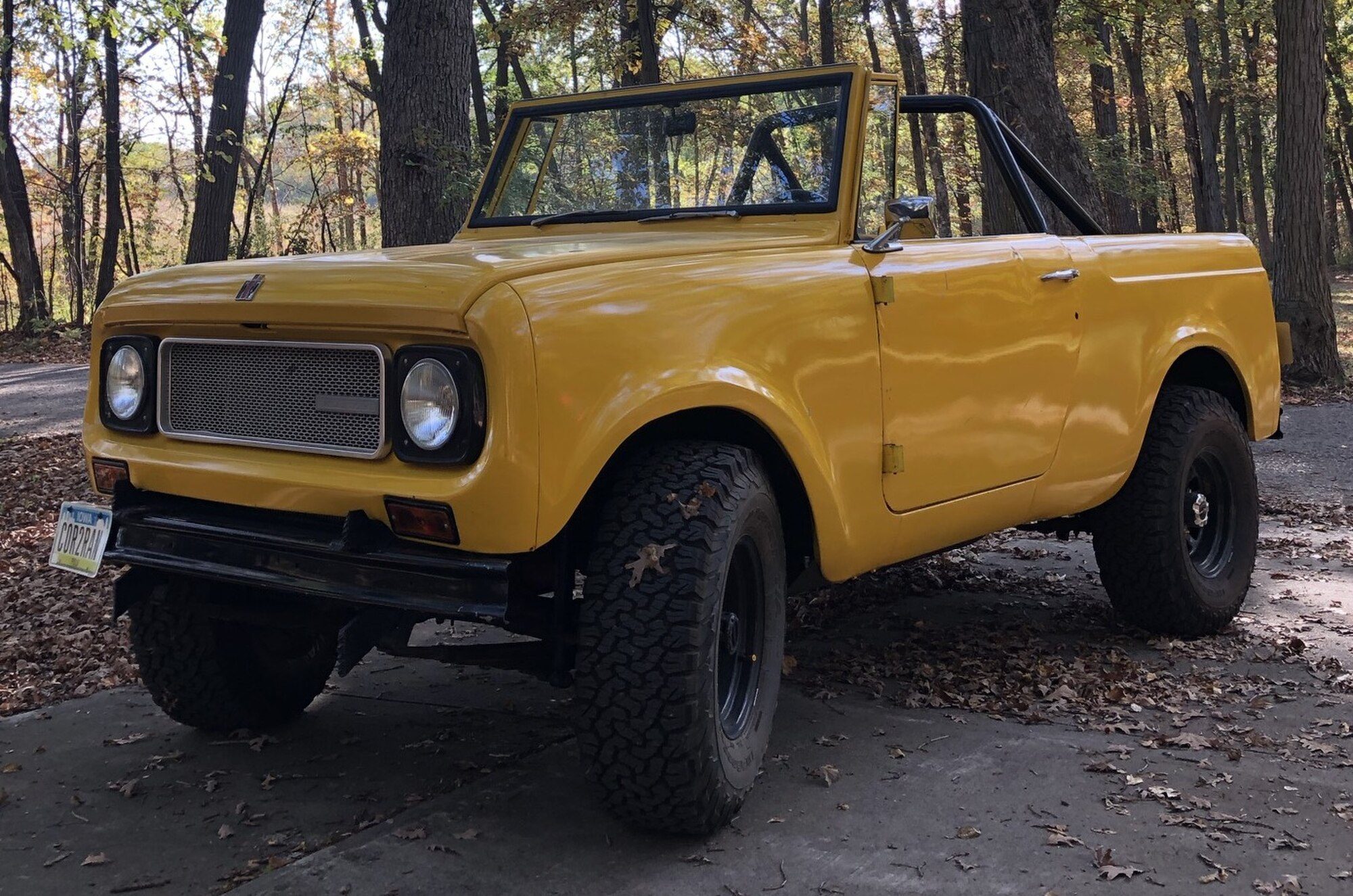
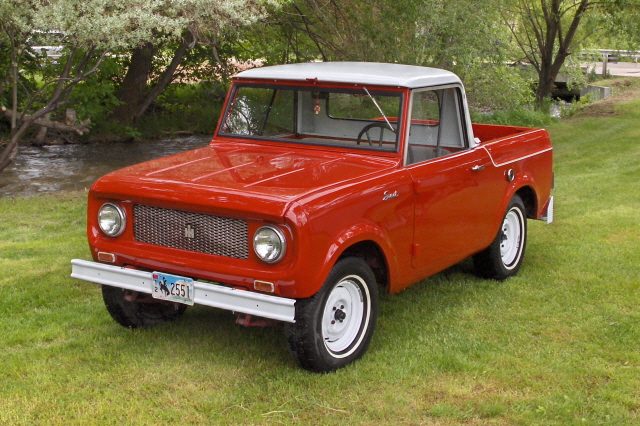
The first Scout was basic. It had a fold-down windshield, vacuum wipers mounted on top of the glass, and, until early 1962, side windows that slid out rather than wound down. It sat on a 100-inch wheelbase with Dana 27 axles front and rear, both offset to the passenger side, and a Dana 18 transfer case behind a three-speed. You could buy it as a pickup, an open roadster or a TravelTop wagon, in two- or four-wheel drive. Sports Car Market says the four-wheel-drive TravelTop was the one buyers wanted most.
THE 80 GROWS UP
IH marked its 100,000th Scout with the Red Carpet edition, about 3,000 trucks in white with red interiors. The Scout 800 arrived in 1965 with a fixed windshield, wipers moved to the bottom of the glass, an aluminum grille, bucket seats, better gauges and a better heater. It was the start of the Scout's slow move from work truck toward family wagon. Japan's FJ40 was a contemporary rival.
The engines grew too. A turbocharged 152 made 111 horsepower. The 196 cubic-inch four, half of IH's 392 V8, arrived in 1966 with the same 111 horsepower and better fuel economy. An AMC-built 232 inline-six followed, and in 1967 the Scout got its first V8, IH's own 266. The 1966 Sportop had a raked fiberglass roof and a nicer interior, and the rare factory Campermobile came with fold-out bunks. Both were early signs of the lifestyle SUV, years before anyone called it that.
800A AND 800B: THE LAST OF THE ORIGINALS
The 800A arrived in November 1968 with a three-piece grille and black headlight bezels. The other half of the 304 V8 was now in the options list, and running gear was heavier. Wikipedia lists a Dana 44 rear axle and a quieter Dana 20 transfer case for the 800A, while Autotrader Classics dates both changes to 1967, so check the truck rather than the paperwork. The 800A also brought the Aristocrat, the dressiest of the original-body Scouts, in blue and silver with a chrome roof rack.
The 800B, built from August 1970 to March 1971, was almost identical except for chrome headlight bezels. It came with a Comanche package, with its own paint and decals, and a SnoStar snowplow package offered only with the six. Production of the Scout II began in April 1971. Hagerty sums up the original run well: the Scout beat Ford's Bronco to market as a more practical alternative to the Jeep CJ, and it was among the early SUV pioneers.
OWNING ONE NOW
Hagerty credits early Scouts with a reputation for durable drivetrains, which it puts down to IH's tractor-building background. The same sources agree that the bodies are the problem. Silodrome warns that trucks driven on salted roads can end up "looking like a colander", and the catalogues of IH Parts America and Super Scout Specialists, full of replacement floors, rockers and patch panels, tell the same story. The good news is that the parts exist. Autotrader Classics notes that large panels such as fenders are not reproduced, but small steel is.
Prices have moved a long way. Sports Car Market recalled that its author bought a 1967 Scout 800 V8 TravelTop for $800 in 2003. In late 2024, Autotrader Classics advised budgeting at least $40,000 for a good one and warned that anything under $15,000 is a major project. Volkswagen Group now owns the Scout name, and its Scout Motors revival is building a factory in South Carolina. Its website's coordinates, 41°03'N 85°04'W, point straight back to Fort Wayne.
SIDEBAR · THE SCOUT THAT WENT TO PATAGONIA
Pato, the factory camper, and the Pan-American Highway
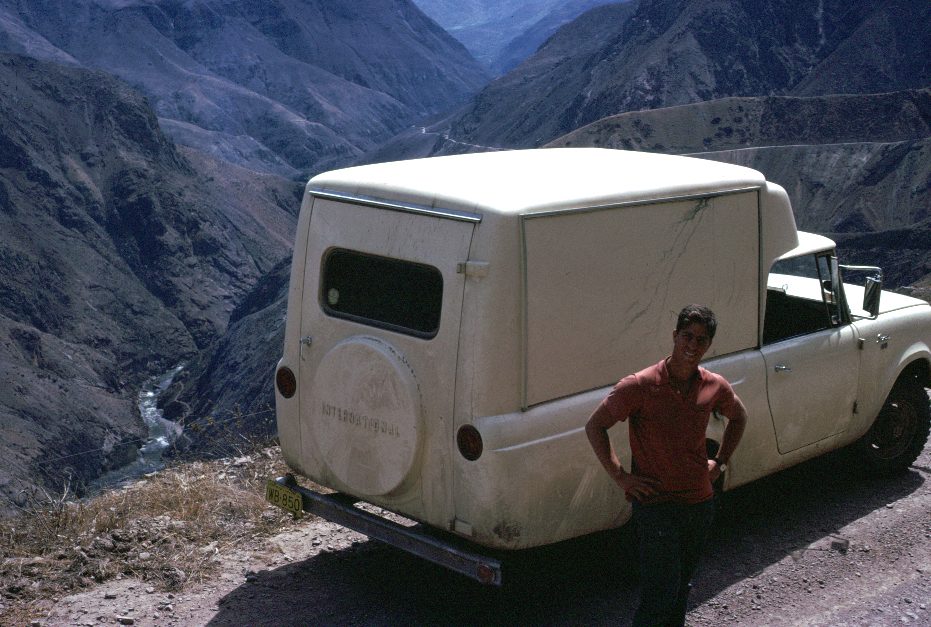
IH offered an experimental factory camper body for the Scout 80. It cost $960 installed as a stripped shell or $1,850 as a deluxe unit. Few were built, and Wikipedia calls them rare today.
One of them went a very long way. According to the man who uploaded the photo below to Wikimedia Commons, his father and a college roommate were given a 1963 or 1964 Scout 80 Camper by International for a drive from Denver to Patagonia on the Pan-American Highway. In return they supplied photos from the trip for IH's print advertising. They named the Scout 'Pato', and it was sold in Santiago, Chile, at the end of the trip. It might still be there.