The story
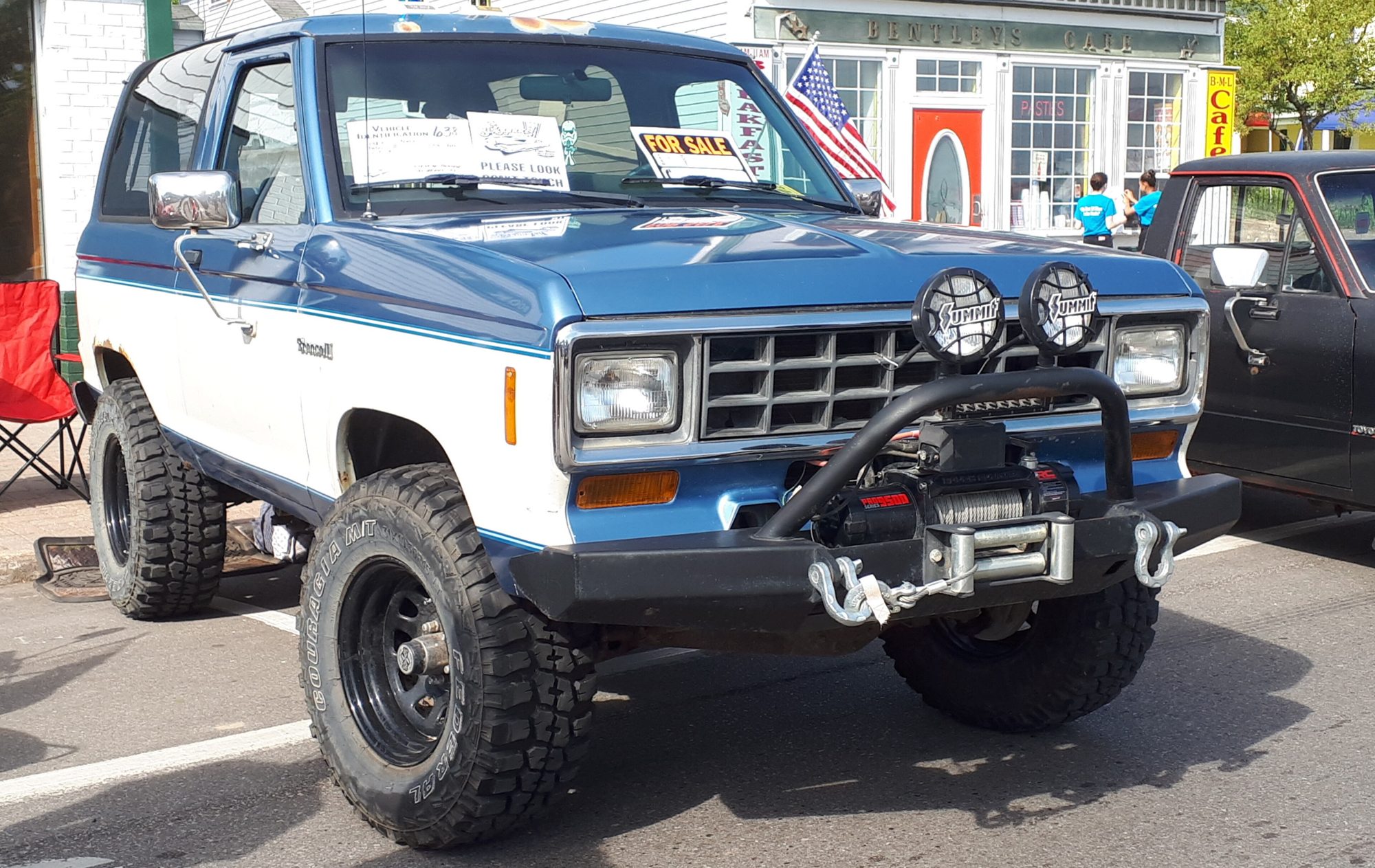
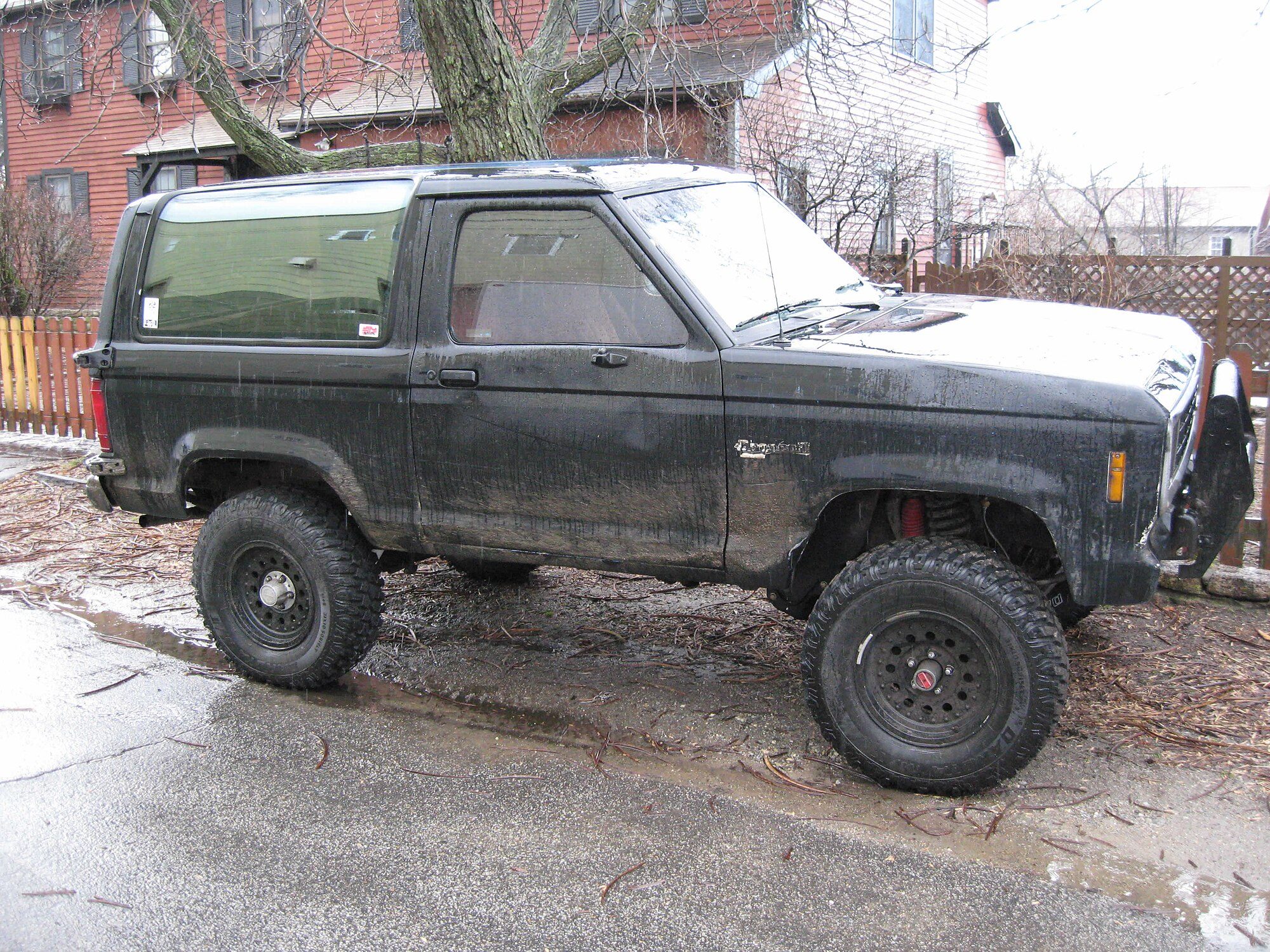
In March 1983 Ford introduced a second Bronco that had almost nothing to do with the first two. The Bronco II was the new Ranger compact pickup with a short enclosed wagon body where the bed would be, built alongside it at Louisville Assembly from January 1983 and sold as a 1984 model. It was roughly the size of the early Bronco, nearly a foot shorter than Chevrolet's new S-10 Blazer, and it arrived the same year as the Jeep Cherokee XJ and the first 4Runner. MotorTrend liked it so much it decided XLT stood for "Xcellent Little Truck". Then the rollover numbers came in.
1984–85: A RANGER WITH A ROOF
Under the skin it was all Ranger: a ladder frame cut to a 94-inch wheelbase, Ford's Twin Traction Beam front suspension with a Dana 28 differential, coil springs and radius arms, and a leaf-sprung Ford 7.5-inch axle at the back. Wikipedia notes that nearly the whole driver's compartment came straight from the pickup. Every early truck was four-wheel drive, with a Borg-Warner 1350 transfer case, and power came from the German-built 2.8-liter Cologne V6: carbureted, 115 hp and 150 lb-ft. A Toyo Kogyo four-speed or a C5 three-speed automatic sent it rearward.
Ford sold it as a lifestyle object from the start. Its own marketing called it a vehicle for "men, single people, or young couples", the sort of John Wayne truck that made buyers feel they could conquer anything. The 1984 range already included an Eddie Bauer edition, which The Ranger Station calls the first Ford to wear the outdoor brand: two-tone paint over Light Desert Tan, a tan interior with pine-tree stitching, and Eddie Bauer luggage shipped to the buyer's house. For 1985 the four-speed became a five-speed, the A4LD four-speed automatic replaced the C5 from November 1984 builds, and power windows and locks finally arrived.
1986–90: FUEL INJECTION, 2WD AND A NEW FACE
For 1986 the 2.8 gave way to a fuel-injected 2.9-liter Cologne V6 with 140 hp and 170 lb-ft, and the push-button Touch-Drive electric transfer case appeared late in the year. A Mitsubishi 2.3-liter turbodiesel was listed as well; The Ranger Station says it was offered for 1986 only, Wikipedia says 1986 and 1987, and everyone agrees almost nobody bought it. Rear-wheel drive arrived too, though NHTSA's sales figures show the first 2WD trucks counted in the 1987 model year. Rear-wheel ABS became standard for 1987, and the XL Sport, with a brush guard, fog lamps and a tubular rear bumper, followed for 1988.
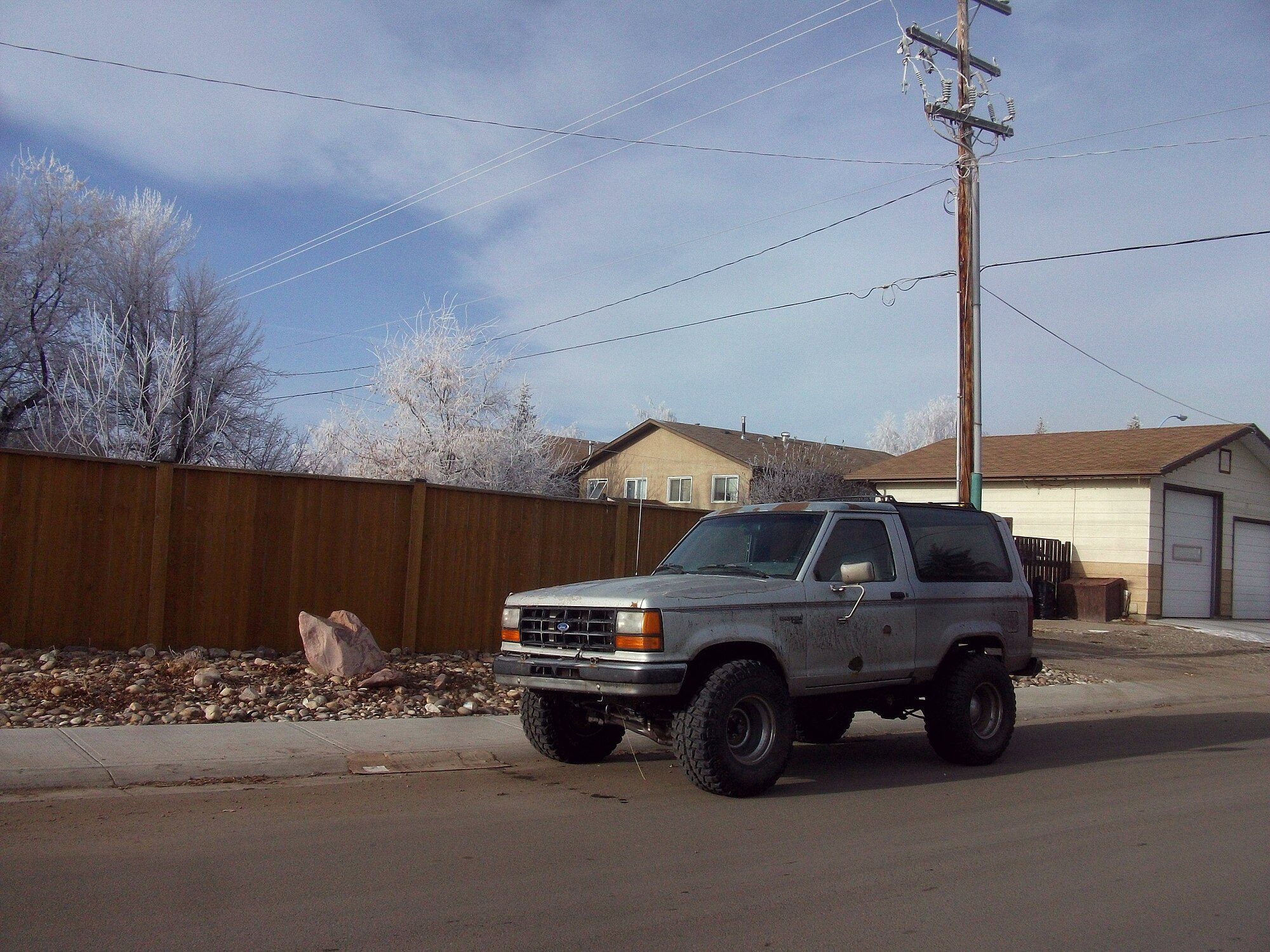
The 1989 facelift matched the restyled Ranger: new hood, fenders and front bumper, a new dashboard with the Touch-Drive buttons moved into it, and 3.6 more inches of overall length on the same wheelbase. The front-door vent windows disappeared, the 2.9 got stronger "89TM" cylinder heads, and Eddie Bauer trucks switched to Light Sandalwood lower paint. The last trucks brought the BW1354 transfer case on electric-shift models and, after November 1989, a Dana 35 front axle in place of the Dana 28. Production ended in early 1990. The Bronco II had been built for barely seven model years, while the full-size Bronco carried on until 1996.
THE ROLLOVER RECORD
The trouble started before production. Automobile Magazine reports that Ford engineers calculated a stability index (a figure based on track width and center-of-gravity height) significantly lower than the S-10 Blazer's and slightly lower than the Jeep CJ-7's, that some test maneuvers were dropped for the drivers' safety, and that proposals to widen the track or lower the truck were mostly vetoed because they would have delayed the launch. In the summer of 1982 Ford's Office of General Counsel collected more than 100 documents on the truck's handling, 53 of which later turned out to be missing.
In March 1989 NHTSA opened an engineering analysis of 1984–89 Bronco IIs after its study of the Suzuki Samurai. That study counted 43 fatal single-vehicle Bronco II rollovers, or 19 per 100,000 vehicles, against 6 for the Samurai, 6 for the S-10 Blazer and Jimmy, and 2.5 for the Cherokee. Two months later Consumer Reports, published by Consumers Union, told readers to avoid the truck after it failed the magazine's emergency-handling tests. NHTSA closed its investigation on October 31, 1990, without a recall. Using its preferred measure, first-event single-vehicle rollovers per single-vehicle crash, the agency found the Bronco II similar to other small SUVs.
The argument never went away. NHTSA turned down a 1997 petition to reopen the case in May 1999. It repeated that the truck's rollover rate did not stand out, but added that its crashworthiness in rollovers was "a cause for concern", with a much higher share of occupants killed in first-event rollovers than in most peer vehicles. By 1997 about 260 people had died in Bronco II rollovers. Ford had paid $113 million to settle injury and death suits, and it offered a class settlement covering about 658,000 owners: new warning labels and manuals, $100 toward worn suspension parts and up to $200 for certain modifications. Ford has always maintained that driving and modifications, not design, caused the rollovers.
THE EXPLORER, AND THE TRUCKS THAT SURVIVED
Ford replaced the Bronco II with the Ranger-based Explorer, introduced in March 1990 as a 1991 model with a 160-hp 4.0 V6 and the four doors the Bronco II never had. Even the two-door Explorer Sport was about a foot longer. According to PBS Frontline, Ford engineers ran an Explorer prototype through the same test the Bronco II had failed and saw it lift its wheels too. Thirty-odd years on, the surviving Bronco IIs are cheap, light and narrow, and owners build them around Explorer parts: Dana 35 front axles, 8.8 rear axles and 4.0 engines. Driven sensibly, kept low and treated as the narrow-track short-wheelbase truck it is, a Bronco II will go places a modern SUV won't fit.
SIDEBAR · THE 2WD WITH A TRANSFER CASE
The BW1359 "dummy" case
When Ford added a rear-drive Bronco II, it didn't redesign the drivetrain. Most 2WD trucks got the four-wheel-drive transmission, the same crossmember and rear driveshaft, and a Borg-Warner 1359 that looks like a transfer case but drives nothing. It passes power straight through to the rear axle and has a permanent seal where the front output would be. The Ranger Station's explanation is assembly-line efficiency: the short wheelbase made unique 2WD driveshafts and exhaust routing more trouble than a pass-through box.
Late in 1990 production some 2WD trucks finally got a true 2WD transmission with a bolt-on flange adapter instead. Owners note that some 1359s are dry and others contain ATF. The case is also why converting a 2WD Bronco II to 4WD is a popular, well-documented project. It only matters for safety because the 2WD truck had the worse record: Automobile Magazine cites IIHS figures of 3.78 rollover deaths per 10,000 rear-drive Bronco IIs in 1986–90, against 1.74 for the 4x4.