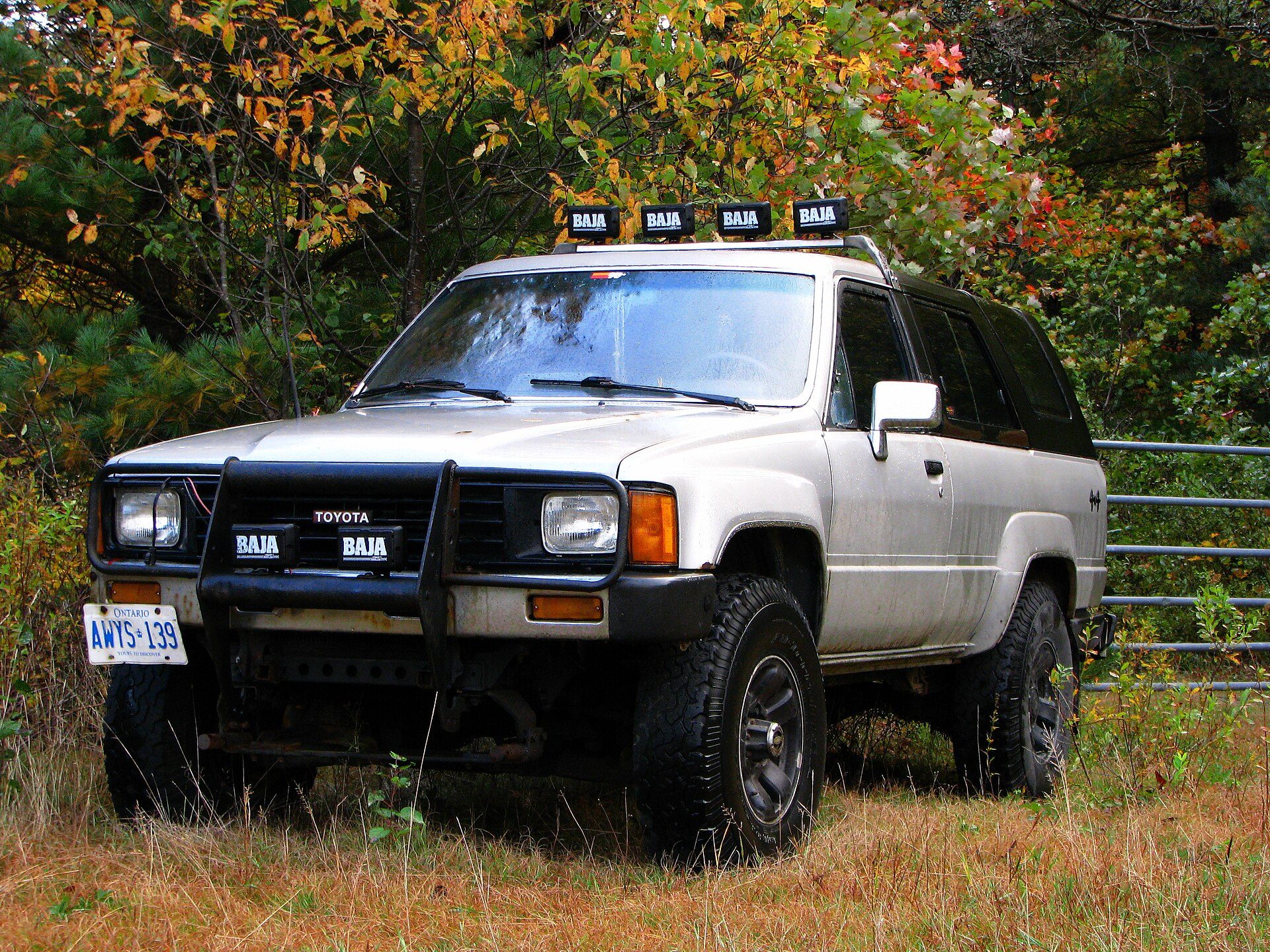
Silver first-generation two-door 4Runner with a black brush guard and roof-mounted Baja lights parked in tall grass below autumn trees
TOYOTA 4RUNNER · N60 · 1984–1989

Toyota 4Runner 1st Gen

N6022R-E 2.4 I4SOLID AXLE 1984–85

“A Hilux pickup with a removable fibreglass hat, a four-cylinder that refuses to die and — for 1984–85 only — a solid front axle. Slow, rusty, uncomfortable and utterly charming, which is exactly why the prices went up.”

PART 01

Overview

Where it came from, why it matters, and how it changed year to year.

The story

The first 4Runner was less designed than improvised: take Toyota's redesigned 1984 Hilux 4x4 pickup, give the bed a fibreglass lid and a back seat (sometimes), and ship it to America. It went on sale in the US in May 1984 as a 1984½ model — two doors, a four-cylinder, a five-speed and, for its first two seasons, a solid front axle on leaf springs. Four decades on it is the 4Runner people call 'pure', and the one Hagerty says can't be ignored now that clean examples keep getting more expensive.

A PICKUP WITH A HAT

Toyota had already seen the idea work. Between 1981 and 1983 Winnebago and Toyota turned short-bed Hilux 4x4s into the Trekker — a fibreglass-lined bed, an extra seat and a fibreglass top — and Curbside Classic counts only around 1,500 of them. The factory version arrived as the Hilux Surf in Japan in October 1983 and as the 4Runner in North America a few months later, just as the FJ40 Land Cruiser left the US market and the small-SUV class filled up with the S-10 Blazer, Bronco II and Jeep Cherokee.

Hagerty describes the details that make owners grin: a rear roof held on by 14 bolts, a standard rear roll bar, and a power rear window that drops into the tailgate. SR5s added an altimeter and inclinometer on the dash, a rear seat, strobe-stripe graphics and chrome wheels; the base DX often came without a rear seat at all, and Toyota never fitted rear shoulder belts.

ENGINES, AND THE AXLE ARGUMENT

The 1984½ trucks used the carburetted 2.4-litre 22R making 96 hp, paired only with a five-speed. Fuel injection arrived for 1985 as the 22R-E — Wikipedia lists 116 hp — and 1986 brought the 135 hp 22R-TE turbo, mostly sold with the automatic in SR5s and far rarer than the plain 22R-E. For 1988 the 3.0-litre 3VZ-E V6 joined the range, rated at 145–150 hp depending on the source. Hagerty's verdict on the whole run: 0–60 times improved 'from months to weeks to about 12 seconds'.

The bigger change came underneath. For 1986 the solid front axle was replaced by independent front suspension with a three-inch-wider track, which made the truck calmer on the road and, by most accounts, a little less heroic off it. That split defines the generation today: 1984–85 trucks are the solid-axle purist's choice, while 1986–89 trucks ride better and share their front end with the second generation. Both keep a leaf-sprung rear axle that Wikipedia notes was never upgraded for the extra weight of the seats and top — so sagging is normal.

WHY IT MATTERS NOW

In its own time the N60 was a slow starter: US sales were 6,498 in 1984 and dipped below 4,000 in 1987, before jumping to 20,880 in 1988 and 36,927 in calendar 1989 (a figure that includes the first 2nd gens). Today the story has flipped. Hagerty reported average values of $8,400 in #3 condition, $13,700 in #2 and $21,100 in #1, with Bring a Trailer sales of a 100,000-mile 1984 SR5 at $19,250, and found that millennials and Gen-Xers made up a far larger share of 4Runner insurance quotes than of the market overall.

The Autopian's David Tracy goes further, naming the 1985 — fuel-injected, solid-axled, convertible-topped and under 3,500 lb — his perfect 4Runner. The catch is survival. Open tops let water in, floors and quarter panels are not reproduced, and Hagerty notes that original seats and upholstery are close to unobtainable. Mechanically, though, the 22R-family engines are among the easiest Toyota ever built, and LC Engineering still runs a whole 1984–1989 4Runner catalogue.

THE AFTERMATH

For 1990 Toyota replaced it with a four-door, fixed-roof second generation that kept the independent front end and swapped the rear leafs for coils. The removable top never returned, and by the third generation the pickup-with-a-lid idea had vanished entirely. The first gen became something else: the cheap, simple base for solid-axle swaps, V8 conversions and camper builds — Expedition Portal's classifieds once listed a 1985 SR5 on Old Man Emu springs with a FlipPac pop-up roof for $8,000. Nobody is building them that way from new any more, which is rather the point.

SIDEBAR · BEFORE THE 4RUNNER

The Trekker: Winnebago's 4Runner prototype you could buy

Before Toyota built its own 4Runner, Winnebago did a version for it. Curbside Classic describes how short-bed Toyota 4x4 pickups were sent to Winnebago, which lined the bed with fibreglass, added a seat and fitted a fibreglass top; 'only some 1500 Trekkers were made and sold, between 1981 and 1983'.

Its true origins are hazy, and Curbside Classic found no evidence that the Trekker's top was meant to come off. But the concept — Hilux 4x4 plus enclosed back with seats — is exactly what Toyota put into production for 1984. LC Engineering still lists the 1981–1983 Trekker as its own model in its parts catalogue.
Year by year

What changed, model year by model year. Sweet spot Beware

  1. 1984½US sales start May 1984: two doors, removable fibreglass top, carbureted 22R, five-speed, solid front axle; base DX has no rear seatSweet spot
  2. 1985Fuel-injected 22R-E (116 hp) arrives; rear seat available on all trims. Still solid-axleSweet spot
  3. 1986Hi-Trac independent front suspension replaces the solid axle, track 3 in wider; 22R-TE turbo (135 hp) added
  4. 1987No changes
  5. 19883.0 3VZ-E V6 (145 hp) replaces the turbo on SR5; SR5 gets automatic locking hubs
  6. 1989Minor cosmetic and option changes before the 1990 replacement
PART 02

Specs & capability

How it’s built, what it can do, and what fits under it.

How it’s built

Mechanically the N60 is a Toyota Hilux 4x4 pickup, nearly part-for-part. That means a ladder frame, a leaf-sprung live rear axle, a part-time transfer case and an engine bay designed for the simple 22R family. The interesting choices are the 1984–85 solid front axle with manual locking hubs, the switch to torsion-bar independent front suspension for 1986, and a removable fibreglass rear roof.

CHASSISHilux 4x4 ladder frameNearly mechanically identical to the 1984-on Hilux pickup.
FRONTSolid axle → IFSLeaf-sprung solid axle with manual hubs 1984–85; torsion-bar IFS with a 3 in wider track from 1986.
REARLeaf-sprung live axleHotchkiss drive; springs weren't uprated for the seats and top, so they sag.
ENGINE22R-E 2.4 I4Carburetted 22R in 1984; EFI from 1985; turbo 22R-TE from 1986; 3VZ-E V6 from 1988.
4WDPart-time, two-speedManual locking hubs; automatic hubs added to SR5s for 1988.
BODYTwo-door, removable topFibreglass rear roof held by 14 bolts, standard roll bar, power tailgate glass.

Variants & engines

YEARSPLATFORMENGINEOUTPUTWORTH KNOWING
1984½N60 · solid axle22R 2.4 I4 (carb)96 hpFive-speed manual only. DX or SR5.
1985N60 · solid axle22R-E 2.4 I4 (EFI)116 hpFuel injection arrives; the last solid-axle year.
1986–1989N60 · IFS22R-E 2.4 I4116 hp / 140 lb-ftIFS with 3 in wider track; two-segment grille from 1986.
1986–1987N60 · IFS22R-TE 2.4 turbo I4135 hpMostly automatic SR5s; much rarer than the 22R-E.
1988–1989N60 · IFS3VZ-E 3.0 V6145–150 hpOptional V6; auto hubs on SR5s. Sales take off.

Capability numbers

Curb weight3,520–3,760 lb (1,597–1,706 kg)
Fuel economyEPA 17 mpg city (22R-TE)14.5 mpg observed in period testing

Wheels & tires

LIFTBIGGEST TIREWHAT IT TAKES
Stock31x10.50R15Toyota-4Runner.org owners run 31s with no lift and no regear; 33x12.50s rub the front valance, wheel-well corners and rear pinch weld
≈1.5–2 in33x12.50R15IH8MUD: 'about an inch and a half' of lift plus hammering the pinch weld/valance; a narrower 33x10.50 rubs less. Owners call stock gearing 'a dog' on 33s

Forum consensus, not a guarantee: wheel offset, tire brand and suspension wear all change clearance. Confirm before you buy.

Production & special editions

Built at Tahara, Japan, from October 1983 to August 1989; US sales took off only once the V6 arrived.

ProductionOctober 1983 – August 1989 (Tahara, Japan)
US sales (calendar year; 1989 includes early 2nd gens)6,498 (1984) · 5,495 (1985) · 5,564 (1986) · 3,635 (1987) · 20,880 (1988) · 36,927 (1989)
PredecessorWinnebago-built Toyota Trekker, about 1,200–1,500 sold 1981–83
PART 03

Buying one

What to pay, what to check, and how to tell a good one from a clone.

What they cost

Values have climbed hard; clean, unmodified early solid-axle trucks with manual gearboxes take the big money, while IFS automatics stay affordable.

Project / needs work$8k–13k
Driver$13k–22k
Excellent / low-mile original$28k–60k+

Based on 20 Bring a Trailer sales from November 2025 to October 2026 (median about $16,600). The top three were 1984–85 solid-axle five-speeds, including a 42k-mile 1985 SR5 at $60,500. Prices move; checked October 2026. See live listings below.

What to check before you buy

  1. 01
    Rust, everywhereForum owners point to the frame ahead of the rear spring perches, the rear quarters and wheel wells, the left rear near the exhaust exit, and, on sunroof-equipped trucks, A-pillars that owners say rotted from blocked drains. Hagerty warns that floors and quarter panels aren't reproduced, so a rusty body is a fabrication job, not a parts order.
  2. 02
    Know which axle you're buying1984–85 trucks have the solid front axle; 1986–89 have IFS. Solid-axle trucks carry a price premium and some sellers stretch the truth, so look underneath: leaf springs and manual hubs up front mean solid axle; torsion bars and CV axles mean IFS.
  3. 03
    22R-E timing chain guidesThe plastic timing-chain guides are a known breakage item — LC Engineering makes metal-backed replacements specifically for it. A cold-start rattle from the front of the engine, or no record of the job, means budget for chain, guides and tensioner.
  4. 04
    V6 head gasketsThe 1988–89 3VZ-E shares the V6's head-gasket reputation. Toyota's October 1996 policy adjustment (1988–94 V6 trucks) is long expired and the later V06 campaign only covered 1/90–10/94 builds, so check for coolant loss, overheating history and white exhaust, and ask for paperwork on any head work.
  5. 05
    Sagging rear and tired suspensionRear leafs sag on nearly all of them. Feathered front tyres can mean worn front-end parts or a bad alignment; on IFS trucks check idler arm and tie-rod play.
  6. 06
    Top, glass and sealsRemovable tops and ageing seals leak; a tarp over the roof in the ad is a clue. Check the power tailgate window works — IH8MUD members flag it as a weak point on both early generations.
  7. 07
    Interior partsCarpets can be found, but Hagerty says reproduction seats and upholstery generally can't, and owners say good seats are especially scarce. An intact original interior is worth paying for.
  8. 08
    Rear seats and beltsMany 1984–86 base trucks came without a rear seat, and Toyota never fitted rear shoulder belts. If you plan to carry kids, factor that in.

Spotting the real thing

The 1984½–89 trucks look alike but split hard on axle and engine, and the front half is pure Hilux pickup, so check the hardware rather than the badges.

  1. ID
    Solid axle or IFS1984–85 trucks have a solid front axle on leaf springs; 1986–89 have independent front suspension with a 3 in wider track. Look under the front: a beam axle and leaf packs vs torsion bars and CV shafts.
  2. ID
    Engine by year1984½ is carbureted 22R only; EFI 22R-E from 1985; the 22R-TE turbo only for 1986–87, mostly with the automatic; the 3VZ-E V6 for 1988–89 on SR5.
  3. ID
    Rear seat and trimMany 1984–86 trucks came in without a rear seat (base DX omitted it), partly to classify them as trucks for import duty. The SR5 package added gauges, better trim and the rear seat.
  4. ID
    Hilux Surf twinsJapan's Hilux Surf used 3Y petrol and 2L / 2L-T diesel engines that were never sold in the US; a diesel or right-hand-drive 'first gen' is a gray import, not a US 4Runner.

Recalls & service bulletins

Open recalls follow the VIN, not the model. Run yours through NHTSA before you buy, and ask the seller for dealer records showing recall work.

Check a VIN at NHTSA ↗
Notable recalls
Fuel hose too close to EGR pipe ↗1988 · NHTSA 88V-019Improperly routed fuel hose could lack clearance to the EGR pipe.
Steering relay rod fatigue crack ↗1989 (campaign covers 1989–1995 4Runner) · NHTSA 05V-389Repeated full-lock steering under high effort (e.g. parked) can crack the steering relay rod.

Importing & legality

Japan's version was the Hilux Surf (N60), offered with a 2.0 3Y petrol or 2.4 2L diesel and later the 2L-T turbo-diesel, none of them sold in the US. Every one is now well past the US 25-year exemption from federal safety standards, so diesel and right-hand-drive Surfs can come in, but state titling and emissions rules still apply and vary.

Rules change and vary by state and country. Confirm with your DMV and a licensed importer before you buy.

The one you’ll own someday

For sale now

1984–1989 · USAll 1st gen 4Runners
1984–1985 · USSolid front axle
1986–1989 · USIFS, turbo and V6 years
PART 04

Owning one

Baseline service, the repairs you’ll actually do, and where the manuals live.

Post-purchase baseline

After you buy it

Assume nothing on a 35-plus-year-old truck: baseline every fluid, filter and wear item the day you buy it, then keep records. Factory capacities and fluid grades for the N60 aren't reliably published online. Figures marked AMSOIL come from AMSOIL's application guide for the 1987 22R-E, and plug data from Denso's catalogue; check those and anything still marked below against the owner's or factory service manual, and know which hubs and axle you have before ordering parts.

Engine oil & filter22R-E: 10W-30, 10W-40 or 10W-50 above −23 °C (15W-40 to 20W-50 above −12 °C) · ≈4.5 US qt with filter (AMSOIL, 1987 22R-E) · 3VZ-E V6 [CONFIRM IN MANUAL]At purchase, then per the manual

Watch for a 22R-E burning oil at high mileage; leaks often come from the valve cover gasket.

Air filterPanel filterAt purchase; more often on dusty trails

Check the airbox seals and intake boot for cracks while it's open.

Fuel filter (EFI trucks)EFI in-line filterAt purchase if no record

On the 22R-E it sits below the intake manifold. 4Runners.com owners pull the driver's front wheel for access, mind the flow arrow, and fit new crush washers.

Spark plugs, wires, cap & rotor22R-E: Denso W16EXR-U, gap 0.8 mm (0.031 in) (Denso catalogue, 22R-E 4Runner from 08/87) · earlier trucks and 3VZ-E V6 [CONFIRM IN MANUAL]At purchase

Old ignition parts cause most rough-running complaints on distributor-ignition 22R-Es and 3VZ-Es.

Timing chain & guides (22R-E)Single-row chain; metal-backed guides recommendedInspect at purchase; replace if noisy or undocumented
Timing belt & water pump (3VZ-E V6, 1988–89)Belt, tensioner, idlers, water pumpA 4Runners.com member recalls 4 years / 96,000 km (≈60,000 mi) as typical
CoolantToyota-type long-life coolant · 22R-E ≈9 US qt (AMSOIL, 1987 22R-E) · V6 capacity [CONFIRM IN MANUAL]Drain and refill at purchase

4Runners.com owners: use a coolant that meets the manual's spec ('Asian formula for Toyota'); Toyota pink is pre-diluted red. Never let either engine overheat — especially the V6.

Manual / automatic transmission fluidManual: GL-4 or GL-5 gear oil, 75W-90 or 80W-90 (AMSOIL, 1987 22R-E) · capacity and automatic fluid [CONFIRM IN MANUAL]At purchase (drain and refill)
Transfer case & differentialsTransfer case (manual-gearbox trucks): GL-4 or GL-5 gear oil, ≈3.4 pt (AMSOIL, 1987 22R-E) · differential grades and capacities [CONFIRM IN MANUAL]At purchase

Break the fill plug loose before the drain plug. 1984–85 solid-axle trucks also have closed knuckles that need fresh grease or oil.

Front wheel bearings & hubsClean, inspect, repack, set preloadAt purchase

1984–89 trucks came with manual or automatic hubs; 4Runners.com owners say the auto hubs are less reliable and often get swapped for manual ones.

Brake fluidType [CONFIRM IN MANUAL]Flush at purchase

No ABS on these trucks — fresh fluid and healthy rubber lines matter all the more.

Steering & front-end wear (IFS trucks)Idler arm, tie-rods, pitman armInspect at purchase

Idler-arm slop is the classic cause of wander on 1986–95 IFS Toyotas.

Rear spring bushings & U-boltsLeaf-spring bushingsInspect at purchase

Sagging rear leafs are near-universal; replace bushings when you replace springs.

For the hands-on owner

Common repairs

The jobs owners actually end up doing, rated for a competent home mechanic with a decent tool kit. Always confirm torque figures, fluids and procedures against the factory service manual for your VIN, and work safely — support the truck on stands, never just a jack. You do this work at your own risk; see the disclaimer. Some parts links are affiliate links.

22R-E timing chain, guides and tensioner
DIFFICULTY · 3 / 5TIME · Most of a weekend for a first-timerSHOP COST · Metal-backed guides ≈ $64 (LC Engineering), plus chain, tensioner and gaskets
SYMPTOMSRattle or slap from the timing cover at start-up, broken guide pieces in the oil pan, or simply no record that it's ever been done.
THE FIXDrain coolant, remove the fan, radiator and accessories, then the timing cover. Fit the new guides positioned toward the outside of the block without tightening, install the crank gear, then the cam gear and chain with the bright link on top. Tighten the straight guide to 9 ft-lb, install the tensioner (also 9 ft-lb), position the curved guide toward the outside so the tensioner is mostly retracted, torque everything and refit the cam gear (per LC Engineering's instructions). Reassemble with a new cover gasket set.
TOOLS & PARTSMetric sockets · torque wrench · gasket scraper · LCE metal-backed guides (single row, 1985–95) · timing chain · tensioner · timing cover gasket set
3VZ-E head gaskets (1988–89 V6)
DIFFICULTY · 5 / 5TIME · Several days; heads usually go to a machine shopSHOP COST · MLS head gasket set ≈ $116 (LC Engineering), plus machining and a timing belt kit
SYMPTOMSCoolant loss with no visible leak, white exhaust after warm-up, overheating, misfires — 4Runners.com members say cylinder 6 is the usual victim.
THE FIXThis is an engine-out-of-the-car level job in all but name: drain fluids, strip the intake and exhaust crossover, remove the timing belt and cams, pull both heads and have them checked flat. Fit MLS gaskets (they need a very smooth deck finish), new head bolts or studs, and do the timing belt, water pump and thermostat while it's apart. Many owners add an exhaust crossover delete to reduce heat at the back of the engine.
TOOLS & PARTSFull metric socket set · torque wrench · cam/crank pulley tools · LCE MLS head gasket set · 3VZ OE head bolt set (88–95) · 3VZ timing belt kit (1988–92)
Rear leaf spring replacement
DIFFICULTY · 2 / 5TIME · An afternoonSHOP COST · Parts plus labor
SYMPTOMSRear sitting low or level with the front, bottoming out over bumps, cracked or flattened leaves.
THE FIXSupport the frame on stands and take the weight off the axle with a jack. Remove the shocks' lower mounts, the U-bolts and spring plate, then the shackle and front hanger bolts. Swap in new springs (LC Engineering sells 1984–89 4Runner sets at +2, +3 and +4 in) with new bushings, refit the U-bolts and torque everything with the truck back on its wheels so the bushings aren't preloaded.
TOOLS & PARTSFloor jack · stands · breaker bar · penetrating oil · new U-bolts · LCE 1984–89 4Runner rear leaf spring set
IFS idler arm and steering slop (1986–89)
DIFFICULTY · 2 / 5TIME · An afternoonSHOP COST · Parts plus labor; a Total Chaos 'Caddy' idler arm costs more than a stock one
SYMPTOMSWander on the highway, play at the wheel, a clunk over bumps, especially on bigger tyres.
THE FIXWith the front supported, check for play at the idler arm, tie-rod ends and pitman arm. To replace the idler arm, separate the centre link from it with a puller, unbolt it from the frame and fit the new one, then re-torque and get an alignment. IH8MUD members recommend a stronger idler arm or brace on any IFS truck that sees off-road use.
TOOLS & PARTSPitman/tie-rod puller · torque wrench · Total Chaos Caddy idler arm 95130 (1986–95 4Runner) or OEM-type arm
Solid-axle front end refresh (1984–85)
DIFFICULTY · 4 / 5TIME · A weekendSHOP COST · Parts plus labor
SYMPTOMSGrease or gear oil weeping from the knuckles, wheel bearing play, clicking from worn birfields on tight turns in 4WD.
THE FIXPull the hubs, spindles and birfield axles, clean and inspect the joints, then replace wheel bearings and seals and rebuild the knuckles (trunnion bearings and wiper seals). Repack with fresh grease and set bearing preload on reassembly. Trail-Gear's Classic front lift kit for 1979–85 solid-axle trucks bundles a knuckle rebuild kit and wheel bearing kits for exactly this reason.
TOOLS & PARTSHub socket · slide hammer · snap-ring pliers · knuckle rebuild kit · wheel bearing kits · Longfield or RCV axle upgrades if you're running bigger tyres
Sunroof drain and leak control
DIFFICULTY · 1 / 5TIME · A quick jobSHOP COST · Next to nothing — until it rots an A-pillar
SYMPTOMSOn sunroof-equipped trucks: wet headliner or carpets, rust bubbling at the base of the A-pillars, a musty cab.
THE FIXOwners report blocked sunroof drains rusting out A-pillars on trucks fitted with a sunroof. Clear the drain tubes with trimmer line or low-pressure air, check the outlets aren't crushed, and replace hardened top and window seals. Treat any surface rust in the pillars before it goes through.
TOOLS & PARTSTrimmer line · low-pressure air · rust converter · new seals
Swap failing auto hubs for manual hubs
DIFFICULTY · 2 / 5TIME · An afternoon, including a bearing repackSHOP COST · Aisin manual hubs ≈ $249 a set (1986–95 IFS) or ≈ $415 a pair (1979–85 solid axle), plus a ≈ $28 conversion kit (LC Engineering)
SYMPTOMSFront hubs that won't lock, slip under load or let go in reverse. 4Runners.com notes the auto hubs fitted to some 1984–89 4Runners are less reliable than manual hubs and will sometimes unlock in reverse.
THE FIXConfirm you have auto hubs (no dial to turn on the hub cap). Remove the auto hub assemblies and the auto-hub hardware on the spindle. Fit LC Engineering's conversion kit: the locking nuts and plates that hold the hub and rotor on the spindle once the auto-hub parts are gone. Repack the wheel bearings and set the preload to the factory manual while it's apart, then fit the manual hubs on new gaskets. Solid-axle (1984–85) and IFS (1986–89) hubs have different spline counts, so order the right ones.
TOOLS & PARTSSockets · spindle-nut socket · snap-ring pliers · torque wrench · wheel-bearing grease and new seals
Power tailgate window that sticks or drops
DIFFICULTY · 2 / 5TIME · An afternoonSHOP COST · Parts plus labor; one Toyota-4Runner.org member recommends a used motor
SYMPTOMSThe roll-down rear glass works only some of the time, stalls part-way or suddenly drops into the tailgate. IH8MUD members flag the electric rear window as a weak point on both early generations; Toyota-4Runner.org owners trace it to tired motors, regulator gears and drag in the channels.
THE FIXPull the tailgate's inner access panels. Run the glass up and down and check it stays in its tracks, then push and twist the regulator to see whether its gears stay meshed. If the regulator is sound, test the motor directly on a battery, then check the relay. Clean the channels and put silicone spray on the glass edges and rubber seals; one owner says a dealer clean-and-lube cured his. Toyota-4Runner.org members describe the motors as easily overwhelmed by drag, and one says 1st and 2nd gen motors are the same apart from the connector plug. If the glass has dropped and broken before, check the regulator was actually fixed, not just the glass.
TOOLS & PARTSTrim-panel tools · screwdrivers · 12 V jumper leads · multimeter · silicone spray
Asked on every forum

Toyota 4Runner 1st Gen questions, answered

What's the biggest tire I can fit without a lift?

Owners' consensus is 31x10.50R15 — Toyota-4Runner.org members say 31s fit with no lift and you can get away without regearing. 33x12.50s on a stock truck rub the front valance, wheel-well corners and rear pinch weld; IH8MUD owners estimate about 1.5 in of lift (plus some trimming) for 33s, and say the 22R-E will want lower gears.

SOURCE · T4R.ORG / IH8MUD
Which years have the solid front axle?

1984 and 1985. Toyota switched to independent front suspension with a three-inch-wider track for 1986, so 1986–89 trucks are IFS. Solid-axle trucks are the off-roader's favourite; IFS trucks ride better on the road.

SOURCE · HAGERTY / WIKIPEDIA
22R-E or V6?

Most enthusiasts prefer the 22R-E four-cylinder — Hagerty says so, and Expedition Portal members advise skipping the V6. The 3.0 V6 (1988–89) has more power but carries the 3VZ-E's head-gasket reputation and is harder to work on; the 22R-E is slow but famously simple.

SOURCE · HAGERTY / EXPEDITION PORTAL
Can I take the roof off?

Yes. The rear fibreglass top is held on by 14 bolts, and a rear roll bar was standard. Owners note the open-top experience mostly benefits rear passengers — and that ageing tops are a common leak point.

SOURCE · HAGERTY / TACOMAWORLD
Was there a diesel 4Runner?

Not in the US. Diesel engines were offered in Hilux pickups, but Wikipedia records that no diesel 4Runners were imported to the US.

SOURCE · WIKIPEDIA
What about the turbo?

The 22R-TE turbo four arrived for 1986 with 135 hp, mostly paired with the four-speed automatic in SR5s. It's much rarer than the 22R-E, and LC Engineering still sells dedicated 22R-TE short blocks and turbo parts.

SOURCE · HAGERTY / LCE
What fuel economy should I expect?

Not much. Wikipedia records an EPA city rating of 17 mpg for the 22R-TE turbo truck and 14.5 mpg in period testing; Trail4Runner quotes 19 city / 23 highway for a stock four-cylinder, which looks optimistic. Expect less with bigger tyres, a lift or a tired engine.

SOURCE · WIKIPEDIA / TRAIL4RUNNER
Is a 1988–89 V6 covered by Toyota's head gasket campaign?

Not any more. An October 1996 Special Policy Adjustment extended head-gasket coverage for 1988–1994 V6 trucks; the later V06 campaign covered 1/90–10/94 production and expired on 24 September 2018. Today a blown 3VZ-E head gasket is on you.

SOURCE · CARCOMPLAINTS (V06 TSB)
What's a first gen worth?

Hagerty's write-up on rising 1984–89 values gave averages of $8,400 (#3 Good), $13,700 (#2 Excellent) and $21,100 (#1 Concours), and cited Bring a Trailer sales of $19,250 for a 100,000-mile 1984 SR5 and $17,500 for a 168,000-mile 1986 SR5. Expedition Portal members reckoned a maintained 22R-E truck under about 170,000 miles could still be found for under $5,000.

SOURCE · HAGERTY
Should I solid-axle swap an IFS truck?

IH8MUD members are split. Some say the 1986–95 Toyota IFS is 'pretty stout' unless you rock-crawl hard; others who broke IFS shafts say to 'spend the money on a SAS and never look back'. Kits for 1979–85-style solid axles, long-travel IFS and stronger axles are all still sold.

SOURCE · IH8MUD
Can I still get parts?

Mechanical parts, yes — the 22R family is shared with Toyota pickups and LC Engineering runs a dedicated 1984–1989 4Runner catalogue. Body panels, floors and interior trim are the hard part; Hagerty notes reproduction seats and floors generally don't exist.

SOURCE · HAGERTY / LCE
PART 05

Building one

Who makes the good stuff, where owners gather, and who to watch.

Common modifications & who does them

SOLID-AXLE LIFT (1984–85)Flexier leaf packs, longer shocks and high-steer turn a solid-axle truck into a proper crawler — Trail-Gear claims up to 20 in of articulation from its Classic kit.
IFS LIFT & STEERING (1986–89)Ball-joint spacers and torsion bars are the classic budget lift; a stronger idler arm takes the slop out on bigger tyres.
ARMORBumpers and skids protect the parts that are hardest to replace — and the 1st gen market is small, so buy from people who still make it.
GEARING & LOCKERSBigger tyres and a 22R-E need help: transfer-case reduction gears and a rear locker are the traditional answers.
AXLE SHAFTSBirfields and CVs are the weak links once you add tyre size and a locker.
ENGINE REFRESHWhen a 22R-E is worn out, a fresh or stroked long block is cheaper than you'd think — and LC Engineering has built them for decades.

Clubs & events

Resources

Channels, accounts & forums

All 4Runner resources →
SourcesWikipedia — Toyota 4RunnerHagerty — Toyota's first-gen 4Runners offer go-anywhere fun with affordabilityHagerty — The rise of 1984–89 Toyota 4Runners can't be ignoredCurbside Classic — 1984–1985 Toyota 4Runner: beginning of a long line, end of the solid front axleThe Autopian — What's the best Toyota 4Runner of all time?Car and Driver (via AOL) — History of the Toyota 4RunnerTrail4Runner — 4Runner generation historyExpedition Portal — Advice on buying 1st gen 4RunnerExpedition Portal — Overland classifieds: 1985 4Runner with FlipPac camper conversionTacomaWorld — Anyone in here have a 1st gen 4Runner or facts on them?IH8MUD — Buying guide (mini trucks and early 4Runners)IH8MUD — IFS or axle swap?IH8MUD — 33" tires, too big?Toyota-4Runner.org — Tire question (1985 4Runner)Toyota-4Runner.org — 3VZ-E head gasket Special Service Campaign (V06) threadCarComplaints — 3VZ-E Head Gasket Special Service Campaign (V06) dealer packet4Runners.com — Make your 3VZ-E last forever!4Runners.com — 1st gen 4Runner suspension recommendations4Runners.com — 1st Gen T4R Armor ThreadLC Engineering — 22R/22RE metal-backed timing chain guides (install instructions)LC Engineering — MLS head gasket set, 3VZLC Engineering — Trail-Gear 'Classic' front lift kit, 1979–1985 pickup & 4RunnerLC Engineering — Sway-A-Way torsion bars, 1986–1995 4WD pickup & 4RunnerLC Engineering — First generation 4Runner (1984–1989) catalogueBring a Trailer — Toyota 4Runner (N60)4Runners.com — 4 cylinder fuel filter tips4Runners.com — What type of coolant is Toyota Pink4Runners.com — ID hubs: manual, auto, locked/ADD4Runners.com — Timing belt questionsLC Engineering — Manual hub conversion kit (auto hubs to manual, 1984–89)LC Engineering — Aisin manual locking hubs, 1986–1995 4Runner & pickupLC Engineering — Aisin manual locking hubs, 1979–1985 solid axle (pair)LC Engineering — Front hub star gasket (Toyota 43531-60010)Toyota-4Runner.org — Rear window issues (1990–95 power tailgate glass)Toyota-Club.net — Spark plug application table (Denso overseas-market catalogue)AMSOIL product guide — 1987 Toyota 4Runner 2.4L 22R-E fluids & capacitiesWikipedia — Toyota 4RunnerNHTSA recalls API — Toyota 4Runner 1988NHTSA recalls API — Toyota 4Runner 1989Toyota-4Runner.org — Tire question (Classic T4Rs)IH8MUD — 33" tires too big?Bring a Trailer — Toyota 4Runner N60 sold results (20 sales, Nov 2025–Oct 2026)BE FORWARD — Hilux Surf N185 1KZ-TE: US-legal specs (25-year rule)Rising Sun 4WD Club of ColoradoToyota JamboreeC4 Fabrication — C4 at Toyota Jamboree 2026