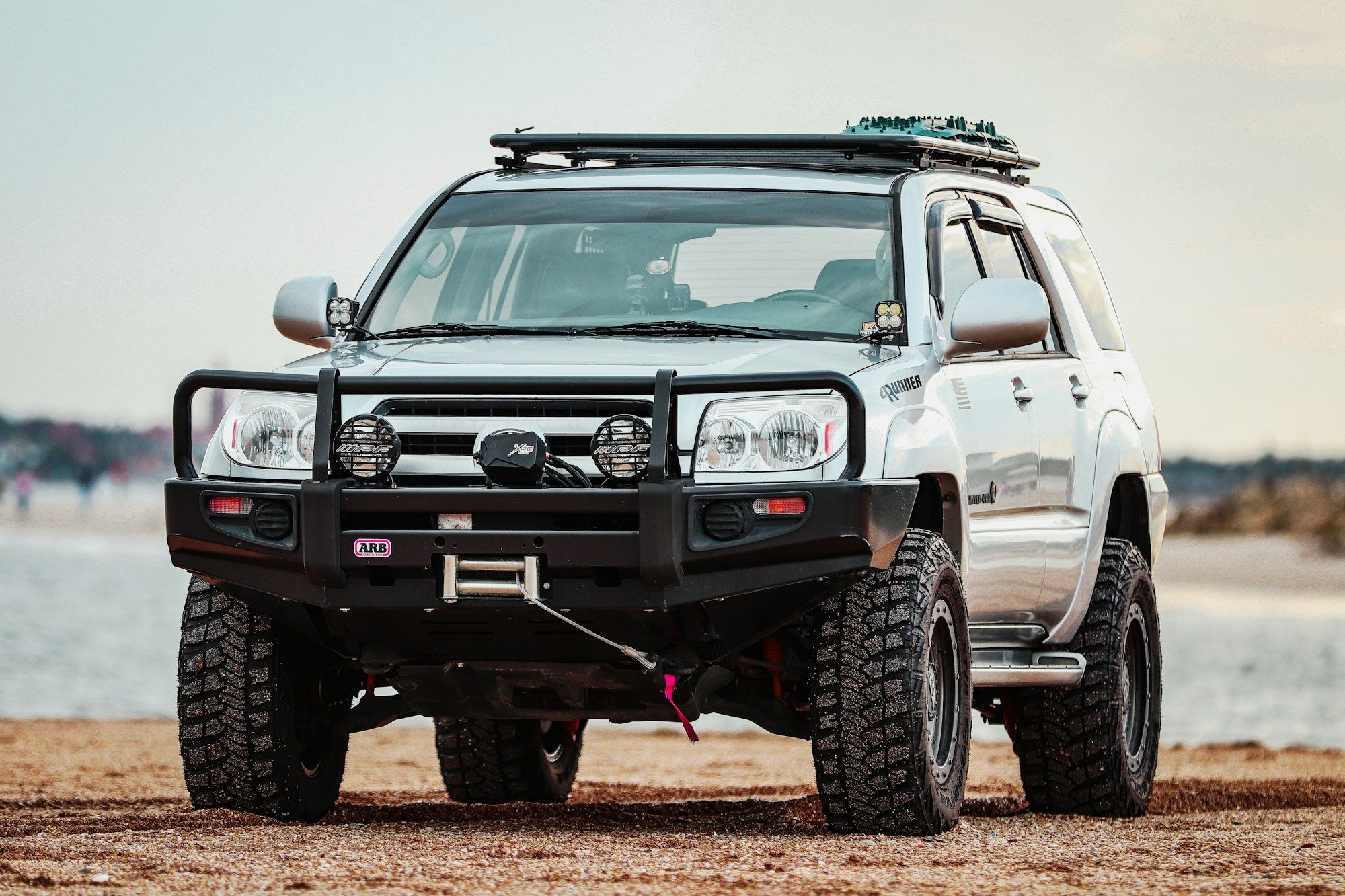
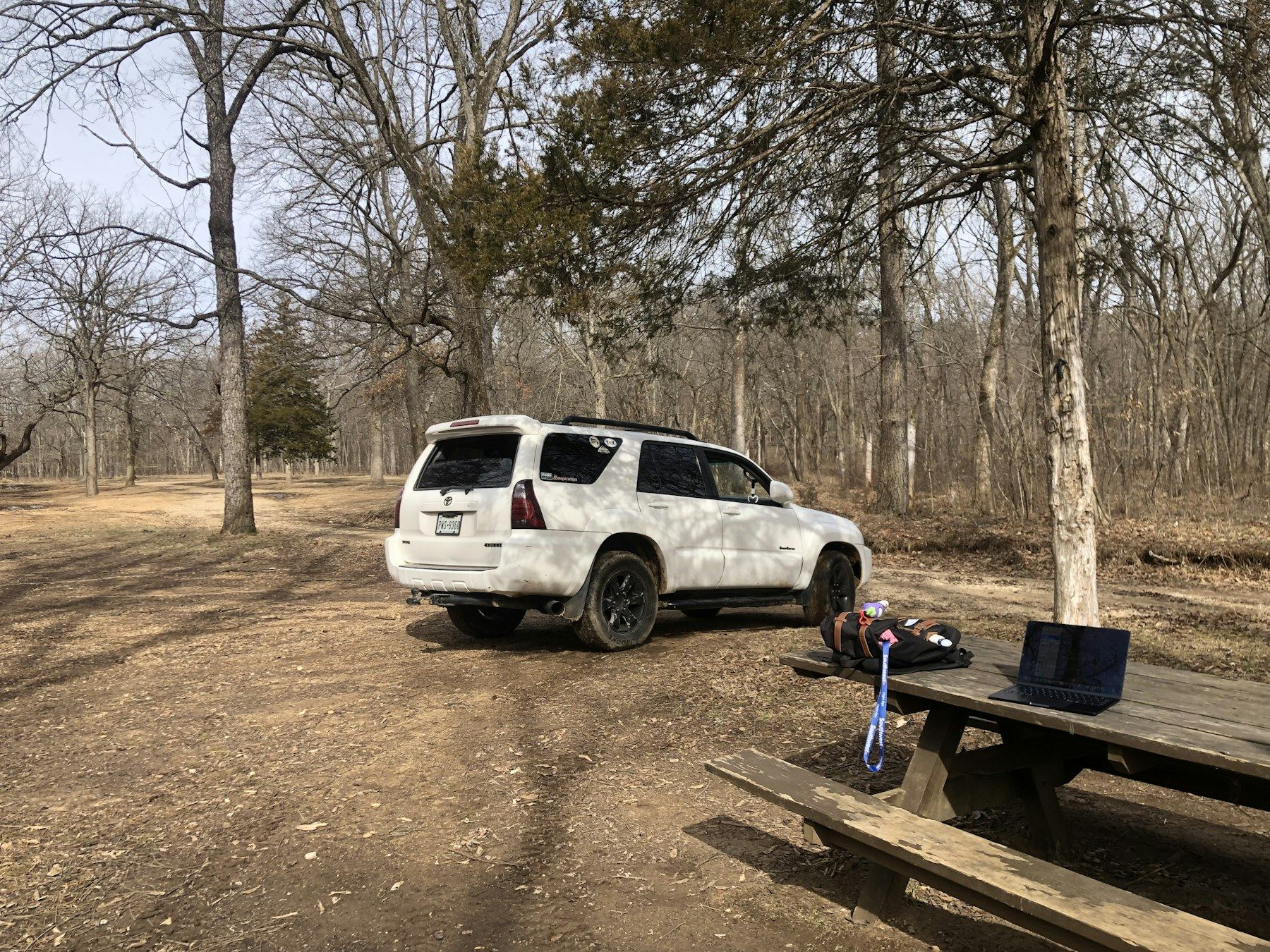
The story
Car and Driver called the fourth generation the largest, heaviest, most luxurious and most powerful 4Runner yet, and that is the whole story in one sentence. Built on the Land Cruiser Prado 120 platform and launched in October 2002 as a 2003 model, it brought a 4.0-litre V6, the first and only V8 4Runner, a third-row seat and trick suspension options. It kept the things that matter, too: a ladder frame, a solid rear axle and a lockable centre differential. Two decades on, it's the generation that quietly does everything well — and costs less than the cult ones on either side.
PRADO UNDERNEATH
Production ran from August 2002 to August 2009, with the Japanese Hilux Surf twin built until September 2009. Wikipedia describes the recipe: double-wishbone independent front suspension, a solid rear axle 'retained for strength and durability', and the Prado 120's chassis — the same underpinnings as the Lexus GX 470. Launch trims were SR5, Sport Edition and Limited; the SR5 and Sport wore grey cladding, the Limited body colour, and Sport models got a non-functional hood scoop.
The 4.0-litre 1GR-FE V6 made 245 hp and 282 lb-ft; the optional 4.7-litre 2UZ-FE V8 — the same engine family as the Land Cruiser 100's — launched at 235 hp and 320 lb-ft and gained VVT-i for 2005, rising to roughly 270 hp and 315 lb-ft (Wikipedia says 268 hp, Car and Driver quoted 270). Car and Driver clocked a 2005 V8 at 7.2 seconds to 60. Everything was automatic: a four-speed on early V6s, with a five-speed standard on the V6 from the 2005 model year.
THE CLEVER BITS
Four-wheel drive came in two flavours. V6 trucks used Toyota's part-time Multi-Mode system; V8s ran full-time 4WD; both used a lockable Torsen centre differential, with Hill-start Assist and Downhill Assist Control standard on 4WD models. Towing was rated at 5,000 lb for the V6 and up to 7,300 lb for a rear-drive V8 (7,000 lb with 4WD). The 3rd gen's optional rear E-locker, however, did not return until the very end.
Then there was X-REAS — standard on the Sport Edition and optional on SR5 and Limited — which links diagonally opposite dampers through hydraulic lines and a centre valve to cut body roll. Some Limiteds paired it with rear height-control air suspension. Both work well when new and become expensive with age, which is why replacing them with conventional shocks or coil springs is now a common 4th gen job.
YEAR BY YEAR
Toyota kept fiddling. Late 2003 brought standard tyre-pressure monitoring and an optional third-row seat on SR5 and Limited for 2004 — making this, as the Autopian notes, the first 4Runner with a third row. 2005 brought the five-speed V6 and the VVT-i V8; the 2006 refresh added new bumpers, grille, projector headlamps and LED tail lamps; 2007 had the oddball Urban Runner package; and 2008 made curtain and front-side airbags standard. The IIHS rated it Good in frontal offset and side tests but Poor for rear-impact protection.
Sales tell the arc. US buyers took 109,308 in 2003 and a peak of 114,212 in 2004, before demand slid to 47,878 in 2008 and 19,675 in calendar 2009. The fifth generation replaced it for 2010 — on the J150 platform, with a V6 only. No 4Runner has had a V8 since, and the current 6th gen runs four-cylinders. That, more than anything, is why a well-kept V8 4th gen has a following.
SIDEBAR · 2009 ONLY
Trail Edition: the locker comes back
When the 3rd gen dropped its optional rear E-locker after 2000, the 4Runner went most of a decade without one. Toyota fixed that in the 4th gen's final year: Wikipedia records that the 2009 Trail Edition added an electronic locking rear differential, an A-TRAC switch and Bilstein dampers.
As a one-year package on the last model year of the generation, Trail Editions are scarce. If you want a factory-locked 4th gen, it's the only one; check the switch on the dash and test the locker in 4Lo before you pay.