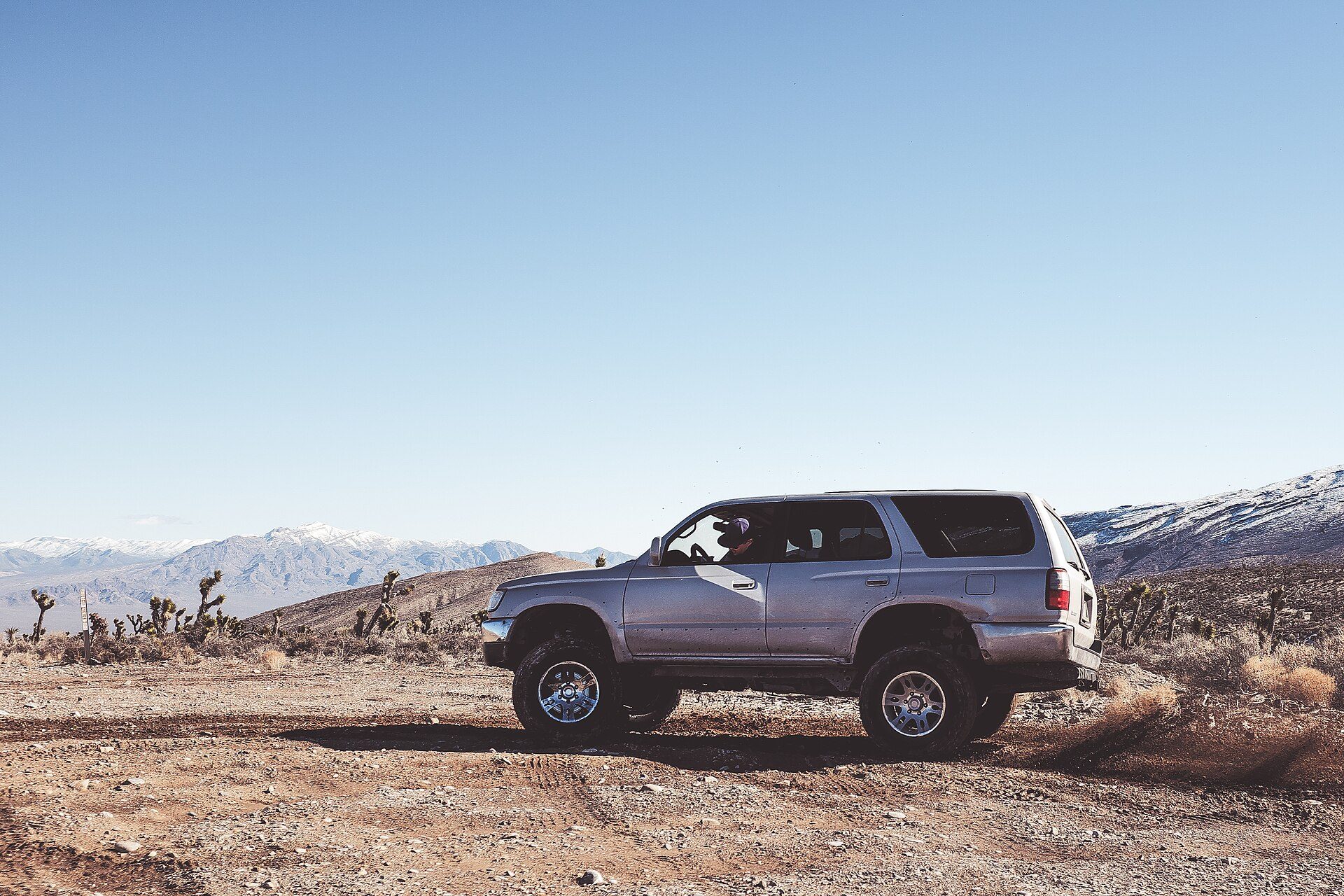
Lifted silver third-generation 4Runner throwing dust on a dirt track among Joshua trees with snow-capped desert mountains behind
TOYOTA 4RUNNER · N180 · 1996–2002

Toyota 4Runner 3rd Gen

N1805VZ-FE 3.4 V6REAR E-LOCKER 1996–2000

“The 4Runner that finally stopped being a pickup with a roof and became a proper SUV — without going soft. Small, simple, stupidly durable, and now priced like everyone figured that out at once.”

PART 01

Overview

Where it came from, why it matters, and how it changed year to year.

The story

For its first twelve years the 4Runner was, essentially, a Hilux pickup wearing a hat. The third generation, launched in late 1995 as a 1996 model, was the moment Toyota stopped bolting a lid onto a truck bed and built the thing as an SUV from the frame up. It got coil springs at all four corners, rack-and-pinion steering, a chassis shared with the Land Cruiser Prado (J90) and, for the first time on a 4Runner, an optional electric rear locker. Nearly three decades later it is the generation trail people lower their voices about — and the one sellers have noticed.

THE BREAK FROM THE HILUX

The first 4Runner arrived in 1983 as a Hilux with a removable fibreglass top; the second generation swapped that for a one-piece steel body but still rode on the pickup's bones. The N180 cut the cord. Wikipedia records an all-new body and chassis shared with the J90 Prado, a wheelbase 2.3 inches longer than before, coils all round, rack-and-pinion steering and dual airbags. MotorWeek's 1996 test noted towing jumping from 3,500 to 5,000 lb, and the 3.4-litre V6 rising to 183 hp and 217 lb-ft from the old 3.0's 150 hp.

It was not expensive, either. MotorWeek priced a two-wheel-drive four-cylinder base model at $19,908 and the 4WD SR5 V6 most people actually wanted at $25,568. Under the hood sat two engines borrowed from the brand-new Tacoma: the 150 hp 2.7-litre 3RZ-FE four and the 5VZ-FE V6. Gearboxes were a five-speed manual or four-speed automatic, and two-wheel drive was standard — so plenty of the 3rd gens for sale are not the trail trucks they look like. Check the badge, then check underneath.

FACELIFT, MULTI-MODE AND THE LOST LOCKER

The 1999 refresh brought a new nose with revised bumper and headlights, a reorganised centre stack and — the bit that matters — an optional Multi-Mode transfer case that could run full-time 4WD on slippery roads. Wikipedia records the rest: a 'fat lip' bumper that lengthened the front crush zone, multi-parabola headlamps, a new instrument panel with a digital odometer, and colour-keyed bumpers, flares and running boards on the Limited and the Highlander, a trim later renamed Sport Edition. The rear E-locker stayed on the options list.

Then came 2001. The final two years made VSC stability control standard, fitted the Multi-Mode transfer case (with its lockable centre differential) to every 4WD truck and added brake-based traction control — but, as Wikipedia and HotCars both record, they lost the optional rear E-locker that had been available from 1996 to 2000. The manual had already gone for 2000 and the four-cylinder followed for 2001, leaving a V6-automatic-only line-up. For a lot of buyers that makes the 1999–2000 Limited or SR5 with a locker the sweet spot, while purists still argue for the simpler pre-facelift trucks.

WHY THE TRAIL CROWD WORSHIPS IT

The electric rear locker was the headline. Wikipedia notes Toyota had offered an electric rear locker on the US Land Cruiser since 1993 — the 80 Series was the big brother in showrooms at the time — and the 3rd gen was the first 4Runner to get one. Combine that with a compact footprint, decent ground clearance and a 105.3-inch wheelbase, and you have a truck that fits trails a full-size SUV has to winch around.

Then there is the 5VZ-FE. It is not fast — MotorWeek clocked 9.5 seconds to 60 — but it is the sort of engine owners talk about in hundreds of thousands of miles. 8020 Automotive calls it non-interference, so a snapped timing belt usually means a tow rather than a rebuild, and SlashGear notes the 3rd gen consistently ranked among the SUVs most likely to pass 250,000 miles. Because it shares so much with the first-generation Tacoma, the aftermarket for suspension, armour and parts is enormous.

THE AFTERMATH

Production ended in August 2002 and the fourth generation reached US showrooms that October as a 2003 model, built on the bigger Prado 120 platform that also underpins the Lexus GX 470. It brought a V8 and more comfort, and a lot more mass. The N180, meanwhile, slid into the used market and became the default answer to 'what cheap 4x4 should I build?' — right up until it stopped being cheap. Its shared DNA with the first-generation Tacoma kept parts plentiful long after the dealer stopped caring.

Today the clean ones are collector items in all but name: Yahoo Autos reports unmodified examples under 100,000 miles mostly trading in the mid-to-upper $20,000s. The rest are rolling restoration projects held together by forum knowledge — lower ball joints, rear axle seals, frame rust and timing belts are the usual list. None of it is exotic, all of it is documented, and that, more than any spec sheet, is why the 3rd gen refuses to die.

SIDEBAR · THE JAPANESE TWIN

Hilux Surf: the diesel 3rd gen America never got

In Japan the N180 was sold as the Hilux Surf, and it came with something US buyers never got: diesel. Yahoo Autos notes the diesel options were Japan-only, and BE FORWARD lists Surfs like the KZN185 with the 1KZ-TE, a 3.0-litre four-cylinder turbodiesel making roughly 130 hp but far more low-end torque than the petrol V6.

Much of the chassis, suspension and brakes is shared with the US 4Runner, so the parts problem is smaller than it looks. And because the US 25-year import rule frees vehicles from federal safety standards once they reach that age, a right-hand-drive Surf is now a legal, if quirky, way to own the diesel 3rd gen Toyota never sold here.
Year by year

What changed, model year by model year. Sweet spot Beware

  1. 1996All-new Prado-based chassis: coils all round, rack-and-pinion, dual airbags, 3RZ-FE four or 5VZ-FE V6, optional rear e-lockerSweet spot
  2. 1997Minor updates, colour-keyed cargo cover
  3. 1998New switch panels and four-spoke steering wheel with redesigned airbag
  4. 1999Facelift ('fat lip' bumper, multi-parabola headlights), new dash; optional Multi-Mode transfer caseSweet spot
  5. 2000Manual gearbox dropped (last manual 4Runner); rear e-locker still optionalSweet spot
  6. 2001Four-cylinder dropped; VSC and Multi-Mode standard on 4WD; rear e-locker replaced by traction control
  7. 2002Chrome liftgate trim; final year
PART 02

Specs & capability

How it’s built, what it can do, and what fits under it.

How it’s built

Underneath, the N180 is old-school Toyota done properly: a ladder frame shared with the J90 Prado, double-wishbone independent front suspension, a solid coil-sprung rear axle, and Tacoma-derived engines tuned for longevity rather than lap times. The clever bits are in the drivetrain — an optional electric rear locker in the early years, and the Multi-Mode transfer case that arrived with the 1999 facelift.

CHASSISLadder frameShared with the Land Cruiser Prado J90; 105.3 in wheelbase.
FRONTDouble-wishbone IFSCoil springs and rack-and-pinion steering, both new to the 4Runner.
REARSolid axle on coilsCoil springs all round gave a better ride than you'd expect from a body-on-frame truck.
ENGINE5VZ-FE 3.4 V6183 hp / 217 lb-ft, DOHC 24-valve, timing belt; a 2.7 3RZ-FE four was also offered.
4WDPart-time → Multi-ModePart-time case at launch (lever, with a pushbutton for H4 on Limiteds); Multi-Mode with lockable centre diff optional from 1999 and standard on 4WD for 2001–02.
LOCKERElectric rear (opt.)Factory option on 4WD trucks 1996–2000; dropped for 2001–02 in favour of VSC/TRAC.

Variants & engines

YEARSPLATFORMENGINEOUTPUTWORTH KNOWING
1996–2000N180 · 2WD/4WD3RZ-FE 2.7 I4150 hp / 177 lb-ftBase engine; five-speed manual (dropped for 2000) or four-speed auto. Four-cylinder gone after 2000 in North America.
1996–1998N180 · pre-facelift5VZ-FE 3.4 V6183 hp / 217 lb-ftLever part-time 4WD; rear E-locker optional on 4WD.
1999–2000N180 · facelift5VZ-FE 3.4 V6183 hp / 217 lb-ftNew nose and dash; Multi-Mode t-case optional; E-locker still offered. Highlander ('99) and Sport Edition ('00) trims.
2001–2002N180 · late5VZ-FE 3.4 V6183 hp / 217 lb-ftAuto only; VSC and traction control standard, Multi-Mode standard on 4WD. No rear locker.
N180 era · JapanHilux Surf KZN1851KZ-TE 3.0 turbodiesel I4≈130 hpJapan-market only; intercooled version (≈140 hp) from July 1996. Importable to the US under the 25-year rule.

Capability numbers

Towing5,000 lb (2,270 kg)V6
Fuel tank18.5 gal (70 L)
Ground clearance8.5 in (216 mm)
Curb weight3,616–3,902 lb (1,640–1,770 kg)

Wheels & tires

FACTORY TIRES
225/75R15 (base)265/70R16
Bolt pattern6x139.7 (6x5.5")
Offset+15 mm (stock 7 in wheels)
Center bore106.1 mm
Lug threadM12x1.5
Lug-nut torque83 lb-ft (110 N·m) per Toyota's 1999–2002 owner's manuals
LIFTBIGGEST TIREWHAT IT TAKES
Stock265/75R16Toyota-4Runner.org consensus (about 31.6 in); wide aggressive treads or spacers can rub at full compression
≈2 in285/75R16One owner reports no rub on 16x8 wheels with 4.5 in backspacing and about 2 in of front lift (not yet wheeled)
3 in285/75R16Common 33-in setup; expect to fold the pinch weld and trim the fender liner, and keep backspacing around 4–4.5 in. Spacers make it worse

Forum consensus, not a guarantee: wheel offset, tire brand and suspension wear all change clearance. Confirm before you buy.

Production & special editions

Built at Tahara and at Hino's Hamura plant from August 1995 to August 2002; its 1997 US sales of 128,496 stood as the 4Runner record until the 5th gen passed it in 2018.

ProductionAugust 1995 – August 2002
US sales (calendar year; 2002 includes early 4th gen sales)99,597 (1996) · 128,496 (1997) · 118,484 (1998) · 124,221 (1999) · 111,797 (2000) · 90,250 (2001) · 77,026 (2002)
Highlander / Sport Edition1999–2002Colour-keyed running boards, bumpers, flares and mud flaps; the Highlander name became Sport Edition
PART 03

Buying one

What to pay, what to check, and how to tell a good one from a clone.

What they cost

Prices are strong and rising; low-mile, unmodified SR5s and Limiteds, especially lockered 1996–2000 trucks, sit at the top.

Project / needs work$7k–13k
Driver$13k–22k
Excellent / low-mile$30k–38k+

Based on 24 Bring a Trailer sales from August to October 2026 (median about $18,750). The top sale was a 41k-mile 1997 SR5 4WD at $38,250. Prices move; checked October 2026. See live listings below.

What to check before you buy

  1. 01
    Frame rust, properlyCrawl under it. Forum members flag the crossmember-to-frame welds, the rear lower control arm mounts, the triangular trailing-arm brackets, the area behind the axle where the spare hangs, and the rocker ends. Probe with a screwdriver: a hole or two is fixable, a frame thin from end to end is not.
  2. 02
    Lower ball jointsThe stock LBJ is the 3rd gen's famous weak link — if it lets go the control arm drops and the wheel folds under. 2001–02 trucks were covered by Toyota safety recall 50J (NHTSA 05V-225), which replaced the lower ball joints; on any year, ask what was fitted. AdventureTaco's advice is OEM Toyota only.
  3. 03
    Timing belt recordsThe V6 wants a belt at roughly 90,000-mile intervals, ideally with the water pump and thermostat. It's a non-interference engine, so a failure is usually a tow, not a rebuild — but no paperwork means budget for the job.
  4. 04
    Rear axle seals and brakesBlown rear axle seals are a known 3rd gen habit; gear oil then soaks the drum brake shoes and washes out the wheel bearing. Look for wet backing plates and listen for a bearing growl on the test drive.
  5. 05
    Locker and 4WD functionIf it's a 1996–2000 4WD with the E-locker, make sure it actually engages (it's meant for 4Lo and low speed). On Multi-Mode trucks, cycle every mode. 2001–02 trucks have no factory rear locker regardless of what the ad says.
  6. 06
    Steering slopWandering or a clunk over bumps often points to worn steering rack bushings (common around 100k miles) or tie-rod ends. Both are cheap to fix but useful bargaining chips.
  7. 07
    Recalls and readiness1996–98 trucks are covered by NHTSA recall 02V-021 (Toyota campaign 20A), under which dealers replaced rear suspension parts; ask whether it was done. And plug in a scanner — IH8MUD members warn about sellers clearing codes to hide a dead catalytic converter, so check all readiness monitors are complete.
  8. 08
    Who lifted it?A tidy lift with known parts is a bonus; a mystery spacer lift with no alignment records is a project. Forum veterans' advice is blunt: skip a lifted truck unless the lift was done properly.

Spotting the real thing

Plenty of 3rd gens for sale are two-wheel-drive, four-cylinder or locker-less, and the locker is the option that sets prices.

  1. ID
    Model codesUS trucks are RZN180/185 (2.7 3RZ-FE four) or VZN180/185 (3.4 5VZ-FE V6). KZN185 and KDN185 are Japanese diesel Hilux Surfs.
  2. ID
    Rear e-lockerOptional on 4WD trucks from 1996 to 2000, never standard on any trim per a 1997 brochure cited by owners, and gone for 2001–02. Look for the dash switch, the actuator and wiring on the rear diff, and the factory locker placard. A locked rear diff also takes more oil: 2.75 L vs 2.45 L.
  3. ID
    Facelift tells1999–2000 trucks have the 'fat lip' bumper and multi-parabola headlamps; 2001–02 add clear tail lamps, a new grille and five-spoke wheels; 2002 adds chrome liftgate trim.
  4. ID
    Transfer case1996–98 4WD trucks use a part-time lever (Limiteds use a pushbutton for H4); Multi-Mode was optional from 1999 and standard on 4WD from 2001.

Recalls & service bulletins

Open recalls follow the VIN, not the model. Run yours through NHTSA before you buy, and ask the seller for dealer records showing recall work.

Check a VIN at NHTSA ↗
Notable recalls
Missing utility-vehicle warning label ↗1996 · NHTSA 96V-098The required rollover warning sticker was not fitted to the driver's sun visor.
Stability under heavy load and severe steering ↗1996–1998 · NHTSA 02V-021Loading to both rear axle rating and GVWR plus a severe manoeuvre could cause the 2WD 4Runner to lose directional stability.
Front lower ball joints ↗2001–2002 · NHTSA 05V-225Scratched ball surface can cause excessive wear and looseness in the lower ball joint.

Importing & legality

Japan's Hilux Surf (N185) came with diesels never sold in the US: the 3.0 1KZ-TE turbo-diesel (1995–2000) and the common-rail 1KD-FTV (2000–02). Once a Surf is 25 years old it can be imported without meeting US federal safety standards. Per BE FORWARD, the first 2001 models crossed that line in 2026, so late 1KD-FTV trucks are only now becoming eligible. They are right-hand drive, and state titling and emissions rules still apply.

Rules change and vary by state and country. Confirm with your DMV and a licensed importer before you buy.

The one you’ll own someday

For sale now

1996–2002 · USAll 3rd gen 4Runners
1996–2000 · USE-locker years
2001–2002 · USLate trucks (VSC, Multi-Mode)
PART 04

Owning one

Baseline service, the repairs you’ll actually do, and where the manuals live.

Post-purchase baseline

After you buy it

Assume nothing on a 20-plus-year-old 4Runner: unless there are receipts, do the timing belt, every fluid and the cheap 5VZ-FE wear items in one go. The 5VZ-FE is non-interference, but with a 90,000-mile belt interval most trucks are on their third or fourth belt, or overdue on their second. Capacities below come from Toyota's own 1999–2002 owner's manuals, cross-checked against Toyota-Club.net's compilation.

Engine oil & filterAPI SJ/SL 'Energy-Conserving' or ILSAC multigrade · SAE 5W-30 preferred · 5.2 L (5.5 US qt) with filter (Toyota owner's manual)Then every 5,000 mi or per the owner's manual

Spin-on filter on the 5VZ-FE. Check for valve-cover seepage while you're there (see repairs).

Engine air filterPanel filter in the airboxInspect at every oil change; replace when dirty

Dusty-trail trucks clog these fast.

Cabin air filter (add-on)None from the factoryOptional add-on

AdventureTaco notes the 3rd gen 4Runner never had a cabin filter; their kit fits in the blower-motor housing under the glovebox (three T25/8 mm screws).

Spark plugsDenso K16TR11 (Toyota 90919-01192) or NGK BKR5EKB-11 · gap 1.1 mm (0.043 in) (Toyota 2001–02 owner's manuals; Toyota-Club plug table)Replace now if history unknown

Six plugs; Toyota-Club lists the same plug for the 5VZ-FE in the 1999–2003 Tundra and the Hilux Surf.

Timing belt, water pump & thermostatBelt 13568-69095 · Aisin pump · 82 °C thermostat 90916-03075Every ≈90,000 mi (or now, if undocumented)

Do the pump, idlers, hydraulic tensioner, cam/crank seals and thermostat with the belt — AdventureTaco's OEM kit list. See the repair card above for the procedure.

CoolantToyota red Long Life Coolant (00272-1LLAC concentrate, mixed with distilled water) · 8.0 L (9.0 L with rear heater)Drain and refill now; renew with every timing belt

AdventureTaco refilled with two gallons of red concentrate plus distilled water after the belt job. Don't mix in green conventional coolant.

Drive beltsA/C 99364-20870 · alternator 90080-91090 · power steering 90080-91126Replace with the timing belt

All three come off for the timing job anyway; part numbers from AdventureTaco's OEM kit.

Automatic / manual transmissionAutomatic: ATF Dexron II/III · ≈2.0 L per drain and refill (4WD). Manual: 75W-90 GL-4/5 · 2.2 LDrain and refill now, then per the owner's manual

A drain and refill replaces only part of the automatic's fluid, so on a truck with unknown history repeat it two or three times over a few hundred miles rather than one high-pressure flush.

Transfer case75W-90 GL-4/5 · 1.0 L (lever control) / 1.2 L (lever + button control)Change now, then with the diffs

Crack the fill plug before you drain.

Front & rear differentials + rear breatherHypoid GL-5 · front 1.15 L: owner's manual gives SAE 75W-90 for A.D.D. trucks, Toyota-Club lists 80W-90 · rear 2.45 L (no locker) / 2.75 L (with locker): SAE 90 above −18 °C, SAE 80W or 80W-90 below (owner's manual)Change now; after any deep water crossing

The rear axle's breather sits on the housing and can suck in water when a hot diff is submerged. AdventureTaco's fix: a union plus hose run up to a breather plug behind the fuel door.

Power steering fluidATF Dexron II/IIICheck; turkey-baster refresh if dark

Same fluid as the automatic transmission.

Brake fluidDOT 3 or DOT 4Flush now if history unknown, then per the owner's manual

Rear drums: inspect for gear oil on the shoes (see rear axle seals).

Fuel filterToyota 23300-62030 (4Runner-specific bracket; Tacoma's differs)With the timing belt (≈90,000 mi); every 30,000 mi in very dusty country

Frame-mounted; 14 mm flare-nut wrench plus a 19 mm to hold the filter. AdventureTaco skips the FSM's fuel-pump-disconnect step and catches the spill.

PCV valve & grommetValve 12204-62010 · grommet 90480-18001 · hose 12261-62041 (optional)Replace now (cheap, 30 minutes)
For the hands-on owner

Common repairs

The jobs owners actually end up doing, rated for a competent home mechanic with a decent tool kit. Always confirm torque figures, fluids and procedures against the factory service manual for your VIN, and work safely — support the truck on stands, never just a jack. You do this work at your own risk; see the disclaimer. Some parts links are affiliate links.

Lower ball joint replacement
DIFFICULTY · 2 / 5TIME · ≈ 30–60 min per sideSHOP COST · Dealer did the 2001–02 campaign in about 3 hours; otherwise parts plus labor
SYMPTOMSStiff steering, poor self-centering, front-end clunks or squeaks, a torn boot. Toyota's 50J letter warns a worn joint can separate from the knuckle.
THE FIXSupport the truck on stands and pull the wheel. Remove the four 14 mm bolts holding the LBJ to the knuckle, pull the cotter pin and loosen the 24 mm castle nut, then pop the stud from the lower control arm with a pitman-arm puller (repeat for the 19 mm tie-rod castle nut on a 4Runner). Swing the hub aside, fit the correct left/right joint, torque the knuckle bolts with blue Loctite (37 ft-lb black washer bolts or 59 ft-lb green flanged bolts), castle nuts to 103 ft-lb (LCA) and 67 ft-lb (tie rod), then new cotter pins.
TOOLS & PARTS14/19/24 mm sockets · OTC 6295 front end service set · torque wrench · blue Loctite 242 · new cotter pins · OEM 4Runner LBJs L 43340-39465 / R 43330-39585
Timing belt and water pump (5VZ-FE)
DIFFICULTY · 4 / 5TIME · ≈ 8–14 hours (AdventureTaco's first attempt took about 14)SHOP COST · Parts ≈ $200–400 with water pump, labor ≈ $200–300 (8020 Automotive)
SYMPTOMSDue at around 90,000 miles or with unknown history; a cracked belt, misfires or rough running. It's non-interference, so failure usually strands you rather than wrecking the engine.
THE FIXDrain coolant, remove the fan, radiator and drive belts, then the upper timing cover. Hold the crank pulley and break the bolt, pull the pulley, remove the lower cover and set #1 to TDC. Remove tensioner, belt and idlers; replace cam and crank seals, water pump and thermostat (AdventureTaco fits the thermostat jiggle valve at 6 o'clock). Fit idlers and belt, then the hydraulic tensioner, rotate two full turns to confirm marks, torque the crank bolt to 217 ft-lb, refill and bleed.
TOOLS & PARTSHarmonic damper holder · OTC 4518 puller · cam pulley holder · seal puller · Toyota belt 13568-69095 · tensioner 13540-62021 · Aisin water pump 16100-69398-83 · new crank bolt 90119-16006
Rear axle seals and bearings
DIFFICULTY · 4 / 5TIME · ≈ a full day for most (press work)SHOP COST · ≈ $250 per side at a shop (IH8MUD owner estimate), more if the brakes are oil-soaked
SYMPTOMSGear oil on the backing plate or inside the drum, oil-soaked shoes that won't stop the truck, a growling rear wheel bearing.
THE FIXLift and support the rear, pull wheels and drums, disconnect the e-brake cable, brake line and ABS sensor, and drain the diff. Remove the four backing-plate nuts and pull the axle. Press off the retainers and tone ring, press the old bearing out and the new one in with its dust seal, fit a new snap ring and retainers. Drive in a new inner seal square with a matched driver, reinstall the axle (backing-plate nuts 48 ft-lb), refill with 80W-90 and bleed the brakes. Do both sides.
TOOLS & PARTS20-ton press · axle bearing puller/installer · seal driver · slide hammer · inner seal 90310-50006 · bearing 90363-40020-77 ('96–'00) or 90363-40068 ('01–'02) · O-rings 90301-88077
Steering rack bushings
DIFFICULTY · 3 / 5TIME · ≈ 3–4 hoursSHOP COST · Parts plus labor; urethane kits are inexpensive
SYMPTOMSVague steering, wander and clunks; rack visibly shifting in its mounts. AdventureTaco treats about 1/16 in of play as normal and 1/4 in or more as time for new bushings.
THE FIXSupport the front, remove wheels and the front sway bar, and separate the outer tie-rod ends from the knuckles. Unbolt the passenger bracket, centre bolt, driver bolt and power-steering line bracket, then wiggle the rack free (support it on a jack). Press out old bushings with a C-clamp and receiver cups, clean the seats, grease and press in urethane bushings with the matching sleeve. Reinstall: passenger bracket and centre bolt 123 ft-lb, driver nut 141 ft-lb, tie-rod castle nuts 67 ft-lb. Get an alignment.
TOOLS & PARTS12–22 mm sockets · OTC 6295 puller · OTC 7249 ball-joint press kit · torque wrench · Energy Suspension 8.10103 kit (4Runner, per AdventureTaco) or Total Chaos urethane rack bushing kit
Valve cover gaskets (5VZ-FE)
DIFFICULTY · 3 / 5TIME · ≈ 3–5 hours (intake plenum access)SHOP COST · Gaskets under $40; shop labor ≈ $250–500 (8020 Automotive)
SYMPTOMSOil seeping down the heads, a burning-oil smell after a drive, slowly falling oil level.
THE FIXHeat cycles harden and crack the gaskets, so leaks only get worse. Access is the work: clear the intake plumbing to reach the covers, unbolt them, clean the sealing surfaces thoroughly, fit new gaskets and grommets, and torque the covers down evenly.
TOOLS & PARTSMetric sockets and extensions · torque wrench · gasket scraper · RTV · new valve cover gaskets
Spare-tire crossmember and frame rust repair
DIFFICULTY · 4 / 5TIME · ≈ a weekendSHOP COST · Parts plus labor; welding required
SYMPTOMSFlaking scale where crossmembers meet the frame, holes behind the rear axle, a spare carrier that won't release or sags.
THE FIXSalt and debris pack in between body and frame and rot the rear crossmember from the inside — often discovered when the spare won't come down. Cut out the rotten section and weld in a replacement such as the Rust Buster 11-gauge crossmember (replaces Toyota 51209-35171), then treat surrounding metal with rust converter and a yearly oil- or grease-based inhibitor.
TOOLS & PARTSWelder · angle grinder · Rust Buster crossmember · rust paint · inhibitor spray
4WD won't engage: ADD vacuum system and actuators
DIFFICULTY · 2 / 5 (diagnosis, hoses, VSV) · 3 / 5 (actuator rebuild)TIME · An hour or two to diagnose · an actuator rebuild needs a day for the glue to cureSHOP COST · Parts plus labor; vacuum hose is cheap
SYMPTOMSLever or button in 4WD but only the rear wheels drive, and the 4WD light stays off. On a part-time truck, a slow tight turn on pavement should make 4WD bind within about thirty feet. No bind means no front drive (Toyota-4Runner.org).
THE FIXOn 1996–2000 trucks the front axle is engaged by vacuum. With the engine running and 4WD off, check for vacuum at the twin VSVs on the driver's-side fender wall. No vacuum: check the check valve to the intake manifold, the hoses and the reservoir. If one hose has vacuum, engage 4WD and see whether it moves to the other. If it moves but the axle doesn't engage, suspect the diff actuator or its line. If it doesn't move, mark and swap the two hoses: if the truck now goes into 4WD the diff is fine, and a test light shows whether the transfer-case switch signal changes sides. Signal but no change in vacuum means a bad VSV. Check the fuse and the ADD relay too; one 1998 SR5 owner found it behind the passenger kick panel. 2001–02 trucks use an electric front actuator, so the vacuum tests don't apply. On push-button trucks the transfer-case actuator motor can quit when its magnets come loose. One owner rebuilt his (1996 Limited, A340F, actuator 36410-35040) by re-gluing the magnets and fitting a new O-ring.
TOOLS & PARTSHand vacuum pump with gauge · test light · marker · 12 mm and 10 mm sockets · dielectric grease
Rear hatch window drops or won't rise
DIFFICULTY · 2 / 5TIME · An afternoonSHOP COST · Parts plus labor; owners hunt used relays and switches to save money
SYMPTOMSThe back glass drops into the hatch and won't come up, often in wet weather, or lowers itself unasked.
THE FIXStart with the fuse and the rear-door power-window relay. One 1997 SR5 owner on Toyota-4Runner.org found the relay shell melted and burned wires at the window limit switch, with the damage spread into neighbouring harness wires to the rear door ECU. Pull the hatch trim, repair the harness, then feed the motor 12 V directly, using the wiring diagram to pick the right leads. That tells you whether the motor or the controls are at fault. If the window drops by itself, another owner cured it by removing the short harness section between the hatch key lock and the hatch harness; after that the window works only from the dash switch. The thread gives the limit switch as Toyota 84290-35020.
TOOLS & PARTSTrim-panel tools · multimeter · fused 12 V jumper leads · soldering iron or crimper · heat-shrink

Manuals & documentation

Asked on every forum

Toyota 4Runner 3rd Gen questions, answered

What's the biggest tire I can fit without a lift?

The Toyota-4Runner.org consensus is 265/75R16 (roughly a 31.6-inch tire) on stock suspension. Some owners see rubbing at full compression off-road with wide, aggressive tread or wheel spacers; if you want zero drama, 265/70R16 or 265/70R17 are the conservative picks. Anything bigger is lift territory.

SOURCE · TOYOTA-4RUNNER.ORG
Does my 4Runner have the factory rear locker?

Only if it's a 1996–2000 4WD truck that was ordered with it — it was an option on Base, SR5 and Limited 4WD models, never standard, and it wasn't common. For 2001–02 the rear E-locker was dropped in favour of VSC, traction control and a centre diff lock.

SOURCE · WIKIPEDIA / T4R.ORG / HOTCARS
How should I use the E-locker?

The owner's manual guidance quoted on the forums is to engage it only in 4Lo and keep speed below about 5 mph. It locks both rear wheels together, so it'll fight you in turns on high-traction surfaces — use it for the obstacle, then switch it off.

SOURCE · TOYOTA-4RUNNER.ORG
When does the timing belt need doing — and is the 3.4 an interference engine?

Plan on about every 90,000 miles, and do the water pump, thermostat and seals while you're in there. The 5VZ-FE is non-interference, so a broken belt shouldn't destroy valves, but it will leave you stranded.

SOURCE · 8020 AUTOMOTIVE
How much can it tow?

Up to 5,000 lb when properly equipped — a big jump from the 3,500 lb of the previous generation. Owners on Expedition Portal report fuel economy dropping to roughly 11–13 mpg when towing.

SOURCE · MOTORWEEK / AUTO CHANNEL
What fuel economy should I expect?

EPA ratings were around 17 city / 19 highway for the 1996 V6 and 16/19 for a 2002 SR5 4x4; owners typically report 16–18 mpg. The 18.5-gallon tank and a notoriously inaccurate fuel gauge mean range is modest, so carry a jerry can on long trips.

SOURCE · MOTORWEEK / EXPEDITION PORTAL
What are the fluid capacities?

From Toyota's 1999–2002 owner's manuals: 5VZ-FE oil 5.2 L with filter (5W-30 preferred); coolant 8.0 L (9.0 L with rear heater); automatic drain-and-refill up to 2.0 L (4WD) of Dexron III/II; transfer case 1.0–1.2 L of GL-4/5 75W-90; front diff 1.15 L, where the manual gives 75W-90 for A.D.D. trucks and Toyota-Club gives 80W-90; rear diff 2.45 L (2.75 L with diff lock) of GL-5 SAE 90, or 80W-90 below −18 °C.

SOURCE · TOYOTA OWNER'S MANUAL · TOYOTA-CLUB.NET
Which years should I buy or avoid?

Forum favourites are 1999–2000 trucks, especially Limiteds or SR5s with the Multi-Mode case and E-locker. 1996–98 trucks are simpler and cheaper to fix. 2001–02 get VSC and traction control but lose the locker and manual, and some owners prefer the simpler earlier drivetrain. Condition and rust matter far more than model year.

SOURCE · TOYOTA-4RUNNER.ORG
Is the four-cylinder worth considering?

Most owners steer you toward the 3.4 V6: 183 hp and 217 lb-ft versus 150 hp and 177 lb-ft for the 2.7 four, for similar running costs. The four is a durable engine, but it'll struggle with big tires and a loaded roof rack.

SOURCE · IH8MUD / SLASHGEAR
What lift options are there?

The classic is an Old Man Emu kit of about 2–3 in, with ICON, Total Chaos and others offering springs, coilovers and control arms. As a lift grows, aftermarket upper control arms help restore alignment range; Total Chaos makes both UCAs and a bolt-on lower ball joint conversion for this truck.

SOURCE · LCE PERFORMANCE / OVR MAG
How long will a 3rd gen last?

With maintenance, a long time. SlashGear notes it consistently ranked among the SUVs most likely to pass 250,000 miles, and 8020 Automotive puts a well-maintained 5VZ-FE at 300,000–400,000 miles. Frame rust and neglected ball joints usually kill these trucks before the engine does.

SOURCE · SLASHGEAR / 8020
PART 05

Building one

Who makes the good stuff, where owners gather, and who to watch.

Common modifications & who does them

SUSPENSION LIFTA modest 2–3 in lift and fresh shocks transform a sagging, 25-year-old suspension and make room for 265/75R16s or slightly larger.
CONTROL ARMS & BALL JOINTSLifted IFS runs out of alignment range, and the stock lower ball joint is the 3rd gen's weak link — fix both at once.
ARMORRock sliders protect the rockers that rust and dent first; a steel bumper adds a winch mount and approach angle.
ROOF RACKThe 3rd gen has no rain gutters or full-length rails, so a model-specific rack is the clean way to carry a tent or recovery gear.
STEERINGUrethane rack bushings take the slop out of tired steering, especially on bigger tires.
FORCED INDUCTION183 hp feels thin with 32s and a loaded roof. Superchargers for the 5VZ-FE are the classic fix (premium fuel and extra upkeep included).
MAINTENANCE PARTSA 3rd gen specialist with timing kits, bushings and OEM parts sorted by system saves hours of part-number hunting.

Clubs & events

Resources

Channels, accounts & forums

All 4Runner resources →
SourcesWikipedia — Toyota 4RunnerSlashGear — Here's What Made The 3rd Generation Toyota 4Runner So GreatYahoo Autos — Toyota 4Runner third-generation through the yearsJapanese Nostalgic Car — The third-generation Toyota 4Runner brought it into the modern age (MotorWeek 1996 review)HotCars — 3rd gen Toyota 4Runner off-roadThe Auto Channel — 2002 Toyota 4Runner SR5 4x4 review & specsNHTSA — Toyota Safety Recall 50J owner letter (2001–2002 4Runner lower ball joints)8020 Automotive — The 3 most common Toyota 5VZ-FE 3.4 V6 engine problemsToyota-4Runner.org — What is the biggest tire I can get on a stock suspension?Toyota-4Runner.org — 1997 Limited: locking diff standard?Toyota-4Runner.org — Rear Locker (3rd gen)Toyota-4Runner.org — What year to buy?Toyota-4Runner.org — 1996 Recall (Safety Recall 20A, rear suspension)Toyota-4Runner.org — Opinions on this rustToyota-4Runner.org — Ball joint replacement writeupsIH8MUD — 3rd gen 4runner, any problems or issues?IH8MUD — 3rd Gen. 4Runner InfoExpedition Portal — What are the cons of a 3rd gen 4runnerAdventureTaco — Lower ball joint replacement (1st gen Tacoma / 3rd gen 4Runner)AdventureTaco — 5VZ-FE timing belt & water pumpAdventureTaco — Replacing rear axle seal & bearing (1st gen Tacoma / 3rd gen 4Runner)AdventureTaco — Steering rack bushing replacement (1st gen Tacoma / 3rd gen 4Runner)OVR Magazine — Bolt-on lower ball joint conversion for 1st gen Tacoma and 3rd gen 4Runner by Total ChaosToyota-Club.net — 4Runner (180, US) technical data: fluids & capacitiesLiftKits4Less — Rust Buster spare tire carrier crossmember, 1996–2002 4RunnerBE FORWARD — Toyota Hilux Surf N185: 1KZ-TE diesel & US legal specsLCE Performance — Old Man Emu suspension system for 1996–2002 4RunnerTotal Chaos Fabrication — 1996–2002 4Runner upper control armsDometic — Front Runner 3rd Gen 4Runner Slimline II roof rackBring a Trailer — Toyota 4Runner (N180)AdventureTaco — Replace the fuel filter in a 96–04 Tacoma or 96–02 4RunnerAdventureTaco — Replacing the PCV valve on a 5VZFE (Tacoma, 4Runner)AdventureTaco — Installing a cabin air filter (1st gen Tacoma / 3rd gen 4Runner)AdventureTaco — Rear diff breather modAdventureTaco — Timing belt replacement for 3.4L V6 5VZFE (parts list)Toyota-Club.net — Spark plug application tableNHTSA recalls API — Toyota 4Runner 1997 (02V-021 / Toyota SSC 20A)NHTSA recalls API — Toyota 4Runner 2001 (05V-225 / recall 50J)Toyota — 1999 4Runner owner's manual (Toyota-hosted PDF)Toyota — 2001 4Runner owner's manual OM35768U (Toyota-hosted PDF)Toyota — 2002 4Runner owner's manual OM35787U (Toyota-hosted PDF)AMSOIL product guide — 2002 Toyota 4Runner 3.4L 5VZ-FEToyota-4Runner.org — 4WD issues (ADD VSV troubleshooting, 1996–2000)Toyota-4Runner.org — 4WD, ADD: troubleshooting and actuator rebuildExpedition Portal — No 4WD light, no 4WD (1998 4Runner SR5)Toyota-4Runner.org — Rear window stuck down (1997 4Runner)Wikipedia — Toyota 4RunnerNHTSA recalls API — Toyota 4Runner 1996NHTSA recalls API — Toyota 4Runner 2001Toyota-Club.net — 4Runner 180 fluids & capacitiesLimitless Tire — 1999 Toyota 4Runner wheel & tire sizesToyota-4Runner.org — 33's on 16sToyota-4Runner.org — Rear lockerToyota-4Runner.org — 1997 Limited: locking diff standard?Bring a Trailer — Toyota 4Runner N180 sold results (24 sales, Aug–Oct 2026)BE FORWARD — Hilux Surf N185 1KZ-TE: US-legal specsToyota TISRising Sun 4WD Club of ColoradoToyota JamboreeC4 Fabrication — C4 at Toyota Jamboree 2026Toyota — 1999 4Runner owner's manual (Toyota-hosted PDF)Toyota — 2001 4Runner owner's manual OM35768U (Toyota-hosted PDF)Toyota — 2002 4Runner owner's manual OM35787U (Toyota-hosted PDF)