The story
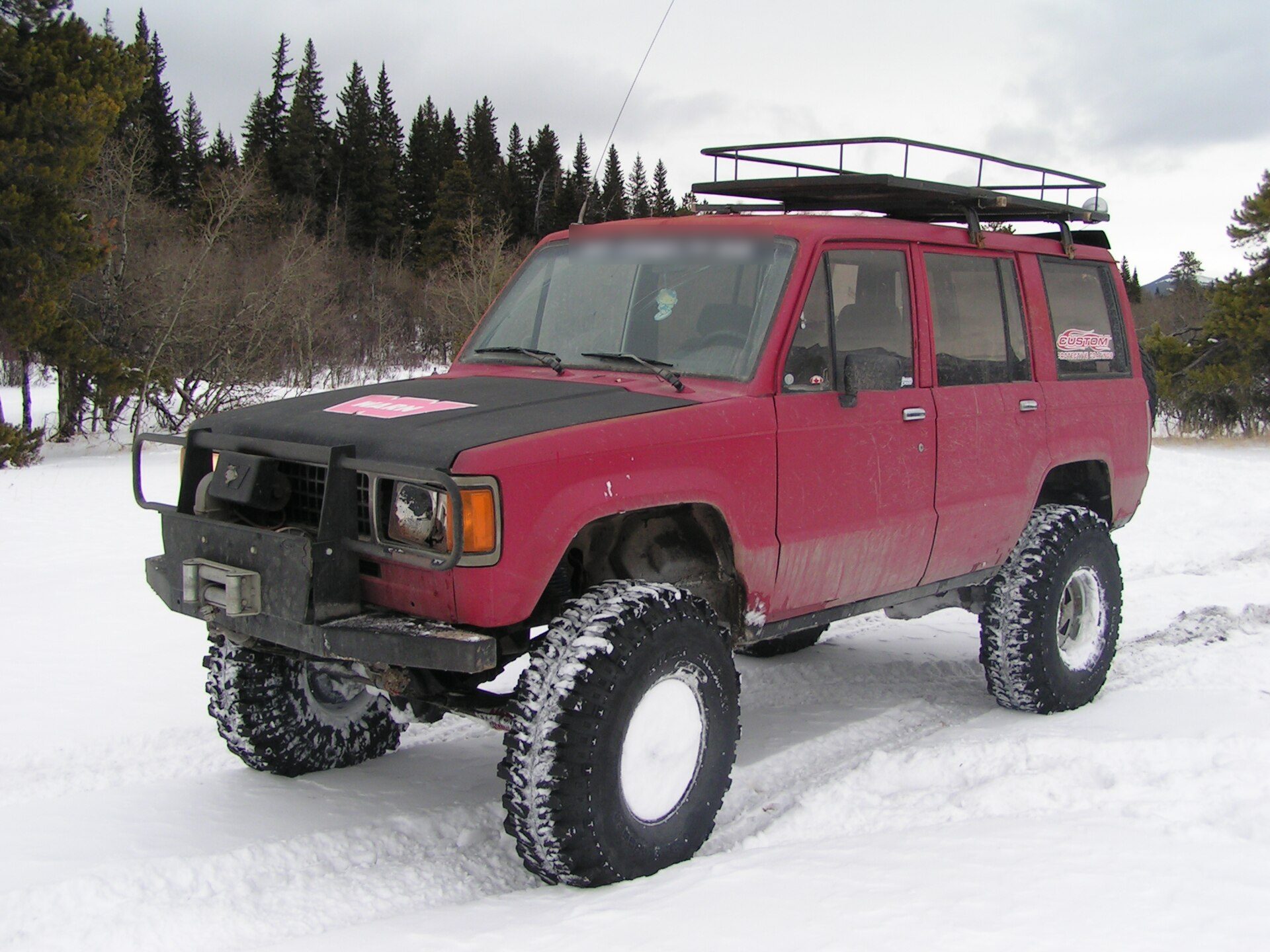
In September 1981 Isuzu announced a compact four-wheel-drive wagon called the Rodeo Bighorn. Underneath it was the company's own pickup, sold in America as the Isuzu P'UP and Chevy LUV. Car and Driver reckoned that almost everything under the squarish steel skin, from the chassis to the driveline, was identical or very similar to the four-wheel-drive pickup. On top sat a body drawn with a set square: flat glass, flat sides and a roof you could land a helicopter on. It would be sold under more names than almost any SUV in history, and every one of them was a box.
THE TROOPER II ARRIVES
America got it for 1984 as the Trooper II, a two-door imported as a truck. Isuzu chose to pay the 25 percent duty on light trucks rather than squeeze it into Japan's car import quotas, which is why the rear seat was a $300 option. The 'II' marked that truck version; a passenger-car 'Trooper I' was promised and never came. Car and Driver's May 1984 test car had the 1.95-liter four with 82 hp, a four-speed manual and a 13.2-gallon tank. The magazine called the power modest and the ride about as plush as a 4x4 got, and estimated the base price at well under $9,000.
Isuzu's own 1985 brochure shows how quickly the truck grew. That year brought a four-door body, a 2.3-liter gas four, a 2.2-liter turbo-diesel (not sold in California), a five-speed, auto-locking front hubs, three skid plates and a 21.9-gallon tank. The brochure also boasted that the Trooper II had been named 4-Wheel & Off-Road magazine's 1985 '4x4 of the Year', ahead of rivals including the Jeep Cherokee and Toyota 4Runner.
GROWING UP, 1987–1991
For 1987 the Trooper II got flush rectangular headlights, a bold new grille, a wider track and bigger P235/75R15 tires, and the four-door could now be had as a plusher LS. The brochure quoted 96 hp and 123 lb-ft from the 2.3-liter four, and the same brochure shows a Trooper II racing in the Baja 1000's Class 14 in November 1986. For 1988 the 2.6-liter 4ZE1 with fuel injection and 120 hp arrived, and for 1989 Isuzu added an optional 2.8-liter General Motors V6, the pushrod engine from the Chevrolet S-10, until its own V6 was ready.
Late trucks could also be had with a four-speed automatic: Wikipedia says four-cylinder trucks used an Aisin A340H and V6 trucks a GM 4L30E. The basic hardware never changed much. An independent front end on torsion bars, a live rear axle on leaf springs, part-time four-wheel drive and a two-speed transfer case made it more capable than its skinny tires and narrow track suggested. In 1989 only, Isuzu sent America the short-wheelbase, two-door Trooper RS (see the sidebar).
ONE BOX, MANY BADGES
Outside the US the truck was everywhere, under different names. Australians and New Zealanders bought it as the Holden Jackaroo, named after the word for a young man working on a sheep or cattle station. Indonesia and South America knew it as the Chevrolet Trooper, Venezuela built it locally as the Caribe 442, and in Japan it was the Isuzu Bighorn. From November 1988 Subaru sold a Bighorn of its own, only with Irmscher trim and the 2.8-liter turbo-diesel. Isuzu also offered a limited run of 100 Bighorn Irmscher R models, with Recaro seats and graphics but no extra power.
The strangest relative came from Korea. In November 1988 SsangYong began licensed production of the Trooper under its own bodywork as the Korando Family, first with the Trooper's 2.2-liter diesel and later with Peugeot and Mercedes-Benz diesels. Rival boxes of the era included the first Mitsubishi Pajero and Toyota's 4Runner, while Curbside Classic's owner story compares the Trooper's shape to the Range Rover at less than half the price.
HOW IT ENDED
Isuzu replaced it with a bigger, more luxurious second-generation Trooper in December 1991. The old shape went out on a high in Australia, where a short-wheelbase Holden Jackaroo won the Marathon class of the 1989 Australian Safari in Peter Lockhart's hands, and it lived on for years in Korea as the Korando Family.
Today the first Trooper is a cult truck with modest prices: Bring a Trailer sales from 2024 to 2026 run from $3,500 for a 2.6-powered 1986 project to $14,250 for a 1986 two-door LS five-speed, with a Japanese Bighorn Irmscher at $25,000. Owners love the space and the visibility. They also warn about rusted rear-door hinges, cracked cylinder heads and failed head gaskets on the fours, and wheel studs that strip at the first impact gun. Parts support has thinned, so many owners rely on the Planet Isuzoo community for help.
SIDEBAR · THE SHORT ONE
Trooper RS and the Safari-winning Jackaroo
For 1989 only, Isuzu imported a short-wheelbase two-door to the US as the Trooper RS. Wikipedia lists the wheelbase at about 90 inches, against 104 for the regular truck. Every RS had the fuel-injected 2.6-liter four, 4.77:1 axle gears and 15 x 7-inch 'snowflake' alloys, with a choice of manual or automatic.
Australia had the same short body as the Jackaroo SWB, and one of them gave the box its best sporting moment of the decade: Peter Lockhart won the Marathon class of the 1989 Australian Safari in one.