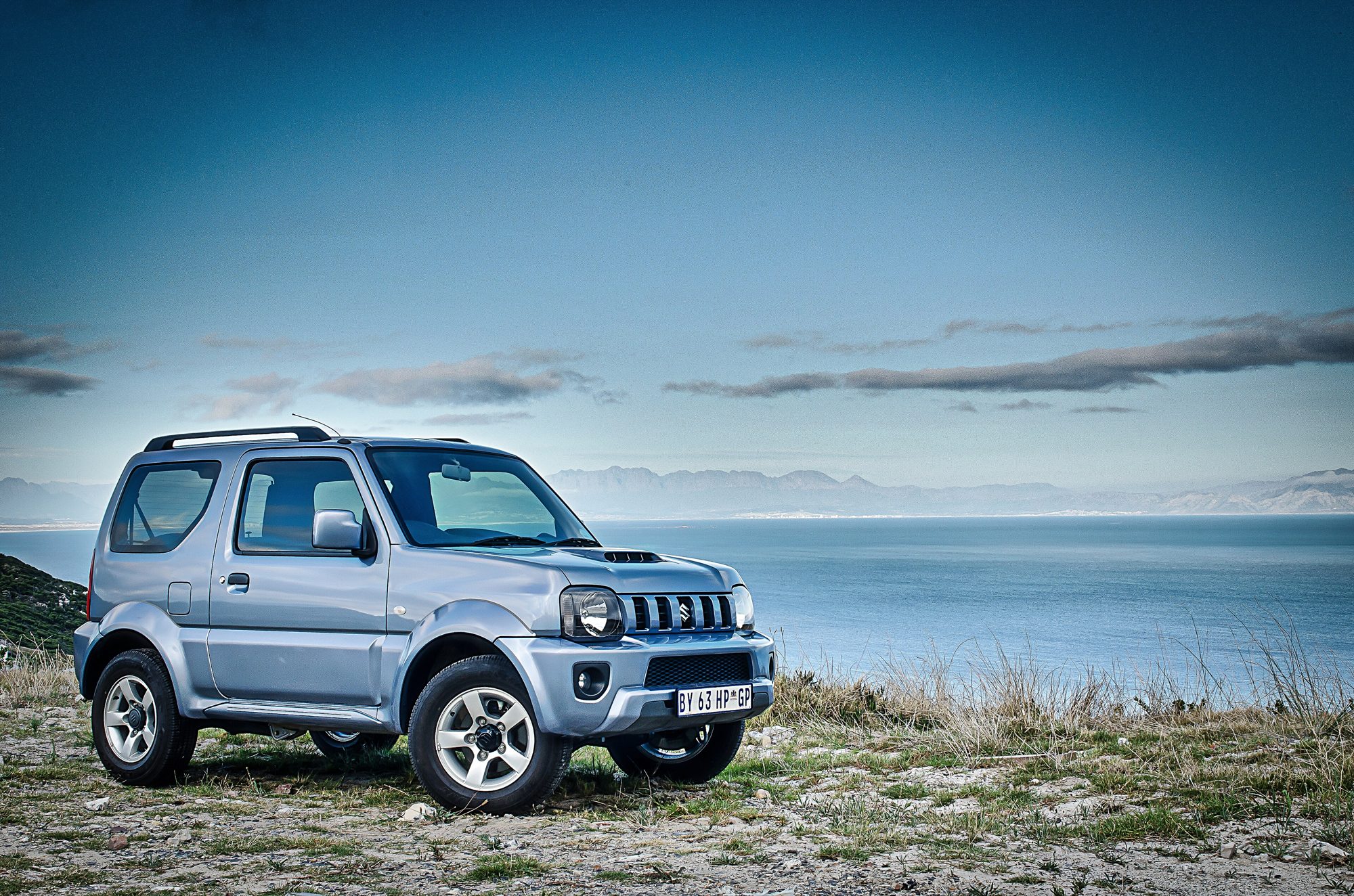
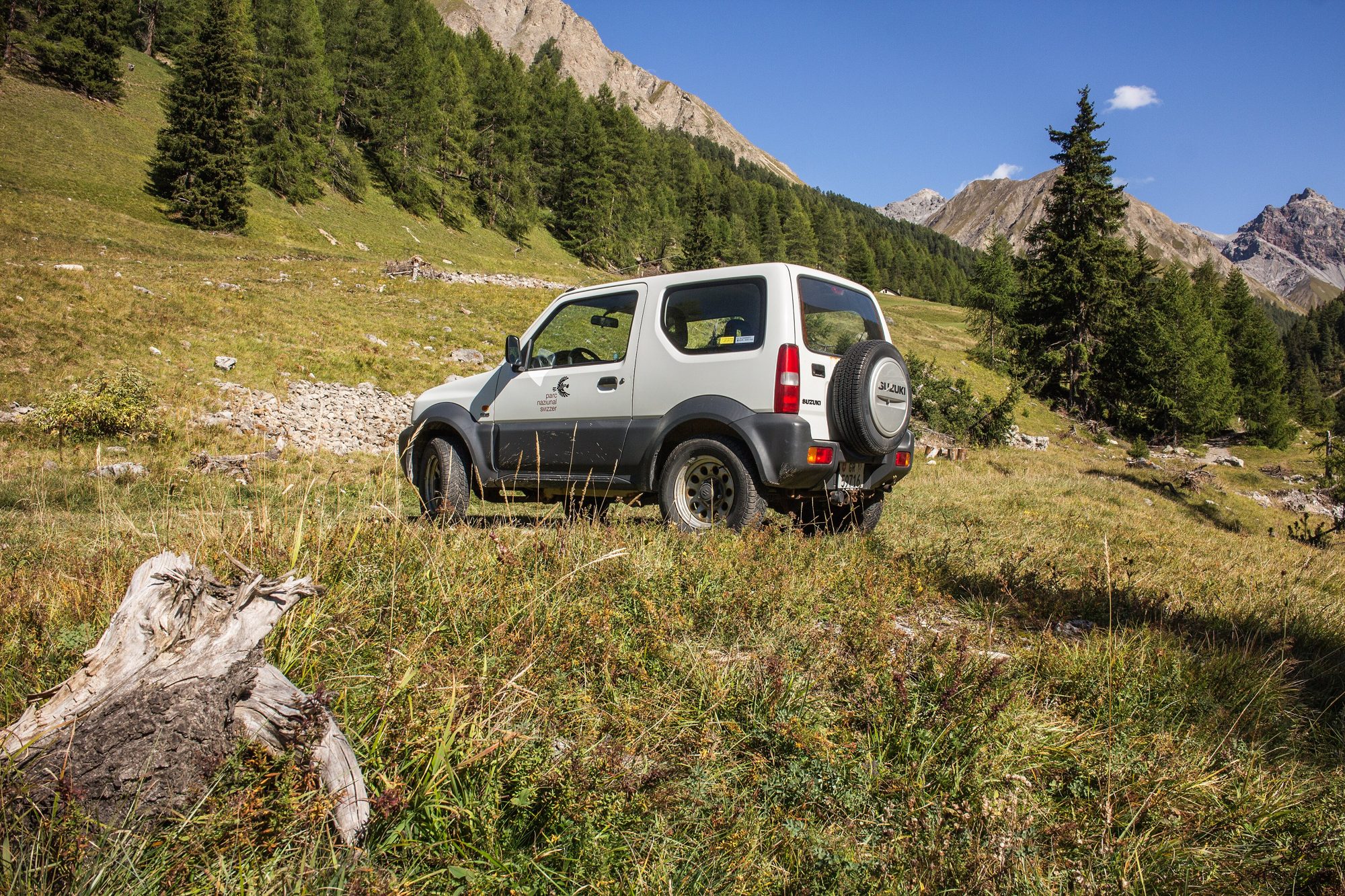
A white Swiss National Park third-generation Suzuki Jimny parked in an alpine meadow in Val Trupchun, with larch trees and rocky peaks behind
SUZUKI JIMNY · THIRD GENERATION · 1998–2018

Suzuki Jimny JB23 / JB43

JB23 · JB33 · JB43 · JB53M13A 1.3 I4COIL-SPRUNG SOLID AXLESNEVER SOLD NEW IN THE US1998–2001 BUILDS NOW 25-YEAR ELIGIBLE

“A ladder frame, two live axles and a real low range, shrunk until it fits in a Japanese parking space and priced like a hatchback. The Jimny that ran for twenty years is the smallest proper 4x4 you can import, and its only natural predator is road salt.”

PART 01

Overview

Where it came from, why it matters, and how it changed year to year.

The story

Suzuki showed the third-generation Jimny at the 1997 Tokyo Motor Show, and it went on sale in Japan in January 1998 as the 1.3-liter Jimny Wide. While rivals were turning small 4x4s into crossovers, Suzuki kept the separate ladder frame, the solid axles and a two-speed transfer case. It then built the thing, mostly unchanged under the skin, for twenty years. It replaced the Samurai in most markets and carried the Jimny name around the world. America was the one big market that never got it new, and Suzuki stopped selling cars in the US altogether in 2012.

KEI CAR, WIDE CAR

There are really two trucks under one badge. The JB23 is the Japanese kei car: 3,395 mm long and 1,475 mm wide, with no fender flares, small bumpers and a 658 cc turbocharged K6A three-cylinder. It reached showrooms in October 1998, months after the bigger car, because it was designed around new kei rules that hadn't yet taken effect. Everything else is the 'Wide' car, with flares, bigger bumpers and a 1.3-liter four. That's the JB33 with the 80 PS G13BB, then the JB43 with the M13A from January 2000 in Japan. Japan revived the Sierra name for the 1.3 in January 2002, and Australia adopted it in 2007.

The family spread wide. Santana Motor in Spain built the Canvas Top from 1999 to 2009, and its soft tops kept the old G13BB until 2005. Europe got the JB53 diesel, a Santana- and Suzuki-built Jimny with Renault's 1.5 K9K, from 2004 to 2011, though never in Britain or Ireland. GM Colmotores assembled a 'Chevrolet Jimny' in Bogotá from 1999, and Mazda sold the kei car as the AZ-Offroad. Brazil kept building the facelifted 1.3 until 2022, when new rules caught up with the M13A.

COILS, VACUUM AND A DRY KNUCKLE

The mechanical recipe is old-school 4x4 at three-quarter scale. Both axles are solid beams located by radius arms, and apart from the late SJ 'Coily,' this was the first Jimny on coil springs at all four corners after decades of leaves. Steering is recirculating ball. Drive is part-time with no center differential, so 4WD is for loose surfaces only. Vacuum-locking front hubs let you shift from 2WD to 4WD at up to 100 km/h (62 mph), while low range needs a stop. From about 2005 a push-button, motor-driven transfer case replaced the lever. BigJimny's owners compare the layout to a shrunken Patrol Y61, which is fair, if generous.

The weak point is where the front wheels steer. Each front hub swings on a pair of tapered kingpin bearings inside a knuckle that BigJimny bluntly calls 'poorly sealed by design.' Water and grit get in, the lower bearing wears, the halfshaft seal follows, and the result is the notorious 'death wobble' at around 45–50 mph. Unlike a Land Rover swivel, the Jimny's is meant to run dry with grease, not oil. Fresh Koyo bearings, a new seal and good waterproof grease fix it, and owners who wheel hard do this job often.

THE M13A YEARS

The engine most export Jimnys carry is the M13A, a 1,328 cc all-aluminum DOHC 16-valve four with a timing chain, so there's no belt to budget for, unlike the G13BB it replaced. The original version made about 82 PS (60 kW). The 2005–06 update added variable valve timing for 85–86 PS (63 kW) and 110 Nm at 4,100 rpm, and from 2007 every petrol Jimny used the VVT engine. BigJimny's verdict is that the G13BB and M13A are 'generally very robust' and mostly suffer sensor and electrical niggles. The gearbox paired with the VVT engine, the R72, is a different story: early boxes, roughly 2005–2008, are known for bearing failures.

Suzuki kept freshening the outside. A deeper front bumper arrived around 2006 and cost some approach angle. In 2012 a squarer grille and a fake hood scoop appeared, and late cars added ESP, TPMS and a traction-control mode that only works in low range. Production ended worldwide in 2018, except in Brazil, as Suzuki retooled for the fourth generation.

RUST, AND HOW AN AMERICAN GETS ONE

The thing that kills Jimnys isn't the drivetrain. BigJimny's wiki says every generation left the factory with 'particularly poor rust prevention,' and lists the usual spots: body and spring mounts on the chassis, factory welds, the boot floor and the floor under the rear seats, the panels behind the plastic cladding, and the cavity behind each headlamp. Its rust article shows a ten-year-old car with only 60,000 km, mostly on salted alpine roads, and a chassis rail weakened enough to keep a truck off the road. Buy the driest one you can find, then rust-proof it.

For Americans, the clock is the attraction. NHTSA lets anyone import a vehicle that is 25 or more years old, measured from its date of manufacture. That covers every 1998–2001 Jimny today: the first JB33 Wides turned 25 around the start of 2023, the first kei JB23s in late 2023 and the first M13A JB43s in 2025, and each later truck qualifies on its own 25th birthday. That's why US auctions are full of right-hand-drive JB23 turbos, while the 70 Series follows the same path a few sizes up.

SIDEBAR · THE JIMNY WITH A MAZDA BADGE

Mazda AZ-Offroad

In October 1998 Mazda launched the AZ-Offroad, a rebadged kei JB23 sold through its Autozam small-car channel, which is where the 'AZ' comes from. It used the same 658 cc K6A turbo three, rated at 64 PS, with manual four-wheel drive, auto-locking front hubs, low range and an optional automatic. It carried its own model code, JM23, and production ended in early 2014.

Because it's a JB23 underneath, parts and know-how carry straight over, and it qualifies for import under the same 25-year rule. A 2000 AZ-Offroad sold on Bring a Trailer for $9,401 in July 2025, right in the middle of the market for JB23 Jimnys from the same years.
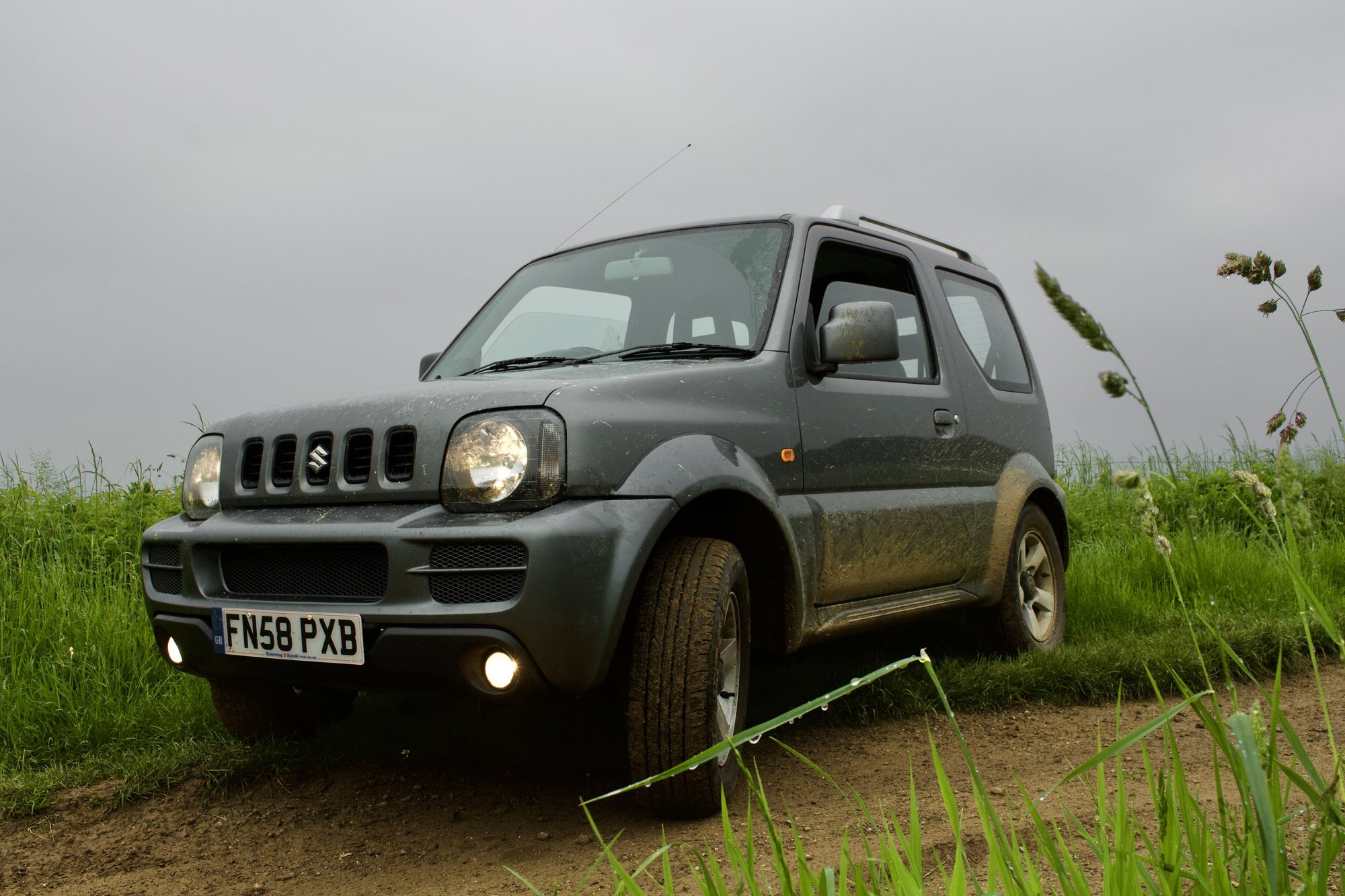
Year by year

What changed, model year by model year. Sweet spot Beware

  1. 1997Third-generation Jimny revealed at the Tokyo Motor Show
  2. 1998January: 1.3 G13BB Jimny Wide (JB33) on sale in Japan. October: kei JB23 with the K6A turbo and the Mazda AZ-Offroad twin arrive. Europe launch at the Paris show
  3. 1999Santana's Canvas Top revealed at the Barcelona show in May; GM Colmotores starts building the 'Chevrolet Jimny' in Colombia
  4. 2000January: M13A DOHC engine replaces the G13BB in Japan (JB43); other markets follow by 2002. JB23 gets standard ABS and airbag from October 1999Sweet spot
  5. 2002Japan revives the 'Jimny Sierra' name for the 1.3 in January; JB23 grille separates from the hood
  6. 2004European JB53 diesel arrives with Renault's 65 PS K9K 700, whose fuel pump failures can ruin the engineBeware
  7. 2005Push-button electric transfer case, new interior and the R72 manual gearbox; early R72s (about 2005–2008) are prone to bearing failure
  8. 2005–2006M13A gains VVT (63 kW / 110 Nm); diesel moves to the 86 PS intercooled K9K 266; deeper front bumper hurts approach angle
  9. 2009Santana ends its agreement with Suzuki; the Canvas Top is discontinued
  10. 2012Facelift: squarer grille, hood scoop, shallower bumper and ISOFIX
  11. 2014ESP, low-range traction control and TPMS added where required; new instrument panel and steering wheelSweet spot
  12. 2018Production ends everywhere except Brazil as Suzuki retools for the JB64/JB74; Brazil follows in 2022
  13. 2023–2026First JB33s, then JB23s (late 2023) and M13A JB43s (2025) reach 25 years old and become importable to the US
PART 02

Specs & capability

How it’s built, what it can do, and what fits under it.

How it’s built

A separate ladder frame carries a steel body that isn't structural. Both axles are solid beams on coil springs, located by radius arms and a panhard rod. Power goes to the rear wheels, and a lever (or, from about 2005, push buttons) adds the front axle and a 2:1-ish low range through a separate transfer case. There's no center differential, and the front hubs lock by vacuum.

CHASSISLadder frame, 2,250 mm wheelbaseSame wheelbase for the kei JB23 and the Wide/Sierra; the body isn't a load-bearing part.
SUSPENSIONSolid axles, coil springs all roundThe first full Jimny generation on coils (a late SJ 'Coily' aside). Radius arms and panhard rods locate the axles; the arm mounts are a known rust and wear point.
4WD SYSTEMPart-time, no center diffVacuum-locking front hubs allow 2WD to 4WD shifts up to 100 km/h (62 mph). Low range requires stopping.
LOW RANGE2.145:1 lever box; 2.002:1 push-button manualBigJimny's ratio tables. Push-button transfer cases arrived around 2005 with the VVT engine.
ENGINE (EXPORT)M13A 1.3 DOHC I4, timing chain82 PS early, 85–86 PS (63 kW) and 110 Nm with VVT from 2005–06. Early JB33s used the belt-driven G13BB.
STEERINGRecirculating ball, kingpin knucklesThe knuckles are greased, not oil-filled. Worn kingpin bearings are the main cause of 'death wobble.'

Variants & engines

YEARSPLATFORMENGINEOUTPUTWORTH KNOWING
1998–2018JB23 (Japan kei)K6A 658 cc turbo I364 PSKei-sized with no fender flares. Arrived October 1998; these right-hand-drive turbos dominate US imports.
1998–2001 (to 2005 in Spanish soft tops)JB33 Jimny WideG13BB 1.3 SOHC 16v I480 PS (59 kW)The first third-gen Jimny on sale, January 1998. Timing belt.
2000–2005JB43 Wide / SierraM13A 1.3 DOHC I482 PS (60 kW)Japan from January 2000; other markets 2000–2002. Lever-shift transfer case.
2005–2018JB43 Sierra / JimnyM13A VVT 1.3 DOHC I485–86 PS (63 kW) / 110 NmPush-button 4WD, new interior and the R72 gearbox. Facelifts in 2012 and 2014. Brazil built it until 2022.
2004–2011JB53 DDiS (Europe)Renault K9K 1.5 turbo-diesel I465 PS, then 86 PSBuilt in Japan and by Santana. The early K9K 700 is the troublesome one. Never sold in the UK or Ireland.
1998–2014JM23 Mazda AZ-OffroadK6A 658 cc turbo I364 PSRebadged kei JB23 sold by Mazda in Japan.

Capability numbers

Towing1,300 kg (2,866 lb) braked / 500 kg (1,102 lb) unbraked2017 Jimny Sierra, New Zealand spec
Gross vehicle mass1,420 kg (3,131 lb)2017 Sierra
Fuel tank40 L (10.6 US gal)
Ground clearance190 mm (7.5 in)unladen
Approach / departure34° / 46°2017 Sierra
Fuel economy7.1 L/100 km combined (about 33 US mpg)Suzuki claim, 2017 manual
Curb weight1,062 kg (2,341 lb)2017 Sierra manual; kei JB23 930–1,000 kg
Turning circle9.8 m (32.2 ft)
Engine output63 kW (86 PS) / 110 Nm at 4,100 rpmM13A VVT

Wheels & tires

FACTORY TIRES
205/70R15 on 15x5.5 alloy (JB43 Jimny Sierra, e.g. 2017 New Zealand market)
Bolt pattern5x139.7 (5x5.5")
OffsetET5 (+5 mm) on the factory 15x5.5
Center bore108.1 mm
Lug threadM12x1.25
LIFTBIGGEST TIREWHAT IT TAKES
Stock215/75R15BigJimny consensus for an unmodified Wide/Sierra, about 27.7 in. Bigger than this and owners advise regearing to protect the clutch or the automatic's fluid.
2 in235/75R15About 28.8 in. Forum regulars say a gen 3 still needs some trimming at 2 in, though some owners accept minor rubbing at full flex instead.
3 in265/75R15 (≈31 in)Trimming required, per BigJimny's tire-size notes; plan on lower transfer gearing.

Forum consensus, not a guarantee: wheel offset, tire brand and suspension wear all change clearance. Confirm before you buy.

Production & special editions

Twenty years of production across Japan, Spain, Colombia and Brazil; Suzuki counted 2.85 million Jimnys of all generations sold in 194 countries by 2018.

Production1998–2018 (Brazil until 2022)
AssemblyIwata, Japan; Santana Motor, Linares, Spain (1999–2009); GM Colmotores, Bogotá, Colombia; MMC Automotores, Brazil
Europe sales peak28,388 in 2006
Japan salesAbout 11,000–17,000 a year from 2001 to 2017
Canvas Top1999–2009Built only by Santana in Spain; most kept the G13BB until 2005
Jimny L / J22000–2002Two-wheel-drive kei JB23 marketed in Japan; the J2 ran from February 2001 to January 2002
Mazda AZ-Offroad1998–2014Rebadged kei JB23 (JM23) with the 64 PS K6A turbo
Kansai edition1999JB23 turbo with 'by Kansai Yamamoto' side graphics, seen in several US Bring a Trailer sales
PART 03

Buying one

What to pay, what to check, and how to tell a good one from a clone.

What they cost

US prices are set by imports: mostly right-hand-drive kei JB23 turbos from 1998–2000, with clean, low-kilometer and special-edition trucks at the top. Rust history matters more than mileage.

Driver / needs work$5k–7k
Good driver$7k–11k
Excellent / special edition$11k–17k

Based on Bring a Trailer results from April 2025 to October 2026 for 1998–2000 JB23-generation trucks: a 1999 Wild Wind at $5,500, several 1999 'Kansai' editions from $6,400 to $16,750, a 1998 JB23 turbo at $10,500 and a 2000 Mazda AZ-Offroad at $9,401. A 1998 JB33 Wide was bid to $5,200 without selling. Prices move; checked October 2026. See live listings below.

What to check before you buy

  1. 01
    Crawl under it before anything elseBigJimny's buying guide calls rust 'the main issue with most Jimnys.' Look at the body and coil-spring mounts on the chassis, the factory welds and the rear crossmember. A body-on-frame truck can look fine from above while the mounts are rotting. One forum owner's 2000 Jimny failed its UK MOT on two body mounts and the rear crossmember.
  2. 02
    Pull up the boot floor and the rear seatThe rear seat bench lifts out by hand. Check the floor around the rear seat-belt anchors, the tool well above the exhaust and the joint between the rear floor and the inner arches. BigJimny says this is the most common rot-through, and it's worse on soft tops.
  3. 03
    Look behind the headlamps and the claddingThe cavity behind each headlamp is a water drain that rarely drains properly, and the plastic sill and arch cladding hides rust until it's advanced. Pop the inner arch liners if the seller will let you.
  4. 04
    Listen for a clunk pulling awayA clunk from the rear in first gear points to loose or worn radius-arm mounts. The mounting holes can wear oval and the brackets can rust through, which needs welding.
  5. 05
    Drive it at 45–50 mphSteering shake in that band is the classic Jimny 'death wobble,' usually from worn kingpin bearings. Gear oil weeping onto the swivel balls means the halfshaft seal has gone too. It's fixable, but price it in.
  6. 06
    Engage 4WD on a loose surfaceTry 4WD and low range on gravel and listen for the front hubs clicking in. Erratic engagement on lever cars means vacuum leaks. On push-button cars, flashing 4WD lights usually point to the transfer-case actuator or its wiring.
  7. 07
    Abuse the transfer case, brieflyBigJimny's test: a hard launch in first. A loud machine-gun rattle with no movement means a stretched transfer chain. Used transfer cases are cheap, so it's a bargaining point rather than a deal-breaker.
  8. 08
    Importing? Read the build plateThe 25-year exemption runs from the date of manufacture, not the model year, so check the build date before you pay. Get the export certificate and import paperwork, and check how your state titles right-hand-drive kei imports before the truck lands.

Spotting the real thing

None of these were sold new in the US, so every American truck is an import, and the code on the paperwork should match the metal.

  1. ID
    Model code and VINBigJimny's manual guide notes the model is coded in the VIN: JB23 (Japanese kei), JB33 (G13BB Wide), JB43 (M13A Wide/Sierra) and JB53 (diesel). The VIN is in the engine bay below the windscreen, on top of the dash and stamped in the chassis rail behind a rear wheel. The Mazda version is coded JM23.
  2. ID
    Kei or WideA JB23 has no fender flares and small bumpers to stay within Japan's kei-car size limits (3,395 x 1,475 mm). The Wide/Sierra has flares, larger bumpers and is 1,600 mm wide.
  3. ID
    Lever or buttonsA transfer-case lever between the gearshift and handbrake means a pre-2005 truck. Three dash buttons (2WD, 4WD, 4WD-L) mean the later electric transfer case, used on every M13A VVT Jimny.
  4. ID
    Bumper generationsBigJimny dates the fronts: first bumper 1998–2005, a deeper second bumper 2006–2012, and a shallower third bumper with a hood scoop and new grille from 2012.
  5. ID
    Diesel and 2WD odditiesA JB53 diesel has a prominent fake intake bulge on the hood. Rare 2WD-only Jimnys exist, including the export JB33 2WD (1998–2000) and the Japanese Jimny L / J2 (JB23, 2000–2002); no transfer lever on an early-interior truck is the giveaway.

Recalls & service bulletins

For UK-registered trucks, check open recalls by registration with the DVSA.

DVSA recall check ↗
Notable recalls
Lateral (panhard) rod bolts may loosen ↗Built 9 May 2012 – 24 March 2014 · UK defect notice (2018)A bolt securing the lateral rods to the front and rear axles may come loose and cause vibration through the steering; check it has been done on a UK-market truck.
Service bulletins & known fixes
Kingpin preload shims ↗Suzuki released shims for the kingpins to add preload to the bearings, a fix for 'death wobble'; on a Jimny the shims go on the pin itself, unlike the SJ.

Importing & legality

Suzuki never sold the third-generation Jimny new in the United States, and it stopped selling cars here altogether in 2012. Every US example is a private import. Under NHTSA's rule (49 CFR 591.5(i)), a vehicle that is 25 or more years old can be imported without meeting the federal safety standards. In the 2022 Puerto Rico seizure of a newer Jimny, DOT said age is counted 'from the date of manufacture,' so check the build date, not the model year.

As of October 2026, that means trucks built up to about October 2001. The JB33 Wide (on sale from January 1998) became eligible around the start of 2023, the kei JB23 (from October 1998) in late 2023, and the first M13A JB43s (Japan, January 2000) in 2025. The window rolls forward a month at a time, so 2002 builds qualify through 2027. The last Japanese-built trucks, from 2018, won't qualify until 2043, and Brazil's, built until 2022, not until 2047.

EPA has a separate age-based exemption in 40 CFR 85.1511 for vehicles more than 20 years past their original production year. A 25-year-old Jimny clears that age too, but the EPA declaration still has to be filed alongside NHTSA's HS-7. Most US imports are right-hand-drive Japanese kei JB23s with the 658 cc turbo, plus some European left-hand-drive JB33s and Spanish-built soft tops. Titling, inspection and emissions rules are set by each state, so check yours before you buy.

Rules change and vary by state and country. Confirm with your DMV and a licensed importer before you buy.

The one you’ll own someday

For sale now

1998–2001 · US imports (25-year eligible)Jimny JB23 / JB33 / JB43
PART 04

Owning one

Baseline service, the repairs you’ll actually do, and where the manuals live.

Post-purchase baseline

After you buy it

Specs below are from the Suzuki owner's-manual tables BigJimny reproduces for UK-market M13A VVT trucks, with earlier-engine differences noted. A US import may be a kei JB23 with the K6A turbo, which has its own specs, so confirm your model code first. BigJimny's advice for any secondhand Jimny without history: change every fluid and filter, and the belts, straight away.

Engine oil & filterM13A: 4.0 L, API SL/SM or newer, 5W-30 or 10W-30 · G13BB: 3.7–4.2 L depending on typeSuzuki: 15,000 km / 12 months; BigJimny suggests 10,000 km

Factory filter for the VVT engine is Suzuki 16510-61A31 (16510-61A01 and -61A20 also fit). Replace the sump-plug gasket each time.

Air filterSuzuki 13780-81A00Suzuki: 45,000 km / 3 years; BigJimny: 25,000–30,000 km, sooner in dust

Check it at every oil change on a truck that sees gravel roads.

Cabin filterNot every Jimny has one fittedNo factory interval; BigJimny suggests about 20,000 km or two years

Purely for the occupants, but worth doing on a dusty import.

Spark plugsM13A VVT: NGK BKR6E-11 / Denso K20PR-U11 (nickel) or NGK IFR6J11 (iridium)Nickel 45,000 km, iridium 60,000 km (with O2 sensor)

Suzuki prefers iridium plugs, especially in cold climates.

CoolantM13A VVT: 5.2–5.9 L by type · ethylene glycol, silicate-free45,000 km / 3 years (non-HOAT)

From 2005 Suzuki's manuals specify silicate-free coolant, and BigJimny applies that to every gen 3. Flush an unknown truck.

Manual gearboxAPI GL-4 75W-90 · 1.3 L (VVT), 1.1 L (earlier)BigJimny: 50,000 km / 3 years

On an R72 box, a furry drain plug or metal flakes is the early warning of bearing failure.

Automatic gearboxVVT: Suzuki ATF3317, Mobil ATF3309 or Dexron III · 3.7 L or 5.7 L depending on typeBigJimny: 75,000 km / 4–5 years

BigJimny: the autos 'love fresh ATF'; poor shifts and a top gear that won't select follow neglect.

Transfer caseAPI GL-4 75W-90 · 1.13 L (VVT), 0.7–0.8 L (earlier)Suzuki: never; BigJimny: 50,000 km / 3–5 years

Check the push-button actuator cover for water ingress while you're under there.

Front & rear differentialsAPI GL-5 80W-90 hypoid · front 1.65 L, rear 1.35 L (VVT); 1.1 L / 1.3 L earlierSuzuki: never; BigJimny: 50,000 km / 3–5 years

Milky oil after water crossings means the breathers or seals let water in.

Kingpins & steering knucklesHeavy-duty waterproof grease, not oilInspect now; rebuild if there's play or leakage

BigJimny: the lower bearing can rust solid on trucks that sat for years and show no play at all, so inspect inside on an unknown truck.

Power steering & brake fluidPS: Dexron IIE or III · brakes: DOT 3 / SAE J1703Brakes: 30,000 km / 2 years

Suzuki doesn't define a power-steering interval; refresh it if it's dark.

BeltsG13BB timing belt 12761-70C00 · M13A uses a chainG13BB belt 100,000 km; V-ribbed drive belts 90,000 km / 6 years

Whirring or squealing on an M13A is usually a drive belt, tensioner or alternator bearing (BigJimny's noise guide).

4WD system & vacuum hubsExercise 4WD and low rangeBigJimny: use it from time to time so parts don't seize

Test hub engagement on a loose surface; dormant vacuum hubs are the usual failure.

Underbody rust protectionClean to bare metal where rusty, then coat and wax cavitiesThoroughly now, then check and touch up yearly

BigJimny: wash the underbody regularly in winter, then drive it dry.

For the hands-on owner

Common repairs

The jobs owners actually end up doing, rated for a competent home mechanic with a decent tool kit. Always confirm torque figures, fluids and procedures against the factory service manual for your VIN, and work safely — support the truck on stands, never just a jack. You do this work at your own risk; see the disclaimer. Some parts links are affiliate links.

Replace the kingpin bearings and halfshaft seal
DIFFICULTY · 3 / 5TIME · ≈ Half a day per sideSHOP COST · Parts plus labor
SYMPTOMSSteering-wheel shake around 45–50 mph, play when you rock a raised wheel at 12 and 6 o'clock with the brakes held, and diff oil mixed with grease leaking from the swivel ball. A rusted-solid lower bearing can show no play at all.
THE FIXStrip the steering knuckle, replace both tapered kingpin bearings (BigJimny recommends Koyo, the OE supplier) and fit the 26 x 38 x 9 mm double-lip Suzuki halfshaft seal rather than a shallower aftermarket one. Pack the bearings with heavy-duty waterproof grease in normal quantities, use only a thin film of sealant on the kingpins, and add Suzuki's preload shims if the wobble persists. Replace the large swivel seal while you're in there.
TOOLS & PARTSJack and axle stands · torque wrench · bearing drift · gasket sealant · waterproof grease.
Chase down a death wobble that isn't the kingpins
DIFFICULTY · 2 / 5TIME · ≈ 1–3 hours per itemSHOP COST · Parts plus labor
SYMPTOMSWobble remains after new kingpin bearings, or a sloppy, wandering feel at speed.
THE FIXWork through BigJimny's list in order: worn tie-rod ends (one standard and one reverse thread per rod), worn radius-arm bushes (most often the chassis end of the front arms), wheel balance (beads help with chunky mud tires), and rust on the hub face behind the brake disc that stops the disc and wheel seating square. Warped discs can mimic it too.
TOOLS & PARTSTie-rod end puller · bush press or drawbolt kit · wire brush for hub faces · alignment afterward.
Fix vacuum front hubs that won't engage
DIFFICULTY · 2 / 5TIME · ≈ 1–2 hours to diagnoseSHOP COST · Often just hose or valve parts
SYMPTOMSThe 4WD light flashes, the front hubs don't click in, or 4WD works one day and not the next. Common on trucks that rarely use 4WD.
THE FIXThe system only pulls vacuum for a few seconds, so you can't hear a leak. Pull a wheel, disconnect the two hub hoses and apply vacuum with a large syringe to each spigot in turn: the hub should click. If it does, test again at the valve block. The pipe from the intake manifold to the valves is the most common failure, and a leaky 'unlock' valve can stop the 'lock' circuit working. If you're tired of chasing it, BigJimny documents converting to manual or fixed hubs.
TOOLS & PARTS100 ml syringe · vacuum hose · basic hand tools.
Revive the push-button transfer-case actuator
DIFFICULTY · 3 / 5TIME · ≈ 2–3 hoursSHOP COST · Free if cleaning fixes it
SYMPTOMSOn 2005-on trucks, the green 4WD light flashes (one owner counted 12 flashes) with a click, the 4L light may flash too, and 4WD won't engage even though the hubs lock when tested.
THE FIXFirst rule out the hubs and check the clutch is fully down (or the auto is in neutral). Then check the plugs and wiring on the transfer case. If they're fine, remove the round tin actuator cover at the back of the transfer case. One BigJimny owner found condensation and rust inside, cleaned and dried it, and it worked perfectly afterward. Watch for two springs that fly out when the armature comes out, and set the actuator's position relative to the selector shaft per Suzuki's procedure on reassembly. Change the transfer-case oil while you're there.
TOOLS & PARTSBasic hand tools · contact cleaner · service manual for the actuator alignment procedure.
Repair rotten floors, sills and radius-arm brackets
DIFFICULTY · 4 / 5TIME · ≈ Days, with weldingSHOP COST · Parts plus fabrication labor
SYMPTOMSHoles in the boot floor or under the rear seats, rust around the seat-belt anchors, MOT or inspection failures on body mounts, or a rear clunk from a corroded arm bracket.
THE FIXCut back to clean metal before judging it: forum regulars warn it always looks worse once cleaned up. Pressed repair floors are available in the UK, and sills and radius-arm brackets come as panels. Weld in new metal, seam-seal and paint, then wax the cavities. If the chassis rail itself or the spring and body mounts are badly rotted, BigJimny warns the truck may be beyond economical repair.
TOOLS & PARTSMIG welder · grinder · seam sealer · cavity wax and underbody coating.
Renew radius-arm bushes and check the axle mounts
DIFFICULTY · 3 / 5TIME · ≈ Half a daySHOP COST · Parts plus labor
SYMPTOMSA clunk when letting the clutch up, vague steering, or cracked and split bushes you can open with a screwdriver.
THE FIXUnbolt the arms and inspect the mounts on the axle and chassis: BigJimny notes they're thin, wear oval, and on older trucks can corrode and tear off entirely. Press new bushes into the arms (nylon SuperPro-type bushes are easier to fit but ride firmer), check the arms against a straight edge for bends, and torque the bolts with the truck at ride height.
TOOLS & PARTSBush press or drawbolt set · straight edge · torque wrench.
Rebuild a noisy R72 gearbox
DIFFICULTY · 4 / 5TIME · ≈ A weekendSHOP COST · About £700 at a shop, per BigJimny
SYMPTOMSGrinding or whining when cruising in 3rd or 4th on 2005-ish to 2008 petrol trucks, and a furry drain plug or metal chunks in the oil.
THE FIXRemove the gearbox, split the three-piece case and replace the open deep-groove bearings with metal-shielded ones, as Suzuki's later parts do. BigJimny suspects early oil starvation (some trucks also had leaking prop-shaft center caps). Keep the synchro rings, clips and needle bearings in order. The procedure is in Suzuki supplementary manual 99501-81A10-01E. Do the clutch while the box is out.
TOOLS & PARTSTransmission jack · bearing pullers · impact sockets for pressing bearings · liquid gasket.
Change the G13BB timing belt (1998–2001 JB33)
DIFFICULTY · 3 / 5TIME · ≈ Half a daySHOP COST · Parts plus labor
SYMPTOMSNo visible symptom until it snaps. It's a service item on early 1.3 Jimnys, which are exactly the trucks now eligible for US import.
THE FIXSuzuki's interval for the G13BB belt (part 12761-70C00) is 100,000 km. With no receipt, change the belt and tensioner on arrival, and do the water pump at the same time. The M13A that replaced it uses a chain and doesn't need this.
TOOLS & PARTSTiming marks and service manual · tensioner tools · coolant for the pump.

Manuals & documentation

Asked on every forum

Suzuki Jimny JB23 / JB43 questions, answered

What's the biggest tire I can fit without a lift?

Stock on the Wide/Sierra is 205/70R15 (about 27.1 inches). BigJimny's consensus is that 215/75R15 (about 27.7 inches) is the largest that fits an unmodified truck. 235/75R15 (about 28.8 inches) wants a 2-inch lift, and forum regulars say gen 3s still need some trimming even then, though a few owners run them with minor rubbing at full flex. Anything bigger than 215 really calls for regearing, or you'll cook the clutch or the automatic's fluid.

SOURCE · BIGJIMNY
Can I legally import one to the US?

Yes, if it's at least 25 years old from its date of manufacture, which is the NHTSA exemption in 49 CFR 591.5(i). As of late 2026 that covers trucks built up to about October 2001: JB33 Wides, early JB43s and kei JB23s, plus the Mazda AZ-Offroad. Each later truck becomes eligible on its own 25th birthday. EPA has its own age-based exemption, and your state decides how it's titled.

SOURCE · eCFR · NHTSA
What's the difference between JB23, JB33, JB43 and JB53?

JB23 is the Japanese kei car with the 658 cc turbo three and no fender flares. JB33 is the export 1.3 'Wide' with the G13BB. JB43 is the M13A-engined Wide or Sierra from 2000 to 2018. JB53 is the European diesel with Renault's 1.5 K9K. All four share the 2,250 mm wheelbase.

SOURCE · WIKIPEDIA · BIGJIMNY
Which engine should I look for?

BigJimny rates both petrol engines as robust. The G13BB uses a timing belt with a 100,000 km interval, while the M13A uses a chain that doesn't need replacing. The M13A VVT (2005–06 on) is the strongest petrol at 85–86 PS, but its R72 gearbox had bearing problems in roughly 2005–2008 trucks. Avoid the early K9K 700 diesel, whose injection pump failures can wreck the engine.

SOURCE · BIGJIMNY
Can I leave it in 4WD on the road?

No. There's no center differential, so 4WD on dry tarmac binds the driveline and can break CV joints, and Suzuki only sells the CV joint with the halfshaft. On push-button trucks, check you haven't knocked 4WD on by accident. Use 4WD on snow, mud, gravel, wet grass and sand.

SOURCE · WIKIPEDIA · BIGJIMNY
How fast can I shift into 4WD?

The vacuum-locking front hubs let you go from 2WD to 4WD-High at up to 100 km/h (62 mph). Low range requires stopping, and on push-button trucks the clutch must be down with the gearbox in neutral.

SOURCE · WIKIPEDIA
How much can it tow?

A 2017 New Zealand-market Jimny Sierra was rated at 1,300 kg (2,866 lb) braked and 500 kg (1,102 lb) unbraked. Bear in mind that it only has 110 Nm of torque.

SOURCE · CAREXPERT NZ
What fuel economy should I expect?

Suzuki claimed 7.1 L/100 km combined for the 2017 manual Sierra, about 33 US mpg, from a 40-liter (10.6-gallon) tank. Bigger tires, roof racks and the 4-speed automatic all make it worse.

SOURCE · CAREXPERT NZ
Does it have lockers?

Not from the factory: both axles have open differentials, and late trucks add a traction-control mode that only works in low range. BigJimny's owners rate the ARB Air Locker as the best aftermarket option because it's selectable, while Lockright and Kaiser are cheaper automatic lockers that can misbehave on the road.

SOURCE · BIGJIMNY
Should I fill the front swivels with oil like a Land Rover?

No. BigJimny warns that Land Rover-trained mechanics sometimes try it. The Jimny's knuckle is a greased, 'dry' joint, and its swivel seal acts more as a dust shield and steering damper than an oil seal. Corroded swivel balls aren't critical either: file them smooth and paint them.

SOURCE · BIGJIMNY
Are wheel spacers OK?

Forum regulars advise against them. They shorten the life of the kingpin and wheel bearings dramatically, to as little as six months in hard off-road use according to one experienced owner.

SOURCE · BIGJIMNY
PART 05

Building one

Who makes the good stuff, where owners gather, and who to watch.

Common modifications & who does them

KINGPINS & AXLE REBUILDThe first thing every hard-used Jimny needs. Koyo kingpin bearings, Suzuki seals, preload shims and proper waterproof grease keep the wobble away.
MANUAL HUBSSwapping the vacuum hubs for manual or fixed hub heads removes the most failure-prone part of the 4WD system. BigJimny documents every route, from Samurai or Vitara hubs to tailor-made Jimny items.
GEARINGThe stock low range is tall, and anything over 215/75R15 needs help. The classic fix is a Rock Lobster-style transfer case with lower ratios, or a lower diff ratio from a later VVT truck.
LOCKERSOpen diffs front and rear. A selectable air locker in the rear axle is the most popular serious upgrade.
LIFT & BUSHESTwo inches of lift clears 235/75R15s. Caster-correction bushes are fine for a 2-inch lift; BigJimny says a 3-inch lift needs proper replacement arms.
RUST PROOFINGThe cheapest mod with the biggest payoff. Clean, seal and wax the underbody and cavities before the rot starts, then touch it up yearly.

Clubs & events

Resources

Channels, accounts & forums

All Samurai & Jimny resources →

From the wider Samurai & Jimny community:

SourcesWikipedia — Suzuki JimnyWikipedia — Suzuki M engine (M13A)Wikipedia — Suzuki (US car sales end, 2012)eCFR / Cornell LII — 49 CFR 591.5 (vehicles 25 or more years old)Cornell LII — 40 CFR 85.1511 (EPA import exemptions by age)BigJimny Wiki — Buying a JimnyBigJimny Wiki — Common problems overviewBigJimny Wiki — King pin bearing changeBigJimny Wiki — Regular maintenance intervals and consumablesBigJimny Wiki — Transmission gearing ratiosBigJimny Wiki — Gearbox R72 rebuildBigJimny Wiki — Radius arms and bush replacementBigJimny Wiki — Differential lockersBigJimny Wiki — Workshop manualsBigJimny Forum — The death wobble threadBigJimny Forum — 4WD light flashing on dash (vacuum hubs)BigJimny Forum — Gen 3 4WD switch/actuator fixBigJimny Forum — Causes of typical rust hotspots in Jimnys 3BigJimny Forum — Body mount rust repairBigJimny Forum — Gen 3 new tyres / lift / suspension upgradeBigJimny Forum — 31in tyres, 2in lift, standard bumpers?BigJimny Blog — What tyre sizeCarExpert NZ — 2017 Suzuki Jimny Sierra 1.3 manual specsBring a Trailer — Suzuki Jimny auction resultsWikipedia — Suzuki JimnyWikipedia — SuzukiCornell LII — 49 CFR 591.5Cornell LII — 40 CFR 85.1511U.S. CBP — CBP seizes vehicle smuggled from Mexico into Puerto Rico (29 Sep 2022)Global Suzuki — Suzuki launches the all-new Jimny 4WD vehicles in Japan (2.85 million sales figure)BigJimny Wiki — Buying a JimnyBigJimny Wiki — Manuals and owner's guidesBigJimny Wiki — Workshop manualsBigJimny Blog — What tyre sizeBigJimny Forum — 31in tyres, 2in lift, standard bumpers?BigJimny Forum — The death wobble threadTireWheelGuide — 2007 Suzuki Jimny Sierra tire and wheel sizesCarExpert NZ — 2017 Suzuki Jimny Sierra 1.3 manual specsCar-Recalls.eu — Suzuki Jimny common problems and UK recallsBring a Trailer — Suzuki Jimny auction resultsBring a Trailer — 1999 Suzuki Jimny Turbo Kansai (JB23W)BigJimny — BigJimny Event 2026 tickets