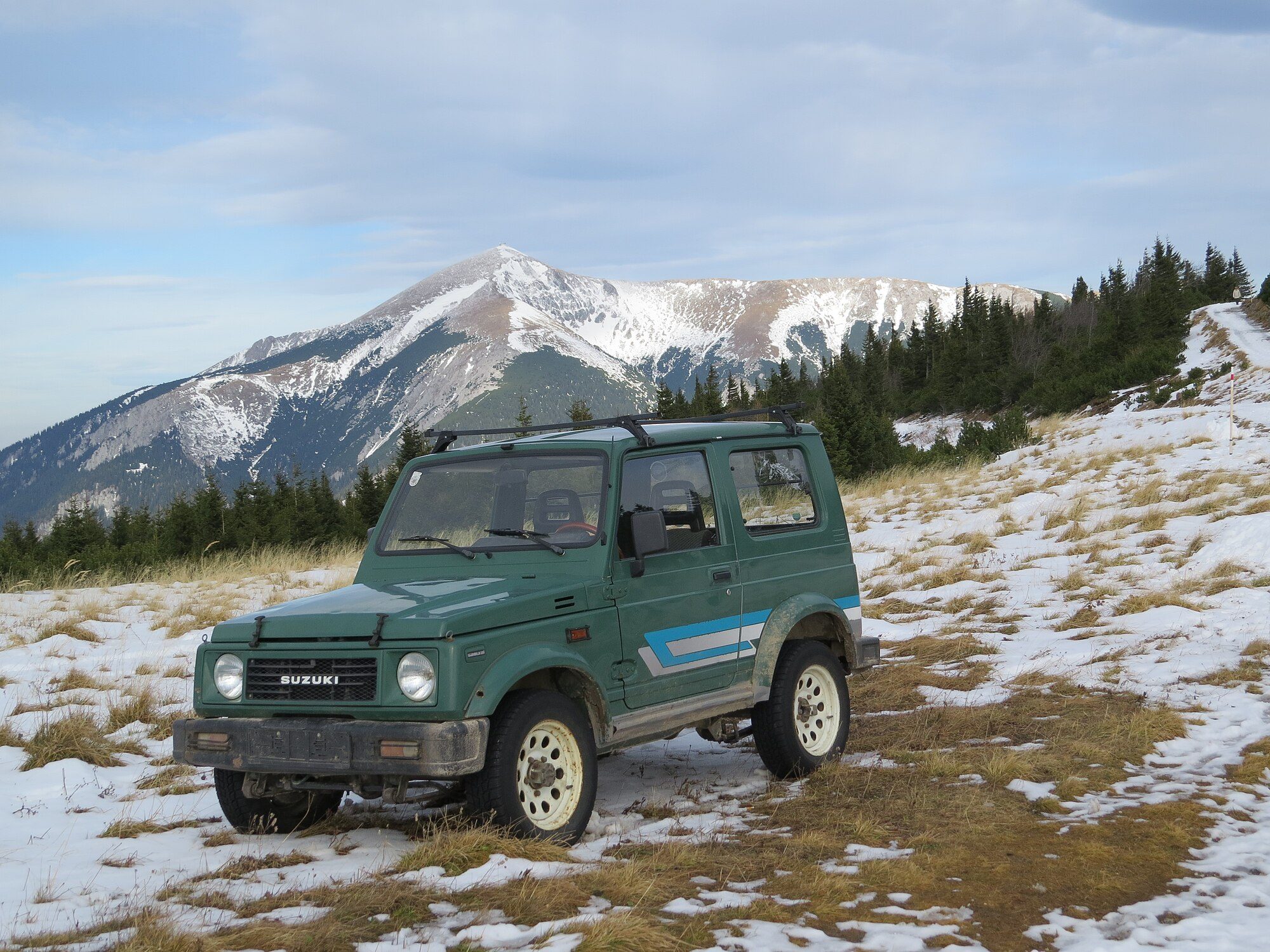
Samurai & Jimny
“The smallest proper 4x4 you can buy: ladder frame, two solid axles, low range and almost nothing else. It has been out-climbing trucks three times its size for more than half a century.”
Suzuki's off-road line began with a purchase. In 1968 it bought the rights to the HopeStar ON360, a tiny 4x4 from the struggling Hope Motor Company, and in April 1970 it launched the result as the Jimny LJ10, the first four-wheel-drive kei car to reach series production. The LJ series grew from a 359 cc two-stroke twin to the 797 cc four-stroke LJ80, and it took the Suzuki name to export markets for the first time.
In 1981 the second generation arrived. Export markets knew it as the SJ410 and SJ413, Australians as the Sierra, and Americans, from late 1985, as the Samurai. A 1988 Consumer Reports test, and the libel suit that followed, nearly buried it in the US, but off-roaders adopted it anyway. Spain's Santana and India's Maruti (as the Gypsy) built it for decades.
The third-generation Jimny of 1998 swapped the leaf springs for coils and stayed in production for 20 years. The boxy fourth generation followed in 2018. Every generation keeps the same recipe: a separate ladder frame, solid axles front and rear, a part-time transfer case with low range, and very little weight.