The story
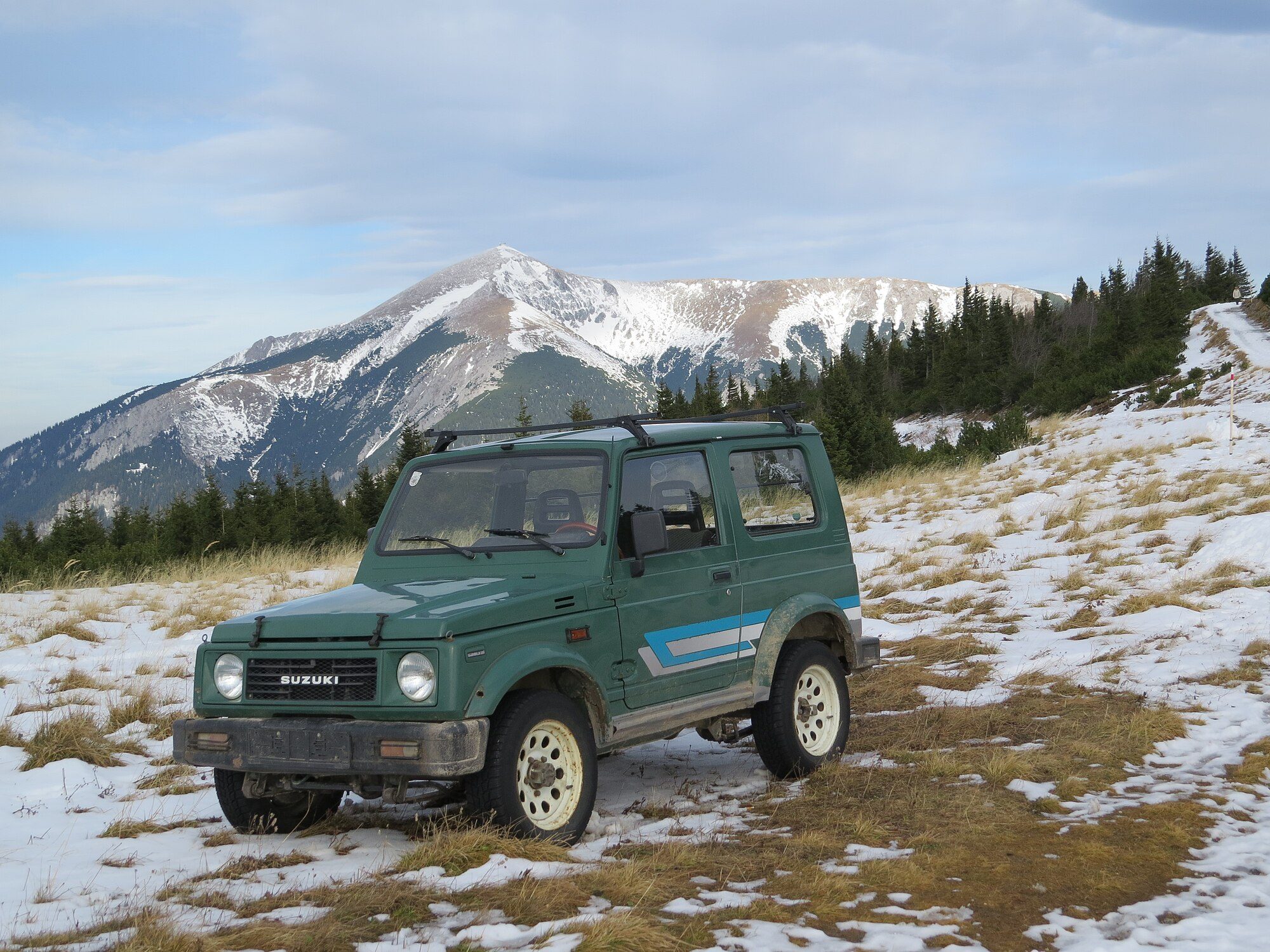
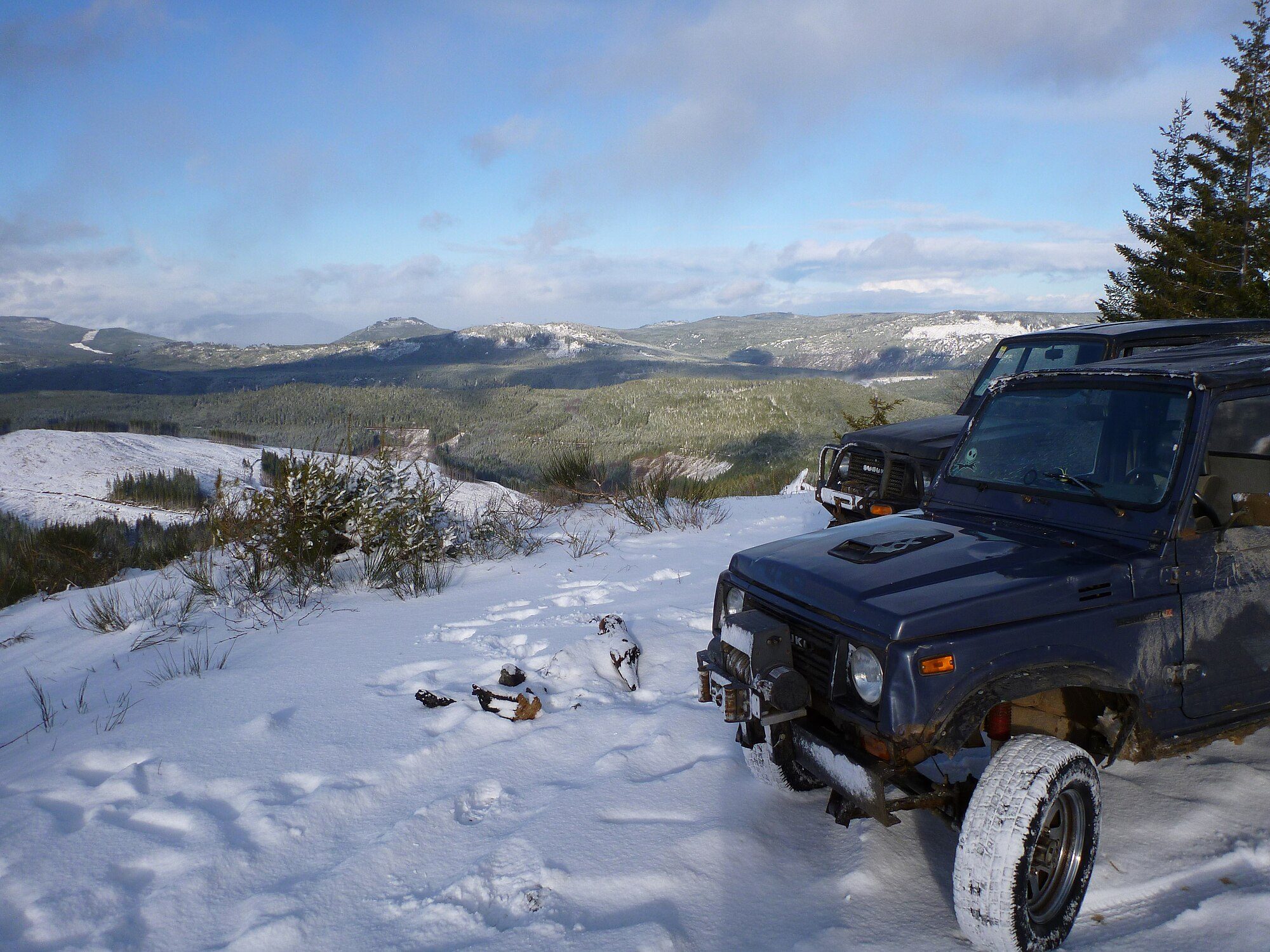
The second-generation Jimny arrived in 1981 as the export SJ410, a little 1.0-litre box on a ladder frame with leaf springs and solid axles at both ends. In November 1984 Suzuki added the 1.3-litre SJ413, and in late 1985 it brought that truck to the United States as the Samurai, the first four-wheeled vehicle Suzuki sold there. It cost about two-thirds as much as a new Jeep Wrangler and weighed roughly 2,100 lb. Americans bought 47,000 in the first year. Then Consumer Reports rolled one.
FROM SJ410 TO SAMURAI
The SJ410 replaced the LJ80 in 1981 and was sold as a soft top, a hardtop and a long-wheelbase pickup. Australia called it the Sierra, and Holden sold it as the Drover. The SJ413 that followed in 1984 brought the 1,324 cc G13A four, a five-speed gearbox, front disc brakes, an anti-roll bar and a new dashboard. In Japan it was the Jimny 1300 (JA51), at the time the biggest engine Suzuki sold.
The US Samurai launched in California in November 1985 as a 1986 model, already on the wider track that Suzuki later used for the Samurai worldwide. Suzuki's 1986 brochure lists 1,300 mm front and 1,310 mm rear, against about 1,210 mm on the narrow SJ. It quoted 64 hp, 74 lb-ft, 8.1 inches of ground clearance and 43/38-degree approach and departure angles. MotorTrend timed it at 16.9 seconds to 60 mph. Nobody bought one for the acceleration, and by mid-1988 Americans were buying 8,000 a month.
THE CONSUMER REPORTS AFFAIR
The July 1988 issue of Consumer Reports rated the Samurai 'Not Acceptable', the first time the magazine had used that rating, saying it tipped up in its short-course accident-avoidance maneuver. According to evidence Suzuki cited in court, the Samurai went through more than three dozen runs on CU's established course with no tip-up. CU then modified the course, and a test driver tipped it onto its outriggers. In June 1988 CU showed reporters video of the tip-ups and asked for a recall. NHTSA denied two 1988 petitions for a defect investigation, saying the evidence didn't show that a vehicle defect, rather than the driver or the environment, caused the rollovers.
The damage was done anyway. Reuters reported that Samurai sales fell about 70 percent. In 1996 Suzuki sued Consumers Union for $60 million over CU's renewed claim that the Samurai 'easily rolls over in turns'. A district judge threw the case out, and in 2003 the Ninth Circuit revived it. In July 2004 the two sides settled with no money paid. CU said it never meant that the Samurai easily rolls over in routine driving, but it stood by its tests, while Suzuki disputed them. NHTSA's Michigan crash data for 1986–90 put the Samurai's single-vehicle rollover rate (29 percent) next to the Wrangler's (28 percent) and below the CJ-7's (46–48 percent). It is still a short, narrow, tall truck, though, and MotorTrend's verdict is that it tips more readily in sudden swerves than most 4x4s.
THE ROCK-CRAWLING CULT
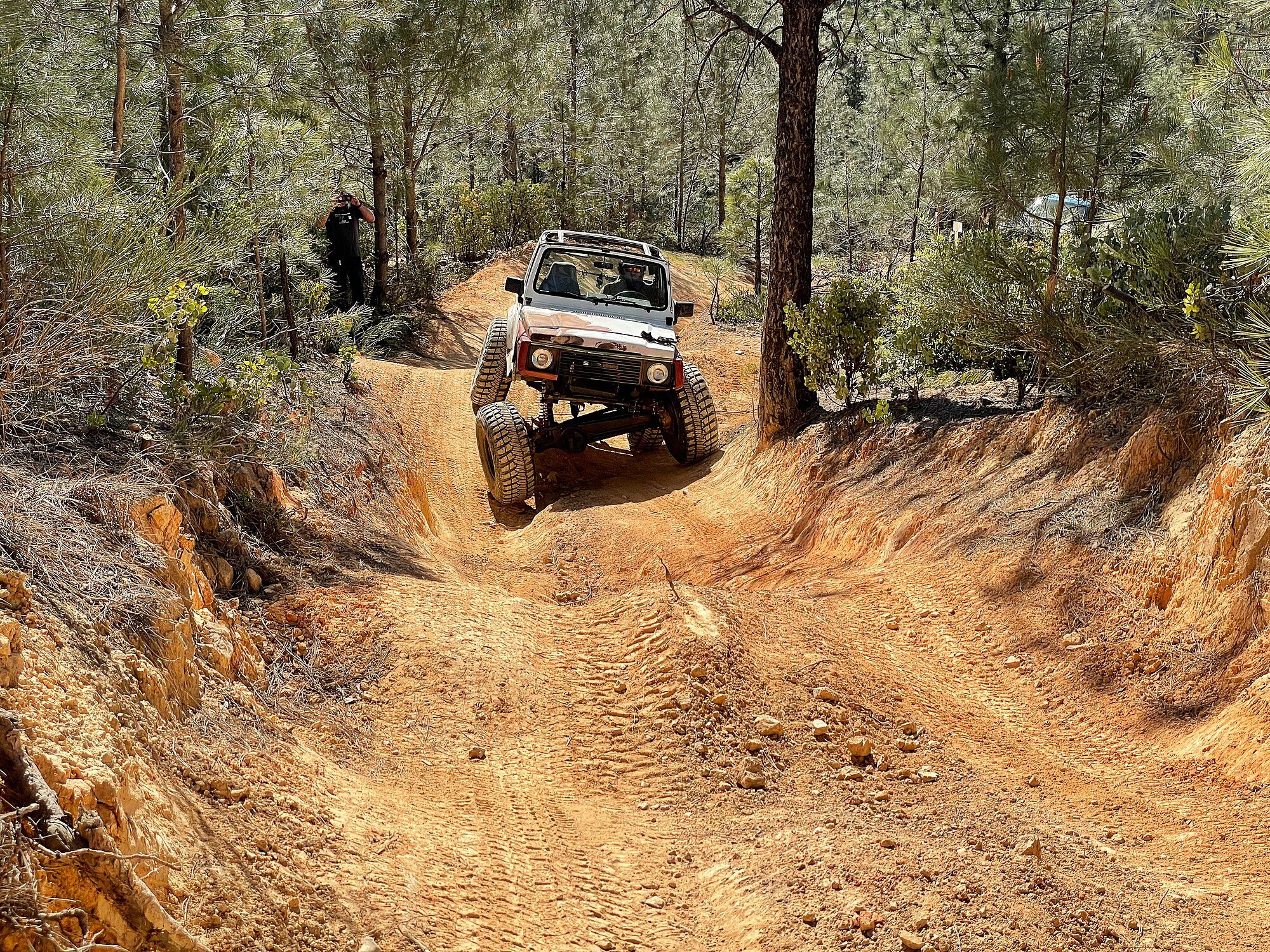
What sank the Samurai as a commuter made it a legend on the trail. It weighs little, it's narrow, and it has a real transfer case with low range. Lifted on a spring-over, it can be geared down with transfer-case gear sets as low as 6.4:1 and wedged into lines that big trucks can't fit. Trail Tough, a shop started by Samurai enthusiasts in the 1980s, still sells spring-over kits, Sumo gear sets, knuckle-over steering and 1.6- to 2.3-litre Suzuki engine conversions. In 2007 two Chileans drove a modified SJ413 to 6,688 m on Ojos del Salado, a Guinness-certified altitude record for a four-wheeled vehicle at the time.
The other big upgrade is an axle swap. Trail-Gear and Low Range Off-Road sell kits that put 1979–85 Toyota truck axles under a Samurai. On Zukiworld, one builder wrote in 2006 that the Toyota swap had 'become as common as a SPOA lift.' The Toyota axles are about 5 inches wider, take the same brake-line fittings and have a huge aftermarket, but Samurai steering won't fit them. Some builders prefer Dana 44s instead.
SANTANA, GYPSY AND HOW IT ENDED
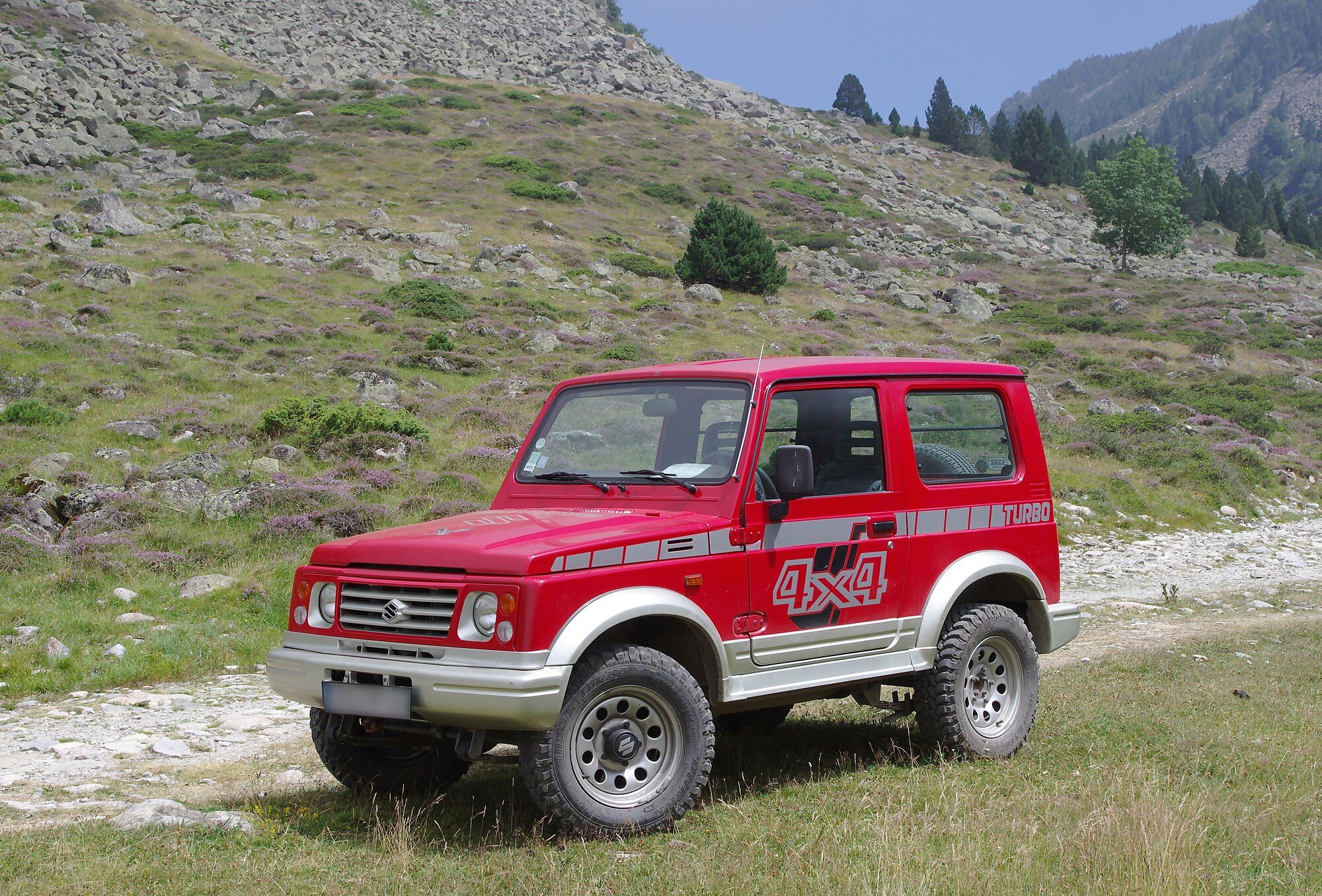
Spain's Santana built SJs in Linares from 1985, and because they were more than 60 percent local content they got around Europe's quotas on Japanese imports. Santana built Samurais with Peugeot and later Renault diesels until about 2003–04. In India, Maruti launched the long-wheelbase Gypsy in December 1985. In 1993 it got the 90 mm wider track and became the MG410W, then became the 1.3-litre Gypsy King in 1996. It stayed in production until 2018, a staple of the Indian Army and police.
In the US the Samurai lost its rear seat for 1994 and 1995, because adding the required rear shoulder belts would have meant re-engineering it. It was gone after 1995, replaced in spirit by the Sidekick. Japan got a coil-sprung version (JB32) in 1995, and the line ended there in 1998, when the JB23 Jimny took over.
SIDEBAR · 6,688 METRES
The Samurai that topped the Jeep
On April 21, 2007, Chileans Gonzalo Bravo and Eduardo Canales drove a modified 1986 SJ413 Samurai to 6,688 m (21,942 ft) on Ojos del Salado. That beat the record for the highest altitude reached by a four-wheeled vehicle, set by a team in a Jeep Wrangler. It was their third attempt, after bad weather and then an engine fire, and the truck ran a supercharged Suzuki G16A engine.
The Jeep team had left a sign at the top: 'Jeep Parking Only: All others don't make it up here anyway.' The Chileans brought it home. Guinness certified the record that July, and a Unimog later beat it.