The story
By 1969 Ford had the Bronco, International had the Scout and Jeep had the CJ-5, and General Motors had nothing in the small, go-anywhere class. Chevrolet's answer was not small at all. The K5 Blazer took the half-ton K10 4x4 pickup, cut the wheelbase from 115 to 104 inches, and gave it a removable top. Wikipedia credits that pickup basis with three advantages over the rivals: more cargo room, a better on-road ride from the wider track and longer wheelbase, and lower cost, because most of the parts were already on a production line.
A PICKUP WITH THE BACK CUT OFF
MotorTrend's history of the K5 puts it bluntly: Ford had the Bronco, Jeep had the CJ, even a tractor company had the Scout, and GM had nothing. Basing the Blazer on the short-box K10 let Chevrolet reach the market quickly and with more capability than the competition. The base truck was spartan to the point of comedy. MotorTrend notes that early base Blazers came without a roof or a passenger seat, so the driver had the only seat in the house.
Underneath it was all 1969 Chevy truck: a ladder frame, tapered leaf springs at both ends, a Dana 44 front axle and a GM 12-bolt rear. Chevrolet's 1969 spec sheet lists 8 inches of ground clearance, a 35-degree approach angle, a 25-degree departure angle, a 23.5-gallon tank and a 5,000 lb maximum GVW. Engines matched the pickups: the 250 six as standard, a 307 V8, and the 350 V8, which came only with the four-speed SM465 or the Turbo Hydra-Matic 350.
THE TOP COMES OFF
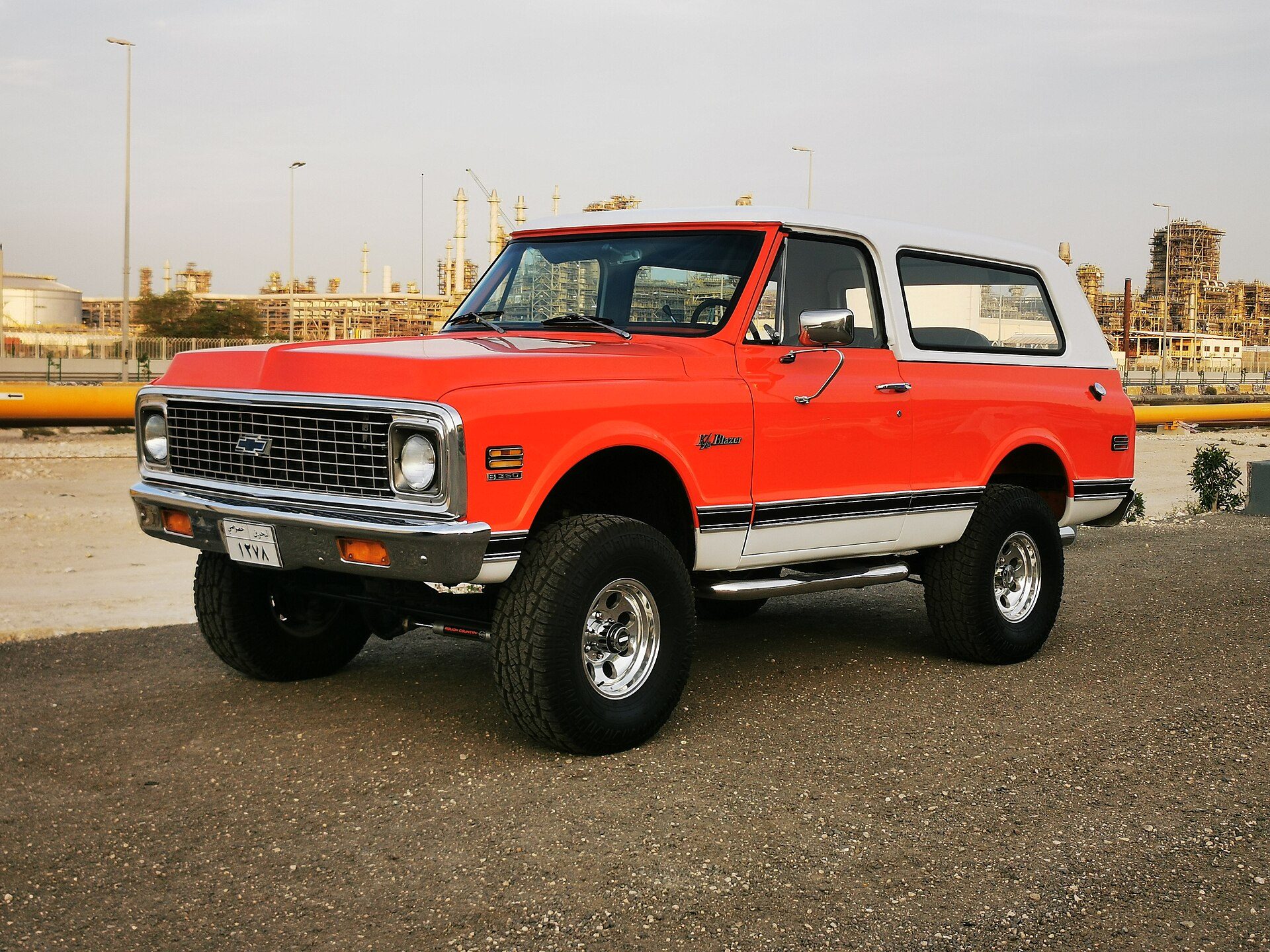
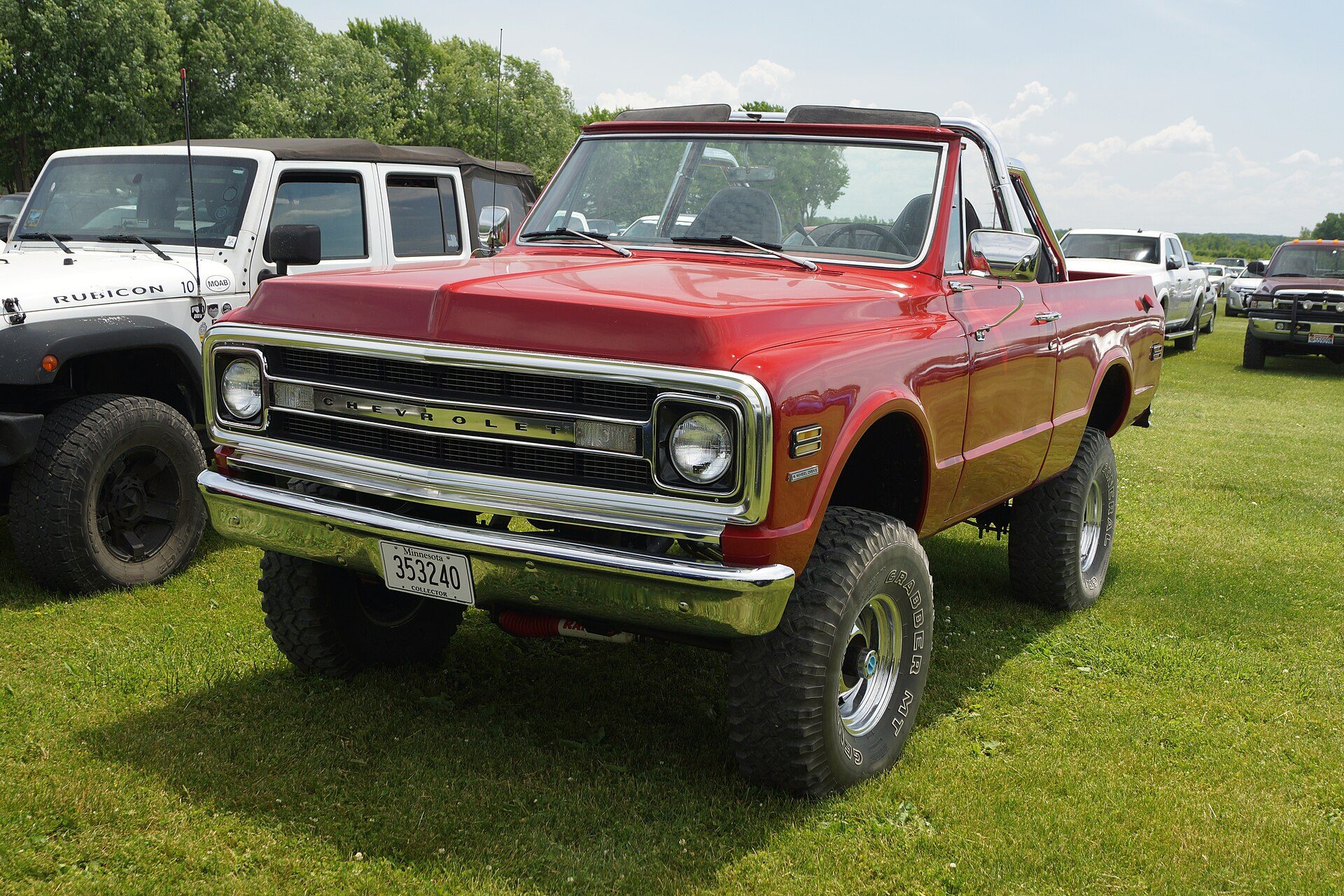
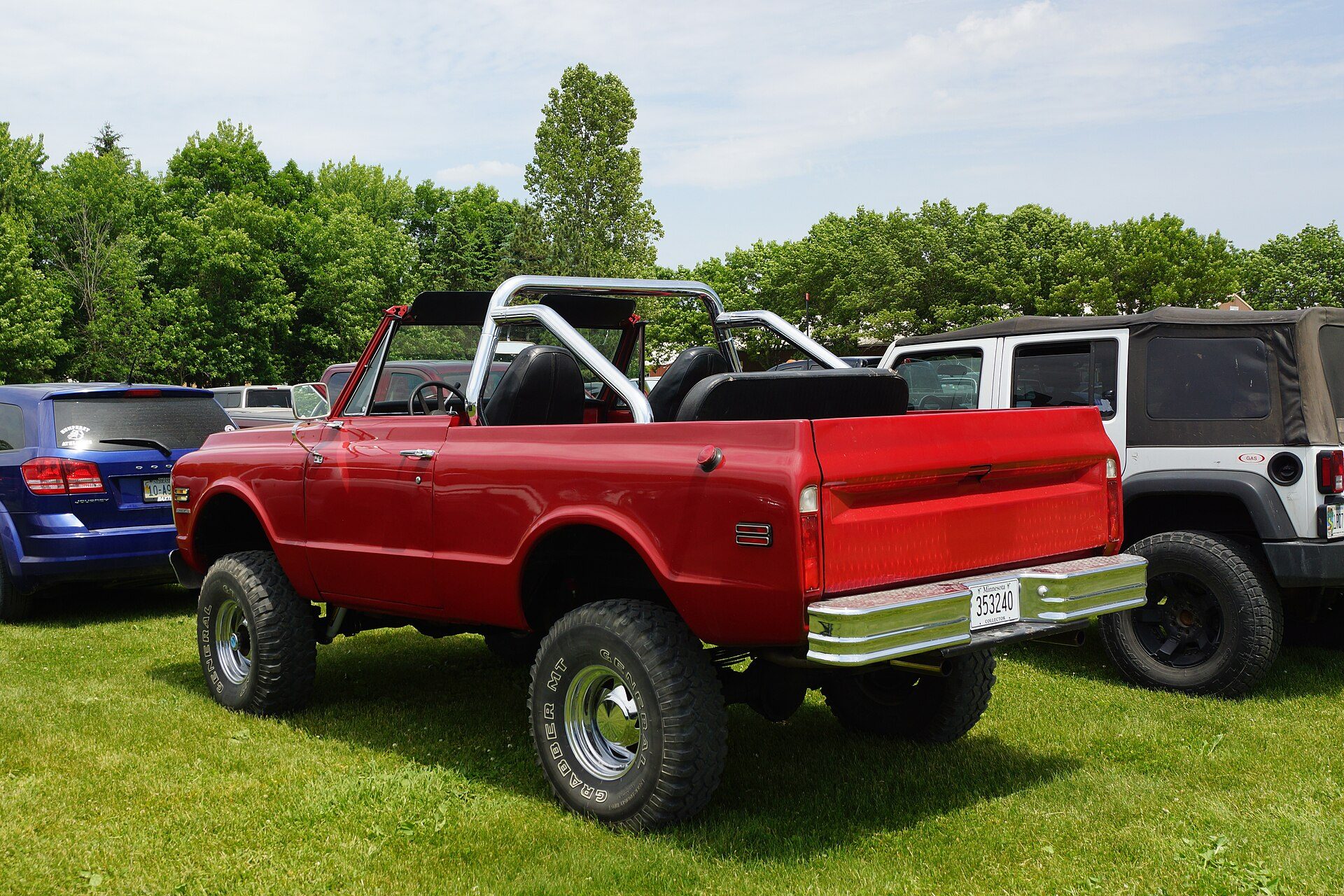
The first-generation Blazer is the only K5 whose whole roof comes off. MotorTrend describes a completely removable hardtop that left only the windshield sticking up. Chevrolet's 1971 brochure describes the auxiliary top as reinforced fiberglass with textured paint in black or white, with side rear windows and a lift tailgate, and says it 'bolts on' and 'lifts off quickly.' A canvas soft top on steel framing was a dealer-installed accessory. Chevrolet claimed it went up or down in under two minutes.
The 1973–75 Blazers on the new square-body chassis kept a fully removable top. From 1976 a fixed steel roof covered the front seats and only the rear section came off. If you want to drive with nothing above you but sky and the windshield header, the 1969–72 trucks are where the K5 story begins. They're also the shortest K5s, at 177.5 to 180 inches against 184.8 for the 1973 truck, which helps on tight trails.
THE 1971–72 TRUCKS
The changes came fast. For 1970 Chevrolet added a two-wheel-drive Blazer with coil-spring independent front suspension, and GMC got its own version, the Jimmy. For 1971, power front disc brakes became standard across GM's light trucks, replacing four-wheel drums. The 1971 truck also got an egg-crate grille and grew to 180 inches long. That year's brochure pushed the CST package: bucket seats, a console, chrome bumpers, extra insulation and deep-twist carpet.
For 1972 the 292 six disappeared from the option list, and the 350 was rated at 175 net horsepower. Then sales took off. CK5's model-year figures show production going from 4,935 in 1969 to 44,266 in 1972, matching MotorTrend's claim that sales grew roughly tenfold over the first generation. In April 1970 Car and Driver wrote, and Chevrolet happily quoted in its 1971 brochure, that someone had finally discarded the idea that four-wheel-drive vehicles could only be operated by ex-tank commanders and veteran truck drivers.
WHY IT MATTERS
Wikipedia says the Blazer had overtaken its rivals by 1970. Dodge answered with the Ramcharger and Jeep with the SJ Cherokee for 1974, and in 1978 Ford moved the Bronco onto a shortened F-100 platform specifically to fight the K5. The truck-based SUV recipe that the later K5, the Tahoe and nearly every full-size SUV since have followed starts with these four model years.
Today the early Blazer and Jimmy are serious collector trucks. Recent Bring a Trailer results for original-spec examples run from the mid-$20,000s to $100,000, with resto-mods higher still. Parts are easy because so much is shared with 1967–72 Chevy and GMC pickups, and reproduction sheet metal and seals are plentiful. Rust and tired frames are where the money goes, so buy the best body you can afford and fix the drivetrain later.
SIDEBAR · THE GMC VERSION
GMC Jimmy: same truck, different badge
GMC got the truck for the 1970 model year and called it the Jimmy, a long-standing nickname for GMC itself. MotorTrend says the two were essentially identical apart from a few styling tweaks.
GMC's 1971 brochure lists four series: CE-1550 and CS-1550 for two-wheel drive, and KE-1550 and KS-1550 for 4x4. The 4x4s were rated at 4,600–5,000 lb GVW and used the same engines as the Chevrolet: the 250 six and the 307 and 350 V8s. Tires ran from E78-15B as standard up to 10-16.5 on the 4x4s. On Bring a Trailer the Jimmy is the cheaper way into a first-gen truck. Original Jimmys have sold for about $24,000–72,000 since 2025.