The story
The Unimog 404, sold as the Unimog S, is the most-built Unimog there has ever been: 64,242 of them left the Gaggenau plant between 1955 and 1980. It was also the odd one out. Earlier Unimogs were all-purpose machines for farmers, and the 404 was conceived as a small, very capable off-road truck, mainly for armies. Its price list didn't even offer the three-point hitch, rear PTO or hydraulics that made other Unimogs universal tools. What it had was a downswept frame, portal axles and a 2.2-liter petrol six, and that turned out to be plenty.
A TRUCK THE FRENCH ARMY ORDERED
French forces stationed in south-west Germany already ran about 450 early Unimogs when, in 1952, French officers watched test drives on the Sauberg proving ground near Gaggenau and started asking questions. Their wish list became a specification: something like the Unimog 2010, but wider and longer, good for 80 to 90 km/h, carrying 1.5 to 2 tonnes or ten to twelve soldiers, and running on petrol because France was a NATO member. Daimler-Benz chose the M 180 six from its passenger cars. The first prototype, the MU 80/0, ran in summer 1953 with a flat ladder frame and a boxy cab that looked nothing like the production truck.
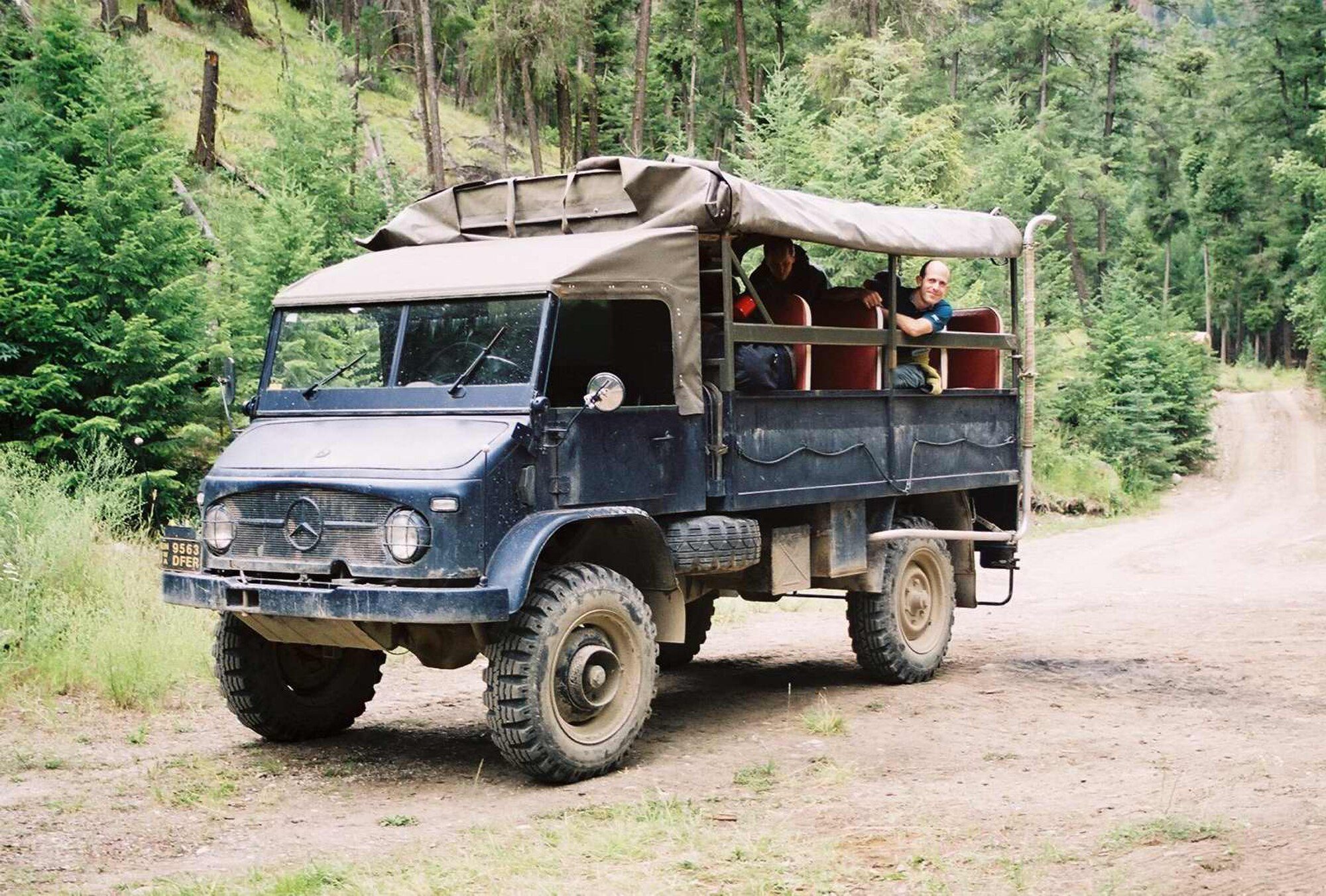
The French then objected to the spare wheel taking up space on the bed where soldiers should sit. To hang it underneath, the engineers designed a downswept frame for the third prototype in mid-1954. It also let the chassis twist more, which improved the truck off-road, and the cranked frame became a defining feature of later Unimogs. Production began in May 1955 with an initial series on a 2,670 mm wheelbase, and the first 1,100 pre-series and initial-series trucks went to the French army. The main series, on a 2,900 mm wheelbase, started in January 1956.
THE BUNDESWEHR'S MULE
When the new West German army went shopping for a 1.5-tonne cross-country truck, it put out a tender for 25,000 vehicles. Borgward and Hanomag bid too, but the Unimog 404 S won, according to German Wikipedia, even though at about 18,000 Deutschmarks it was the most expensive. The Bundeswehr eventually bought 36,638 of them as flatbeds, driving-school double cabs, radio and ambulance box bodies, dry-powder fire trucks and training-tank chassis. Fire brigades bought it too, some with four-door crew cabs, and Eurotransport says it was officially delivered to more than 100 countries.
Underneath, the 404 is pure Unimog: torque-tube-located portal axles with reduction gears at each wheel, coil springs and shocks at both ends, four equal-size wheels and hydraulic ATE drum brakes. It drives the rear wheels, with front drive and diff locks engaged by lever. The fully synchronized six-speed gearbox has two reverse gears, and its first gear is a 14.93:1 crawler. The result, per the 1966 operator's handbook, is 400 mm of ground clearance and a 70% climb in first, though sixth gear tops out at 95 km/h. Owners mention the noise a lot.
THE 406 CAB AND THE 2.8
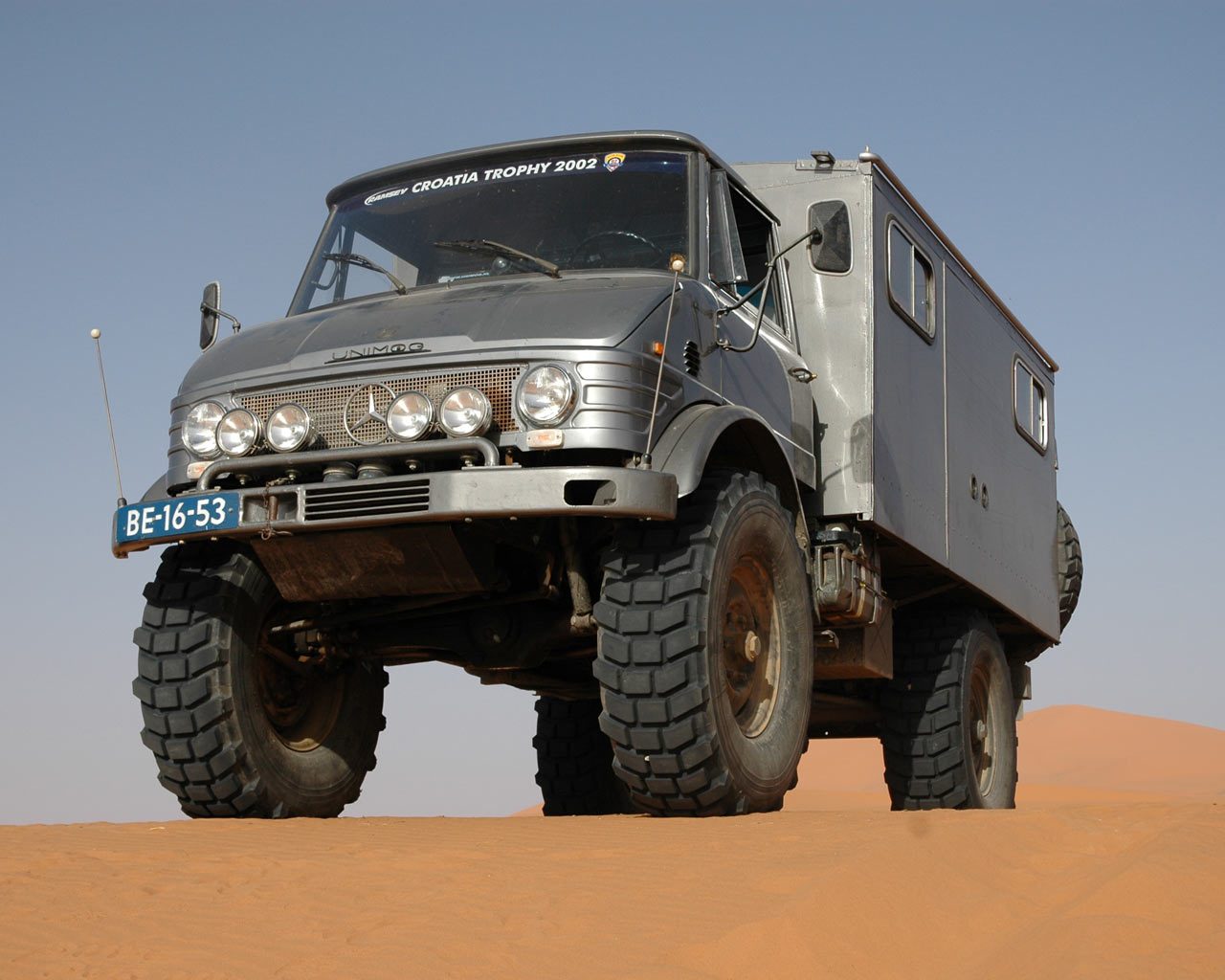
The diesel Unimog 406 arrived in 1963 and demand for the petrol 404 fell away; Eurotransport says buyers preferred the diesels' fuel economy. German Wikipedia says output dropped from 6,605 trucks in 1962 to 795 in 1971. That year Daimler-Benz launched the 404.0, sold as the U110: it wore the 406's cab with a one-piece windshield, and from the 404.012 it had the 2.8-liter M 130 six from Mercedes' S-Class and SL, good for 110 PS. A folding-top version with the 416's cab followed in 1972. Only 1,791 404.0s were built, so nearly every 404 you'll meet is a split-windshield 404.1 with the 2.2.
HOW IT ENDED
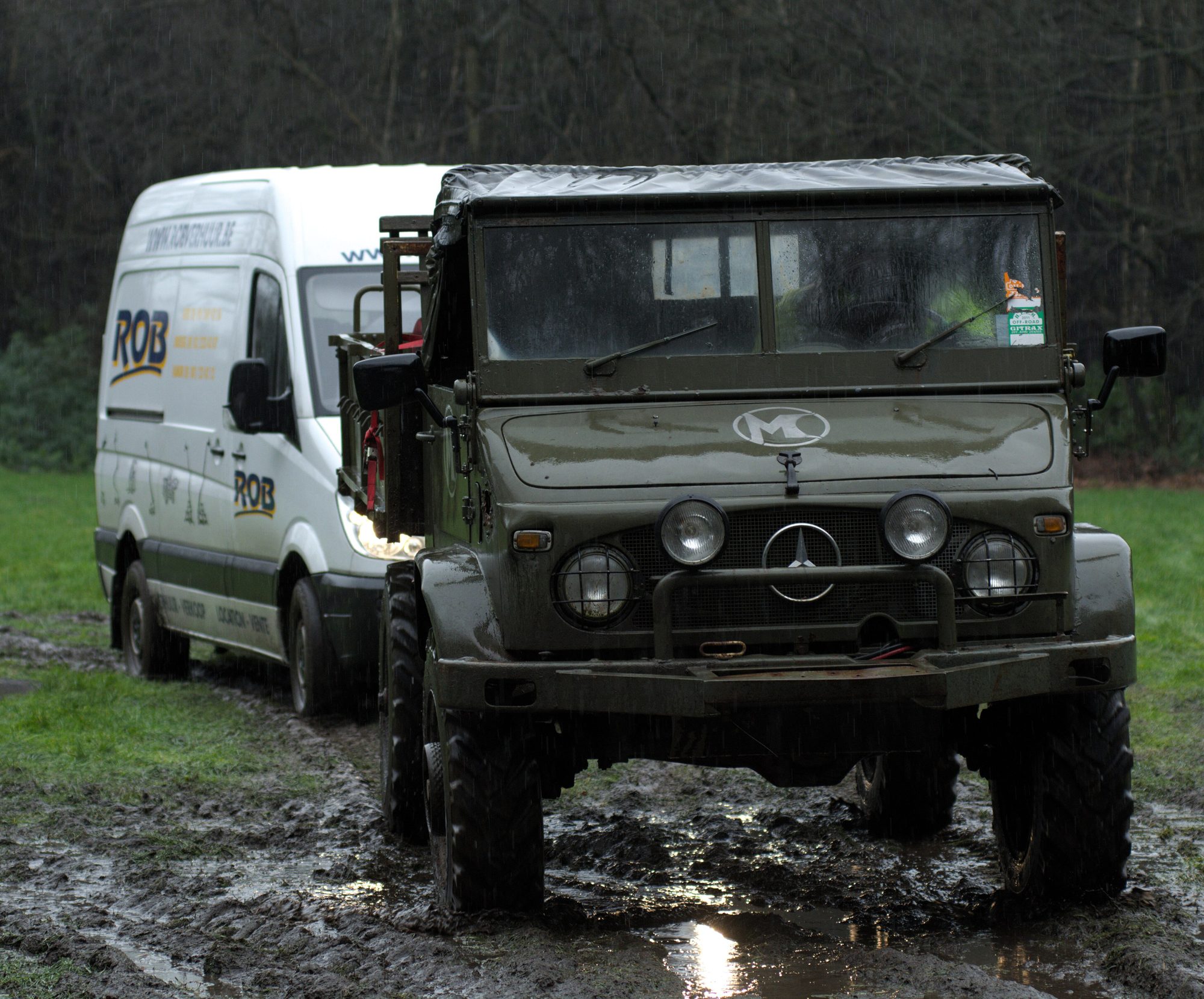
From October 1975 the U 1300 L gave the 404 competition from inside the company, and it eventually replaced the 404 in the Bundeswehr. The army began retiring its flatbeds around 1976 and its box-body trucks by the early 2000s. Production of the 404 ended in 1980. That's what put so many on the surplus market: ex-Swiss, Belgian and French army trucks now turn up all over the US, often still in drab green with canvas tops and kilometer odometers.
Its legacy is everywhere in the Unimog range. The downswept frame stayed, and Mercedes later went back to the 404's idea of a dedicated cross-country truck with the 437 series. The portal axle that gives a 404 its daylight under the diffs later turned up on the G 500 4×4². Meanwhile, 404 owners have kept their trucks alive with mailing lists, forum threads and specialist suppliers who still stock seals, wheel cylinders and carburetor kits for a truck that was designed in 1953.
SIDEBAR · THE DIESEL QUESTION
81 factory diesels, and everyone else's
Almost every 404 has the petrol M 180. The exception is the 404.117: 81 trucks built in 1969–70 for the Portuguese market with the OM 615 four-cylinder diesel, rated at 44 kW. If someone offers you a "factory diesel 404," check the type number before you believe it.
Owners have fitted all sorts of engines since. Expedition Imports calls the M 180 to M 130 swap doable but 'not a "plug and play" conversion', and one mechanic warned that a hard-shifting gearbox won't last long with the extra power. At the far end, a 1963 404 with an OM617 turbodiesel five-cylinder, 39.5-inch tires and a crane sold on Bring a Trailer for $35,000 in 2025.
 YT