Suzuki Samurai vs Jimny (JB74)
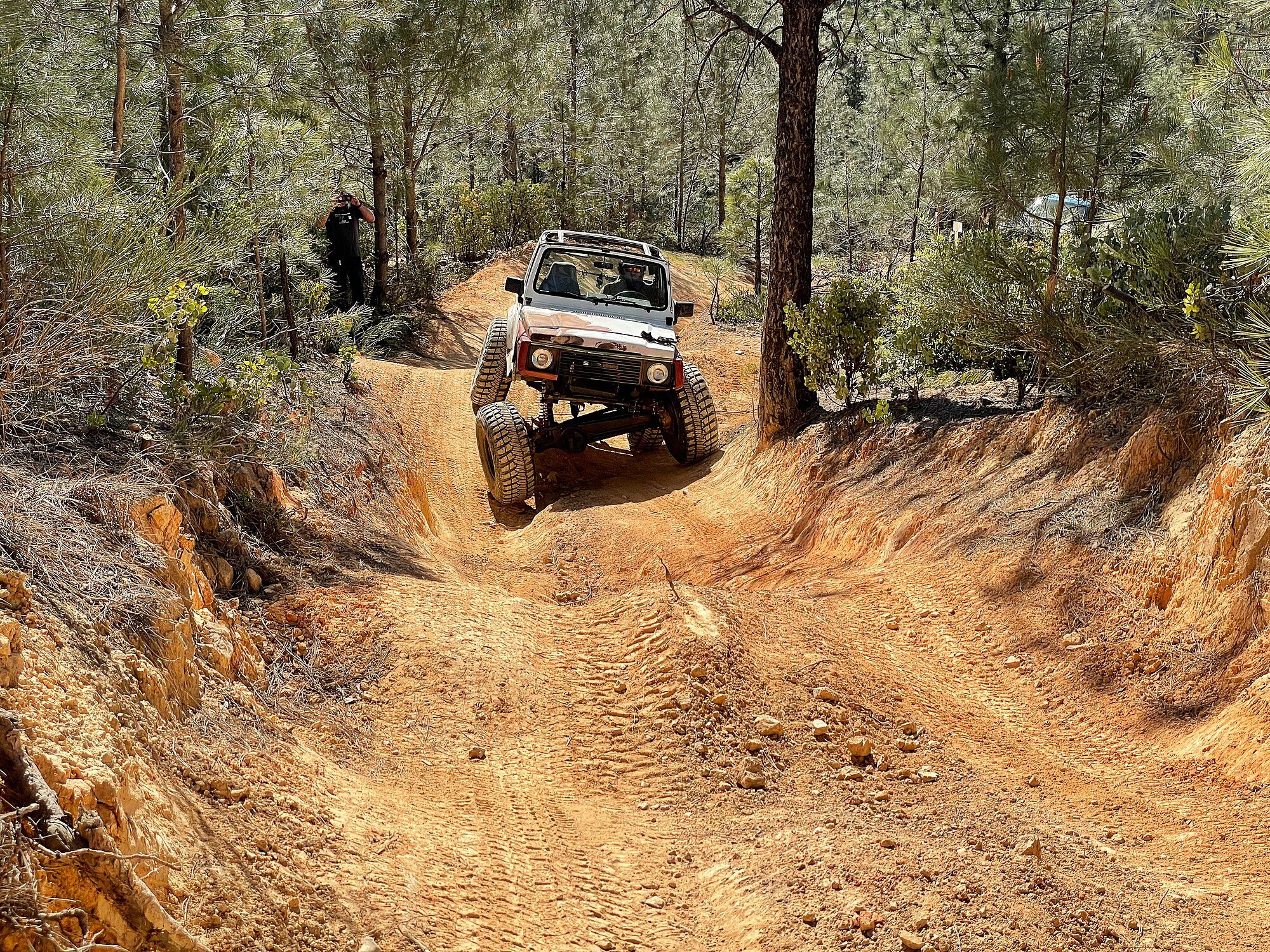
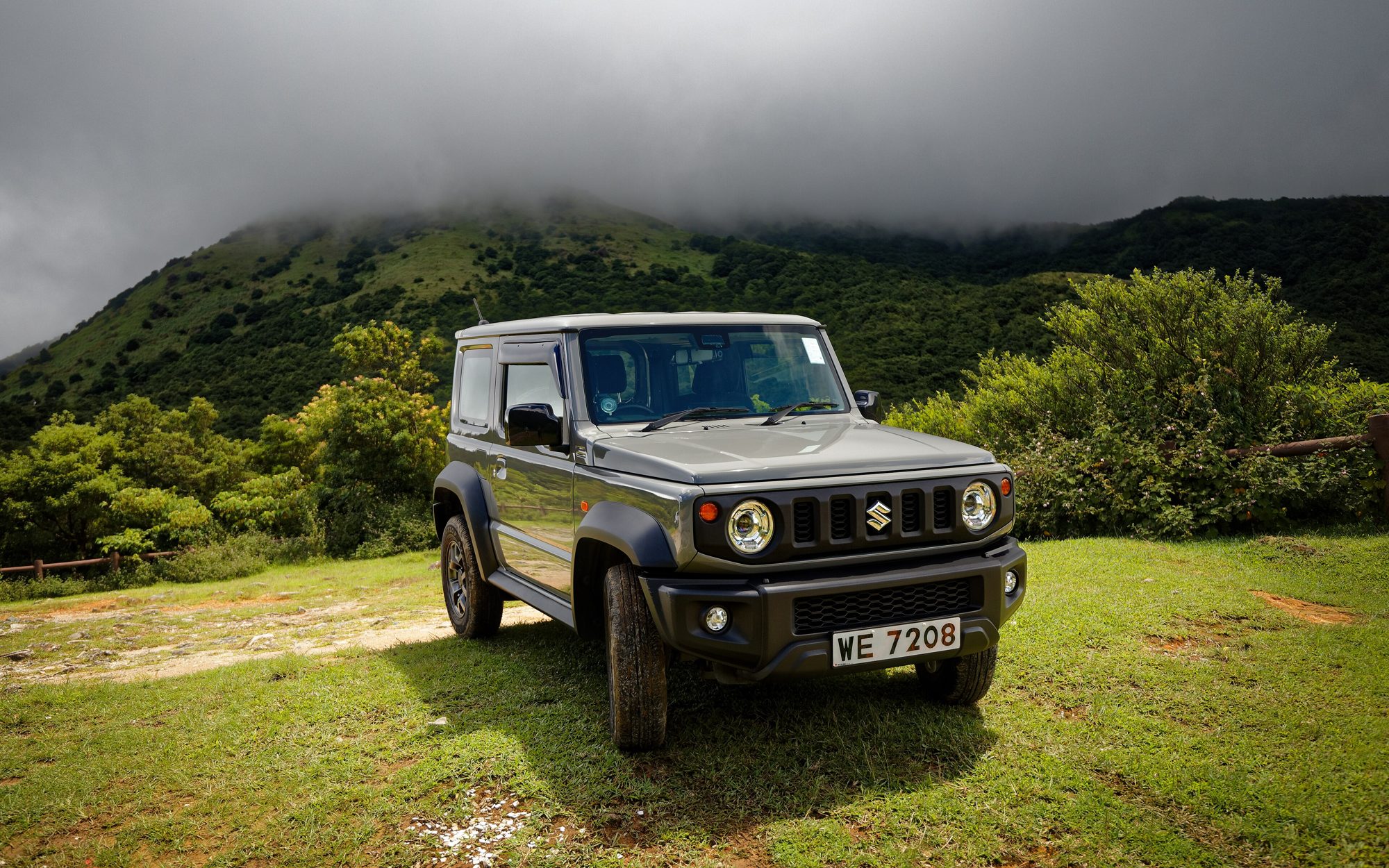
In the US the Samurai wins by default, because the JB74 was never sold here and can't be legally imported until each truck turns 25, starting in mid-2043. Everywhere else the JB74 is the better daily and the safer bet, but the Samurai is lighter, has a lower low range and has a far deeper crawler aftermarket.
The short answer
you live in the US, want a cheap, light, endlessly modifiable leaf-sprung crawler and can live with 64 hp and 1980s safety
you live where it's sold and want a new, warrantied little 4x4 with coil springs, airbags, an automatic option and about 100 hp
Side by side
| SUZUKI SJ / SAMURAI | SUZUKI JIMNY JB74 / JB64 | |
|---|---|---|
| Years (US) | 1986–95 (on sale late 1985) | Never sold; earliest trucks import-eligible mid-2043 |
| Engine | 1.3 G13A SOHC I4, 64 hp / 74 lb-ft (carbureted '86–89); throttle-body injection '90–95 | 1.5 K15B DOHC VVT I4, 75 kW (102 PS) / 130 Nm (96 lb-ft) |
| Transmission | 5-spd manual | 5-spd manual or 4-spd auto |
| 4WD | Part-time, 2-speed, 2.268 low, no center diff | Part-time ALLGRIP PRO, 2.002 low (manual), no center diff |
| Suspension | Solid axles on leaf springs | Solid axles on coils, 3-link |
| Traction aids | None stock; Spartan, ARB and spools aftermarket | Brake-LSD traction control; open diffs, ARB Air Lockers aftermarket |
| Wheelbase | 79.9 in (2,030 mm) | 88.6 in (2,250 mm); 5-door 2,590 mm |
| Curb weight | 2,094–2,127 lb | 1,095–1,110 kg (≈2,414–2,447 lb) |
| Ground clearance | 8.1 in (205 mm) | 8.3 in (210 mm) |
| Approach / departure | 43° / 38° | 36° / 47° (27° breakover) |
| Towing | — | 1,300 kg (2,866 lb) braked, Australia |
| Fuel economy | 27 city / 29 hwy (1986 EPA estimate) | 6.4 L/100 km combined, manual (Australian test) |
| Wheel bolt pattern | 5 x 139.7 (5 x 5.5 in) | 5 x 139.7 (5 x 5.5 in) |
| Biggest tire, no lift | 215/75R15 | 215/75R15 |
| Typical prices now | $5k–9k project; $8k–17k driver; $20k–25k best (US) | A$36,490–42,490 new, drive-away (Australia, 3-door) |
| Best years | No consensus; condition and build quality first | Any, with recall work done; manual preferred |
The American problem
Before anything else: if you're in the US, you can't legally buy a JB74 here. Suzuki never certified it for US safety or emissions rules, and it hasn't sold cars in America since 2012. The only way in for a foreign-market car this new is NHTSA's 25-year exemption, which counts from the date of manufacture. JB74 production began on 29 May 2018, so the first trucks qualify in mid-2043, 2023-on five-doors from 2048, and every truck only on its own 25th birthday.
People have tried sooner. In September 2022 CBP seized a 2022 Jimny that a US citizen had bought in Mexico and taken to Puerto Rico, because DOT ruled it 'less than 25 years old from the date of manufacture.' CBP said such vehicles must be brought into compliance, exported or destroyed. So a US 'Samurai vs Jimny' decision is really Samurai vs a 25-year-old JB23, or Samurai vs waiting.
Off-road
Both are ladder-frame trucks with solid axles at each end, a real low range and no center diff, which is why both embarrass much bigger 4x4s. The Samurai is the lighter, shorter and more crawl-friendly of the two: about 2,100 lb on a 79.9-inch wheelbase, a 43-degree approach angle and a 2.268 low range. The JB74 weighs roughly 300 lb more, sits on a longer 2,250 mm wheelbase and has a taller 2.002 low range in manual trucks, which Unsealed 4X4 calls 'geared way too high for anywhere near sizeable tyres.' It does have 5 mm more ground clearance and a much better 47-degree departure angle.
Stock, the JB74's coil-sprung axles and brake-LSD traction control make it the easier truck to drive off-road, though Unsealed found it waiting for the traction control to kick in on steep climbs, and Suzuki fitted no lockers. A built Samurai is another animal: spring-over lifts, Sumo transfer-case gears down to 6.4:1, Toyota axle swaps and lockers turn it into a proper rock crawler. In 2007 a modified SJ413 set a then-record of 6,688 m on Ojos del Salado.
On-road and daily use
No contest. The K15B makes about 100 hp against the Samurai's 64, the JB74 rides on coils instead of leaves, and it can be had with an automatic, though the old four-speed auto is widely panned and Unsealed says the manual feels like it has an extra 30 kW. The Samurai took 16.9 seconds to reach 60 mph in MotorTrend's test. Neither is quick, and both carry a 40-litre (10.6-gallon) tank.
Safety is a generational gap. Euro NCAP gave the 2018 JB74 three stars, and current Australian cars have six airbags and AEB. The Samurai is a 1980s truck, best known for Consumer Reports' 1988 'Not Acceptable' rating. NHTSA declined to open a defect investigation, and CU later said it never meant the Samurai rolls over easily in routine driving. It's still short, narrow and tall, so drive it like one.
Reliability and what breaks
The Samurai's list is familiar to every owner: front knuckles weeping gear oil, cracked transfer-case mounts and frame hangers (worse with low transfer-case gears), worn transfer-case shift sheets, oil leaks at the distributor, fussy carburetors on 1986–89 trucks and failing ECMs on injected ones. The G13A has a timing belt, but it's a non-interference engine, so a snapped belt strands you without bending valves.
The JB74 is young, but it has three EU recalls: two for fuel pumps that could stall the engine (cars built May 2018 to September 2019) and one for door wiring that could stop the side and curtain airbags deploying (built to December 2020). BigJimny expects the third generation's kingpin-related steering wobble at 45–50 mph to show up on the similar JB74 axles. It also says every Jimny generation has poor factory rust protection, so check the chassis welds and mounts on both trucks.
Modifying and parts
Both trucks use a 5 x 139.7 mm bolt pattern, and owners of both settle on 215/75R15 as the biggest tire that fits without a lift. After that they part ways. The Samurai has a deep US aftermarket in Trail Tough, Low Range Off-Road and Trail-Gear: a 2-inch Old Man Emu kit for 29s, a spring-over for 31s, lockers, crawler gears, 1.6-liter engine conversions and Toyota axles. Trail Tough's advice is to regear the axles as well as the transfer case so you don't overload the case mounts.
JB74 parts are mostly Australian and Japanese: Old Man Emu, Ironman and EFS lifts of 40–50 mm with caster correction, ARB Air Lockers, and GVM upgrades that Ironman says take payload from about 340 kg to 690 kg. Anything bigger than 215/75R15 really wants lower gearing, and BigJimny owners warn that skipping it burns clutches and cooks automatic fluid. Japan's DAMD will even sell you a 'little G.' kit that makes it look like a tiny G-Class.
Buying one now
Samurais have gone from throwaway to collectible. Twenty-two Bring a Trailer sales from September 2025 to October 2026 ran from $5,500 to $25,000, with a median of about $9,400; a 7,000-mile 1987 brought $24,000. Most have been modified, so buy on the quality of the build, the condition of the frame and transfer-case mounts, and whether 4WD and low range both engage. An automatic is always a swap.
A JB74 is a new car wherever it's sold, often with a wait. In October 2026 Suzuki Australia listed the 3-door at A$36,490–42,490 drive-away and the 5-door XL from A$40,490. If you're buying used abroad, have a dealer confirm the recalls were done, and choose the manual. In the US, don't buy one with 'paperwork in progress.'
Questions, answered
Can I import a JB74 Jimny into the US?
Not legally until it's 25 years old, counted from its date of manufacture. Production began on 29 May 2018, so the earliest trucks become eligible in mid-2043 and 2023-on five-doors from 2048. CBP seized a 2022 Jimny brought in from Mexico in 2022 and ordered it brought into compliance, exported or destroyed.
Is the Samurai or the Jimny better off-road?
Stock, the JB74 is easier thanks to coil springs, more power and brake-LSD traction control, and it has more clearance and a better departure angle. The Samurai is lighter, has a better approach angle and a lower low range, and its aftermarket for spring-overs, crawler gears, lockers and axle swaps is far deeper, so a built Samurai is the more serious crawler.
Will Samurai wheels fit a JB74?
Both use a 5 x 139.7 mm (5 x 5.5 in) bolt pattern. That doesn't guarantee fitment: check offset and center bore (108.1 mm on the JB74) before you bolt anything on.
What's the biggest tire for each without a lift?
215/75R15 for both. Zukiworld owners say it fits a stock Samurai and 225s fit with a little effort; BigJimny's consensus is the same size for a JB74 on stock rims. With about 2 inches of lift, both take 235/75R15s with some trimming.
Which is more reliable?
The JB74 is a modern car with a chain-driven engine and a warranty, but check its fuel-pump and door-harness airbag recalls. A Samurai's reliability depends on its last 35 years: knuckle seals, transfer-case mounts, shift sheets and carburetors or ECMs are the usual jobs, and parts are cheap and plentiful in the US.
Isn't the JB23 the one to compare in the US?
For Americans it's the practical alternative. The coil-sprung JB23 was built from 1998, so the earliest trucks are now 25-year eligible to import, unlike the JB74.
The full guides
- Wikipedia — Suzuki Jimny
- Wikipedia — Suzuki G engine
- Wikipedia — Suzuki K engine (K15B)
- Wikipedia — Suzuki (US car sales end, 2012)
- MotorTrend — The Suzuki Samurai: History, Generations, Models (Aaron Gold)
- Suzuki — 1986 US Samurai brochure (auto-brochures.com scan)
- Consumers Union — Suzuki and Consumers Union agree to settle lawsuit (joint statement, July 8, 2004)
- Federal Register 64 FR 27344 (May 19, 1999) — NHTSA denial of defect petition DP97-006, history of rollover petitions incl. DP88-011 and DP88-019
- Zukiworld forum — How tall can you go on tires with stock suspension (87 Zuk)
- Zukiworld forum — Samurai larger tires but no lift
- Trail Tough — Question: transfer case gears or axle gears?
- Trail Tough — Transfer case / frame mount repair kit
- Trail Tough — Old Man Emu Samurai and SJ410 lift
- Trail Tough — SPOA suspension system, deluxe
- Trail Tough — Spartan automatic locker
- Trail-Gear / Low Range Off-Road — Toyota leaf spring swap kit for Suzuki Samurai (front)
- Bring a Trailer — Suzuki Samurai auction results
- Bring a Trailer — 7k-mile 1987 Suzuki Samurai 5-speed
- Global Suzuki — Suzuki launches the all-new Jimny 4WD vehicles in Japan (5 July 2018)
- Suzuki Australia — Jimny specifications
- Suzuki Australia — Jimny range and drive-away pricing
- Unsealed 4X4 — 2024 Suzuki Jimny XL 5-door first drive
- Unsealed 4X4 — Ironman 4X4 Jimny GVM upgrade
- Unsealed 4X4 — Suzuki Jimny suspension buyer's guide
- U.S. CBP — CBP seizes vehicle smuggled from Mexico into Puerto Rico (29 Sep 2022)
- Cornell LII — 49 CFR 591.5
- Euro NCAP — Suzuki Jimny 2018
- Car-Recalls.eu — Suzuki Jimny 2018 fuel pump recall
- Car-Recalls.eu — Suzuki Jimny 2018–2019 fuel pump failure recall
- Car-Recalls.eu — Suzuki Jimny 2018 door harness / airbag recall
- TireWheelGuide — 2020 Suzuki Jimny tire and wheel sizes
- BigJimny Wiki — Common problems overview
- BigJimny Wiki — Transmission gearing ratios
- BigJimny Forum — Re: New gen Jimny tyre size
- BigJimny Forum — 31in tyres, 2in lift, standard bumpers?
- ARB — Air Lockers, Suzuki Jimny 2019–present
- DAMD — Jimny Sierra little G. ADVANCE / TRADITIONAL