Jeep Cherokee XJ vs Wrangler TJ
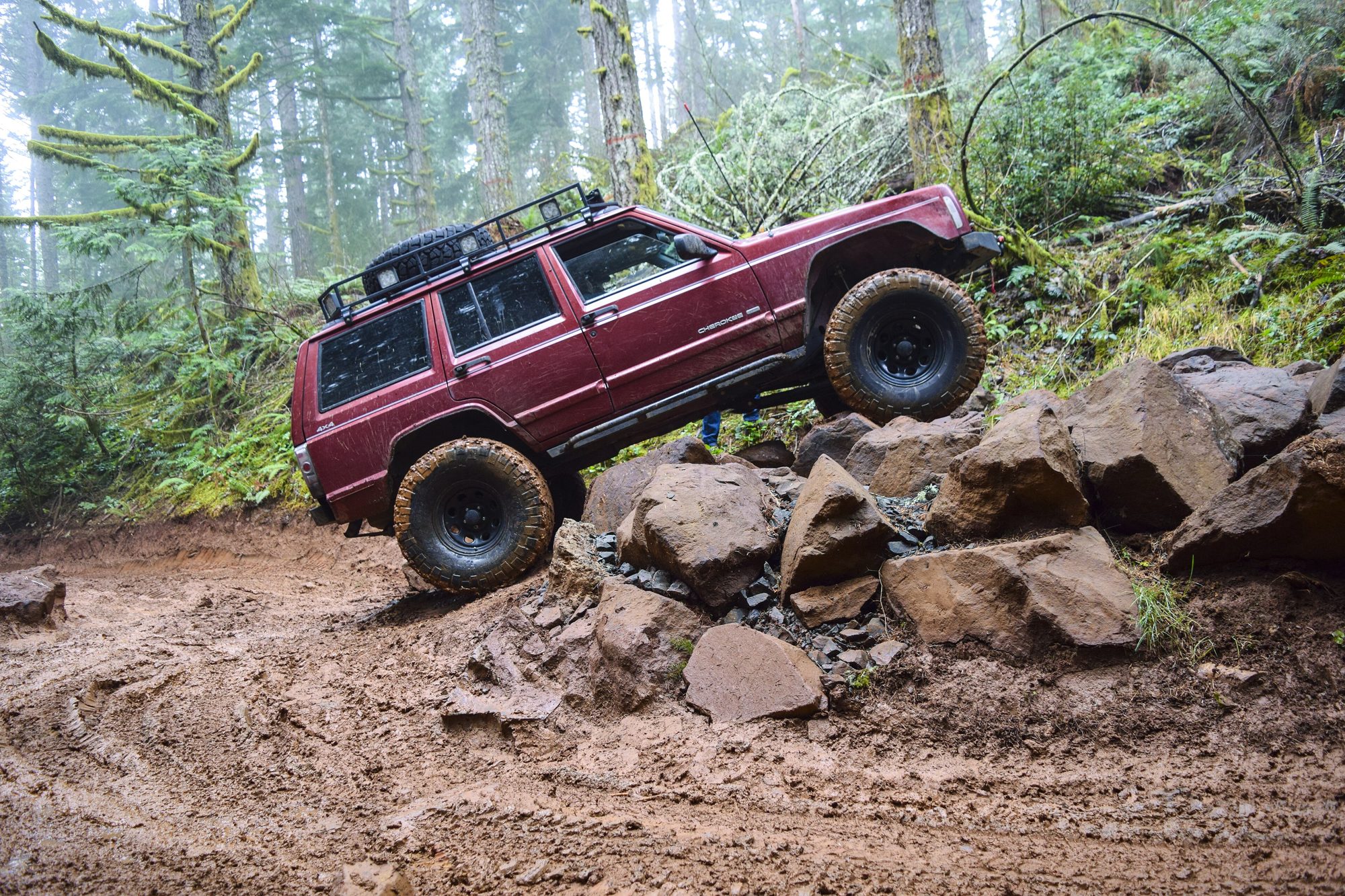
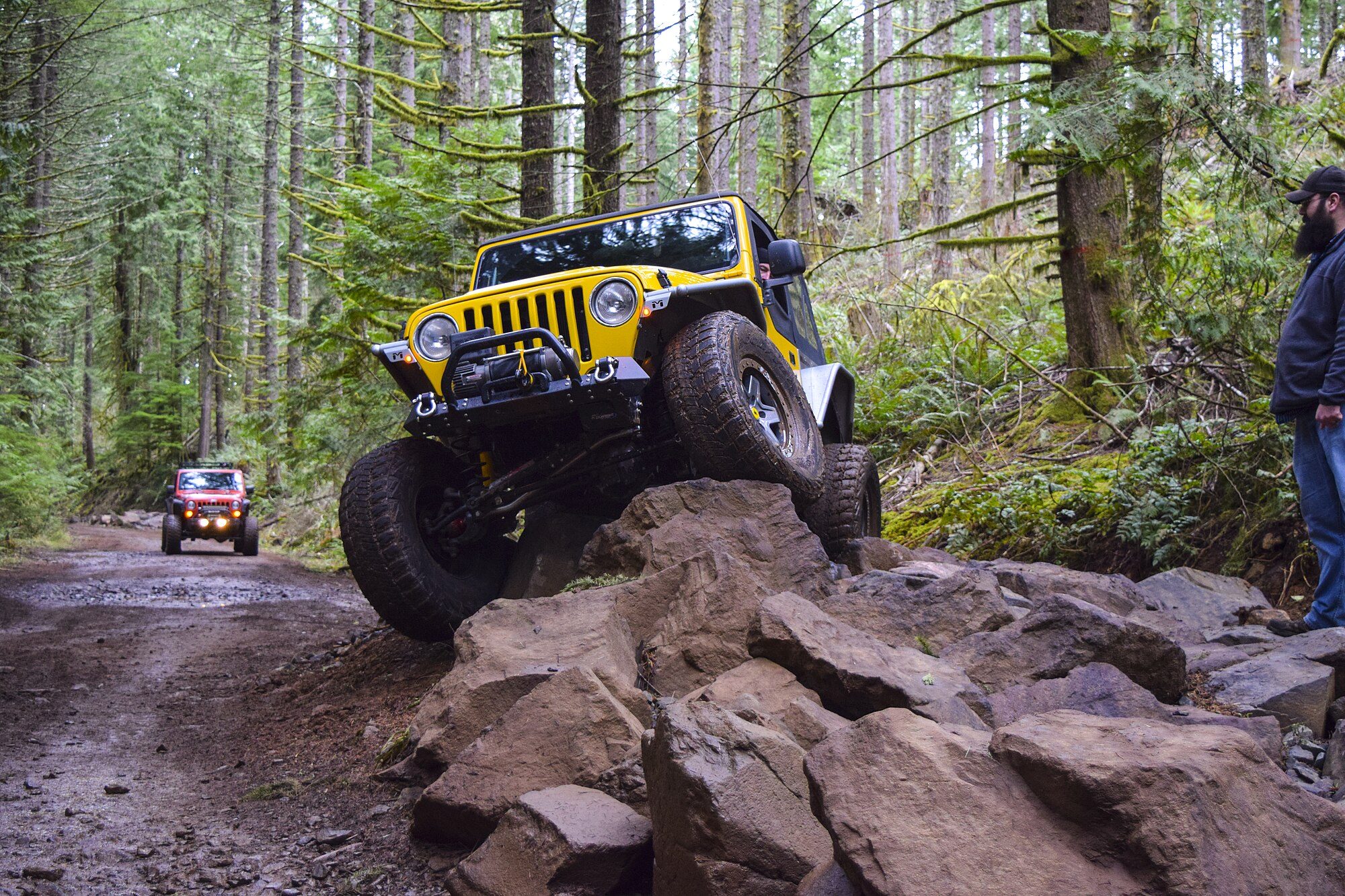
Buy the TJ if the trail is the point and the XJ if the trail is just where you go at the weekend. The TJ has a ladder frame, coils at all four corners, a shorter wheelbase and, as a 2003–06 Rubicon, factory lockers. The XJ has four doors, a hard roof, room for a family and a 5,000 lb tow rating, and it usually costs less.
The short answer
you need one vehicle for errands, family, camping gear and trails, want to tow more than 2,000 lb, or want the cheapest way into a 4.0 solid-axle Jeep
you mostly drive trails, want a separate frame and coil springs at both ends, or can stretch to a Rubicon with lockers and a 4:1 transfer case
Side by side
| JEEP CHEROKEE XJ | JEEP WRANGLER TJ | |
|---|---|---|
| Years (US) | 1984–2001 (4.0 from 1987) | 1997–2006 |
| Structure | Unibody 'Uniframe' | Ladder frame |
| 4.0 I6 output | 173–177 hp (Renix) · 190 hp / 225 lb-ft (HO) · 193 hp / 231 lb-ft (2000–01) | 181 hp / 222 lb-ft (1997–99) · 190 hp / 235 lb-ft (2000–06) |
| Transmissions (4.0) | AW4 4-spd auto · BA-10/5, AX-15, NV3550 5-spd manual | 32RH 3-spd (to 2002), 42RLE 4-spd auto · AX-15, NV3550, NSG370 6-spd (2005–06) |
| Transfer case | NP231 Command-Trac or NP242 Selec-Trac, 2.72:1 | NP231 · NV241OR Rock-Trac, 4.0:1 (Rubicon) |
| Suspension | Coils and four links front · leaf springs rear | Coils and control arms at both ends |
| Axles | Dana 30 front · Dana 35, Chrysler 8.25 or Dana 44 (some 1987–91) rear | Dana 30 front · Dana 35 or optional Dana 44 rear · Dana 44s on Rubicon |
| Factory lockers | None (Trac-Lok rear limited slip on some) | Front and rear air lockers on 2003–06 Rubicon |
| Wheelbase | 101.4 in (2- and 4-door) | 93.4 in |
| Ground clearance | 7.3–8.3 in at the diffs | 8.6–9.1 in at the rear axle ('05–06) |
| Approach / departure | 37.6–38° / 31–32.1° | 42.2° / 31.5° ('05–06) |
| Towing | 5,000 lb (2001 4.0) | 2,000 lb (4.0); 1,000 lb some builds |
| Fuel economy (EPA) | 14 city / 18 hwy (2001 4.0) | 15 / 18 (1997 4.0 manual) · 13 / 17 (2005–06) |
| Biggest tire, no lift | 235/75R15; 30x9.50R15 is the practical limit | 31x10.50R15 (may rub at full flex); Rubicon had 31s stock |
| Typical prices now | $8k–16k driver · $20k–38k best low-mile originals | $10k–20k driver · $20k–39k excellent or Rubicon |
| Best years | 1991–2001 4.0 HO; non-ABS 1998–99 a favorite; check the head on 2000–01 | No consensus year; get the 4.0. 2003–06 Rubicon; check the OPDA on 2005–06 |
Off-road
Stock for stock, the TJ is the better trail tool. It has a separate ladder frame, coil springs and control arms at both ends instead of the XJ's rear leaf packs, and a 93.4 in wheelbase against the XJ's 101.4 in. Jeep's 2005–06 figures give it a 42.2° approach angle; the specs posted on NAXJA put the XJ at 37.6–38°. The 2003–06 Rubicon then adds what no XJ ever had from the factory: Dana 44s at both ends with air lockers, and the NV241OR transfer case with a 4.0:1 low range against the XJ's 2.72:1.
The XJ is still a very good off-roader, and lighter than it looks: a 2001 four-door Sport weighs 3,355 lb, against 3,200–3,857 lb for a 2005–06 TJ. Its front end works like the TJ's, with a solid Dana 30 on coils, four control arms and a track bar. NAXJA members argue about the longer wheelbase; some call it an advantage, others note that 'the wheelbase monster can get you no matter what the wheelbase'. The real catch is the unibody. One NAXJA owner says an XJ needs bracing and stiffening to last on the trail, where a Wrangler needs far less.
On-road and daily use
This is the XJ's win, and it isn't close. It has a hard roof, a choice of two or four doors and a real cargo area. NAXJA owners describe it carrying four people plus camping gear, or a load of furniture, where a short-wheelbase Wrangler is 'limited'. It is rated to tow 5,000 lb with the 4.0, while Jeep's 2005–06 spec sheet gives a TJ 2,000 lb, or 1,000 lb with the 2.4 or a 4.0 automatic on the base 3.73 axle.
Fuel economy is close: the EPA gives a 2001 XJ 4.0 14 city and 18 highway, a 1997 TJ manual 15 and 18, and a 2005–06 six-speed TJ 13 and 17. On Expedition Portal, an owner of both reckons an XJ gets 1–2 mpg more than a similarly built TJ. If you need a roofless Jeep, or want a long-wheelbase Wrangler for travel, the 2004–06 Unlimited (LJ) adds 10 inches of wheelbase and more cargo room.
Reliability and what breaks
Both use the AMC 4.0 straight-six, so they share its habits: leaks from the rear main seal, oil pan, valve cover and oil-filter adapter, cooling systems that punish neglect, and death wobble that usually starts at the track bar. Both were also built with plenty of weak Dana 35 rear axles, so read the tag.
XJ-specific: the 0331 cylinder head on 2000–01 trucks can crack between cylinders 3 and 4 and put coolant in the oil; 1987–90 Renix trucks store no fault codes; crank sensors fail when hot; and rust in the unibody rails is a deal-breaker, because the body is the frame. TJ-specific: Quadratec flags the oil pump drive assembly (the 'laughing monkey') on 2005–06 4.0s, frames rust badly at the rear lower control-arm mounts, early cowl vents leak onto the floors, 1997–2000 exhaust manifolds crack, and plastic-tank radiators often start leaking around 100,000 miles. Drivingline adds that the AX-15 manual has synchro issues and the later NV3550 is stronger.
Running costs and parts
Cheap for both, and more of it is shared than you'd think. Both use a 5 x 4.5 in (5 x 114.3 mm) wheel pattern with a 71.5 mm center bore and 1/2-20 studs, so wheels swap across. Quadratec lists many 4.0 and front-end parts for both, including Crown's 1999–2006 TJ/XJ cylinder head, Rancho's adjustable track bar for 1984–2006 TJs and XJs, and Old Man Emu's steering stabilizer for both.
The expensive surprises are different. On an XJ it's unibody rot or a cracked 0331 head; on a TJ it's frame repair at the rear control-arm mounts, which Quadratec's Rick Rotondo says is only for experienced welders, or an OPDA failure that damages the engine. Both are covered by enormous parts catalogs from Quadratec, ExtremeTerrain and Crown.
Modifying
Both lift easily, but they get there differently. XJ kits range from TeraFlex's 1.5 in Budget Boost to 4.5–6.5 in long-arm kits; a 3 in lift clears 31x10.50s with some trimming, and ExtremeTerrain's chart puts 33x12.50s on 4.5 in. TJ lifts are coil-based: Quadratec's buyer's guide puts 31s on a 2 in spacer lift, 33s on 3 in, and 35s on a long-arm setup. Either way, plan on regearing and replacing a Dana 35; Drivingline puts a bolt-in TJ rear axle upgrade at 'a couple grand'.
Armor priorities differ too. The XJ's rockers are part of its structure, so sliders come before the first rock. The TJ's low tub corners and rockers take the hits, so rails and corner guards are the usual first buy. Owners on Expedition Portal say the aftermarket is about equal: 'Any solid axle Jeep platform will have a good aftermarket.'
Buying one now
The XJ is usually the cheaper buy. Bring a Trailer's XJ sales in October 2026 had a median of about $11,500, with drivers at $8,000–16,000 and the best low-mile 1998–2000 trucks in the mid-$30,000s. TJs had a median of about $15,500 over 256 sales from April 2025 to October 2026, Rubicons about $20,000, and a 21,000-mile 2006 Rubicon six-speed sold for $39,000. Expedition Portal owners add that unmodified XJs are easier to find.
On an XJ, buy a 4.0 HO from 1991 or later, check the rails before anything else, and check the head on a 2000–01. On a TJ, check the frame at the rear lower control-arm mounts, ask for OPDA records on a 2005–06, and confirm a Rubicon by its VIN (a 6 in the sixth character) and its Dana 44s, because badges and decals bolt on.
Questions, answered
Which is better off-road, the XJ or the TJ?
Stock, the TJ. It has a ladder frame, coil springs at both ends, a shorter 93.4 in wheelbase and a steeper approach angle, and the 2003–06 Rubicon adds front and rear lockers and a 4.0:1 transfer case. A well-built XJ goes almost anywhere a TJ does, but owners say its unibody needs bracing to survive hard use.
Which is the better daily driver?
The XJ. It has a hard roof, two or four doors, room for four people and camping gear, and a 5,000 lb tow rating against the TJ's 2,000 lb. Fuel economy is about the same, around 14–15 mpg in town and 17–18 on the highway on EPA figures.
Do XJ and TJ wheels and parts interchange?
Wheels do: both use 5 x 4.5 in (5 x 114.3 mm) with a 71.5 mm center bore and 1/2-20 studs. Many 4.0 engine and front-end parts are listed for both, such as Crown's 1999–2006 cylinder head and Rancho's adjustable track bar. Rear suspension parts don't swap, because the XJ uses leaf springs and the TJ uses coils.
Is the XJ's unibody a problem off-road?
It's a trade-off. The unibody keeps the XJ light, but rust in the frame rails is a structural problem, not cosmetic, and a NAXJA owner says an XJ needs bracing and stiffening to last on the trail. Another owner calls it 'very workable' because every part of it is structural.
What's the biggest tire I can fit on each without a lift?
On an XJ, NAXJA members agree a 235/75R15 fits on the stock wheels and treat 30x9.50R15 as the practical limit. On a TJ, Four Wheel Trends puts the limit at 31x10.50R15, which may rub at full flex, and the Rubicon came on 31-inch LT245/75R16s.
Which years should I look for?
XJ: a 1991–2001 4.0 HO, with NAXJA members favoring non-ABS 1998–99 trucks; check the head on any 2000–01. TJ: there's no consensus year, but get the 4.0, and if you want a six-speed 2005–06, check that the oil pump drive assembly has been replaced. A Rubicon is the one to stretch for.
The full guides
- Wikipedia — Jeep Cherokee (XJ)
- Wikipedia — AMC straight-6 engine (4.0 and 0331 head)
- Wikipedia — Jeep Wrangler (TJ)
- OffroadXtreme — Buyer's guide: how to buy the perfect Jeep Cherokee XJ
- Off Road Xtreme — Buyer's guide: how to buy the perfect TJ Wrangler
- Drivingline — Jeep Wrangler TJ buyer's guide
- Drivingline — A history of the Jeep Wrangler TJ
- Jeep / DaimlerChrysler press release — 2003 Wrangler Rubicon (The Auto Channel)
- NAXJA — XJnewb crash course
- NAXJA — 1984–2001 specs
- NAXJA — Advantages Cherokee vs Wrangler
- NAXJA — Biggest tire for stock 2001 Cherokee Sport
- Expedition Portal — wrangler vs cherokee
- Kelley Blue Book — 2001 Jeep Cherokee specs
- Quadratec — Jeep Wrangler TJ specifications 2005–2006 (Jeep press data)
- Quadratec — Used Jeep Wrangler inspection checklist by generation
- Quadratec — How to repair Wrangler lower rear trail arm mount (Rick Rotondo)
- Quadratec — Everything Jeep Wrangler Buyer's Guide (PDF)
- Quadratec — Jeep wheel bolt patterns and lug nut torque specs
- Quadratec — Crown 53010334 cylinder head, 1999–2006 TJ/XJ 4.0L
- Quadratec — Rancho front adjustable track bar, TJ/XJ/MJ
- Quadratec — Old Man Emu steering stabilizer, 1984–2006 XJ/ZJ/YJ/TJ
- ExtremeTerrain — Jeep Cherokee XJ wheel bolt pattern guide
- ExtremeTerrain — Jeep wheel specifications & size guide
- Four Wheel Trends — Largest tire on a stock Jeep Wrangler
- fueleconomy.gov — Jeep Wrangler 4WD EPA ratings by year
- NHTSA vPIC — VIN decoder
- Bring a Trailer — Jeep XJ Cherokee sold results
- Bring a Trailer — Jeep Wrangler TJ (1997–2006) results