Land Rover LR3 vs Land Cruiser 100 Series
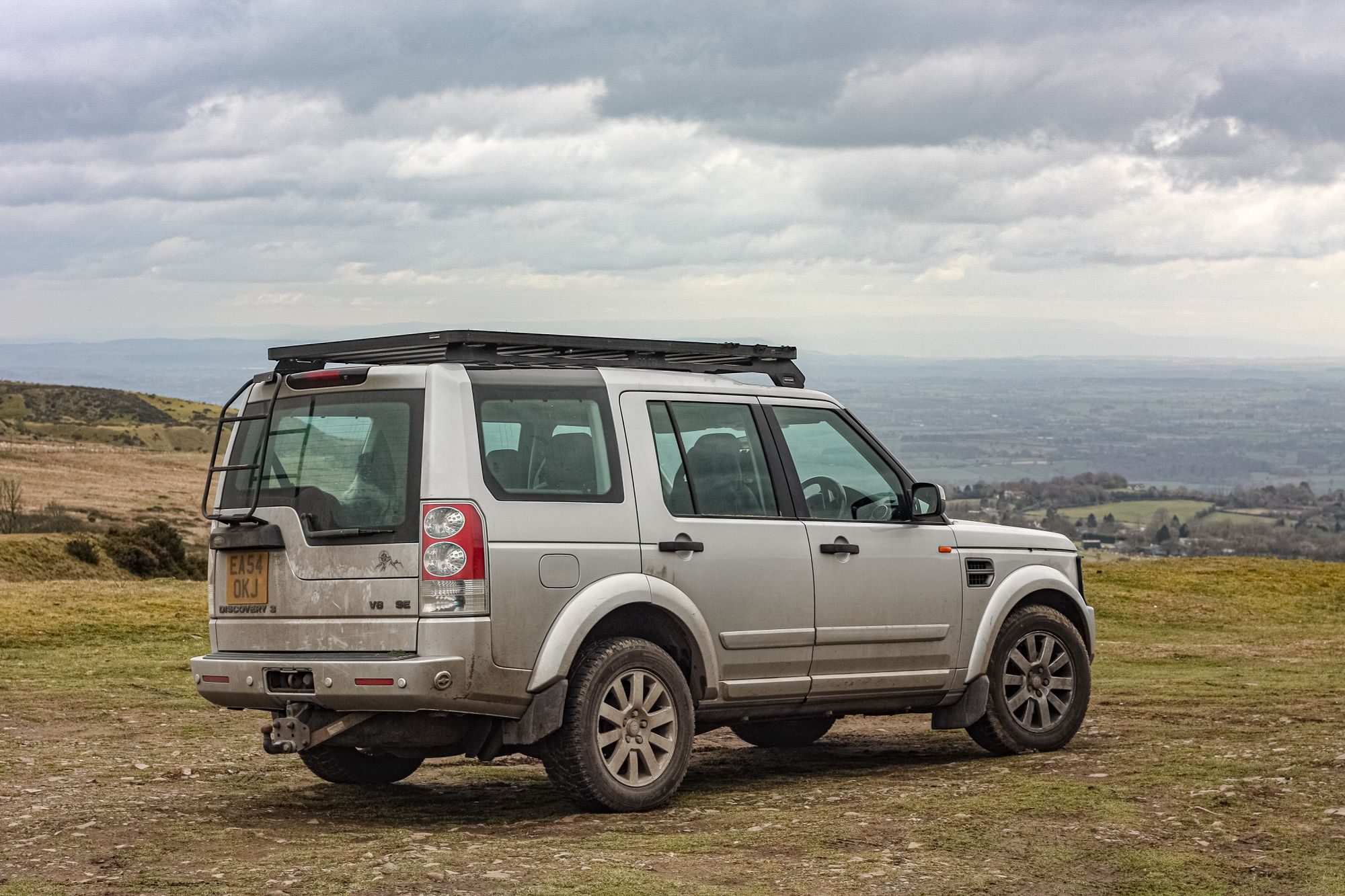

Buy the 100 if you want a truck to keep for another 200,000 miles; buy the LR3 if you want more off-road hardware for far less money and can live with its electronics. The LR3 has air suspension, Terrain Response and an optional rear locker, while the 100 has a ladder frame, a V8 owners trust and resale values to match.
The short answer
you want the most capable stock truck per dollar, will own a diagnostic tool, and accept air suspension, an electronic parking brake and a lot of control modules
you want proven long-term durability, simple torsion-bar suspension, room for 33s without a lift and a truck that holds its value
Side by side
| LAND ROVER LR3 / DISCOVERY 3 | TOYOTA LAND CRUISER 100 SERIES | |
|---|---|---|
| Years (US) | 2005–09 | 1998–2007 |
| Engine | 4.4 V8, 300 hp / 315 lb-ft · 4.0 V6, 216 hp (2005–07) | 4.7 V8 2UZ-FE, 230 hp / 320 lb-ft; 235 hp ('03); 275 hp / 332 lb-ft with VVT-i ('06–07) |
| Transmission | ZF 6HP26 6-spd auto (V8) | 4-spd A343F; 5-spd A750F from 2003 |
| 4WD | Permanent, 2.93:1 low range, progressively locking center diff | Full-time HF2A, lockable center diff; A-TRAC from 2000 |
| Structure | Integrated Body Frame: monocoque cabin on a ladder frame | Ladder frame |
| Suspension | Independent double wishbones, air springs at all four corners | Independent torsion-bar front · live rear axle on coils |
| Factory lockers | Electronic rear locker optional | Rear optional, 1998–99 only |
| Wheelbase | 113.6 in | 112.2 in |
| Ground clearance | 7.3 in standard · 9.4 in off-road height | 9.8 in ('05) |
| Approach / departure | 37.2° / 29.6° | — |
| Curb weight | 5,426 lb (V8) | 5,115–5,425 lb |
| Towing | 7,716 lb braked | 6,500 lb (2002–06) |
| Fuel economy (EPA) | 12–13 city / 17 hwy (V8) | 12 city / 16 hwy ('05) |
| Biggest tire, no lift | 265/65R18 or 285/60R18 (≈31 in); 275/65R18 with tweaks | 285/75R16 or 285/65R18 (≈33 in) |
| Typical prices now | $7k–13k driver · $15k–23k excellent | $15k–36k driver · $40k–65k excellent |
| Best years | 2008–09 | 2003–07 (five-speed) |
Off-road
Out of the box, the LR3 brings more off-road hardware. Its air springs lift it from 7.3 in of clearance to 9.4 in at off-road height, and cross-link off-road so that when one wheel drops the other rises, like a beam axle. Terrain Response sets ride height, throttle, traction control and diff locking for the surface, the center diff locks progressively, and a locking rear diff was optional. One Expedition Portal owner says a stock LR3 'blew me away' off-road. Land Rover quotes a 700 mm (27.6 in) wading depth.
The 100 has a ladder frame, torsion-bar front suspension, a coil-sprung live rear axle and a center diff you can lock, plus 9.8 in of ground clearance in KBB's 2005 figures. After 1999 it relies on A-TRAC brake traction control instead of a rear locker; one Expedition Portal owner calls A-TRAC 'very, very good', while an IH8MUD member found it no match for real lockers. Its big advantage for the trail is tire room: about 33 in fit without a lift, against about 31 in on the LR3. Watch for cracked lower wishbones on 100s that have hit the bump stops hard, and for the 1998–99 two-pinion front diff.
On-road and daily use
Both are big, heavy wagons with third-row seats, at around 5,400 lb. The LR3's 300 hp V8 and six-speed ZF are stronger than the 100's 230–275 hp and four- or five-speed automatic, and Land Rover rates it to tow 7,716 lb braked against the 100's 6,500 lb.
Neither saves fuel: the EPA rates the LR3 V8 at 12–13 mpg city and 17 highway, and KBB lists 12 and 16 for a 2005 100. Owners on Expedition Portal disagree on size; one calls the Land Cruiser 'much bigger', another says 'they are both big vehicles'. The 100 has a larger tank, 25.4 gallons against 22.8.
Reliability and what breaks
This is the 100's win. On Expedition Portal, one owner calls the 2UZ-FE 'possibly one of the most reliable engines Toyota ever sent to North America' and says critical failures between 150,000 and 250,000 miles are rare. Its known jobs are well documented: the 90,000-mile timing belt and water pump, brittle heater-hose tees, spark plugs that work loose, lower ball joints, starter contacts and, on AHC trucks, fluid flushes. Owners in the same thread add the rack-and-pinion steering, CV boots and exhaust manifolds.
The LR3's list is longer and more electronic: air springs, compressors and height sensors, an electronic parking brake that clogs and jams, front lower-arm bushes worn out by the weight, ZF fluid that Land Rover's interval left too long, a cracking plastic thermostat housing on the 4.4 V8, and electrical faults. NHTSA logged 96 complaints for the 2005 LR3 against 8 for 2008, and PistonHeads notes that in 2012 Warranty Direct logged more claims on the Discovery 3 than on any other used car from a European maker. US trucks at least avoid the TDV6 diesel's crankshaft-bearing failures.
Running costs and parts
The LR3 is cheap to buy and costs more to keep right. An owner-level diagnostic tool such as Gap's IIDTool is close to essential for suspension calibration and fault codes, and one Expedition Portal member warns that finding a Rover specialist can be difficult. LR4 owners on LandRoverWorld report $900–2,200 shop quotes for parking-brake actuator work, and one LR3 owner was quoted $1,400 for both front lower arms plus alignment.
The 100's big bill is predictable: one IH8MUD owner spent about $600 on parts for a full timing-belt kit, and the heater-hose tees cost under $15. Slee Off-Road, Cruiser Outfitters and IH8MUD's 100-series FAQ cover nearly every job. Nothing interchanges: the LR3 uses a 5 x 120 wheel pattern, the 100 uses 5 x 150.
Modifying
The LR3's cheap lift is a set of lift rods, which lengthen the height-sensor links so the air suspension sits 2–2.5 in higher; 275/65R18s (about 32 in) are the common tire with them. A diagnostic tool can change the programmed heights instead. Owners who've had enough of air can fit Terrafirma's +2 in coil conversion, which Lucky8 says clears 32–33 in tires with minor trimming. Its independent rear leaves more of the underside exposed, so sliders and skid plates come early.
The 100 lifts with Old Man Emu torsion bars, rear coils and shocks (about 1.5 in), and the torsion-bar adjusters set the front height. With 2–3 in of lift, 315/75R16s (35 in) fit but rub at full compression. ARB Air Lockers are the usual way to add lockers. One Expedition Portal owner grumbles that the torsion-bar front 'kind of sucks' for modifying.
Buying one now
The price gap is huge. Bring a Trailer LR3 sales from September 2025 to October 2026 ranged from $3,250 to $23,000, with a median of about $9,100. Comparable 100s run $15,000–36,000 as drivers and $40,000–65,000 for clean, low-mile trucks. An Expedition Portal buyer summed it up: for the money, the LR3 is newer, lower-mileage and in better condition, but it 'has poor resale'.
Buy an LR3 on its service file: 2008–09 trucks log the fewest complaints, and ReRev names 2005 the year to avoid. Check every suspension height, the parking brake and the ZF's fluid history, and run the VIN for open recalls. Buy a 100 on timing-belt receipts; 2003–07 trucks are the ones owners recommend for the five-speed. If you want the Land Cruiser drivetrain with more luxury, look at the LX 470, and budget for its AHC.
Questions, answered
Is the LR3 more capable off-road than the 100 Series?
Stock, it has more off-road hardware: height-adjustable air suspension with 9.4 in of clearance at off-road height, Terrain Response, a progressively locking center diff and an optional rear locker. The 100 has more ground clearance at normal height (9.8 in), a live rear axle and room for 33s without a lift, which matters once you start building it.
Which is more reliable?
The 100, by owner consensus. Its 2UZ-FE V8 is widely trusted, and its main jobs (timing belt, heater-hose tees, ball joints) are predictable. The LR3's air suspension, electronic parking brake and electrics are its weak spots, and first-year 2005 trucks log by far the most NHTSA complaints.
Is the LR3 body-on-frame like the 100?
Partly. Land Rover's Integrated Body Frame builds the cabin and engine bay as a monocoque and joins it to a ladder frame that carries the gearbox and suspension. The 100 is a conventional ladder-frame truck.
Which tows more?
On paper, the LR3: Land Rover's launch specification gives 7,716 lb (3,500 kg) braked, against 6,500 lb for a 2002–06 100 in KBB's figures. The LR3's 300 hp V8 also has more power than any US 100.
Can I get rid of the LR3's air suspension?
Yes. Terrafirma sells a +2 in coil conversion with a module to keep the warning lights off, and Old Man Emu coils are sold for the LR3 too. Most US 100s have no air suspension to worry about; Active Height Control was standard on the LX 470 and owners report it on some Land Cruisers.
Which years should I buy?
For the LR3, 2008–09, which ReRev rates the most reliable and which log the fewest NHTSA complaints; avoid 2005 unless the history is excellent. For the 100, owners point to 2003–07 for the five-speed automatic, and to 2000 on if you want the stronger four-pinion front diff.
The full guides
- Wikipedia — Land Rover Discovery (Discovery 3 / LR3)
- The Auto Channel — 2005 Land Rover LR3 specifications (Sept 2004)
- PistonHeads — Shed buying guide: Land Rover Discovery 3
- Carbuyer — Used Land Rover Discovery buying guide (2004–2009 Mk3)
- fueleconomy.gov — 2005 Land Rover LR3 4.4 V8
- fueleconomy.gov — 2009 Land Rover LR3 4.4 V8
- ReRev — Land Rover LR3 years to avoid
- NHTSA — complaints, 2005 Land Rover LR3
- NHTSA — complaints, 2008 Land Rover LR3
- koleso.ee — Land Rover LR3 L319 2005–2009 wheel and tyre sizes
- Expedition Portal — LR3 tire size to prevent rubbing
- LandRoverForums — Biggest and best off-road tires for LR3
- LandRoverWorld — Electronic Parking Brake (EPB) failure
- LandRoverWorld — 2006 LR3 HSE: Replacing front lower control arms
- Lucky8 — Terrafirma LR3/LR4 HD +2 in coil conversion
- Gap Diagnostic — IIDTool
- Bring a Trailer — Land Rover LR3
- Wikipedia — Toyota Land Cruiser (J100 section)
- Slee Off-Road — 100 Series Newbie Guide
- IH8MUD — 100-series FAQ
- IH8MUD — What is the largest tire I can fit with no lift?
- IH8MUD — Max tire size (100 Series, lifted)
- IH8MUD — 90k service parts list
- IH8MUD — DIY: Replacing heater hose pipe T's
- IH8MUD — 80 vs 100 series LC
- IH8MUD — New 100 owner (year-by-year buying notes)
- IH8MUD — 100 vs LR3
- Kelley Blue Book — 2005 Toyota Land Cruiser specs
- Kelley Blue Book — 2002 Toyota Land Cruiser specs
- Cruiser Outfitters — 100 Series parts (OME torsion bars and coils)
- ThreePiece — 1999 Toyota Land Cruiser wheel & bolt pattern specs
- Expedition Portal — 100 series LC/LX470 vs Land Rover LR3 vs 1st generation Sequoia
- Expedition Portal — Thinking about getting a LC or LX470 or maybe the LR3
- Toyota (via The Auto Channel) — Toyota Announces Prices for 2006 Land Cruiser
- Bring a Trailer — Toyota Land Cruiser 100 Series auction results