Toyota FJ Cruiser vs 4Runner (5th gen)
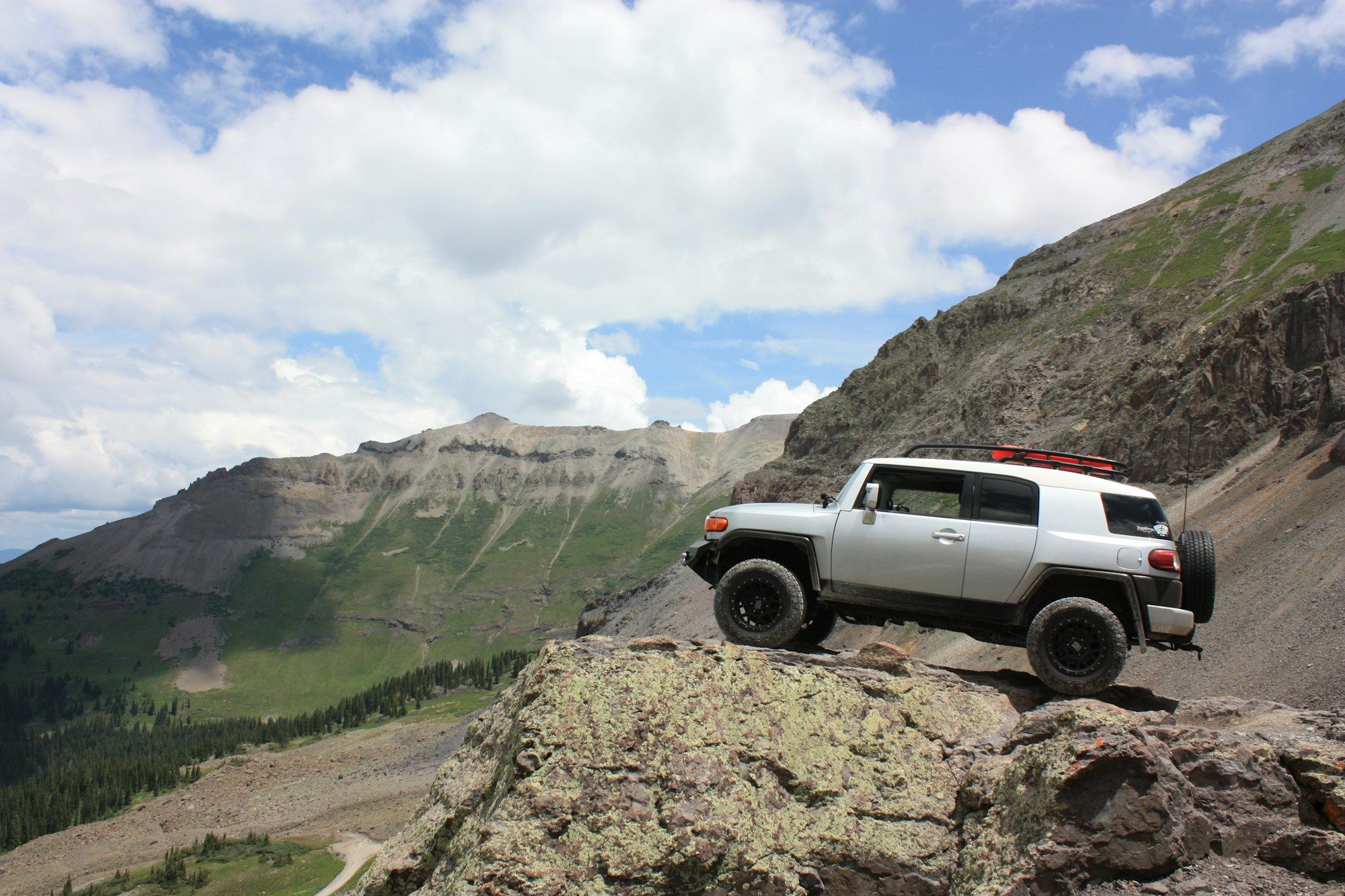
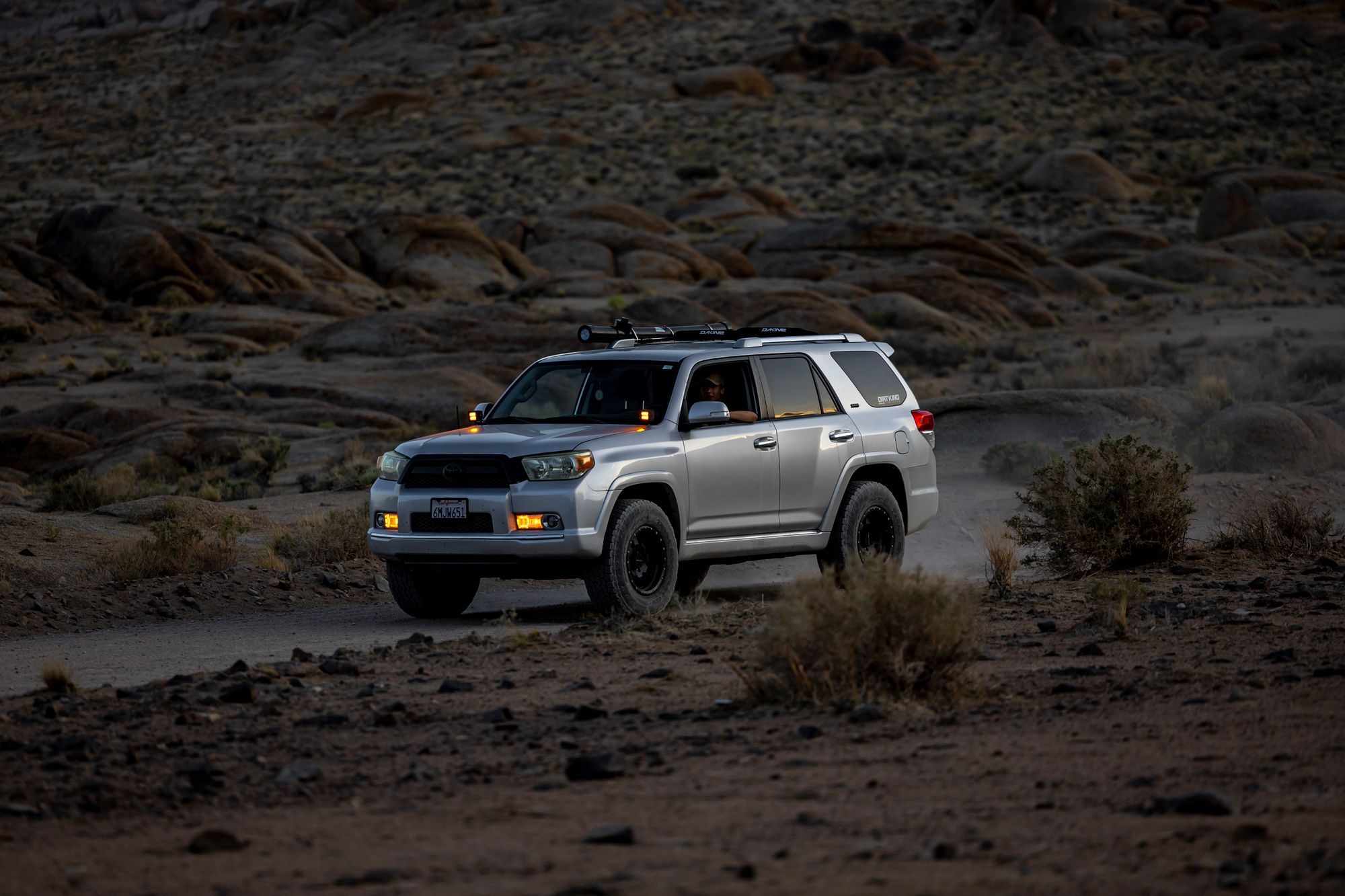
If it's mostly you, a passenger and a trail, buy the FJ Cruiser: it has the better angles, a shorter wheelbase and a rear locker without trim-hunting. If anyone sits in the back, you want to sleep inside or you'd like a truck built as recently as 2024, buy the 4Runner.
The short answer
you want the best factory approach and departure angles, a short wheelbase, a rear locker (standard on manuals) or the only one of the two with a six-speed manual and full-time 4WD
you carry people or gear, want to sleep in the back, want KDSS or newer safety tech, or want the widest choice of years, trims and parts
Side by side
| TOYOTA FJ CRUISER | TOYOTA 4RUNNER 5TH GEN | |
|---|---|---|
| Years (US) | 2007–14 | 2010–24 |
| Engine | 4.0 V6 1GR-FE: 239 hp / 278 lb-ft on premium ('07–09); 259–260 hp / 270–271 lb-ft on regular ('10–14) | 4.0 V6 1GR-FE: 270 hp / 278 lb-ft (2.7 I4 on 2010 2WD only) |
| Transmission | 6-spd manual or 5-spd auto | 5-spd auto |
| 4WD | Manual: full-time, lockable Torsen center. Auto: part-time. Both 2-speed | Part-time 2-speed; full-time on Limited |
| Suspension | Double-wishbone IFS; 4-link coil rear | Double-wishbone IFS; 4-link coil rear; KDSS optional on Trail / TRD Off-Road |
| Factory lockers | Rear e-locker: standard with manual, optional with auto | Rear e-locker on Trail, TRD Off-Road, TRD Pro |
| Wheelbase | 105.9 in | 109.8 in |
| Ground clearance | 9.6 in (4x4) | 9.0 in; 9.6 in TRD Off-Road / Pro ('24) |
| Approach / departure | 34° / 31° (4x4, '14) | 30° / 26°; 33° / 26° TRD Off-Road / Pro ('24) |
| Seats / cargo (cu ft) | 5 seats; 28 behind rear seat, 67 max ('14) | 5 or 7 seats; 47.2 behind 2nd row, 89.7 max ('24) |
| Towing | 5,000 lb; 4,700 lb (2014, SAE J2807) | 5,000 lb |
| Fuel economy (EPA) | 17 / 20 ('14 auto); 15 / 18 ('14 manual) | 16 / 19 / 17 |
| Fuel tank | 19 gal | 23 gal |
| Biggest tire, no lift | 285/70R17 (≈33 in), may touch the mud flap | 275/70R17 or 255/75R17 (≈32 in) |
| Typical prices now | $12.5k–17k high-mile '07–08; $26k–37k driver '10–13; $38k–56k+ low-mile | $15k–25k early/high-mile; $25k–46k driver; $50k–58.5k low-mile TRD Pro |
| Best years | 2010–14 | 2020–24 |
Same engine, different ideas
The FJ Cruiser and the 5th-gen 4Runner both come from Toyota's mid-size Prado family of parts: a ladder frame, double-wishbone front suspension, a coil-sprung four-link live rear axle and the 4.0-liter 1GR-FE V6. They overlap in US showrooms for only five model years, 2010 to 2014, and the 4Runner then carried on until 2024.
What Toyota did with those parts is very different. The FJ is a short-wheelbase (105.9-inch) retro two-door with rear-hinged access doors, built around the FJ40's face. The 4Runner is a 109.8-inch-wheelbase family wagon with four proper doors, a roll-down rear window and an optional third row. One is a toy that works; the other is a tool that sells.
Off-road
Stock for stock, the FJ has the geometry. Toyota quotes 34° approach and 31° departure for a 4x4 FJ, against 30° and 26° for a base 2024 4Runner and 33° and 26° for the TRD Off-Road and TRD Pro, which also share the FJ's 9.6 inches of clearance. The FJ's shorter wheelbase helps over crests, and on an Expedition Portal thread comparing the two, an FJ owner singles out its angles, short wheelbase and e-locker.
The 4Runner's answer is suspension. The Trail (2010–16), TRD Off-Road (2017–24) and TRD Pro get the rear locker plus Crawl Control and Multi-Terrain Select, and KDSS was optional on the Trail and TRD Off-Road. A 4Runner owner in the same thread reckons a 5th gen is 'as capable if not more capable' than an FJ off-highway, crediting KDSS for better articulation. On the FJ, the locker is standard with the six-speed manual and optional with the automatic, and the manual's full-time 4WD gives it a 41.84:1 crawl ratio against the automatic's 33.76:1. SR5 and Limited 4Runners have no locker at all.
On-road and daily use
This is the 4Runner's round, and it isn't close. Reviewers criticized the FJ's huge blind spots, small cargo area and cramped, awkward rear seat when it was new, and they haven't got any smaller. Cars.com lists 28 cubic feet behind the FJ's rear seat and 67 with it folded; Toyota lists 47.2 and 89.7 for a 2024 4Runner. One FJ owner says its folded seatbacks don't sit level with the cargo floor, which rules out sleeping in it, while a 4Runner owner points out that his rear seats fold flat so he can sleep in the back.
Neither is fast or frugal. Both are rated to tow 5,000 lb (4,700 lb for a 2014 FJ under SAE J2807). The EPA rates a 2014 automatic FJ at 17 city and 20 highway and later 4Runners at 16 and 19, but the FJ has a 19-gallon tank to the 4Runner's 23, so the 4Runner goes further between fills. Car and Driver found a 2022 4Runner TRD Pro needed 7.7 seconds to 60 mph and leaned with 'a huge amount of body roll and brake dive', so this isn't a contest of sports cars. 2007–09 FJs were rated on premium fuel; from 2010 the FJ's dual VVT-i engine is rated on regular.
Reliability and what breaks
Both use the 1GR-FE V6, which has a timing chain with no scheduled replacement, so neither has a big engine job waiting. The problems are in the bodywork and the chassis. Early FJs, 2007 and some early 2008 trucks, can have bulging or cracked inner fender aprons in the engine bay, and CarGurus says 2007 draws far more owner complaints than any other year. FJ owners also deal with a downshift clunk that greasing the rear driveshaft slip yoke usually cures (T-SB-0046-12), release-bearing squeaks on 2007–11 manuals, failed front-axle disconnect actuators on automatics, cracked windshields and the 2007–13 access-door recall.
The 5th-gen 4Runner's list is shorter: leaking front axle seals, torn CV boots on lifted trucks and leaking KDSS cylinders, which owners describe as expensive to fix. Autotrader says the fifth generation has no major issues of concern. On either truck, run the VIN for open recalls: Takata airbags on 2010–16 4Runners and Denso fuel pumps on 2014–15 and 2018–19 4Runners and some 2014 FJs. Salt-belt frame rust can finish either one, and one IH8MUD member who shopped the Northeast found every FJ he looked at had rot around the rear control-arm brackets or had already been patched.
Modifying
Both trucks have a huge aftermarket, and both use the same 6 x 139.7 mm (6 x 5.5 in) wheel pattern with M12 x 1.5 studs and a 106.1 mm hub bore. The FJ fits a 285/70R17 on stock suspension, sometimes after heating and flattening a mud flap. With a 3-inch Old Man Emu lift, owners still run 285/70R17s, and with the front body mounts chopped (Metal Tech sells $34.95 cap plates) they go to 305/70R17 and even 35s.
The 4Runner is a little tighter at stock height: Trail4R puts the limit at about 32 inches, calls a 285/70R17 'questionable' and says 33s on a 2-inch level will need a body-mount chop. Beyond about 2.5–3 inches of lift, plan on aftermarket upper control arms, and on KDSS trucks Trail4R puts the practical lift limit at about 3 inches before sway-bar and panhard corrections. SR5 and Limited owners can add a rear locker such as an Eaton E-Locker; FJ owners who want a front locker have fitted a Harrop E-Locker.
Buying one now
Prices overlap more than you'd think. On Bring a Trailer between August and October 2026, FJs ran from $12,500 for a high-mile 2007 to $56,250 for a 7,000-mile 2014, with 2010–13 drivers at about $26,000–37,000. Fifth-gen 4Runners from October 2025 to October 2026 sold for a median of about $38,000, and low-mile 2022–24 TRD Pros reached $53,500–58,500. TrueCar notes that 2010–13 4Runners under 150,000 miles can often be had for under $20,000.
For an FJ, buy a 2010–14 truck if you can: the dual VVT-i engine runs on regular and the fender-apron trouble is mainly a 2007–09 problem. Check the build date on any early truck, look behind both headlights and get underneath with a hammer. For a 4Runner, Autotrader recommends a late truck, preferably 2020–24 for Toyota Safety Sense and CarPlay. If you want the locker, make sure it's a Trail, TRD Off-Road or TRD Pro, because badges are easy to add.
Questions, answered
Are the FJ Cruiser and 5th-gen 4Runner the same truck underneath?
They're related, not identical. Both are ladder-frame trucks built from Toyota's Prado family of parts, with double-wishbone front suspension, a four-link coil-sprung rear axle and the 4.0-liter 1GR-FE V6. The FJ has a 105.9-inch wheelbase and two doors plus rear-hinged access doors; the 4Runner has a 109.8-inch wheelbase and four doors.
Which is better off-road?
Stock, the FJ has better approach and departure angles (34° and 31° against 33° and 26° for the best 4Runners) and a shorter wheelbase, and every manual FJ has a rear locker. A locked 4Runner (Trail, TRD Off-Road, TRD Pro) with KDSS articulates well and matches the FJ's 9.6 inches of clearance. Owners argue both ways, and the driver matters more.
Will FJ Cruiser wheels fit a 5th-gen 4Runner?
The bolt pattern (6 x 139.7 mm), hub bore (106.1 mm) and stud thread (M12 x 1.5) are the same, so they bolt on. Check the offset and brake clearance for your specific wheel before you buy; factory 4Runner wheels are listed at +15 mm.
Which has more room?
The 4Runner, by a lot. Toyota lists 47.2 cubic feet behind the second row and 89.7 maximum for a 2024 4Runner, with an optional third row on some trims. Cars.com lists 28 and 67 cubic feet for a 2014 FJ, which seats five, and getting into the back means opening a front door first.
Which years should I buy?
For the FJ, 2010–14: the dual VVT-i engine runs on regular fuel and the inner-fender problem is mainly on 2007–09 trucks. For the 4Runner, Autotrader recommends 2020–24 for Toyota Safety Sense and CarPlay, though there's no bad engine year. On both, rust and records matter more than the model year.
Which is cheaper to buy used?
It depends on the year. High-mile 2007–08 FJs start around $12,500 on Bring a Trailer, but clean 2010–13 FJs sell for $26,000–37,000, about the same as a driver-quality 4Runner. Early 2010–13 4Runners under 150,000 miles can often be had for under $20,000, according to TrueCar.
The full guides
- Wikipedia — Toyota FJ Cruiser
- Toyota Pressroom — 2014 Toyota FJ Cruiser continues a long tradition of off-road capability
- Kelley Blue Book — 2014 Toyota FJ Cruiser specs
- Cars.com — 2014 Toyota FJ Cruiser specs
- FuelEconomy.gov — 2014 Toyota FJ Cruiser 4WD
- FuelEconomy.gov — 2009 and 2010 Toyota FJ Cruiser 4WD
- CarGurus — Toyota FJ Cruiser buying guide: cost, reliability and the best years to buy
- Vehicle Service Pros — Who hit me? The truly hard shift (T-SB-0046-12)
- Toyota T-SB-0365-10 — 6-speed manual clutch release bearing squeak or rattle noise (PDF via Phoenix Friction)
- NHTSA — Recall 13V098000 (FJ Cruiser access-door panels)
- NHTSA — Recall 20V012000 (Denso low-pressure fuel pump)
- NHTSA — recalls by vehicle (Toyota 4Runner 2014)
- IH8MUD — Looking for an FJ (buying advice, frame rot, gearing)
- IH8MUD — Fender bulge
- IH8MUD — FJC Harrop e-locker clamshell install (ADD actuator notes)
- IH8MUD — FJC 33" tire rub?
- IH8MUD — Max tire size (FJ Cruiser)
- IH8MUD — 285/70x17 tires, any problems?
- Metal Tech 4x4 — FJ Cruiser body mount chop kit
- Limitless Tire — 2012 Toyota FJ Cruiser wheel and tire sizes
- Bring a Trailer — Toyota FJ Cruiser results
- Expedition Portal — FJ vs Tacoma vs 4Runner
- Wikipedia — Toyota 4Runner (fifth generation, N280)
- Toyota — 2024 4Runner eBrochure (specifications)
- Car and Driver — 2022 Toyota 4Runner TRD Pro by the numbers (test)
- TrueCar — 2010–24 Toyota 4Runner buying guide
- Autotrader — Best Toyota 4Runner years to buy used (Joe Tralongo, October 2025)
- Wheel-Size.com — 2016 Toyota 4Runner wheel & tire sizes
- Trail4R — Largest tire size on 5th gen 4Runner
- Trail4R — 7 KDSS mods for the 5th gen
- Trail4R — Top 10 5th gen suspension lift kits
- Trail4R — Eaton rear E-Locker install on 5th gen
- Trail4R — Front axle seal replacement, 5th gen
- Trail4R — CV boot replacement guide, 5th gen
- Trail4R — High-mileage preventative maintenance guide
- Expedition Portal — 5th Gen 4Runner KDSS thread
- Bring a Trailer — Toyota 4Runner (N280)