Lexus GX 470 vs 4th Gen 4Runner
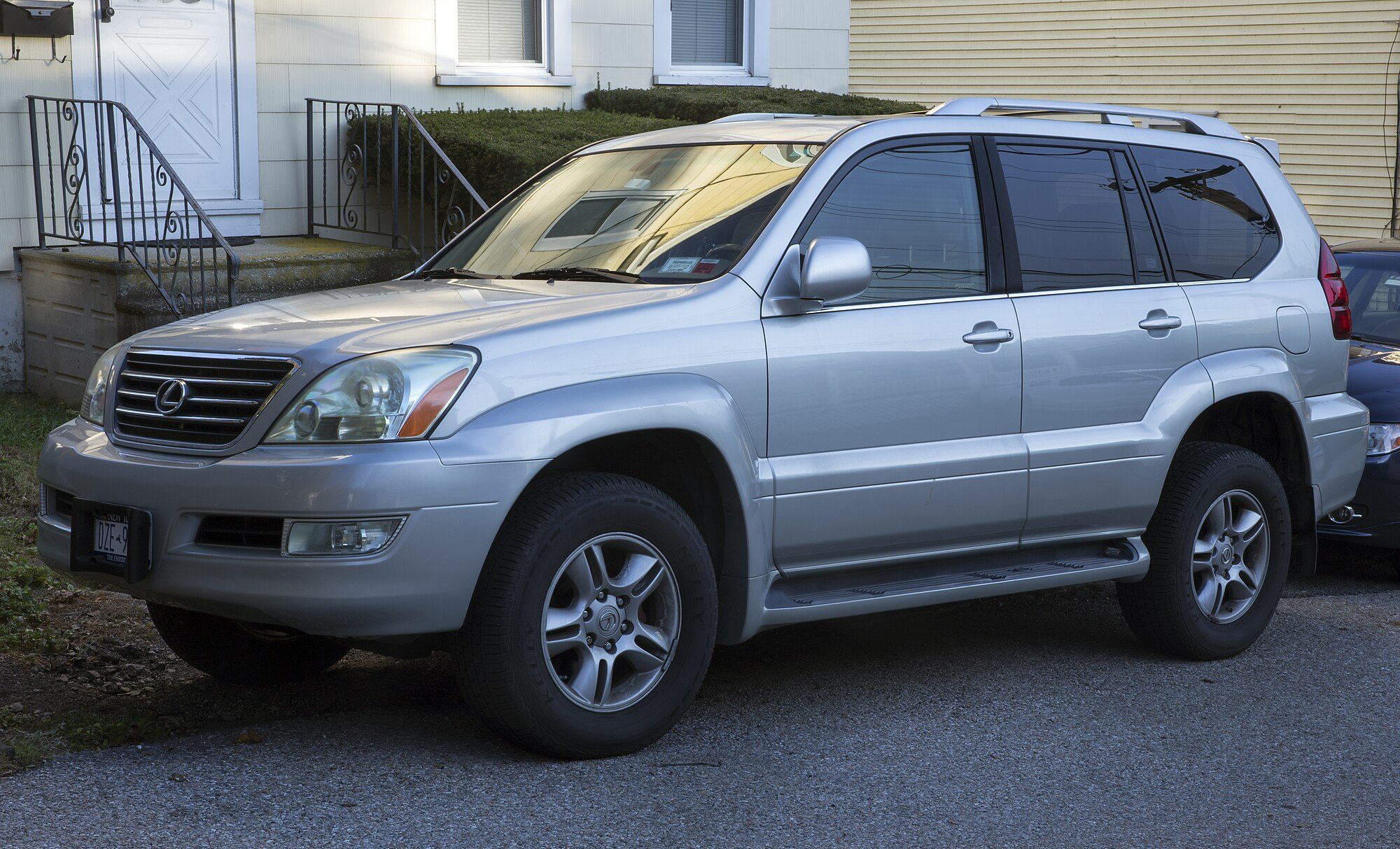
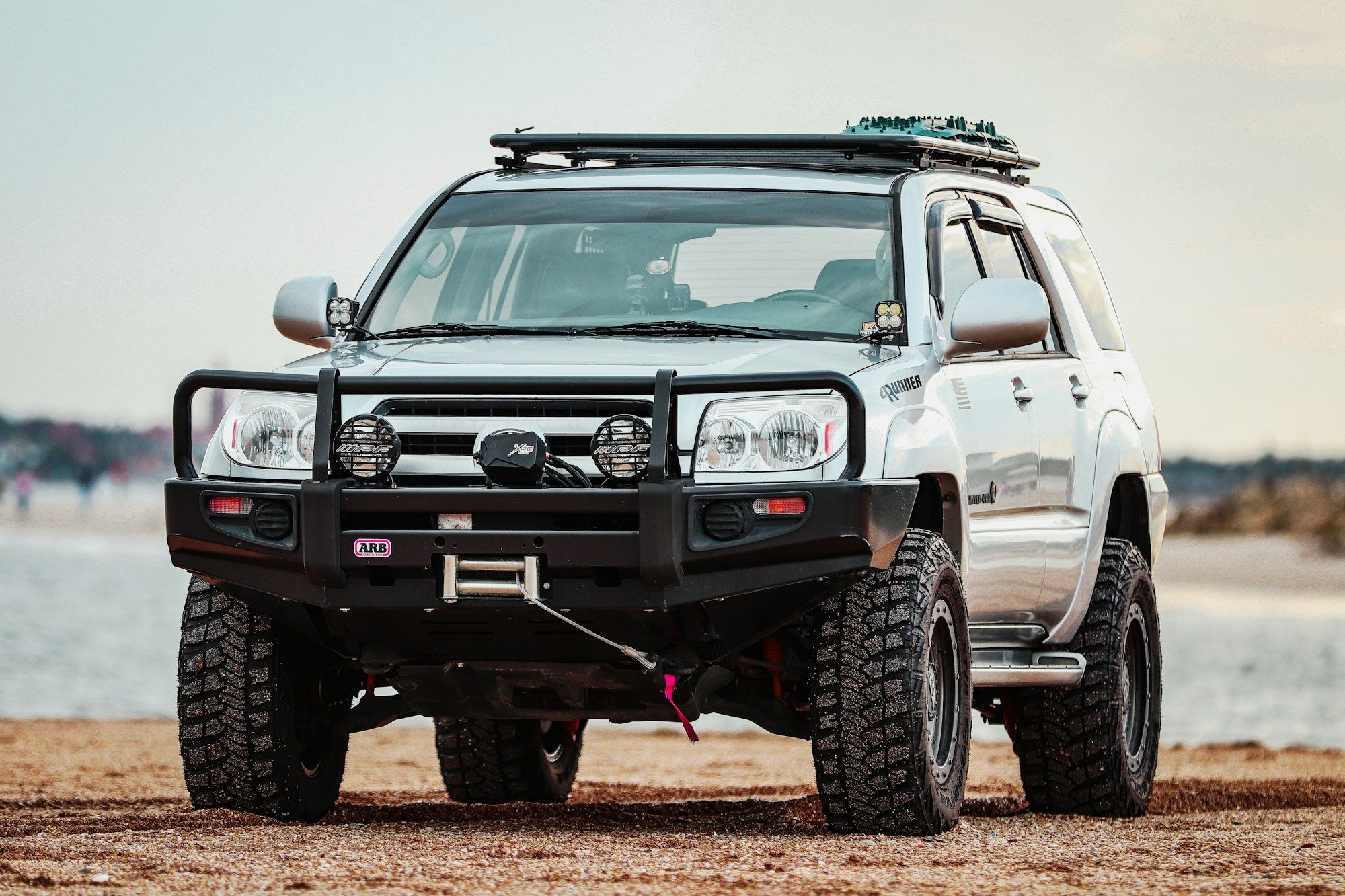
If you want the V8, buy the GX 470: every one has it, with full-time 4WD and a nicer cabin. Buy the 4Runner if you want the cheaper truck, the timing-chain V6, a roll-down rear window or the 2009 Trail Edition's factory rear locker.
The short answer
you want the 4.7 V8 and full-time 4WD as standard, a better-trimmed cabin and a good chance of finding a one-owner truck with records
you want the lowest buy-in, the timing-chain V6, a liftgate with a roll-down window, more V8 towing capacity or a factory rear locker (2009 Trail Edition)
Side by side
| LEXUS GX 470 | TOYOTA 4RUNNER 4TH GEN | |
|---|---|---|
| Years (US) | 2003–09 | 2003–09 |
| Platform | J120 (Prado 120), UZJ120 | N210 (Prado 120-based) |
| Engine | 4.7 V8 2UZ-FE only: 235 hp; 270 hp VVT-i ('05); 263 hp (SAE, '06+) | 4.0 V6 1GR-FE, 245 hp / 282 lb-ft; or 4.7 V8, 235 hp, ≈270 hp / 315 lb-ft ('05+) |
| Timing drive | Belt (90,000 miles) | V6 chain; V8 belt |
| Transmission | 5-spd auto (A750F) | 4-spd auto (early V6) or 5-spd |
| 4WD | Full-time, lockable center diff | V8 full-time; V6 Multi-Mode; lockable Torsen center |
| Suspension | Coilover IFS; 4-link solid rear on air springs; KDSS optional (late '04 on) | Double-wishbone IFS; 4-link solid rear on coils; X-REAS optional; rear air on some Limiteds |
| Factory lockers | None (A-TRAC) | Rear e-locker on 2009 Trail Edition only |
| Wheelbase | 109.8 in | 109.8 in |
| Ground clearance | 8.3 in | 9.0 in ('09 SR5 4WD) |
| Approach / departure | 31° / 25° | — |
| Towing | 5,000 lb; 6,500 lb from mid-2004 | 5,000 lb (V6); 7,000 lb (V8 4WD) |
| Fuel economy (EPA) | 14 city / 18 hwy ('07), premium | 17 / 20 (V6); 15 / 19 (V8) |
| Biggest tire, no lift | 265/70R17 (≈31.6 in) | 265/70R17 (≈31.6 in) |
| Typical prices now | $12k–25k driver; $28k–42k excellent | $8k–23k driver; $27k–39k excellent |
| Best years | No consensus; mid-2004 on for 6,500-lb towing | 2006–09 V8 |
Same truck, different suits
Under the skin these are cousins. The GX 470 is a Land Cruiser Prado 120, and the 4th-gen 4Runner is built on the same Prado 120 bones, with the same 109.8-inch wheelbase, a ladder frame, independent front suspension and a coil-sprung four-link solid rear axle. Both launched for 2003 and both ended in 2009.
The differences are in the drivetrain menu and the trim. Every GX has the 4.7-liter V8, a five-speed automatic and full-time 4WD. Most 4Runners got the 4.0-liter V6 with part-time Multi-Mode 4WD; the V8 4Runner, the only V8 4Runner ever made, also got full-time 4WD. Drivingline puts it simply: if you're set on a V8, a GX 470 will probably be easier to find.
Off-road
On the trail they're close. Both have a lockable center diff on 4WD trucks and lean on A-TRAC brake traction control in place of axle lockers. The exception is the 2009 4Runner Trail Edition, which got a factory rear e-locker, an A-TRAC switch and Bilstein dampers. The GX could be ordered with KDSS, which frees up the anti-roll bars for articulation, from late in the 2004 model year. Lexus Canada quotes the GX at 31° approach and 25° departure with 8.3 inches of clearance; Cars.com lists 9.0 inches for a 2009 4Runner SR5 4WD.
The suspension extras are the catch on both. GX 470s ride on rear air springs that leak with age, while many 4Runners have X-REAS cross-linked dampers that leak and rust and are replaced in pairs. Many owners of both convert to conventional coils and shocks.
On-road and daily use
Drivingline says the GX has more headroom and better interior materials, plus a nicer stereo that's harder to repair or upgrade if it fails. The 4Runner has a conventional liftgate with a roll-down rear window, which many owners prefer to the GX's side-hinged rear door.
The V6 4Runner is the economy choice: Drivingline notes it makes similar power to the V8 with less torque and less refinement, and the EPA rates it at 17 city and 20 highway against 14 and 18 for the GX, which also wants premium fuel. For towing, a V8 4WD 4Runner is rated at 7,000 lb against the GX's 6,500 lb (5,000 lb before the mid-2004 hitch upgrade).
Reliability and what breaks
Jalopnik notes the 2UZ-FE V8's reputation for being indestructible, and it's the same engine in both, with the same faults. It needs a timing belt and water pump every 90,000 miles, and Engine Builder classes belt-driven Toyota V8s as interference engines, so an unknown belt is a gamble. A tick at cold start that fades is usually a cracked exhaust manifold, which is a big job. The secondary air-injection pump on 2005-on V8s fails too: a mechanic quoted one GX owner about $2,000, and 4Runner owners on CarComplaints report $2,000–4,000 bills.
Model-specific issues: GX 470s add rear air springs, steering racks that leak and the original front differential support on 2003–early 2005 trucks, which GXOR warns can fail badly. 4Runners add the X-REAS shocks and, on 2003–05 V6s, more head-gasket failures than average according to Autotrader. Both had dashboard-cracking warranty programs (the 4Runner's ZE6 coverage has expired). Frame rust on salt-belt trucks kills both.
Modifying
Much of the aftermarket fits both. Metal Tech 4x4's rear coil conversion kit is listed for the GX 470 and 4Runner, and Coastal Offroad sells a skid kit for the 4th-gen 4Runner and GX 470. Lifts from Icon, ToyTec and Old Man Emu are common choices.
Tire sizes match too. 265/70R17 fits both with no modification, and 285/70R17 (about 33 inches) needs a body-mount chop and fender-liner work even with a 2–3 inch lift. Get KDSS-specific instructions for sliders and skids if your GX has it.
Buying one now
The GX has stopped being the cheap option. Bring a Trailer's GX 470 sales from January 2025 to October 2026 had a median of $20,000, while 4th-gen 4Runners sold for a median of about $13,750, with low-mile 2006–07 V8 4WD trucks reaching $35,000–39,000. Drivingline adds that a Lexus is more likely to turn up with its original owner and full service records.
On a 4Runner, the 2006–09 V8 is the safe pick. On a GX, there's no consensus year; the GX guide's advice is to buy on rust, timing-belt records, the air suspension, the steering rack and the manifolds, not the build date.
Questions, answered
Is the GX 470 just a fancy 4Runner?
Not quite. It's a Land Cruiser Prado 120 underneath. The 4th-gen 4Runner shares that platform and suspension layout, so many parts and much forum knowledge carry across, but the GX came only with the V8 and full-time 4WD.
V6 or V8?
The V8 gives more torque, full-time 4WD and up to 7,000 lb of towing in a 4WD 4Runner, but it has a timing belt and an air-injection pump that can be expensive. The 1GR-FE V6 has a timing chain and better fuel economy; avoid 2003–05 V6s with signs of head-gasket trouble.
Do parts interchange between the GX 470 and 4th-gen 4Runner?
Many do: the V8 engine parts, rear coil conversion kits, many skid plates and the 265/70R17 tire fitment. Bumpers and body panels don't.
Which tows more?
A 4WD V8 4Runner is rated at 7,000 lb and a 2WD V8 at 7,300 lb. The GX 470 is rated at 6,500 lb from mid-2004, and 5,000 lb before that. V6 4Runners are rated at 5,000 lb.
Does either one have lockers?
Both have a lockable center differential on 4WD trucks. Only the 2009 4Runner Trail Edition got a factory rear locker; the GX 470 never had axle lockers and relies on A-TRAC.
What's the biggest tire without a lift?
265/70R17, about 31.6 inches, on both. For 285/70R17s (about 33 inches) owners use a 2–3 inch lift, a body-mount chop and fender-liner trimming.
The full guides
- Drivingline — Avoid the Toyota Tax with a Lexus? The Fourth Gen 4Runner vs GX470 as an Enthusiast Rig
- Wikipedia — Lexus GX
- Wikipedia — Toyota 4Runner
- Lexus Canada — 2009 Lexus GX 470 specifications
- Cars.com — 2009 Toyota 4Runner SR5 4WD specs
- FuelEconomy.gov — 2007 Lexus GX 470
- Engine Builder — Toyota V8 UZ Engine Timing Belt Issues
- CarSpec — 2UZ-FE engine ticking / exhaust manifold leak
- CarSpec — GX470 air suspension failure
- ClubLexus — Secondary air pump (GX 470)
- CarComplaints — 2005 Toyota 4Runner engine problems
- GXOR — Maintenance (GX470 common problems)
- GXOR — Wheel & tire database (GX 470)
- Autotrader — Best Toyota 4Runner years to buy used
- HotCars — Buying a 4th-gen Toyota 4Runner: what to know
- TacomaWorld — Advice on 2007 4Runner
- CarComplaints — GX 470 dashboard Warranty Enhancement Program
- CarSpecMN — Toyota and Lexus cracked dash warranty (ZE6)
- Expedition Portal Forum — GX470: KDSS or not?
- Metal Tech 4x4 — Rear coil conversion kit for GX 470 & 4Runner
- Metal Tech 4x4 — 2003–2009 4Runner body mount chop kit
- Coastal Offroad — 4th gen 4Runner / Prado 120 / GX 470 skid plate kit
- Jalopnik — Why the V8 Toyota 4Runner is so sought after
- ClubLexus — Largest tires
- Bring a Trailer — Lexus GX auction results
- Bring a Trailer — Toyota 4Runner (N210)